
BuddhistCatholicContemplativeEvangelicalGeneral ChristianHinduJewishLatter-day SaintMuslimNew VisionsProgressive Christian
Beliefs
- Buddhist
- Catholic
- Contemplative
- Evangelical
- General Christian
- Hindu
- Jewish
- Latter-day Saint
- More Voices
- Muslim
- New Visions
- Pagan
- Progressive Christian
Topics
- Religion News
- Food and Religion
- Sports and Religion
- Religious Art
- Religious Music and Entertainment
- Religious Events
- History and Religion
- Style and Religion
- Politics and Religion
- Women in Religion
- Recreation Outdoors and Religion
- Business Finance and Religion
- Careers Workplace and Religion
- Education and Religion
- Family Parenting and Religion
- Health Fitness and Religion
- Home and Religion
- Relationships and Religion
- Technology and Religion
- Travel and Religion
Columnists
- Buddhist Columnists
- Business Finance and Religion Columnists
- Careers Workplace and Religion Columnists
- Catholic Columnists
- Contemplative Columnists
- Education and Religion Columnists
- Evangelists Columnists
- Family Parenting and Religion Columnists
- General Christian Columnists
- Health Fitness and Religion Columnists
- Hindu Columnists
- History and Religion Columnists
- Home and Religion Columnists
- Jewish Columnists
- More Voices Columnists
- Latter Day Columnists
- Muslim Columnists
- New Visions Columnists
- Nonreligious Columnists
- Pagan Columnists
- Politics and Religion Columnists
- Progressive Columnists
- Recreation Outdoors and Religion Columnists
- Relationships and Religion Columnists
- Religion News Columnists
- Religious Art Columnists
- Religious Events Columnists
- Religious Music and Entertainment Columnists
- Sports and Religion Columnists
- Style and Religion Columnists
- Technology and Religion Columnists
- Travel and Religion Columnists
- Women in Religion Columnists
Resource Library
- 2026 Calendar
- Library of World Religions
- The 100 Most Holy Places on Earth
- Patheos Answers
- Podcasts
- Videos
- Faith Leaders Database
- Anglican Episcopalian
- Bahai
- Baptist
- Buddhism
- Christianity
- Confucianism
- Eastern Orthodoxy
- Hinduism
- Holiness and Pentecostal
- ISKCON
- Islam
- Judaism
- Lutheran
- Methodist
- The Church of Jesus Christ of Latter-day Saints
- New Age
- Paganism
- Presbytarian and Reformed
- Protestantism
- Religion Behind the Scenes
- Roman Catholic
- Scientology
- Shia Islam
- Sikhism
- Sufism
- Sunni Islam
- Taoism
- Zen
- See all religions
Research Tools
 Ad-Free & Subscriber Log-In Subscription Support
Ad-Free & Subscriber Log-In Subscription Support
Follow Patheos 

- Trending:
- Forgiveness
- |
- Marriage
- |
- Consciousness
- |
- Death Penalty
- |
- Election
- |
- Halloween

- Home
- Catholic
- “The most vicious animals!” Von Hildebrand & Nazism
“The most vicious animals!” Von Hildebrand & Nazism
Last updated on: February 19, 2015 at 3:48 pm by Russell Shaw
“The most vicious animals!” Von Hildebrand & Nazism 2015-02-19T15:48:33-05:00 Russell Shaw
Patheos Explore the world's faith through different perspectives on religion and spirituality! Patheos has the views of the prevalent religions and spiritualities of the world.
by Russell Shaw
To many Germans in the early 1930s, Adolf Hitler looked like just what Germany needed. Here, they imagined, was a charismatic leader capable of restoring social stability, economic prosperity, and national honor to their battered country. Relatively few saw Hitler for what he was—a megalomaniac demagogue driven by racial fantasies that included hatred for Jews and contempt for Christianity.
Dietrich von Hildebrand was one of those few. He discerned the terrifying truth about Hitler and the Nazis from the start, and he did his best to warn his fellow Germans of the impending disaster. Even before the Beer Hall Putsch of 1923—Hitler’s abortive attempt to launch a nationwide revolution from Bavaria—von Hildebrand’s vocal opposition had landed him on the Nazis’ blacklist, slated for execution when they came to power.
In a way, political activism was out of character for this scholarly man, a philosophy professor by trade. But von Hildebrand also was a man of conscience, and having grasped the evil of Nazism before most others, he saw a duty to speak out.
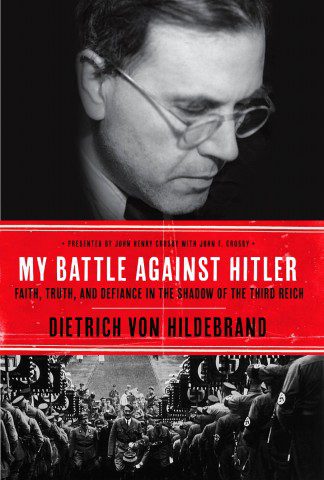
Now the record of that speaking out during a crucial decade and a half leading up to World War II is preserved in a gripping new book, My Battle Against Hitler (Image). The volume has been translated and meticulously edited by John Henry Crosby, founder and director of the Hildebrand Legacy Project, a group devoted to promoting continued study of the life and work of von Hildebrand, and John F. Crosby, professor of philosophy at the Franciscan University of Steubenville.
Today, Dietrich von Hildebrand is perhaps best remembered for his masterful study of the interior life, Transformation in Christ. But the Crosby volume shows that there was much more to his career.
He was born in Florence in 1889, the son of a prominent German sculptor, and prepared for a career in philosophy under the influence of leading figures like Edmund Husserl and Max Scheler. In 1914, he converted to Catholicism and in 1919 began teaching the philosophy of religion at the University of Munich, where students found him a reliable and outspoken guide to resisting the evil intellectual currents of the time. “I tell you the Nazis are the most vicious animals,” he said.
Hitler became chancellor of Germany on January 30, 1933. Von Hildebrand, fearing what lay ahead, fled the country and soon found himself in Vienna, where he began publication of a new journal with the specific task of exposing the intellectual and spiritual corruption of Nazism. His efforts moved the German ambassador to declare “that damned Hildebrand” Nazism’s greatest obstacle in Austria.
It isn’t hard to see why, as this bit of trenchant prose serves to illustrate: “Anyone with the slightest sensitivity…cannot fail to recognize the nature of National Socialism: naturalistic, antagonistic to the things of the spirit, and based on a materialism of blood….The deeds of the National Socialists truly correspond to the spirit of the Antichrist.” Among his sorrows was the fact that so many of his fellow Catholics nevertheless failed to understand that.
After Germany annexed Austria in 1938, von Hildebrand escaped, traveled across Europe, and made his way to the United States, where he taught at Fordham University, writing and lecturing widely until his death in 1977. His output includes important studies on ethics and married love, among other topics. My Battle Against Hitler illuminates a critical period of his career not widely known in this country up to now. Old and new Hildebrand fans alike will find it a fascinating read.
Russell Shaw is a freelance writer based in  Washington, D.C., and the author of twenty books, including American Church: The Remarkable Rise, Meteoric Fall, and Uncertain Future of Catholicism in America is available on Kindle. You can email him at [email protected].
Previous Post

November 25, 2014
Autism: Small Parish Accommodations Bring Big Blessings!
Next Post

December 1, 2014 Indifferent Relativism Helps Totalitarianism to Grow
Browse Our Archives
Select a Category abortion abuse art and culture Books Catholic and Gay Catholic identity Catholic Laity Catholic Vocations Catholic Youth Catholicity Cinema clergy scandal Community of Sant’Egidio Culture of Life Editorial Faith Family Father Robert Barron Guest Post In Defense of Christians Marriage Mary Middle East New Evangelization Parenthood Patheos Catholic Poetry politics Pope Poverty Prayer Priesthood Race in America Sacred Art Saints Series sexuality Shaw Synod Uncategorized
Select a Month August 2023 February 2022 January 2022 December 2021 October 2021 September 2021 August 2021 February 2021 January 2021 December 2020 October 2020 August 2020 June 2020 May 2020 April 2020 November 2019 June 2019 May 2019 March 2019 December 2018 October 2018 September 2018 August 2017 July 2017 October 2016 August 2016 July 2016 June 2016 December 2015 September 2015 August 2015 July 2015 June 2015 May 2015 April 2015 March 2015 February 2015 January 2015 December 2014 November 2014 October 2014 September 2014
TAKE THE
Religious Wisdom Quiz
What is the name for Christian monastic orders that focus on community life and prayer?
Select your answer to see how you score.
Benedictines Waldensians Pentecostals Franciscans
Related posts from The Font

Tweeting With God: Essential Text for RCIA and...

Yes, the Devil is Real. Be Armed.
Confession, The Hidden Sacrament Indeed
TRENDING AT PATHEOS Catholic

The Parable Of The Sower And The Word...
One of Christ’s most famous parables is that of the sower who...

Rejecting Doom: Christian Hope And Human Action
Christianity is a religion of hope. We are to have hope and...

Why I Choose the Eucharist Over the Sermon
Choose the Eucharist, Not the Sermon What are we supposed to get...

5 Design Elements Found in Spiritually Rooted Homes
Putting Spirituality Into Home Decor Our homes are more than our living...

Credo: A Story of God Told with the...
About 10 years ago, I began to imagine a personal "Credo" that...

The Anatomy of Divine Revelation in Catholic Thought
The claim that God has made Himself known to human beings is...
view all Catholic blogs
Ad-Free & Subscriber Log-In Subscription Support
- About Us
- 2026 Calendar
- Videos
- Podcasts
- Library of World Religions
- Faith In Media Tracker
- Advertise With Us
- Write for Us
- Privacy Policy
- Terms of Service
- Do Not Sell My Data
- Contact Us
- Radiant Digital
- Manage Newsletter Subscriptions
- Unsubscribe From Notifications
- Sitemap
Copyright 2008-2026, Patheos. All rights reserved.
Subscription Support Ad-Free & Subscriber Log-In
Follow Patheos