
BuddhistCatholicContemplativeEvangelicalGeneral ChristianHinduJewishLatter-day SaintMuslimNew VisionsProgressive Christian
Beliefs
- Buddhist
- Catholic
- Contemplative
- Evangelical
- General Christian
- Hindu
- Jewish
- Latter-day Saint
- More Voices
- Muslim
- New Visions
- Pagan
- Progressive Christian
Topics
- Religion News
- Food and Religion
- Sports and Religion
- Religious Art
- Religious Music and Entertainment
- Religious Events
- History and Religion
- Style and Religion
- Politics and Religion
- Women in Religion
- Recreation Outdoors and Religion
- Business Finance and Religion
- Careers Workplace and Religion
- Education and Religion
- Family Parenting and Religion
- Health Fitness and Religion
- Home and Religion
- Relationships and Religion
- Technology and Religion
- Travel and Religion
Columnists
- Buddhist Columnists
- Business Finance and Religion Columnists
- Careers Workplace and Religion Columnists
- Catholic Columnists
- Contemplative Columnists
- Education and Religion Columnists
- Evangelists Columnists
- Family Parenting and Religion Columnists
- General Christian Columnists
- Health Fitness and Religion Columnists
- Hindu Columnists
- History and Religion Columnists
- Home and Religion Columnists
- Jewish Columnists
- More Voices Columnists
- Latter Day Columnists
- Muslim Columnists
- New Visions Columnists
- Nonreligious Columnists
- Pagan Columnists
- Politics and Religion Columnists
- Progressive Columnists
- Recreation Outdoors and Religion Columnists
- Relationships and Religion Columnists
- Religion News Columnists
- Religious Art Columnists
- Religious Events Columnists
- Religious Music and Entertainment Columnists
- Sports and Religion Columnists
- Style and Religion Columnists
- Technology and Religion Columnists
- Travel and Religion Columnists
- Women in Religion Columnists
Resource Library
- 2026 Calendar
- Library of World Religions
- The 100 Most Holy Places on Earth
- Patheos Answers
- Podcasts
- Videos
- Faith Leaders Database
- Anglican Episcopalian
- Bahai
- Baptist
- Buddhism
- Christianity
- Confucianism
- Eastern Orthodoxy
- Hinduism
- Holiness and Pentecostal
- ISKCON
- Islam
- Judaism
- Lutheran
- Methodist
- The Church of Jesus Christ of Latter-day Saints
- New Age
- Paganism
- Presbytarian and Reformed
- Protestantism
- Religion Behind the Scenes
- Roman Catholic
- Scientology
- Shia Islam
- Sikhism
- Sufism
- Sunni Islam
- Taoism
- Zen
- See all religions
Research Tools
 Ad-Free & Subscriber Log-In Subscription Support
Ad-Free & Subscriber Log-In Subscription Support
Follow Patheos 

- Trending:
- Forgiveness
- |
- Marriage
- |
- Consciousness
- |
- Death Penalty
- |
- Election
- |
- Halloween

- Home
- Catholic
- Sister Juliet: Love Amidst the Clutter
Sister Juliet: Love Amidst the Clutter
Last updated on: November 20, 2014 at 5:53 pm by Elizabeth Scalia
Sister Juliet: Love Amidst the Clutter 2014-11-20T17:53:55-05:00 Elizabeth Scalia
Patheos Explore the world's faith through different perspectives on religion and spirituality! Patheos has the views of the prevalent religions and spiritualities of the world.
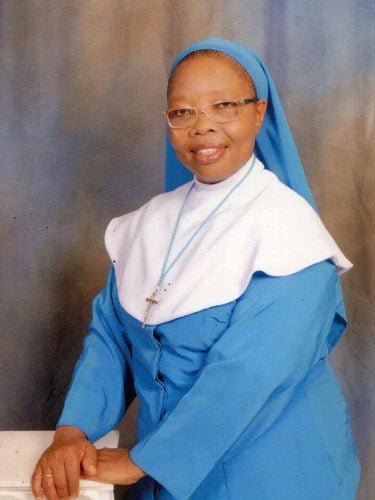
Sister Juliet Duruanyaoha, on the occasion of her 25th Jubilee
By Rev. Msgr. Kieran E. Harrington
This past Wednesday I buried a friend. Actually, she was much more than a friend. She was a companion, a colleague, a role-model, and a religious sister.
She was also my sister. The Lord called her home, on the Feast of All Saints, twenty-eight years after she first professed vows of poverty, chastity and obedience.
I am ashamed to say that for most of the eight years we were assigned together, she was simply an employee in a habit. Don’t misunderstand me, we got along and worked well with one another, but I never took the time to get to know this woman who, I would discover too late, was simply exceptional.
Who was this woman, who so profoundly touched the lives of so many people — young and old — that they came from all over Brooklyn and beyond, to see her in the hospital, only to end up being consoled by her, even as she lay dying?
Sister Juliet Duruanyaoha was born on April 4, 1955 in Lagos, Nigeria. She had a twin sister and seven other siblings, all growing up in a rural and impoverished village in Imo State. The Biafra War left its scars upon her; the conflict claimed over a million civilian lives — many of whom simply starved to death — and her own education was interrupted.
Despite these challenges, she persevered, completed her education and joined the Discalced Carmelites. She desired a life of quiet contemplation, but the enclosed separation that defines the monastic life proved to be a great hardship upon her family; out of love for them, Juliet left the cloister and entered a community formed out of the ravages of war, the Daughters of Divine Love.
The Community was founded in 1969 by Bishop Godfrey Mary Paul Okoye, formerly an Irish Holy Ghost Father, as a means of protecting the young women and girls from the brutality of rape during the Civil War. The experience of Divine Love manifested by the good and courageous Bishop led many of those young women to commit themselves to Christ, as religious women, after the cessation of violence.
Mary Juliet thrived in the convent. Indeed, she was particularly competent and was posted to serve as secretary to the local Bishop. She quickly became a surrogate mother to the young boys who sought to be priests, and resided in the Bishop’s home.
As the community expanded Sr. Juliet was asked to be among the first sisters to go to the United States, as a missionary. Her first apostolate in the States was as a teacher at St. Theresa of Avila in the Prospect Heights section of Brooklyn. She later would be posted to Saint Joseph Church, and had been there for eight years when I first encountered this short, round, vivacious Nigerian nun.
The parish was poor and chaotic; she worked within it six days a week, and was paid for only one. Officially, she ran a CCD program with pathetically few children. Unofficially, she was the Chaplain to the local nursing home, visitor-in-chief for the sick of the parish, counselor for the older ladies, and mother to children facing many hardships.
The one area where Sister was not particularly proficient was administration. Paper work was routinely lost, left incomplete or undone. Frankly it drove me crazy. I fretted that as our parish grew this would become an obstacle to newly arriving families, who would expect order. My anxiety was be compounded by the fact that each week, as we tried to clean the Church and rectory, items I threw into the garbage would find their way back into the office, tucked away into a new place.
Shrugged-off paperwork and reclaimed junk; clutter all around. It made me nuts; it was how she rolled.
I should have been more attentive, that first week in September, when Juliet complained about arthritis, and stayed home at her convent for a week. Neither she nor I knew that she was pivoting toward Calvary — that what we believed to be arthritis was actually a cancer, eating away at her entire body.
Five weeks ago, when I told her she was dying, we had some decisions to make. Missionaries are buried where they fall. For Juliet, the thought that her aged mother might not be able to mourn her compelled her to return to Nigeria.
The travel was perilous. Juliet was dealing with bilateral blood clots in the lungs; more clots were forming in her legs. There was a tumor in the spine, another in her lung, more on her ribs and God only knows where else. On the Saturday before she was to leave for home, her hip was fractured; her bones had become so brittle that gentle massage, meant to lessen her agonizing pain, only brought more injury.
That she would survive the arduous trip seemed doubtful, but Juliet believed.
She did fly home on October 20, arriving in Enugu on the 21st. Despite the exhausting journey Sister Juliet would appear to her sisters and family as being in the picture of health. But the rally was only to last for a day or two, before Calvary truly beckoned.
On November 1, prior to celebrating Holy Mass, I called to wish Sister a blessed anniversary. By now her only response were grunts of pain; her voice was completely gone. Sister believed the Lord would heal her in his own fashion, as she stood before the Altar, that He was working that miracle, and soon it was time for her to return home.
A few hours later, I asked the people at Mass to pray for Sister Juliet as she entered the final agony. As soon as I returned to the rectory the phone rang, it was her traveling companion and friend Sister Nnachibe telling me that Juliet had entered eternity.
The compound of the Daughters of Divine Love is an oasis yet, like the country of Nigeria, it is a work in progress. The Chapel is massive yet simple. As the marching band played Sister Juliet Duruanyaoh into the church, she was greeted by several hundred of her sisters. With blue veils, white habits and beautiful brown skin, they welcomed Juliet home to the novitiate where her life as a bride of Christ had begun. The music was an enchanting combination of traditional chant and indigenous hymns. Soon we prayed for her; the Office of the dead.
Still yet more sisters arrived, and by the time we were ready to celebrate the Rites of the Church we had about seven hundred sisters in the Chapel, fifty priests and two bishops. Juliet had been in the United States for almost fifteen years. Most of the sisters and priests were so young that they had not known her personally, but to each she was a true sister.
As we lowered her to the depths, and laid a blanket of dirt over her body, her family broke down. They had learned only ten days earlier that their daughter and sister was sick. They were impoverished people from the bush and the spectacle, and the loss, was became overwhelming.
Arriving home, the first thing I saw as my car pulled up in front of the rectory was a beaten-up desk at the curb, waiting to be carted away as trash. Juliet would have ransomed it, because she understood — in a way I have only begun to appreciate— the profound poverty so many live with each day. This child of unimaginable poverty was missionary to a people so accustomed to material wealth they saw old, worn things as “clutter and junk”, disposable and not worth saving.
This week, celebrating mass with the people of Saint Joseph’s, I finally understood this contemplative little Nigerian nun, with her round figure and broad smile. She had cultivated a deep interior life and simply invited others in to join her in a great love affair with God, where no one and nothing was junk or clutter — beyond saving, or fit only for the trash heap.
I am grateful that Sister Juliet allowed me to walk with her these last months, to draw nearer to her, and glimpse the life of a saint. She may not have been perfect with the paperwork, but she knew what mattered. She was in love with Jesus Christ, and her love was contagious.
My prayer is that I have been infected.
 Msgr. Kieran E. Harrington is Vicar for Communications for the Diocese of Brooklyn, and Administrator of the Co-Cathedral of Saint Joseph. He also hosts the Catholic radio program “In the Arena”, on 710 WOR Radio
Previous Post

November 19, 2014
The Unique Ache of Desiring
Next Post

November 25, 2014 Autism: Small Parish Accommodations Bring Big Blessings!
Browse Our Archives
Select a Category abortion abuse art and culture Books Catholic and Gay Catholic identity Catholic Laity Catholic Vocations Catholic Youth Catholicity Cinema clergy scandal Community of Sant’Egidio Culture of Life Editorial Faith Family Father Robert Barron Guest Post In Defense of Christians Marriage Mary Middle East New Evangelization Parenthood Patheos Catholic Poetry politics Pope Poverty Prayer Priesthood Race in America Sacred Art Saints Series sexuality Shaw Synod Uncategorized
Select a Month August 2023 February 2022 January 2022 December 2021 October 2021 September 2021 August 2021 February 2021 January 2021 December 2020 October 2020 August 2020 June 2020 May 2020 April 2020 November 2019 June 2019 May 2019 March 2019 December 2018 October 2018 September 2018 August 2017 July 2017 October 2016 August 2016 July 2016 June 2016 December 2015 September 2015 August 2015 July 2015 June 2015 May 2015 April 2015 March 2015 February 2015 January 2015 December 2014 November 2014 October 2014 September 2014
TAKE THE
Religious Wisdom Quiz
What did the angel tell the shepherds?
Select your answer to see how you score.
To Not Be Afraid The Location of the Newborn Savior All of These Things How to Recognize the Newborn Savior
Related posts from The Font
Challenges of Recruiting Vocations in Africa Today
The Sacrament of Matrimony Needs Urgent Pastoral Attention

Prioritizing the Interior Life with Dorothy Day
Pastoral Zeal as Priestly Identity
TRENDING AT PATHEOS Catholic

Rejecting Doom: Christian Hope And Human Action
Christianity is a religion of hope. We are to have hope and...

It’s What Comes From Within Which Matters
One of the most difficult things for us to understand is why...

Why I Choose the Eucharist Over the Sermon
Choose the Eucharist, Not the Sermon What are we supposed to get...

5 Design Elements Found in Spiritually Rooted Homes
Putting Spirituality Into Home Decor Our homes are more than our living...

Credo: A Story of God Told with the...
About 10 years ago, I began to imagine a personal "Credo" that...

The Anatomy of Divine Revelation in Catholic Thought
The claim that God has made Himself known to human beings is...
view all Catholic blogs
Ad-Free & Subscriber Log-In Subscription Support
- About Us
- 2026 Calendar
- Videos
- Podcasts
- Library of World Religions
- Faith In Media Tracker
- Advertise With Us
- Write for Us
- Privacy Policy
- Terms of Service
- Do Not Sell My Data
- Contact Us
- Radiant Digital
- Manage Newsletter Subscriptions
- Unsubscribe From Notifications
- Sitemap
Copyright 2008-2026, Patheos. All rights reserved.
Subscription Support Ad-Free & Subscriber Log-In
Follow Patheos