
BuddhistCatholicContemplativeEvangelicalGeneral ChristianHinduJewishLatter-day SaintMuslimNew VisionsProgressive Christian
Beliefs
- Buddhist
- Catholic
- Contemplative
- Evangelical
- General Christian
- Hindu
- Jewish
- Latter-day Saint
- More Voices
- Muslim
- New Visions
- Pagan
- Progressive Christian
Topics
- Religion News
- Food and Religion
- Sports and Religion
- Religious Art
- Religious Music and Entertainment
- Religious Events
- History and Religion
- Style and Religion
- Politics and Religion
- Women in Religion
- Recreation Outdoors and Religion
- Business Finance and Religion
- Careers Workplace and Religion
- Education and Religion
- Family Parenting and Religion
- Health Fitness and Religion
- Home and Religion
- Relationships and Religion
- Technology and Religion
- Travel and Religion
Columnists
- Buddhist Columnists
- Business Finance and Religion Columnists
- Careers Workplace and Religion Columnists
- Catholic Columnists
- Contemplative Columnists
- Education and Religion Columnists
- Evangelists Columnists
- Family Parenting and Religion Columnists
- General Christian Columnists
- Health Fitness and Religion Columnists
- Hindu Columnists
- History and Religion Columnists
- Home and Religion Columnists
- Jewish Columnists
- More Voices Columnists
- Latter Day Columnists
- Muslim Columnists
- New Visions Columnists
- Nonreligious Columnists
- Pagan Columnists
- Politics and Religion Columnists
- Progressive Columnists
- Recreation Outdoors and Religion Columnists
- Relationships and Religion Columnists
- Religion News Columnists
- Religious Art Columnists
- Religious Events Columnists
- Religious Music and Entertainment Columnists
- Sports and Religion Columnists
- Style and Religion Columnists
- Technology and Religion Columnists
- Travel and Religion Columnists
- Women in Religion Columnists
Resource Library
- 2026 Calendar
- Library of World Religions
- The 100 Most Holy Places on Earth
- Patheos Answers
- Podcasts
- Videos
- Faith Leaders Database
- Anglican Episcopalian
- Bahai
- Baptist
- Buddhism
- Christianity
- Confucianism
- Eastern Orthodoxy
- Hinduism
- Holiness and Pentecostal
- ISKCON
- Islam
- Judaism
- Lutheran
- Methodist
- The Church of Jesus Christ of Latter-day Saints
- New Age
- Paganism
- Presbytarian and Reformed
- Protestantism
- Religion Behind the Scenes
- Roman Catholic
- Scientology
- Shia Islam
- Sikhism
- Sufism
- Sunni Islam
- Taoism
- Zen
- See all religions
Research Tools
 Ad-Free & Subscriber Log-In Subscription Support
Ad-Free & Subscriber Log-In Subscription Support
Follow Patheos 

- Trending:
- Forgiveness
- |
- Marriage
- |
- Consciousness
- |
- Death Penalty
- |
- Election
- |
- Halloween

- Home
- Catholic
- Appraising Kasper’s Proposal via John Henry Newman
Appraising Kasper’s Proposal via John Henry Newman
Last updated on: December 23, 2014 at 12:48 pm by Guest Contributor
Appraising Kasper’s Proposal via John Henry Newman 2014-12-23T12:48:57-05:00 Guest Contributor
Patheos Explore the world's faith through different perspectives on religion and spirituality! Patheos has the views of the prevalent religions and spiritualities of the world.
By Very Rev. Robert Barron
The controversies surrounding the recent Extraordinary Synod on the Family have often put me in mind of John Henry Cardinal Newman, the greatest Catholic churchman of the 19th century. Newman wrote eloquently on an extraordinary range of topics, including university education, the play between faith and reason, the nature of papal authority, and the subtle manner in which we come to assent in matters of religion. But the arguments around the Synod compel us to look at Newman’s work regarding the evolution of doctrine.
When he was at mid-career and in the process of converting from Anglicanism to Roman Catholicism, Newman penned a masterpiece entitled On the Development of Christian Doctrine. In line with the evolutionary theories that were just emerging at that time — Hegel’s work was dominant in most European universities and Darwin’s On the Origin of Species would appear just a few years later — Newman argued that Christian doctrines are not given once for all and simply passed down unchanged from generation to generation. Rather, like seeds that unfold into plants or rivers that deepen and broaden over time, they develop, their various aspects and implications emerging in the course of lively rumination. It is assuredly not the case, for example, that the doctrine of the Trinity was delivered fully-grown into the minds of the first disciples of Jesus and then passed on like a football across the ages. On the contrary, it took hundreds of years for the seed of that teaching to grow into the mighty tree of Augustine’s formulations in the De Trinitate or Aquinas’s complex treatise in the first part of the Summa theologiae.
Moreover, Newman felt that even those definitive theological achievements in turn develop and unfold as they are mused over, turned around, questioned, and argued about. He concludes: “a real idea is equivalent to the sum total of its possible aspects.” And those aspects appear only in the course of time and through the play of the lively minds that consider them. It is precisely in this context that Newman penned the most famous line of On the Development of Christian Doctrine: “In a higher world it is otherwise; but here below, to live is to change and to be perfect is to have changed often.” Ideas change because they are living things.
I realize that many, upon considering this view, will get nervous — as did many in Newman’s day. Does this mean that doctrine is up for grabs? Should we keep our dogmatic statements, as one cynical wag once put it, in loose-leaf binders? To get some clarity on this point, I would recommend that we delve a little further into Newman’s great book and examine the criteria that he laid out to determine the difference between a legitimate development (which makes the doctrine in question more fully itself) and a corruption (which undermines the doctrine). Newman presents seven in total, but I should like to examine just three.
The first is what he calls preservation of type. A valid development preserves the essential form and structure of what came before. If that type is undermined, we are dealing with a corruption. Mind you, type can be maintained even through enormous superficial changes, as, to use Newman’s own example, “a butterfly is a development of the caterpillar but not in any sense its image.” And by the same token, superficialities can remain largely unchanged even as the type utterly morphs, as happened, say, in the transition from the Roman Republic to the Roman Empire.
A second criterion is what Newman refers to as “conservative action upon its past.” An evolution that simply reverses or contradicts what came before it is necessarily a corruption and not a development. In Newman’s own words, an authentic development “is an addition that illustrates, not obscures; corroborates, not corrects the body of thought from which it proceeds.” In accord with this idea, Christianity could be seen as the development of Judaism, since it preserves the essential teachings and practices of that faith, even as it moves beyond them.
Cardinal George Pell alluded to this principle when he said, during the recent Synod debates, “the Church does not do back-flips on doctrine.” So, for example, if a proposal were put forth at the Extraordinary Synod that simply contradicted the teaching of John Paul II in Familiaris consortio or Paul VI in Humanae vitae, it would certainly reflect a corruption.
A third criterion that Newman puts forward is what he calls “the power of assimilation.” Just as a healthy organism can take in what it can from its environment, even as it resists what it must, so a sane and lively idea can take to itself what is best in the intellectual atmosphere, even as it throws off what is noxious. Both total accommodation to the culture and total resistance to it are usually signs of intellectual sickness.
Now how does all of this apply to the Synod? Well, let’s consider the proposal made by Cardinal Walter Kasper regarding communion for the divorced and re-married. Is it an authentic development or a corruption of Catholic moral teaching and practice? Might I suggest that all of the disputants in that argument take a step back and assess the matter using Cardinal Newman’s criteria? Would Newman be opposed in principle to change in this regard? Not necessarily, for he knew that to live is to change. Would he therefore enthusiastically embrace what Cardinal Kasper has proposed? Not necessarily, for it might represent a corruption. As the conversation continues to unfold over the coming months, I think all sides would benefit from a careful reading of On the Development of Christian Doctrine.
 Father Robert Barron is the founder of the global ministry, Word on Fire, and the Rector/President of Mundelein Seminary. He is the creator of the award winning documentary series, “Catholicism” and “Catholicism:The New Evangelization.” Learn more at www.WordonFire.org
Previous Post
October 15, 2014
Grandparenting: A Vocation of Gentle Catechesis
Next Post

October 31, 2014 Will Containing Ebola, Degrading ISIS be Enough?
Browse Our Archives
Select a Category abortion abuse art and culture Books Catholic and Gay Catholic identity Catholic Laity Catholic Vocations Catholic Youth Catholicity Cinema clergy scandal Community of Sant’Egidio Culture of Life Editorial Faith Family Father Robert Barron Guest Post In Defense of Christians Marriage Mary Middle East New Evangelization Parenthood Patheos Catholic Poetry politics Pope Poverty Prayer Priesthood Race in America Sacred Art Saints Series sexuality Shaw Synod Uncategorized
Select a Month August 2023 February 2022 January 2022 December 2021 October 2021 September 2021 August 2021 February 2021 January 2021 December 2020 October 2020 August 2020 June 2020 May 2020 April 2020 November 2019 June 2019 May 2019 March 2019 December 2018 October 2018 September 2018 August 2017 July 2017 October 2016 August 2016 July 2016 June 2016 December 2015 September 2015 August 2015 July 2015 June 2015 May 2015 April 2015 March 2015 February 2015 January 2015 December 2014 November 2014 October 2014 September 2014
TAKE THE
Religious Wisdom Quiz
Though commanded to prophesy, I could not speak or warn the people until God opened my mouth. What affliction kept me silent?
Select your answer to see how you score.
A disease Fear Paralysis Muteness
Related posts from The Font

St. Katharine Drexel’s Life Teaches Us That Philanthropy...
Pope Francis, Ignatius Loyola, and Positive Psychology
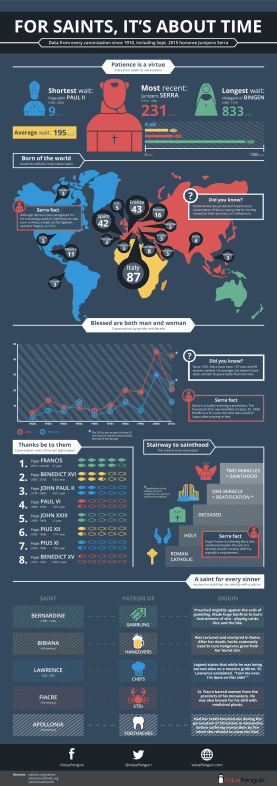
The Road to Sainthood Infographic
TRENDING AT PATHEOS Catholic

Creation, Preservation, and Teleology in Catholic Theology
As I write this, it is very early Monday morning. Like millions...

The Parable Of The Sower And The Word...
One of Christ’s most famous parables is that of the sower who...

Rejecting Doom: Christian Hope And Human Action
Christianity is a religion of hope. We are to have hope and...

Why I Choose the Eucharist Over the Sermon
Choose the Eucharist, Not the Sermon What are we supposed to get...

5 Design Elements Found in Spiritually Rooted Homes
Putting Spirituality Into Home Decor Our homes are more than our living...

Credo: A Story of God Told with the...
About 10 years ago, I began to imagine a personal "Credo" that...
view all Catholic blogs
Ad-Free & Subscriber Log-In Subscription Support
- About Us
- 2026 Calendar
- Videos
- Podcasts
- Library of World Religions
- Faith In Media Tracker
- Advertise With Us
- Write for Us
- Privacy Policy
- Terms of Service
- Do Not Sell My Data
- Contact Us
- Radiant Digital
- Manage Newsletter Subscriptions
- Unsubscribe From Notifications
- Sitemap
Copyright 2008-2026, Patheos. All rights reserved.
Subscription Support Ad-Free & Subscriber Log-In
Follow Patheos