
BuddhistCatholicContemplativeEvangelicalGeneral ChristianHinduJewishLatter-day SaintMuslimNew VisionsProgressive Christian
Beliefs
- Buddhist
- Catholic
- Contemplative
- Evangelical
- General Christian
- Hindu
- Jewish
- Latter-day Saint
- More Voices
- Muslim
- New Visions
- Pagan
- Progressive Christian
Topics
- Religion News
- Food and Religion
- Sports and Religion
- Religious Art
- Religious Music and Entertainment
- Religious Events
- History and Religion
- Style and Religion
- Politics and Religion
- Women in Religion
- Recreation Outdoors and Religion
- Business Finance and Religion
- Careers Workplace and Religion
- Education and Religion
- Family Parenting and Religion
- Health Fitness and Religion
- Home and Religion
- Relationships and Religion
- Technology and Religion
- Travel and Religion
Columnists
- Buddhist Columnists
- Business Finance and Religion Columnists
- Careers Workplace and Religion Columnists
- Catholic Columnists
- Contemplative Columnists
- Education and Religion Columnists
- Evangelists Columnists
- Family Parenting and Religion Columnists
- General Christian Columnists
- Health Fitness and Religion Columnists
- Hindu Columnists
- History and Religion Columnists
- Home and Religion Columnists
- Jewish Columnists
- More Voices Columnists
- Latter Day Columnists
- Muslim Columnists
- New Visions Columnists
- Nonreligious Columnists
- Pagan Columnists
- Politics and Religion Columnists
- Progressive Columnists
- Recreation Outdoors and Religion Columnists
- Relationships and Religion Columnists
- Religion News Columnists
- Religious Art Columnists
- Religious Events Columnists
- Religious Music and Entertainment Columnists
- Sports and Religion Columnists
- Style and Religion Columnists
- Technology and Religion Columnists
- Travel and Religion Columnists
- Women in Religion Columnists
Resource Library
- 2026 Calendar
- Library of World Religions
- The 100 Most Holy Places on Earth
- Patheos Answers
- Podcasts
- Videos
- Faith Leaders Database
- Anglican Episcopalian
- Bahai
- Baptist
- Buddhism
- Christianity
- Confucianism
- Eastern Orthodoxy
- Hinduism
- Holiness and Pentecostal
- ISKCON
- Islam
- Judaism
- Lutheran
- Methodist
- The Church of Jesus Christ of Latter-day Saints
- New Age
- Paganism
- Presbytarian and Reformed
- Protestantism
- Religion Behind the Scenes
- Roman Catholic
- Scientology
- Shia Islam
- Sikhism
- Sufism
- Sunni Islam
- Taoism
- Zen
- See all religions
Research Tools
 Ad-Free & Subscriber Log-In Subscription Support
Ad-Free & Subscriber Log-In Subscription Support
Follow Patheos 

- Trending:
- Forgiveness
- |
- Marriage
- |
- Consciousness
- |
- Death Penalty
- |
- Election
- |
- Halloween
 The Dorothy Option
- Home
- Catholic
- Why You Might Not Want a ‘Strong Work Ethic’
Why You Might Not Want a ‘Strong Work Ethic’
Last updated on: September 6, 2017 at 12:25 pm by Daniel Schwindt
Why You Might Not Want a ‘Strong Work Ethic’ 2017-09-06T12:25:47-05:00 Daniel Schwindt
Patheos Explore the world's faith through different perspectives on religion and spirituality! Patheos has the views of the prevalent religions and spiritualities of the world.
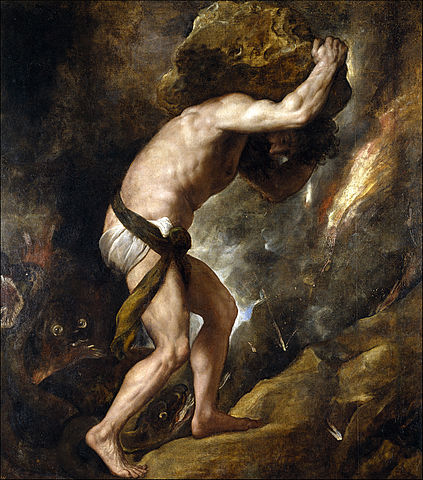
Sisyphus: patron saint of strong work ethics.
We’ve all heard about how important it is to cultivate the illusive Work Ethic. And it seems it should be as “strong” as possible–moderation is not a virtue in this framework.
But what exactly is the Work Ethic? Max Weber defined it by citing Benjamin Franklin who said:
“Remember, that time is money. He that can earn ten shillings a day by his labor, and goes abroad, or sits idle, one half of that day, though he spends but sixpence during his diversion or idleness, ought not to reckon that the only expense; he has really spent, or rather thrown away, five shillings besides. Remember, that money is the prolific, generating nature. Money can beget money, and its offspring can beget more, and so on. Five shillings turned is six, turned again is seven and threepence, and so on, till it becomes a hundred pounds. The more there is of it, the more it produces every turning, so that the profits rise quicker and quicker. He that kills a breeding sow, destroys all her offspring to the thousandth generation. He that murders a crown, destroys all that it might have produced, even scores of pounds.”
A better statement of “economism” would be hard to find. And this is really what’s at the heart of Work Ethic, at least as I’ve seen it presented throughout my life as an ideal to strive for. It refers to a very specific mentality and hierarchy of values that aim at maximizing economic gain through constant labor. Now, someone who knows more than me about Benjamin Franklin might say that this is not what he meant; but what he meant is not what matters, since what he says encompasses the mentality of the Work Ethic as we often find it today. We are using his words, not for the sake of his intent, but for the sake of how appropriately they describe a certain mentality.
So that’s the Work Ethic.
As children we were taught how important it is to cultivate a good Work Ethic, and today we are never short of public lamentations about how many people have failed to do so–about how the Work Ethic has faded from American culture.
Now, I think the Jeremiahs are right. I don’t think very many people–young folks in particular–have the Work Ethic that previous generations viewed so highly. The difference is, I think it is wonderful.
I say this for two reasons:
1) The first is practical.
Our society no longer benefits from the mentality of the Work Ethic as enunciated by Weber via Franklin. It is debatable whether or not we ever did benefit from it; but regardless, the fact is that today it actually hurts, rather than helps, those who continue to cultivate it.
In the words of French philosopher André Gorz:
“The work ethic has become obsolete. It is no longer true that producing more means working more, or that producing more will lead to a better way of life.
“The connection between more and better has been broken; our needs for many products and services are already more than adequately met, and many of our as-yet- unsatisfied needs will be met not by producing more, but by producing differently, producing other things, or even producing less. This is especially true as regards our needs for air, water, space, silence, beauty, time and human contact.”
The values associated with the Work Ethic have come to be not only in conflict with the private good of the worker, but they have begun work against the common good of society as well, which is really a double-blow to the worker, since he needs both.
2) Now for the second reason, which is moral.
In religious terminology, whenever you divorce a part of the truth from the whole you get a heresy. And so we should be suspicious from the start of any sort of “_____ ethic,” since you don’t need the “_____” if you’ve already got the “ethic.”
What I mean is this:
When you adopt seriously the values of the Work Ethic, you get a truncated moral framework that emphasizes a certain set of values which you are to apply to the economic activities in which you engage–and not even the whole of your economic activities, but only a very specific part: the part you play as laborer or wage-earner. Other aspects of economic life, such as consumption and final distribution of goods, are de-emphasized and unaccounted for.
And the massive sphere of non-economic values? Those don’t factor in either.
Next thing you know, you’re talking about Work Ethic as if it were an autonomous value system that operated separately, with its own purpose–its own teleology–and its own means of operation.
The problem is, a person can only have one teleology at a time. One cannot serve both God and Mammon.
Man’s real end is supposed to be God, and the means of realizing that end are found in the Good Life and all of the higher values the Good Life entails, including Ethics as a framework that encompasses all of life’s activities.
But what is the end offered by the Work Ethic? Well, Benjamin Franklin made that pretty clear: Profit. And what is the means of realizing one’s union with Mammon? Well, that would be work. And so, once the Work Ethic displaces Ethics, then Work becomes the Good Life, and Labor becomes the only sacrament.
Image Source: Wikimedia Commons

Previous Post

May 2, 2016
The Importance of Slow Architecture
Next Post
May 5, 2016 Gaudi's Last Walk, a Poem by David Gordon
Browse Our Archives
Select a Category Alternative economics, worker and family empowerment, the spirituality of work, the economy of sharing Art Care for Our Common Home Catholic imagination Catholic Social Teaching Christian Friendship Christian Persecution Community building, models or forms of community, radical hospitality Corporal & Spiritual Works of Mercy Daniel Schwindt Dorothy Day, Peter Maurin, CW aims and means, spirituality Elias Crim Grace Potts Greg Guest Josh Brumfield Mark Gordon Matthew Cooper Mercy Michael Stafford Paul Grenier Peace, nonviolent resistance, conscience and conscientious objection Pope Francis Poverty, economic inequality, consumerism, unemployment, underemployment, living wage Racial Reconciliation Radical Christianity Stan Goff Uncategorized
Select a Month October 2020 September 2020 August 2020 June 2020 May 2020 April 2020 March 2020 February 2020 January 2020 December 2019 November 2019 October 2019 September 2019 June 2018 May 2018 April 2018 October 2017 August 2017 July 2017 May 2017 April 2017 March 2017 January 2017 December 2016 November 2016 October 2016 September 2016 August 2016 July 2016 June 2016 May 2016 April 2016 March 2016 February 2016 January 2016
Follow Us!
TAKE THE
Religious Wisdom Quiz
What is the longest verse in the Bible?
Select your answer to see how you score.
Romans 8:28 Psalm 119:105 John 3:16 Esther 8:9
Related posts from The Dorothy Option


Arizmendi's Big House: Mondragón and the Culture of...

What is Catholic Economics? An Upcoming Conversation with...

Remembering a Black Catholic Cooperativist: Fr. Albert McKnight
TRENDING AT PATHEOS Catholic

Rejecting Doom: Christian Hope And Human Action
Christianity is a religion of hope. We are to have hope and...

It’s What Comes From Within Which Matters
One of the most difficult things for us to understand is why...

Why I Choose the Eucharist Over the Sermon
Choose the Eucharist, Not the Sermon What are we supposed to get...

5 Design Elements Found in Spiritually Rooted Homes
Putting Spirituality Into Home Decor Our homes are more than our living...

Credo: A Story of God Told with the...
About 10 years ago, I began to imagine a personal "Credo" that...

The Anatomy of Divine Revelation in Catholic Thought
The claim that God has made Himself known to human beings is...
view all Catholic blogs
Ad-Free & Subscriber Log-In Subscription Support
- About Us
- 2026 Calendar
- Videos
- Podcasts
- Library of World Religions
- Faith In Media Tracker
- Advertise With Us
- Write for Us
- Privacy Policy
- Terms of Service
- Do Not Sell My Data
- Contact Us
- Radiant Digital
- Manage Newsletter Subscriptions
- Unsubscribe From Notifications
- Sitemap
Copyright 2008-2026, Patheos. All rights reserved.
Subscription Support Ad-Free & Subscriber Log-In
Follow Patheos