
BuddhistCatholicContemplativeEvangelicalGeneral ChristianHinduJewishLatter-day SaintMuslimNew VisionsProgressive Christian
Beliefs
- Buddhist
- Catholic
- Contemplative
- Evangelical
- General Christian
- Hindu
- Jewish
- Latter-day Saint
- More Voices
- Muslim
- New Visions
- Pagan
- Progressive Christian
Topics
- Religion News
- Food and Religion
- Sports and Religion
- Religious Art
- Religious Music and Entertainment
- Religious Events
- History and Religion
- Style and Religion
- Politics and Religion
- Women in Religion
- Recreation Outdoors and Religion
- Business Finance and Religion
- Careers Workplace and Religion
- Education and Religion
- Family Parenting and Religion
- Health Fitness and Religion
- Home and Religion
- Relationships and Religion
- Technology and Religion
- Travel and Religion
Columnists
- Buddhist Columnists
- Business Finance and Religion Columnists
- Careers Workplace and Religion Columnists
- Catholic Columnists
- Contemplative Columnists
- Education and Religion Columnists
- Evangelists Columnists
- Family Parenting and Religion Columnists
- General Christian Columnists
- Health Fitness and Religion Columnists
- Hindu Columnists
- History and Religion Columnists
- Home and Religion Columnists
- Jewish Columnists
- More Voices Columnists
- Latter Day Columnists
- Muslim Columnists
- New Visions Columnists
- Nonreligious Columnists
- Pagan Columnists
- Politics and Religion Columnists
- Progressive Columnists
- Recreation Outdoors and Religion Columnists
- Relationships and Religion Columnists
- Religion News Columnists
- Religious Art Columnists
- Religious Events Columnists
- Religious Music and Entertainment Columnists
- Sports and Religion Columnists
- Style and Religion Columnists
- Technology and Religion Columnists
- Travel and Religion Columnists
- Women in Religion Columnists
Resource Library
- 2026 Calendar
- Library of World Religions
- The 100 Most Holy Places on Earth
- Patheos Answers
- Podcasts
- Videos
- Faith Leaders Database
- Anglican Episcopalian
- Bahai
- Baptist
- Buddhism
- Christianity
- Confucianism
- Eastern Orthodoxy
- Hinduism
- Holiness and Pentecostal
- ISKCON
- Islam
- Judaism
- Lutheran
- Methodist
- The Church of Jesus Christ of Latter-day Saints
- New Age
- Paganism
- Presbytarian and Reformed
- Protestantism
- Religion Behind the Scenes
- Roman Catholic
- Scientology
- Shia Islam
- Sikhism
- Sufism
- Sunni Islam
- Taoism
- Zen
- See all religions
Research Tools
 Ad-Free & Subscriber Log-In Subscription Support
Ad-Free & Subscriber Log-In Subscription Support
Follow Patheos 

- Trending:
- Forgiveness
- |
- Marriage
- |
- Consciousness
- |
- Death Penalty
- |
- Election
- |
- Halloween
 The Dorothy Option
- Home
- Catholic
- Where Are the Churches?
Where Are the Churches?
Last updated on: June 26, 2020 at 10:43 am by Elias Crim
Where Are the Churches? 2020-06-26T10:43:39-05:00 Elias Crim
Patheos Explore the world's faith through different perspectives on religion and spirituality! Patheos has the views of the prevalent religions and spiritualities of the world.
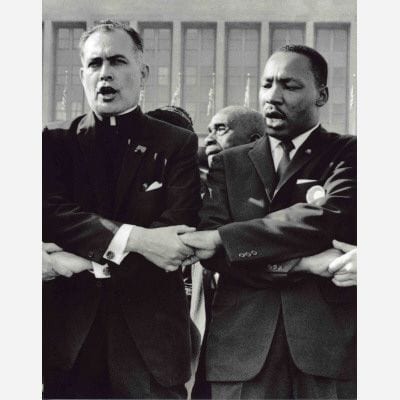
Image via www.nd.edu
What year are we living in — or reliving? That is, what year of recent history?
I’m thinking of the way we’re struggling to understand this moment by comparing it to other times of change and unrest, several of which I lived through myself.
A popular pick, it appears, would be 1968, a year of protest and uprising (against the war in Vietnam and in reaction to the assassination of Martin Luther King Jr.), including riots in 110 cities, probably the greatest wave of civil unrest since the Civil War. I was a senior at UT Austin and had received the initial letter warning me an official draft notice would be coming.
I would argue that 1968 is a less valid choice than 1965, allowing for the fact that these moments are not really comparable at all. Still, here’s my reasoning.
Tragically, the violence and destruction of these last few weeks since the George Floyd murder have descended on innocent citizens and their businesses, despite calls from all sides to avoid such nihilism. In the first weeks of protest, these episodes were fully reported by the media, the images of looting and burning in broadcast loops for hours and days on end. If you knew nothing much about 1968, you might almost think the two outbreaks were comparable in scale. They are not.
Moreover, we are no longer seeing the destruction of stores. Instead, some groups have turned to pulling down and defacing statues, a kind of civil action which has the odd side-effect of generating conversation about the actual histories of the men so memorialized. We do not easily reconsider this settled history, so it can be a shock for some to discover Grant’s role in the Indian Wars or former Philadelphia mayor Frank Rizzo’s views on race and policing.
Very few Southerners today believe that a good way to understand their region’s history is through public sculpture erected by white supremacists in order to celebrate the Confederate cause.
In my own small Indiana town, our Black Lives Matters protest at the courthouse turned out to be an inter-faith, inter-racial prayer vigil, wholly peaceful. In a neighboring town, two Black and white organizers held a similar event at which they publicly washed each other’s feet. Until the media likely got bored with the angle, stories of peaceful protest in unlikely Red State American smalltowns were everywhere. White pastors were sometimes involved, but not evidently to the degree they were in 1965, a year of unrest which also represented an upwelling of hope among many Black and white Christians of various backgrounds.
My theologian friend Holly Coolman posted a comment on her Facebook page recently, urging, “What matters is that we recognize the depth of the challenge and live out the truth that Black lives do matter, linking arms with whomever we can, in whatever way we can, to honor that claim and to move toward a reality that reflects it fully.”
I’m afraid many in the white Christian universe — those over 40, say — grew tired of linking arms over racial justice years ago. Maybe they feel the issue is insoluble. Or possibly, they believe, as some claimed in 1965, the risks of social change — which are always unknowable, as Hannah Arendt has taught us — are simply too high. We have a debt to pay here, they acknowledge, but we can no longer afford to pay it. Not quite yet. There’s the pandemic. And we should restart the (old) economy first.
Meanwhile it is hugely inspiriting to see Black leaders — including especially pastors — apparently watching a different social process underway, and on a global scale. “This time is different,” they say, appearing almost nervous about acknowledging the possibility of hope after a half-century of decline for black families in every measure of well-being. The difference this time is the solidarity across every line of color and class, as well as the sheer scale of the protests against a shared sense of systemic injustice. And the sense of reconciliation.
As in 1965, most white Christian churches — certainly including the Catholics — are absent from whatever this moment is creating. If Rev. William Barber is possibly the most visible Black faith leader of the current moment, his coalition includes only a relative handful of allies representing white churches. But that absence is an indicator of the sad condition of American Christianity. Let us hope its non-witness will not doom this unimagined leap toward a more racially just society in a time of great awakening.
As Thomas Merton once wrote to Fr. Dan Berrigan, “Don’t be discouraged. The Holy Spirit is not asleep.”
Peace, nonviolent resistance, conscience and conscientious objection
Previous Post

May 4, 2020
Shalom versus Pax: On Recovering Ivan Illich
Next Post
August 24, 2020 Guest Post: A Letter from a TLM Catholic Who Stands with BLM
Browse Our Archives
Select a Category Alternative economics, worker and family empowerment, the spirituality of work, the economy of sharing Art Care for Our Common Home Catholic imagination Catholic Social Teaching Christian Friendship Christian Persecution Community building, models or forms of community, radical hospitality Corporal & Spiritual Works of Mercy Daniel Schwindt Dorothy Day, Peter Maurin, CW aims and means, spirituality Elias Crim Grace Potts Greg Guest Josh Brumfield Mark Gordon Matthew Cooper Mercy Michael Stafford Paul Grenier Peace, nonviolent resistance, conscience and conscientious objection Pope Francis Poverty, economic inequality, consumerism, unemployment, underemployment, living wage Racial Reconciliation Radical Christianity Stan Goff Uncategorized
Select a Month October 2020 September 2020 August 2020 June 2020 May 2020 April 2020 March 2020 February 2020 January 2020 December 2019 November 2019 October 2019 September 2019 June 2018 May 2018 April 2018 October 2017 August 2017 July 2017 May 2017 April 2017 March 2017 January 2017 December 2016 November 2016 October 2016 September 2016 August 2016 July 2016 June 2016 May 2016 April 2016 March 2016 February 2016 January 2016
Follow Us!
TAKE THE
Religious Wisdom Quiz
Which sea did Moses cross in the Exodus story?
Select your answer to see how you score.
Sea of Galilee Dead Sea Red Sea Caspian Sea
Related posts from The Dorothy Option

A Catholic Mom's Response to Fr. Meeks

A Beautiful Memoir of Waging Peace

Guest Post: A Letter from a TLM Catholic...
Shalom versus Pax: On Recovering Ivan Illich
TRENDING AT PATHEOS Catholic

Rejecting Doom: Christian Hope And Human Action
Christianity is a religion of hope. We are to have hope and...

It’s What Comes From Within Which Matters
One of the most difficult things for us to understand is why...

Why I Choose the Eucharist Over the Sermon
Choose the Eucharist, Not the Sermon What are we supposed to get...

5 Design Elements Found in Spiritually Rooted Homes
Putting Spirituality Into Home Decor Our homes are more than our living...

Credo: A Story of God Told with the...
About 10 years ago, I began to imagine a personal "Credo" that...

The Anatomy of Divine Revelation in Catholic Thought
The claim that God has made Himself known to human beings is...
view all Catholic blogs
Ad-Free & Subscriber Log-In Subscription Support
- About Us
- 2026 Calendar
- Videos
- Podcasts
- Library of World Religions
- Faith In Media Tracker
- Advertise With Us
- Write for Us
- Privacy Policy
- Terms of Service
- Do Not Sell My Data
- Contact Us
- Radiant Digital
- Manage Newsletter Subscriptions
- Unsubscribe From Notifications
- Sitemap
Copyright 2008-2026, Patheos. All rights reserved.
Subscription Support Ad-Free & Subscriber Log-In
Follow Patheos