
BuddhistCatholicContemplativeEvangelicalGeneral ChristianHinduJewishLatter-day SaintMuslimNew VisionsProgressive Christian
Beliefs
- Buddhist
- Catholic
- Contemplative
- Evangelical
- General Christian
- Hindu
- Jewish
- Latter-day Saint
- More Voices
- Muslim
- New Visions
- Pagan
- Progressive Christian
Topics
- Religion News
- Food and Religion
- Sports and Religion
- Religious Art
- Religious Music and Entertainment
- Religious Events
- History and Religion
- Style and Religion
- Politics and Religion
- Women in Religion
- Recreation Outdoors and Religion
- Business Finance and Religion
- Careers Workplace and Religion
- Education and Religion
- Family Parenting and Religion
- Health Fitness and Religion
- Home and Religion
- Relationships and Religion
- Technology and Religion
- Travel and Religion
Columnists
- Buddhist Columnists
- Business Finance and Religion Columnists
- Careers Workplace and Religion Columnists
- Catholic Columnists
- Contemplative Columnists
- Education and Religion Columnists
- Evangelists Columnists
- Family Parenting and Religion Columnists
- General Christian Columnists
- Health Fitness and Religion Columnists
- Hindu Columnists
- History and Religion Columnists
- Home and Religion Columnists
- Jewish Columnists
- More Voices Columnists
- Latter Day Columnists
- Muslim Columnists
- New Visions Columnists
- Nonreligious Columnists
- Pagan Columnists
- Politics and Religion Columnists
- Progressive Columnists
- Recreation Outdoors and Religion Columnists
- Relationships and Religion Columnists
- Religion News Columnists
- Religious Art Columnists
- Religious Events Columnists
- Religious Music and Entertainment Columnists
- Sports and Religion Columnists
- Style and Religion Columnists
- Technology and Religion Columnists
- Travel and Religion Columnists
- Women in Religion Columnists
Resource Library
- 2026 Calendar
- Library of World Religions
- The 100 Most Holy Places on Earth
- Patheos Answers
- Podcasts
- Videos
- Faith Leaders Database
- Anglican Episcopalian
- Bahai
- Baptist
- Buddhism
- Christianity
- Confucianism
- Eastern Orthodoxy
- Hinduism
- Holiness and Pentecostal
- ISKCON
- Islam
- Judaism
- Lutheran
- Methodist
- The Church of Jesus Christ of Latter-day Saints
- New Age
- Paganism
- Presbytarian and Reformed
- Protestantism
- Religion Behind the Scenes
- Roman Catholic
- Scientology
- Shia Islam
- Sikhism
- Sufism
- Sunni Islam
- Taoism
- Zen
- See all religions
Research Tools
 Ad-Free & Subscriber Log-In Subscription Support
Ad-Free & Subscriber Log-In Subscription Support
Follow Patheos 

- Trending:
- Forgiveness
- |
- Marriage
- |
- Consciousness
- |
- Death Penalty
- |
- Election
- |
- Halloween
 The Dorothy Option
- Home
- Catholic
- What is Catholic Economics? An Upcoming Conversation with John Medaille
What is Catholic Economics? An Upcoming Conversation with John Medaille
Last updated on: January 20, 2020 at 11:48 am by Elias Crim
What is Catholic Economics? An Upcoming Conversation with John Medaille 2020-01-20T11:48:07-05:00 Elias Crim
Patheos Explore the world's faith through different perspectives on religion and spirituality! Patheos has the views of the prevalent religions and spiritualities of the world.
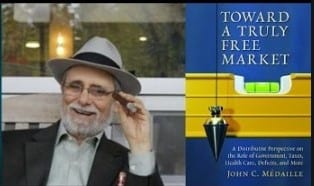
Image via Amazon.com and John Medaille
Asking what the term Catholic economics might mean strikes some people — too many, actually — as like asking whether there is such a thing as Catholic algebra or Catholic physics. The response is usually, “Don’t you know? Economics has become a science, lotsa numbers, econometrics, blah-blah. It can’t be ‘Catholic’ if it’s just like the law of gravity.”
The trouble is: the field of economics, as author and University of Dallas instructor John Médaille has cheerfully pointed out on numerous occasions, is in fact a branch of ethics and thus could be called a social science at best, although one which is suffering lately from theoretical confusion in many quarters.
It’s also the case that the Catholic Church does not endorse specific economic systems, although it’s plain to see that at times the Church pointedly does not endorse certain systems or regimes.
For example, despite Pope St. John Paul II’s statements about capitalism (actually, about “the free economy”) in the encyclical Centesimus Annus, he cannot be transformed into a cheerleader for the forms that late capitalism has taken over the last few decades.
Even less can Pope Francis’ critique of neoliberal economic hegemony since the 1980s (see Evangelium Gaudii, for example) be somehow softened to mean that Catholics should separate finance and morality. As my Texas relatives would say, oh contrare.
To understand these debates around a Catholic understanding of not just economics but what was once called political economy, we are fortunate to have a village explainer in the form of Médaille. He is the author of possibly the only business school text grounded in Catholic social thought, as well as the best popular exposition of the philosophy of distributism, a social theory popularized by G.K. Chesterton and Hilaire Belloc a century ago.
Distributism, insofar as it is remembered at all today, has mostly become the hobby of pipe-smoking would-be Hobbits and diehard Latin Mass attendees.
And yet one sign of its potential vitality is shown in the efforts of two neoliberal institutions — the Acton Institute and (ironically) the Chesterton Society — to host “debates” at which distributism is unfailingly demonstrated to be quaint nonsense badly in need of a good Austrian re-education program.
Médaille’s achievement was to bring distributism into conversation with modern-day economics — especially the Keynesian and Austrian schools — in order to update it, while leaving Keynes and von Mises looking rather the worse for wear.
Anyone interested in these issues can participate in a 90-minute Zoom seminar Tuesday, January 21, at 6 PM CST/7 PM EST, with John Médaille presenting on “the Just Economy.”
A link to the Zoom event is here and a link to the text John will be basing his presentation on is here.
The seminar will be co-hosted by the Francesco Alliance and Solidarity Hall and is the first in what will be an 8-part series.
Previous Post

January 6, 2020
Hearing Ancient Voices
Next Post

February 17, 2020 Arizmendi's Big House: Mondragón and the Culture of Cooperation
Browse Our Archives
Select a Category Alternative economics, worker and family empowerment, the spirituality of work, the economy of sharing Art Care for Our Common Home Catholic imagination Catholic Social Teaching Christian Friendship Christian Persecution Community building, models or forms of community, radical hospitality Corporal & Spiritual Works of Mercy Daniel Schwindt Dorothy Day, Peter Maurin, CW aims and means, spirituality Elias Crim Grace Potts Greg Guest Josh Brumfield Mark Gordon Matthew Cooper Mercy Michael Stafford Paul Grenier Peace, nonviolent resistance, conscience and conscientious objection Pope Francis Poverty, economic inequality, consumerism, unemployment, underemployment, living wage Racial Reconciliation Radical Christianity Stan Goff Uncategorized
Select a Month October 2020 September 2020 August 2020 June 2020 May 2020 April 2020 March 2020 February 2020 January 2020 December 2019 November 2019 October 2019 September 2019 June 2018 May 2018 April 2018 October 2017 August 2017 July 2017 May 2017 April 2017 March 2017 January 2017 December 2016 November 2016 October 2016 September 2016 August 2016 July 2016 June 2016 May 2016 April 2016 March 2016 February 2016 January 2016
Follow Us!
TAKE THE
Religious Wisdom Quiz
True or False: In Revelation, there are ten elders seated around God's throne.
Select your answer to see how you score.
FALSE TRUE
Related posts from The Dorothy Option

A Catholic Mom's Response to Fr. Meeks

A Beautiful Memoir of Waging Peace

Guest Post: A Letter from a TLM Catholic...

TRENDING AT PATHEOS Catholic

Creation, Preservation, and Teleology in Catholic Theology
As I write this, it is very early Monday morning. Like millions...

The Parable Of The Sower And The Word...
One of Christ’s most famous parables is that of the sower who...

Rejecting Doom: Christian Hope And Human Action
Christianity is a religion of hope. We are to have hope and...

Why I Choose the Eucharist Over the Sermon
Choose the Eucharist, Not the Sermon What are we supposed to get...

5 Design Elements Found in Spiritually Rooted Homes
Putting Spirituality Into Home Decor Our homes are more than our living...

Credo: A Story of God Told with the...
About 10 years ago, I began to imagine a personal "Credo" that...
view all Catholic blogs
Ad-Free & Subscriber Log-In Subscription Support
- About Us
- 2026 Calendar
- Videos
- Podcasts
- Library of World Religions
- Faith In Media Tracker
- Advertise With Us
- Write for Us
- Privacy Policy
- Terms of Service
- Do Not Sell My Data
- Contact Us
- Radiant Digital
- Manage Newsletter Subscriptions
- Unsubscribe From Notifications
- Sitemap
Copyright 2008-2026, Patheos. All rights reserved.
Subscription Support Ad-Free & Subscriber Log-In
Follow Patheos