
BuddhistCatholicContemplativeEvangelicalGeneral ChristianHinduJewishLatter-day SaintMuslimNew VisionsProgressive Christian
Beliefs
- Buddhist
- Catholic
- Contemplative
- Evangelical
- General Christian
- Hindu
- Jewish
- Latter-day Saint
- More Voices
- Muslim
- New Visions
- Pagan
- Progressive Christian
Topics
- Religion News
- Food and Religion
- Sports and Religion
- Religious Art
- Religious Music and Entertainment
- Religious Events
- History and Religion
- Style and Religion
- Politics and Religion
- Women in Religion
- Recreation Outdoors and Religion
- Business Finance and Religion
- Careers Workplace and Religion
- Education and Religion
- Family Parenting and Religion
- Health Fitness and Religion
- Home and Religion
- Relationships and Religion
- Technology and Religion
- Travel and Religion
Columnists
- Buddhist Columnists
- Business Finance and Religion Columnists
- Careers Workplace and Religion Columnists
- Catholic Columnists
- Contemplative Columnists
- Education and Religion Columnists
- Evangelists Columnists
- Family Parenting and Religion Columnists
- General Christian Columnists
- Health Fitness and Religion Columnists
- Hindu Columnists
- History and Religion Columnists
- Home and Religion Columnists
- Jewish Columnists
- More Voices Columnists
- Latter Day Columnists
- Muslim Columnists
- New Visions Columnists
- Nonreligious Columnists
- Pagan Columnists
- Politics and Religion Columnists
- Progressive Columnists
- Recreation Outdoors and Religion Columnists
- Relationships and Religion Columnists
- Religion News Columnists
- Religious Art Columnists
- Religious Events Columnists
- Religious Music and Entertainment Columnists
- Sports and Religion Columnists
- Style and Religion Columnists
- Technology and Religion Columnists
- Travel and Religion Columnists
- Women in Religion Columnists
Resource Library
- 2026 Calendar
- Library of World Religions
- The 100 Most Holy Places on Earth
- Patheos Answers
- Podcasts
- Videos
- Faith Leaders Database
- Anglican Episcopalian
- Bahai
- Baptist
- Buddhism
- Christianity
- Confucianism
- Eastern Orthodoxy
- Hinduism
- Holiness and Pentecostal
- ISKCON
- Islam
- Judaism
- Lutheran
- Methodist
- The Church of Jesus Christ of Latter-day Saints
- New Age
- Paganism
- Presbytarian and Reformed
- Protestantism
- Religion Behind the Scenes
- Roman Catholic
- Scientology
- Shia Islam
- Sikhism
- Sufism
- Sunni Islam
- Taoism
- Zen
- See all religions
Research Tools
 Ad-Free & Subscriber Log-In Subscription Support
Ad-Free & Subscriber Log-In Subscription Support
Follow Patheos 

- Trending:
- Forgiveness
- |
- Marriage
- |
- Consciousness
- |
- Death Penalty
- |
- Election
- |
- Halloween
 The Dorothy Option
- Home
- Catholic
- Shalom versus Pax: On Recovering Ivan Illich
Shalom versus Pax: On Recovering Ivan Illich
Last updated on: June 26, 2020 at 9:04 am by Elias Crim
Shalom versus Pax: On Recovering Ivan Illich 2020-06-26T09:04:08-05:00 Elias Crim
Patheos Explore the world's faith through different perspectives on religion and spirituality! Patheos has the views of the prevalent religions and spiritualities of the world.
Wipf and Stock
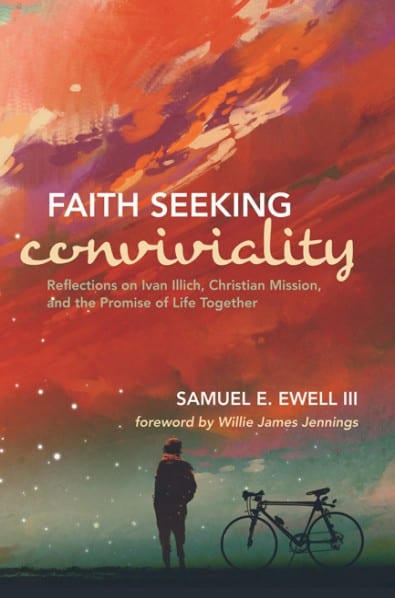
Faith Seeking Conviviality, a new book from Samuel Ewell, a U.K.-based social entrepreneur, is grounded in the author’s lived experiences in the form of a seven-year long stay in Brazil. And yet it is also a kind of spiritual/intellectual travelogue with striking reflections on Christianity, culture, and this special thing called conviviality.
For readers who have not yet looked into the work of 1970s icon Ivan Illich, the Catholic social theorist and tradition-based radical, Ewell has woven together alternating chapters of personal biography with an ongoing meditation on Illich and his writings. By the end, we feel we have met both the author and this foundational figure in the movement to de-institutionalize society as we follow the gradual unfolding of Illich’s impact on Ewell. The book is thus “an exercise in doing theology with and after Illich,” in the author’s description.
In 1999, Ewell, a Duke Divinity School-trained theologian, married Brazilian-born Rosalee Velloso da Silva whom he had met while they were in grad school together. Their marriage ceremony included readings from the Book of Ruth, with its famous promise that “your people will be my people.” They decided to take an offer to do a teaching and missionary stint in Londrina, in the southern state of Paraná in Brazil, where Ewell did indeed make the people of Brazil his people to a remarkable degree.
While becoming a “brasicano” (i.e., someone whose culture is halfway between Brazil and the U.S.), the author also met Claudio Oliver, a pastor in the nearby city of Curitiba, who gave him a copy of Illich’s famous-notorious 1968 speech called “To Hell with Good Intentions.” Long before any notable debate about globalization’s effects (the term in those days was “development”), Illich was sounding an alarm about the “benevolent invasions” sponsored by both the American government and the American Catholic Church into the southern hemisphere. He urged his young audience of do-gooders coming to “help” the people of Mexico to think again about their motives and what they were bringing. Just as Illich himself as a European felt the “Americanizing” tendencies at work on the foreigner here, he cautioned about “the seamy side of charity.” Ewell, still newly arrived and carrying his own notions of “helping” was thunderstruck by the speech and began to dig into Illich’s work in order to understand his foundational ideas.
The latter project simply took Ewell more deeply into practical theology with his new Brazilian community, inspiring him to join a samba circle (as a newbie percussionist) and to take on a volunteer position helping the nearby Claretian sisters manage a large garden (“a demonstration plot for finding and sharing the fullness of life that begins in a garden (Gen 1–2) and ends in a garden city (Rev 22).” (Here’s a video of Ewell presenting on this set of ideas.)
Over time Ewell learned more about why he was in Brazil and what he was doing there, “offering a distinctively Christian presence that is missionary without being manipulative.” In the spirit of Illich, he made the “convivial turn,” toward a preferential option for freedom in interdependence as a way of reclaiming the freedom of living. Theologically speaking, it was a shift from mission as expansion of something in favor of mission as encounter — importantly, incarnational mission.
The author remarks at one point on the irony that for many years the CIA seemed to know a good deal more about Illich and his work than the average American theology department. Now that Illich — this pilgrim, this 20th-century itinerant intellectual priest, half-Catholic, half-Jewish — is coming to be seen as the prophet of post-development, post-scarcity thinking, certainly anyone doing political theology today is likely to be aware of him.
Moreover, what I would call the ongoing institutional collapse of most of American Christianity — visible in its deadly embrace of partisan politics and its catastrophic role as both court chaplain and fund-raising arm of that politics — we are well able to understand one of Illich’s most shattering perceptions: that our condition is the “corruption of Christianity.”
By this phrase he was not suggesting that modern America had abandoned this heritage (pace the culture warriors) but that the forms of Christianity had become institutionalized and thus distorted to the point of betrayal of the message itself. The American Catholic Church (and, he would likely have acknowledged, virtually all churches today) has sacralized the institution, its employees and property — not the human person nor the community.
The dominant notion in American Catholicism for at least half a century has been that unchanging right doctrine is the foundation of right living: conversion of the individual is everything, whereas any sense of community spirituality is almost entirely lacking. (Was the 1960s Civil Rights movement the last time American churches shared such a practice?)
In the time of pandemic, we might also note Illich’s view that the pursuit of health is not primarily a technical task but a collective task and therefore a political one. (His excellent interpreter David Cayley has just posted his thoughts on how Illich might see our present public health catastrophe.)
For all that, Illich is not preaching despair but rather “the recovery of hope as a social force.” Ewell puts it beautifully: “Christian hope centers desire on a person from whom we await a gift.” Thus conviviality means rediscovering an intense hospitality which dispels our perception of scarcity. We cannot be in thrall to our institutions in order to petition them over our needs and what Illich might call some counterfeit hope of expectations.
As Ewell’s insightful book describes, if we can succeed in making this turning, this metanoia, we may recapture Illich’s view of the Incarnation as a surprise, always a surprise, and never anything else.
Community building, models or forms of community, radical hospitality
Previous Post

April 13, 2020
How to Understand the Great Silence We're In
Next Post

June 26, 2020 Where Are the Churches?
Browse Our Archives
Select a Category Alternative economics, worker and family empowerment, the spirituality of work, the economy of sharing Art Care for Our Common Home Catholic imagination Catholic Social Teaching Christian Friendship Christian Persecution Community building, models or forms of community, radical hospitality Corporal & Spiritual Works of Mercy Daniel Schwindt Dorothy Day, Peter Maurin, CW aims and means, spirituality Elias Crim Grace Potts Greg Guest Josh Brumfield Mark Gordon Matthew Cooper Mercy Michael Stafford Paul Grenier Peace, nonviolent resistance, conscience and conscientious objection Pope Francis Poverty, economic inequality, consumerism, unemployment, underemployment, living wage Racial Reconciliation Radical Christianity Stan Goff Uncategorized
Select a Month October 2020 September 2020 August 2020 June 2020 May 2020 April 2020 March 2020 February 2020 January 2020 December 2019 November 2019 October 2019 September 2019 June 2018 May 2018 April 2018 October 2017 August 2017 July 2017 May 2017 April 2017 March 2017 January 2017 December 2016 November 2016 October 2016 September 2016 August 2016 July 2016 June 2016 May 2016 April 2016 March 2016 February 2016 January 2016
Follow Us!
TAKE THE
Religious Wisdom Quiz
How did Jesus heal the mute and deaf man in Decapolis?
Select your answer to see how you score.
Put fingers in ears and touched tongue Anointed his head Said "Go in peace" Gave bread
Related posts from The Dorothy Option

A Catholic Mom's Response to Fr. Meeks

A Beautiful Memoir of Waging Peace

Guest Post: A Letter from a TLM Catholic...

TRENDING AT PATHEOS Catholic

Rejecting Doom: Christian Hope And Human Action
Christianity is a religion of hope. We are to have hope and...

It’s What Comes From Within Which Matters
One of the most difficult things for us to understand is why...

Why I Choose the Eucharist Over the Sermon
Choose the Eucharist, Not the Sermon What are we supposed to get...

5 Design Elements Found in Spiritually Rooted Homes
Putting Spirituality Into Home Decor Our homes are more than our living...

Credo: A Story of God Told with the...
About 10 years ago, I began to imagine a personal "Credo" that...

The Anatomy of Divine Revelation in Catholic Thought
The claim that God has made Himself known to human beings is...
view all Catholic blogs
Ad-Free & Subscriber Log-In Subscription Support
- About Us
- 2026 Calendar
- Videos
- Podcasts
- Library of World Religions
- Faith In Media Tracker
- Advertise With Us
- Write for Us
- Privacy Policy
- Terms of Service
- Do Not Sell My Data
- Contact Us
- Radiant Digital
- Manage Newsletter Subscriptions
- Unsubscribe From Notifications
- Sitemap
Copyright 2008-2026, Patheos. All rights reserved.
Subscription Support Ad-Free & Subscriber Log-In
Follow Patheos