
BuddhistCatholicContemplativeEvangelicalGeneral ChristianHinduJewishLatter-day SaintMuslimNew VisionsProgressive Christian
Beliefs
- Buddhist
- Catholic
- Contemplative
- Evangelical
- General Christian
- Hindu
- Jewish
- Latter-day Saint
- More Voices
- Muslim
- New Visions
- Pagan
- Progressive Christian
Topics
- Religion News
- Food and Religion
- Sports and Religion
- Religious Art
- Religious Music and Entertainment
- Religious Events
- History and Religion
- Style and Religion
- Politics and Religion
- Women in Religion
- Recreation Outdoors and Religion
- Business Finance and Religion
- Careers Workplace and Religion
- Education and Religion
- Family Parenting and Religion
- Health Fitness and Religion
- Home and Religion
- Relationships and Religion
- Technology and Religion
- Travel and Religion
Columnists
- Buddhist Columnists
- Business Finance and Religion Columnists
- Careers Workplace and Religion Columnists
- Catholic Columnists
- Contemplative Columnists
- Education and Religion Columnists
- Evangelists Columnists
- Family Parenting and Religion Columnists
- General Christian Columnists
- Health Fitness and Religion Columnists
- Hindu Columnists
- History and Religion Columnists
- Home and Religion Columnists
- Jewish Columnists
- More Voices Columnists
- Latter Day Columnists
- Muslim Columnists
- New Visions Columnists
- Nonreligious Columnists
- Pagan Columnists
- Politics and Religion Columnists
- Progressive Columnists
- Recreation Outdoors and Religion Columnists
- Relationships and Religion Columnists
- Religion News Columnists
- Religious Art Columnists
- Religious Events Columnists
- Religious Music and Entertainment Columnists
- Sports and Religion Columnists
- Style and Religion Columnists
- Technology and Religion Columnists
- Travel and Religion Columnists
- Women in Religion Columnists
Resource Library
- 2026 Calendar
- Library of World Religions
- The 100 Most Holy Places on Earth
- Patheos Answers
- Podcasts
- Videos
- Faith Leaders Database
- Anglican Episcopalian
- Bahai
- Baptist
- Buddhism
- Christianity
- Confucianism
- Eastern Orthodoxy
- Hinduism
- Holiness and Pentecostal
- ISKCON
- Islam
- Judaism
- Lutheran
- Methodist
- The Church of Jesus Christ of Latter-day Saints
- New Age
- Paganism
- Presbytarian and Reformed
- Protestantism
- Religion Behind the Scenes
- Roman Catholic
- Scientology
- Shia Islam
- Sikhism
- Sufism
- Sunni Islam
- Taoism
- Zen
- See all religions
Research Tools
 Ad-Free & Subscriber Log-In Subscription Support
Ad-Free & Subscriber Log-In Subscription Support
Follow Patheos 

- Trending:
- Forgiveness
- |
- Marriage
- |
- Consciousness
- |
- Death Penalty
- |
- Election
- |
- Halloween
 The Dorothy Option
- Home
- Catholic
- Sacrifice and Reconciliation in Africa
Sacrifice and Reconciliation in Africa
Last updated on: October 31, 2019 at 12:03 pm by Elias Crim
Sacrifice and Reconciliation in Africa 2019-10-31T12:03:57-05:00 Elias Crim
Patheos Explore the world's faith through different perspectives on religion and spirituality! Patheos has the views of the prevalent religions and spiritualities of the world.
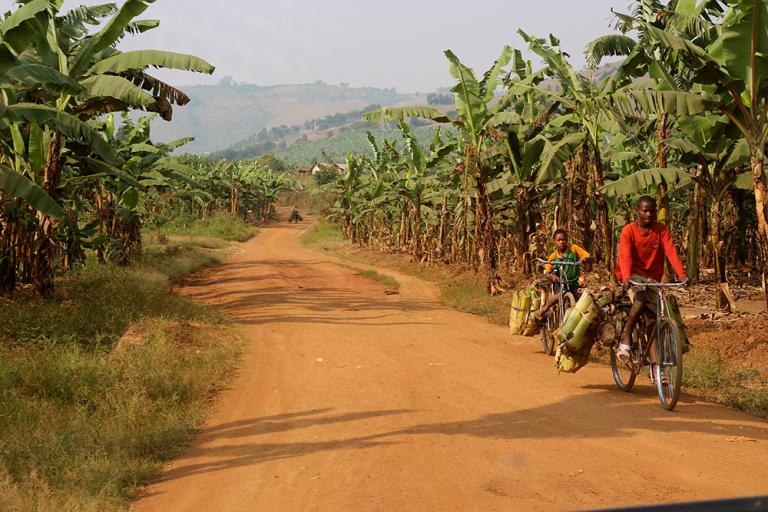
Image via Healthy Child Uganda
In 2008, Fr. Emmanuel Katongole, a Ugandan priest born in 1960 of Rwandan parents (one Hutu, one Tutsi), was moderating a panel at a gathering of the African Great Lakes Initiative near Kampala. A woman named Angelina Atyam shared with the audience her story of the abduction of her daughter from school in 1996, together with 139 other girls, by Joseph Kony’s infamous Lord’s Resistance Army. (The LRA abducted an estimated 26,000 children and killed over 200,000 people.)
In the aftermath, she explained, the girls’ parents met regularly for prayer, fasting and advocacy for their children, forming a group known as the Concerned Parents Association (CPA). Under her leadership, the CPA became increasingly effective, until the growing pressure led rebel leaders to offer her daughter’s release if she would simply be silent.
She responded saying that the rebels must release all the daughters, telling them “every child is my child.” The rebels refused this demand and she walked back to her home without her daughter. She explained that she could never be content to have her own child returned knowing that all the other girls were still suffering in the bush. The affected families had become one: so she was willing to trust.
Atyam nonetheless felt deeply her “sacrifice” of her daughter, especially as her own family soon turned against her for her decision. In a kind of dazed state, she would wash her lost daughter’s clothes, set a place at the table for her, and pray for her, sometimes sitting up at night and “arguing with God.”
And she continued her advocacy, traveling from one community to the next, speaking frequently on the radio. Finally, after seven years and seven months, her daughter, now with two small children, suddenly walked out of bush and returned home. Atyam’s story spread around the world and her advocacy for peace and reconciliation won her group recognition by the U.N. and other organizations.
This episode is one of Fr. Katongole’s inspirations for his work in Africa, attempting to go beyond the seemingly endless cycles of violence and war toward a new politics of forgiveness — an alternative politics, both innovative and non-violent, grounded in a deep sense of grief and suffering.
His writings on reconciliation, social ethics, and the theology of Stanley Hauerwas (with whom he did graduate work in theology at Duke University) describe a theology and politics of hope rarely heard in discussions of African societies. Given his parents’ origins, the fate of Rwanda looms large in Katongole’s writings, as well as his memories of his late brother who fought with Tanzanian troops to oust Idi Amin in 1979.
Africa, he notes, is an overwhelmingly Christian continent with many failures of the nation-state (consider the histories of Central African Republic, Sierra Leone, Southern Sudan, Liberia, Burundi, Uganda). What then is Christianity’s role in the search for peace, democracy, and development? Are these to be left to the political sphere?
“Christianity,” Katongole states, “has saved me from nation-state politics.” Indeed, he sees faith as a form of politics, simply because all politics is theological — it involves claims about life, reality, and the ultimate meaning of life.
His remarkable book, The Sacrifice of Africa, notes that Africa, an overwhelmingly Christian continent, is also the site of a genocide in Rwanda in which almost 1 million died as Christians killed Christians over 100 days of door-to-door bloodlust. (A quarter of a million bodies were later found in one mass grave.) Exactly as in the times of King Leopold’s destruction of 5 to 8 million Congolese between 1885 and 1908, when Western Christians looked away, Christianity in Rwanda in those terrible days became simply “invisible.”
Rwanda, once thought of proudly by the West as a triumph of evangelization and a thoroughly Christian nation, must instead become “a mirror to the Church” in the West, Katongole argues, in order to show us the brokenness of our faith. Indeed, the only hope for our world after Rwanda’s genocide, in his view, is a new kind of Christian identity for the global body of Christ — a people on pilgrimage together, a mixed group, bearing witness to a new identity made possible by the Gospel. (For more on this concept of ecclesial solidarity — i.e., when being a Christian is one’s primary and formative loyalty, the one that defines the legitimacy of other claims on allegiance and conscience such as those of class, nationality and state — see Michael Budde’s excellent Borders of Baptism.)
Typically, Western churches are tempted to make democratic transition in Africa the heart of Christianity, on the premise that Christianity, as a religion, is separate from politics. But this effectively marginalizes faith.
Moreover, elected regimes, Katongole reminds us, have proven as brutal as military ones; multi-party no less dictatorial than single party; homogenous nations (Rwanda) no more stable than culturally diverse ones (Uganda has over 33 language groups).
He notes that other solutions for Africa — usually Western in origin — abound:
- fairer elections in order to get better leaders;
- better constitutional mechanisms (to protect human rights and foster good governance);
- economic reforms/structural adjustment (as though African bureaucrats simply lack either the expertise or the commitment to reform)
- redraw national boundaries (usually to create homogenous nations)
- enlist African culture and traditions (as has been attempted, for example, with Leopold Senghor’s philosophy of négritude, Jomo Keyatta’s harambee, Julius Nyerere’s ujamaa, the recent vogue for ubuntu).
“The tragedy,” Katongole concludes, “is that African nation-states have succeeded in certain important ways — namely, in desacralizing the lives of the people, and in leaving them hopeless.” What is truly needed is what he terms “a mythological adjustment profound enough to address the underlying social imagination and new experiments in social life.”
Katongole’s books are also filled with stories, descriptions of heroic and hopeful figures like Maggy Barankitse, founder of Maison Shalom in Burundi, a collection of “children’s villages” in which multi-ethnic homeless children (including former child soldiers) learn various skills and attend school.
Or the Kuron Holy Trinity Peace Village founded by Sudanese priest Fr. Paride Taban, an example not of development or social work but ecclesiology, with people from multiple tribes living and working together, neither as Catholics nor Christians necessarily.
Or Fr. Katongole’s own Bethany Land Institute in Uganda, a living demonstration of integral ecology and of the spirit of Pope Francis’ vision in Laudato Si’.
Christian social practice, Katongole suggests, should be a Eucharistic spirituality which “includes everything” and means that one’s daily life in this otherwise overwhelming work is typically grounded in the disciplines of prayer, penance, silence, mediation, and Mass.
Reconciliation, on this view, is not “firefighting” or social work. It is a not a goal or a strategy. It is a journey and it is metanoia of a social kind, not merely personal. And, I would add, we non-Africans are in great need of it also.
Community building, models or forms of community, radical hospitality
Peace, nonviolent resistance, conscience and conscientious objection
Previous Post

September 30, 2019
The Strange Death and Life of the Pact of the Catacombs
Next Post
October 7, 2019 From Aparecida to the Amazonian Synod
Browse Our Archives
Select a Category Alternative economics, worker and family empowerment, the spirituality of work, the economy of sharing Art Care for Our Common Home Catholic imagination Catholic Social Teaching Christian Friendship Christian Persecution Community building, models or forms of community, radical hospitality Corporal & Spiritual Works of Mercy Daniel Schwindt Dorothy Day, Peter Maurin, CW aims and means, spirituality Elias Crim Grace Potts Greg Guest Josh Brumfield Mark Gordon Matthew Cooper Mercy Michael Stafford Paul Grenier Peace, nonviolent resistance, conscience and conscientious objection Pope Francis Poverty, economic inequality, consumerism, unemployment, underemployment, living wage Racial Reconciliation Radical Christianity Stan Goff Uncategorized
Select a Month October 2020 September 2020 August 2020 June 2020 May 2020 April 2020 March 2020 February 2020 January 2020 December 2019 November 2019 October 2019 September 2019 June 2018 May 2018 April 2018 October 2017 August 2017 July 2017 May 2017 April 2017 March 2017 January 2017 December 2016 November 2016 October 2016 September 2016 August 2016 July 2016 June 2016 May 2016 April 2016 March 2016 February 2016 January 2016
Follow Us!
TAKE THE
Religious Wisdom Quiz
What language was the New Testament originally written in?
Select your answer to see how you score.
Latin Greek Hebrew Syriac
Related posts from The Dorothy Option

A Catholic Mom's Response to Fr. Meeks

A Beautiful Memoir of Waging Peace

Guest Post: A Letter from a TLM Catholic...

TRENDING AT PATHEOS Catholic

Rejecting Doom: Christian Hope And Human Action
Christianity is a religion of hope. We are to have hope and...

It’s What Comes From Within Which Matters
One of the most difficult things for us to understand is why...

Why I Choose the Eucharist Over the Sermon
Choose the Eucharist, Not the Sermon What are we supposed to get...

5 Design Elements Found in Spiritually Rooted Homes
Putting Spirituality Into Home Decor Our homes are more than our living...

Credo: A Story of God Told with the...
About 10 years ago, I began to imagine a personal "Credo" that...

The Anatomy of Divine Revelation in Catholic Thought
The claim that God has made Himself known to human beings is...
view all Catholic blogs
Ad-Free & Subscriber Log-In Subscription Support
- About Us
- 2026 Calendar
- Videos
- Podcasts
- Library of World Religions
- Faith In Media Tracker
- Advertise With Us
- Write for Us
- Privacy Policy
- Terms of Service
- Do Not Sell My Data
- Contact Us
- Radiant Digital
- Manage Newsletter Subscriptions
- Unsubscribe From Notifications
- Sitemap
Copyright 2008-2026, Patheos. All rights reserved.
Subscription Support Ad-Free & Subscriber Log-In
Follow Patheos