
BuddhistCatholicContemplativeEvangelicalGeneral ChristianHinduJewishLatter-day SaintMuslimNew VisionsProgressive Christian
Beliefs
- Buddhist
- Catholic
- Contemplative
- Evangelical
- General Christian
- Hindu
- Jewish
- Latter-day Saint
- More Voices
- Muslim
- New Visions
- Pagan
- Progressive Christian
Topics
- Religion News
- Food and Religion
- Sports and Religion
- Religious Art
- Religious Music and Entertainment
- Religious Events
- History and Religion
- Style and Religion
- Politics and Religion
- Women in Religion
- Recreation Outdoors and Religion
- Business Finance and Religion
- Careers Workplace and Religion
- Education and Religion
- Family Parenting and Religion
- Health Fitness and Religion
- Home and Religion
- Relationships and Religion
- Technology and Religion
- Travel and Religion
Columnists
- Buddhist Columnists
- Business Finance and Religion Columnists
- Careers Workplace and Religion Columnists
- Catholic Columnists
- Contemplative Columnists
- Education and Religion Columnists
- Evangelists Columnists
- Family Parenting and Religion Columnists
- General Christian Columnists
- Health Fitness and Religion Columnists
- Hindu Columnists
- History and Religion Columnists
- Home and Religion Columnists
- Jewish Columnists
- More Voices Columnists
- Latter Day Columnists
- Muslim Columnists
- New Visions Columnists
- Nonreligious Columnists
- Pagan Columnists
- Politics and Religion Columnists
- Progressive Columnists
- Recreation Outdoors and Religion Columnists
- Relationships and Religion Columnists
- Religion News Columnists
- Religious Art Columnists
- Religious Events Columnists
- Religious Music and Entertainment Columnists
- Sports and Religion Columnists
- Style and Religion Columnists
- Technology and Religion Columnists
- Travel and Religion Columnists
- Women in Religion Columnists
Resource Library
- 2026 Calendar
- Library of World Religions
- The 100 Most Holy Places on Earth
- Patheos Answers
- Podcasts
- Videos
- Faith Leaders Database
- Anglican Episcopalian
- Bahai
- Baptist
- Buddhism
- Christianity
- Confucianism
- Eastern Orthodoxy
- Hinduism
- Holiness and Pentecostal
- ISKCON
- Islam
- Judaism
- Lutheran
- Methodist
- The Church of Jesus Christ of Latter-day Saints
- New Age
- Paganism
- Presbytarian and Reformed
- Protestantism
- Religion Behind the Scenes
- Roman Catholic
- Scientology
- Shia Islam
- Sikhism
- Sufism
- Sunni Islam
- Taoism
- Zen
- See all religions
Research Tools
 Ad-Free & Subscriber Log-In Subscription Support
Ad-Free & Subscriber Log-In Subscription Support
Follow Patheos 

- Trending:
- Forgiveness
- |
- Marriage
- |
- Consciousness
- |
- Death Penalty
- |
- Election
- |
- Halloween
 The Dorothy Option
- Home
- Catholic
- Mass at the Peripheries
Mass at the Peripheries
Last updated on: May 17, 2018 at 7:46 am by Elias Crim
Mass at the Peripheries 2018-05-17T07:46:06-05:00 Elias Crim
Patheos Explore the world's faith through different perspectives on religion and spirituality! Patheos has the views of the prevalent religions and spiritualities of the world.
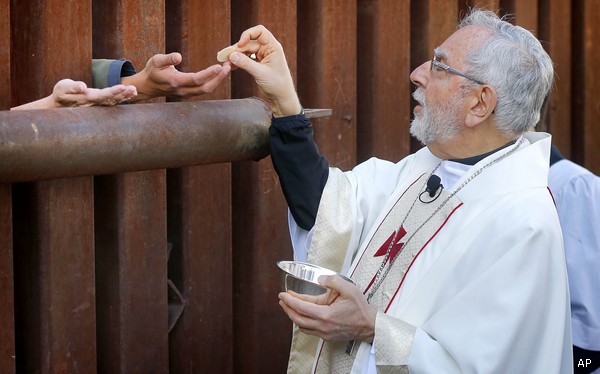
Most Reverend Gerald F. Kicanas, Bishop of Tucson, offers communion to people on the Mexican side of the international border, Tuesday, April 1, 2014, in Nogales, Ariz. Kicanas and Boston Archdiocese Cardinal Sean O’Malley, along with several Bishops who serve along the U.S./Mexico border, were visiting the border town to bring awareness to immigration reform and to remember those who have died trying to cross the border in years past. (AP Photo/Matt York)
We all know the Mass-hopper: that restless type who constantly whines that he can’t take one more of Fr. Ted’s vanilla homilies at St. X’s. Nor can he abide the horrible teen “praise” band ruining Fr. Jim’s services at St. Y’s. So that leaves Fr. Bob at St. Z’s but have you ever seen an uglier sanctuary in your life? I mean, really.
I don’t wish to be That Guy and yet my own recent Mass-hopping in my area doesn’t seem to be driven by any liturgical nitpicking. It’s really Pope Francis’ influence.
We want a church which goes forth, as he puts it in Evangelii Gaudium, adding that “all of us are asked to obey his call to go forth from our own comfort zone in order to reach all the ‘peripheries’ in need of the light of the Gospel” (paragraph 20).
I started thinking about my comfort zone, which is my middle-class, leafy parish in smalltown Indiana, just south of Chicago. Then it dawned on me: culturally speaking, the peripheries come to my parish every Sunday at 1 PM, when a congregation of perhaps 500 Hispanic families arrives for the Spanish-language service.
One literally peripheral aspect of this group is the location of their Mass: in the small chapel at the opposite end of the church from our large sanctuary. Besides the linguistic gulf between our two congregations, our Hispanic parishioners—perhaps 170 (in a space which seats 125) as compared with the 700 or so at the English-language services–are mostly out of sight and out of mind for the rest of the parish.
Not that there are many recent immigrants among these families. Most of the adults work in the food industry or landscaping, some in area factories and plants. Most have been here for a number of years, and many can manage in English fairly well.
I first attended a Spanish-language Mass, armed with my 25-word Spanish vocabulary, several years ago on the Feast of the Virgin of Guadalupe. Everything seemed different and yet the same, as we would expect at practically any Catholic Mass worldwide. Instead of the usual overbearing organ music of our 10 AM service, a small mariachi band provided accompaniment, the hymns were from the wonderful bilingual Flor Y Canto hymnal, and the service ended with many of the congregants coming up to receive a rose before the statue of Our Lady of Guadalupe, in imitation of Juan Diego’s gift of roses from the Blessed Virgin.
Since then, I’ve happily returned almost every Sunday to the Hispanic service—a kind of window, I like to think, into this wonderful but semi-hidden community in my own town.
I love sitting among these families at Mass. Older children patiently look out for the younger ones as needed; none of the teens look angry or alienated in some way. I sense a kind of cultural shyness around me when I get only the briefest of eye contact at the Sign of Peace.
And also perhaps a kind of innocence, what theologian Peter Casarella has referred to as “the healthier imaginations of the world’s poor.”
An image of the Blessed Mother is carried forward in the procession before each Mass and then placed on a table facing the parishioners. The chapel has no kneelers but almost everyone kneels.
Communion is likewise culturally distinct from the Anglo services: rather proceeding in an orderly row-by-row alignment, it resembles more of a slow, disorderly mingling in the direction of the altar. Interestingly, both the young presiding priest and the deacon at this service are Anglos speaking what sounds like pretty fair Spanish.
With a bilingual missalette, I can follow the rubrics of the Mass, including the readings, quite well. Once the homily begins, I’m resigned to understanding perhaps only 20% of the priest’s words, although the percentage is (I think) slowly rising.
As I strain to follow the homily, I think of what it would be like to cross a border and suddenly be immersed in a culture whose language is still mostly opaque to you, that sense of isolation all non-native speakers can easily feel. I decide to have coffee with Maricruz.
Many immigrant communities have individuals known as “fixers”, a rude term for someone as gracious and genuine as Maricruz, whom I know slightly through her German-born husband Nils. We meet at a local café and I explain I’m interested in learning more about the Hispanic community at our parish.
Maricruz first explains that she herself arrived in the U.S. from Querataro, Mexico in 2004 and for a time attended a parish in Detroit which had only monthly Spanish Masses because of the lack of priests. Now she and her family are quite settled in our town and she calls herself the “coordinator” of the parish Hispanic community. It has a few higher-income families, a few “in the middle,” and most are lower-income. Many are from Jalisco, Guanajuato and Puebla, each with their own traditions and local devotions, she explains.
At her Friday rosary group, Maricruz and a dozen or other Hispanic women socialize and keep each other connected. “You are the sisters I used to have,” she tells the others, thinking of the communities they left behind. “With this group, someone can easily say, I’m leaving town this weekend—please keep an eye on my kids.”
She’s aware some Anglo parishioners are wary of the Hispanic group, afraid to support “illegals.” She thinks that probably a large percentage of our Hispanic parishioners have no papers. “It’s only a guess,” she tells me. “It’s not something people talk about openly. Occasionally you hear somebody say ‘I haven’t seen my family in Mexico in X years’ or ‘I don’t have a driver’s license.’”
Back home, she tells me, life is still very different. All siblings in a family know to visit their parents’ graves annually, there are no nursing homes, and we visit grandma every weekend.
How rarely we Anglo Americans grasp that the Latino presence here is a blessing, the creativity lying dormant within that presence, the Blessed Virgin as a hidden cultural force. We Catholics in particular have quite forgotten St. John Paul II’s vision of one church—from Canada to Tierra del Fuego.
I ask Maricruz if she still prefers the Spanish Mass to the English one. She smiles to say, “Spanish is my language of prayer—that’s the most important thing.”
Previous Post
May 9, 2018
Maritain and the Met Gala 2018
Next Post

May 29, 2018 Balancing the Works of Mercy and the Works of Justice
Browse Our Archives
Select a Category Alternative economics, worker and family empowerment, the spirituality of work, the economy of sharing Art Care for Our Common Home Catholic imagination Catholic Social Teaching Christian Friendship Christian Persecution Community building, models or forms of community, radical hospitality Corporal & Spiritual Works of Mercy Daniel Schwindt Dorothy Day, Peter Maurin, CW aims and means, spirituality Elias Crim Grace Potts Greg Guest Josh Brumfield Mark Gordon Matthew Cooper Mercy Michael Stafford Paul Grenier Peace, nonviolent resistance, conscience and conscientious objection Pope Francis Poverty, economic inequality, consumerism, unemployment, underemployment, living wage Racial Reconciliation Radical Christianity Stan Goff Uncategorized
Select a Month October 2020 September 2020 August 2020 June 2020 May 2020 April 2020 March 2020 February 2020 January 2020 December 2019 November 2019 October 2019 September 2019 June 2018 May 2018 April 2018 October 2017 August 2017 July 2017 May 2017 April 2017 March 2017 January 2017 December 2016 November 2016 October 2016 September 2016 August 2016 July 2016 June 2016 May 2016 April 2016 March 2016 February 2016 January 2016
Follow Us!
TAKE THE
Religious Wisdom Quiz
What animal is commonly associated with Jesus?
Select your answer to see how you score.
Lamb Donkey Fish Lion
Related posts from The Dorothy Option

A Catholic Mom's Response to Fr. Meeks

A Beautiful Memoir of Waging Peace

Guest Post: A Letter from a TLM Catholic...

TRENDING AT PATHEOS Catholic

Rejecting Doom: Christian Hope And Human Action
Christianity is a religion of hope. We are to have hope and...

It’s What Comes From Within Which Matters
One of the most difficult things for us to understand is why...

Why I Choose the Eucharist Over the Sermon
Choose the Eucharist, Not the Sermon What are we supposed to get...

5 Design Elements Found in Spiritually Rooted Homes
Putting Spirituality Into Home Decor Our homes are more than our living...

Credo: A Story of God Told with the...
About 10 years ago, I began to imagine a personal "Credo" that...

The Anatomy of Divine Revelation in Catholic Thought
The claim that God has made Himself known to human beings is...
view all Catholic blogs
Ad-Free & Subscriber Log-In Subscription Support
- About Us
- 2026 Calendar
- Videos
- Podcasts
- Library of World Religions
- Faith In Media Tracker
- Advertise With Us
- Write for Us
- Privacy Policy
- Terms of Service
- Do Not Sell My Data
- Contact Us
- Radiant Digital
- Manage Newsletter Subscriptions
- Unsubscribe From Notifications
- Sitemap
Copyright 2008-2026, Patheos. All rights reserved.
Subscription Support Ad-Free & Subscriber Log-In
Follow Patheos