
BuddhistCatholicContemplativeEvangelicalGeneral ChristianHinduJewishLatter-day SaintMuslimNew VisionsProgressive Christian
Beliefs
- Buddhist
- Catholic
- Contemplative
- Evangelical
- General Christian
- Hindu
- Jewish
- Latter-day Saint
- More Voices
- Muslim
- New Visions
- Pagan
- Progressive Christian
Topics
- Religion News
- Food and Religion
- Sports and Religion
- Religious Art
- Religious Music and Entertainment
- Religious Events
- History and Religion
- Style and Religion
- Politics and Religion
- Women in Religion
- Recreation Outdoors and Religion
- Business Finance and Religion
- Careers Workplace and Religion
- Education and Religion
- Family Parenting and Religion
- Health Fitness and Religion
- Home and Religion
- Relationships and Religion
- Technology and Religion
- Travel and Religion
Columnists
- Buddhist Columnists
- Business Finance and Religion Columnists
- Careers Workplace and Religion Columnists
- Catholic Columnists
- Contemplative Columnists
- Education and Religion Columnists
- Evangelists Columnists
- Family Parenting and Religion Columnists
- General Christian Columnists
- Health Fitness and Religion Columnists
- Hindu Columnists
- History and Religion Columnists
- Home and Religion Columnists
- Jewish Columnists
- More Voices Columnists
- Latter Day Columnists
- Muslim Columnists
- New Visions Columnists
- Nonreligious Columnists
- Pagan Columnists
- Politics and Religion Columnists
- Progressive Columnists
- Recreation Outdoors and Religion Columnists
- Relationships and Religion Columnists
- Religion News Columnists
- Religious Art Columnists
- Religious Events Columnists
- Religious Music and Entertainment Columnists
- Sports and Religion Columnists
- Style and Religion Columnists
- Technology and Religion Columnists
- Travel and Religion Columnists
- Women in Religion Columnists
Resource Library
- 2026 Calendar
- Library of World Religions
- The 100 Most Holy Places on Earth
- Patheos Answers
- Podcasts
- Videos
- Faith Leaders Database
- Anglican Episcopalian
- Bahai
- Baptist
- Buddhism
- Christianity
- Confucianism
- Eastern Orthodoxy
- Hinduism
- Holiness and Pentecostal
- ISKCON
- Islam
- Judaism
- Lutheran
- Methodist
- The Church of Jesus Christ of Latter-day Saints
- New Age
- Paganism
- Presbytarian and Reformed
- Protestantism
- Religion Behind the Scenes
- Roman Catholic
- Scientology
- Shia Islam
- Sikhism
- Sufism
- Sunni Islam
- Taoism
- Zen
- See all religions
Research Tools
 Ad-Free & Subscriber Log-In Subscription Support
Ad-Free & Subscriber Log-In Subscription Support
Follow Patheos 

- Trending:
- Forgiveness
- |
- Marriage
- |
- Consciousness
- |
- Death Penalty
- |
- Election
- |
- Halloween
 The Dorothy Option
- Home
- Catholic
- From Aparecida to the Amazonian Synod
From Aparecida to the Amazonian Synod
Last updated on: October 31, 2019 at 12:03 pm by Elias Crim
From Aparecida to the Amazonian Synod 2019-10-31T12:03:39-05:00 Elias Crim
Patheos Explore the world's faith through different perspectives on religion and spirituality! Patheos has the views of the prevalent religions and spiritualities of the world.
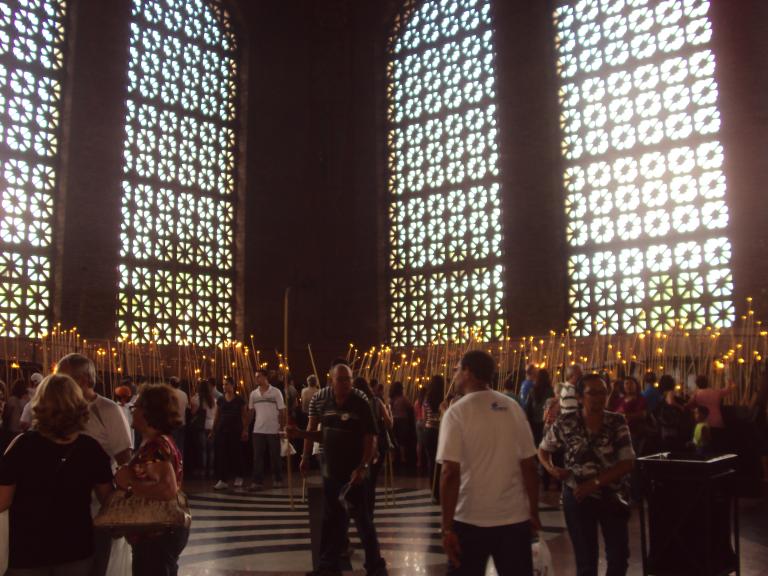
Our Lady of Aparecida Shrine (Brazil) Source: Wikimedia Commons
The Marian spirituality of the Church in Latin America is everywhere to see, particularly in the several national shrines across the continent.
Many Americans are familiar with Our Lady of Guadalupe in Mexico City but may not be aware of Our Lady of Lujan (in Argentina), Our Lady of Charity of El Cobre (in Cuba) or Our Lady of Aparecida (in Brazil), among others.
The Aparecida shrine — a national cathedral — is the second largest basilica in the world and the largest Marian shrine, seating 45,000 people, and receiving an estimated 10 million pilgrims annually.
It was here in May 2007 that the fifth CELAM conference of the Latin American and Caribbean bishops was held. (We might remember that these clerics represent 40% of the world Church.) Pope Benedict XVI made the introductory remarks while then-Cardinal Bergoglio was elected by the bishops as chairman of the committee to write the final document.
The Aparecida Document has turned out to be an interpretive key to the papacy of Pope Francis: he has referred to it as “a treasure yet to be fully exploited”, even as three of his own key statements are heavily inspired by Aparecida: Evangelii Gaudium, Laudato Si’, and Amoris Laetitia.
It is arguably the experience that created what historian Austin Ivereigh has called “The Francis Option.” And its prophetic power is helping to drive the deliberations at this month’s Amazonian Synod in Rome.
Part of the historical background to the Aparecida conference was the Argentinian crisis of 2001, a catastrophe of failed capitalism which had a great impact on the worldviews of Pope Francis and many other Latin American observers.
Another was the end of the Cold War and its various associated repressions of the politics around poverty: a revised, de-Marxified version of liberation theology was able to re-emerge.
We can now see the groundbreaking way these bishops, working from their distinctly Latin American experiences, called in 2007 for a unified way of finally engaging the powerful forces of technocracy, globalization, inequality, ecological disaster, mass migrations, and the decline of nation-states.
In a spirit of self-criticism of the Church, the document also stated (in section n. 12):
… A Catholic faith reduced to mere baggage, to a collection of rules and prohibitions, to fragmented devotional practices, to selective and partial adherence to the truths of the faith, to occasional participation in some sacraments, to the repetition of doctrinal principles, to bland or nervous moralizing, that does not convert the life of the baptized would not withstand the trials of time.
Key themes of the document could be summarized as:
- Importance of the personal encounter (a personalist approach to evangelism, especially developed in the work of the Argentine philosopher Enrique Dussel)
- A new missionary drive to go out to the “peripheries,” including the areas of the indigenous peoples as well urban ministries, along with mission not as a program but as a permanent and paradigmatic way of being
- A recovery of the theological (not merely social) emphasis on the preferential option for the poor and marginalized
- Living with the simplicity and humility taught in the Gospel (see my earlier post on the relevant Pact of the Catacombs)
- Serious commitment to the environment, especially the region of Amazonia
- Commitment to teología del pueblo, ”theology of the people,” emphasizing not Marxism but instead the importance of culture, popular religiosity and popular mysticism
There is of course much more which could be said here of Aparecida and other influences behind the Synod, including the way it was transported onto the larger canvas of the global Church by Pope Francis. These are the same themes we are hearing about in these opening days of the Synod, with more coming later in the month.
More on the Synod shortly.
For now, and relevant to the ethos of this event, I’d like to close with a personal anecdote from my trip to Rio in June 2013 for World Youth Day, a formative experience I’m still working through, one in which the beauty of the global Church became visible before my (and my two young daughters’) eyes.
As a speaker at a symposium on “Christ and the Environment” during the week of World Youth Day, I stayed at a wonderful guesthouse in the bohemian-chic Rio neighborhood called Santa Teresa, along with a number of other panelists and speakers, from Mexico, Spain, Argentina, Peru, Columbia, and Brazil, among other countries.
On one evening, we all had a dinner together and then talked for a bit until someone pulled out a guitar. What followed was mostly raucous and comical, as we sang bad versions of Beatles songs, folk songs, and nonsense.
But near the end of the evening, the guitarist began playing a song I’d never heard, Santa Maria de America Latina. It’s a simple Marian folk song, each verse of which is devoted to a different shrine in a different country: Panama, Cuba, Mexico, Peru, Chile, Brazil, Argentina, Venezuela, Ecuador, Colombia, Guatemala, Costa Rica, Honduras. (I’ll paste in the lyrics in Spanish and English below.)
But as much as the tenderness of the song, what struck me in that Rio setting among new friends from numerous countries was the spontaneous way some seven or eight different Hispanic men — teachers, theologians, laypeople — all apparently knew the song through all its verses. It felt like a small example of just what the teología del pueblo refers to, i.e., an instinctive devotion not created by any committee but from the hearts of the people.
Personally, I feel these currents very strongly in what we’re watching at this month’s Amazonian Synod.
[English/Spanish lyrics of “Santa María de América Latina”]
Santa María de América Latina
Madre nuestra eres, María
Our mother, Mary
de todo este continente
from all over this continent
pues tú has estado presente
well you have been present
en toda nuestra historia
in all our history
y nos sigues conduciendo
and you keep leading us
a la verdadera gloria
to true glory
Nuestra evangelización
Our evangelization
sintió tu mano amante
felt your loving hand
pues tú seguiste constante
Well, you remained constant to
aquella grande misión
that great mission
por eso te apareciste
that’s why you appeared
en el santo Tepeyac
in Saint Tepeyac
Y ahora tus hijos te imploran
And now your children implore you
Latinoamérica toda
Latin America all
Madre de todos los hombres
Mother of all men
con el nombre de La Antigua
with the name of La Antigua
invocado fue tu amparo
invoked was your protection
en Panamá por vez primera
in Panama for the first time
María de Guadalupe
Maria of Guadalupe
te llaman los mexicanos
the Mexicans call you
y son tus fieles cubanos
and they are your faithful Cubans
aun sufriendo pobreza
still suffering poverty
hijos todos muy devotos
all very devoted children
de la Morena del Cobre
of the Morena del Cobre
Virgen de Copacabana
Virgin of Copacabana
te invoca el hombre del Ande
the man of the Andes invokes you
y en todo el Sur del Perú
and throughout southern Peru
te quieren Virgen de Chapi
they love you Virgin of Chapi
y los chilenos piadosos
and pious Chileans
en tu santuario en Maipú
in your sanctuary in Maipú
Y es hacia Aparecida
And it is towards Aparecida
donde van los brasileños
where the Brazilians go
para pedirte postrados
to ask you prostrated
escuches sus sufrimiento
to listen to their sufferings
y en Argentina en Luján
and in Argentina in Luján
te imploran los argentinos
Argentines implore you
Señora de Coromoto
Lady of Coromoto
te aman los venezolanos
Venezuelans love you
y van los ecuatorianos
and the Ecuadorians go
a tu santuario del Quinche
to your sanctuary of Quinche
bella estrella de Colombia
beautiful star of Colombia
Virgen de Chiquinquirá
Virgin of Chiquinquirá
En el Paraguay tu reinas
In Paraguay you reign
Señora de Caacupé
Lady of Caacupé
alma de los uruguayos
Uruguayan soul
Virgen de los 33
Virgin of the 33
sol de los dominicanos
sun of the Dominicans
Señora de la Altagracia
Lady of Altagracia
Oh Señora del Rosario
Oh Lady of the Rosary
lucero de Guatemala
star of Guatemala
y en Cartago de Costa Rica
and in Cartago of Costa Rica
acoges a los peregrinos
you welcome the pilgrims
Virgencita de Suyapa
Virgin of Suyapa
Honduras te da su amor
Honduras gives you its love
En El Salvador te invocan
In El Salvador they invoke you
oh Señora de la Paz
Oh Lady of Peace
y aunque la aflicción se sienta
and although the affliction touches
los fieles nicaragüenses
faithful Nicaraguans
en Chinandega te piden
in Chinandega they ask you
que la fe no sea vencida
that faith is not defeated
María, Virgen y Madre
Mary, Virgin and Mother
cuida este tu continente
take care this your continent
que vivamos en justicia
that we live in justice
y que ya no haya miseria
and that there is no more misery
que en nuestra tierra fecunda
that in our fertile land
haya reconciliación
there is reconciliation
Y ante todo, María, enséñanos el Amor
And above all, Mary, teach us Love
a ser fieles a Dios Padre
to be faithful to God the Father
fraternos con los hermanos
fraternal with the brothers
condúcenos a tu Hijo
lead us your son
que seamos como Jesús
that we be like Jesus
Poverty, economic inequality, consumerism, unemployment, underemployment, living wage
Previous Post
October 3, 2019
Sacrifice and Reconciliation in Africa
Next Post

October 10, 2019 "There is no such thing as just war."
Browse Our Archives
Select a Category Alternative economics, worker and family empowerment, the spirituality of work, the economy of sharing Art Care for Our Common Home Catholic imagination Catholic Social Teaching Christian Friendship Christian Persecution Community building, models or forms of community, radical hospitality Corporal & Spiritual Works of Mercy Daniel Schwindt Dorothy Day, Peter Maurin, CW aims and means, spirituality Elias Crim Grace Potts Greg Guest Josh Brumfield Mark Gordon Matthew Cooper Mercy Michael Stafford Paul Grenier Peace, nonviolent resistance, conscience and conscientious objection Pope Francis Poverty, economic inequality, consumerism, unemployment, underemployment, living wage Racial Reconciliation Radical Christianity Stan Goff Uncategorized
Select a Month October 2020 September 2020 August 2020 June 2020 May 2020 April 2020 March 2020 February 2020 January 2020 December 2019 November 2019 October 2019 September 2019 June 2018 May 2018 April 2018 October 2017 August 2017 July 2017 May 2017 April 2017 March 2017 January 2017 December 2016 November 2016 October 2016 September 2016 August 2016 July 2016 June 2016 May 2016 April 2016 March 2016 February 2016 January 2016
Follow Us!
TAKE THE
Religious Wisdom Quiz
True or False: 1 Peter teaches that believers are living stones being built into a spiritual house.
Select your answer to see how you score.
FALSE TRUE
Related posts from The Dorothy Option

A Beautiful Memoir of Waging Peace

Guest Post: A Letter from a TLM Catholic...

Shalom versus Pax: On Recovering Ivan Illich
TRENDING AT PATHEOS Catholic

Rejecting Doom: Christian Hope And Human Action
Christianity is a religion of hope. We are to have hope and...

It’s What Comes From Within Which Matters
One of the most difficult things for us to understand is why...

Why I Choose the Eucharist Over the Sermon
Choose the Eucharist, Not the Sermon What are we supposed to get...

5 Design Elements Found in Spiritually Rooted Homes
Putting Spirituality Into Home Decor Our homes are more than our living...

Credo: A Story of God Told with the...
About 10 years ago, I began to imagine a personal "Credo" that...

The Anatomy of Divine Revelation in Catholic Thought
The claim that God has made Himself known to human beings is...
view all Catholic blogs
Ad-Free & Subscriber Log-In Subscription Support
- About Us
- 2026 Calendar
- Videos
- Podcasts
- Library of World Religions
- Faith In Media Tracker
- Advertise With Us
- Write for Us
- Privacy Policy
- Terms of Service
- Do Not Sell My Data
- Contact Us
- Radiant Digital
- Manage Newsletter Subscriptions
- Unsubscribe From Notifications
- Sitemap
Copyright 2008-2026, Patheos. All rights reserved.
Subscription Support Ad-Free & Subscriber Log-In
Follow Patheos