
BuddhistCatholicContemplativeEvangelicalGeneral ChristianHinduJewishLatter-day SaintMuslimNew VisionsProgressive Christian
Beliefs
- Buddhist
- Catholic
- Contemplative
- Evangelical
- General Christian
- Hindu
- Jewish
- Latter-day Saint
- More Voices
- Muslim
- New Visions
- Pagan
- Progressive Christian
Topics
- Religion News
- Food and Religion
- Sports and Religion
- Religious Art
- Religious Music and Entertainment
- Religious Events
- History and Religion
- Style and Religion
- Politics and Religion
- Women in Religion
- Recreation Outdoors and Religion
- Business Finance and Religion
- Careers Workplace and Religion
- Education and Religion
- Family Parenting and Religion
- Health Fitness and Religion
- Home and Religion
- Relationships and Religion
- Technology and Religion
- Travel and Religion
Columnists
- Buddhist Columnists
- Business Finance and Religion Columnists
- Careers Workplace and Religion Columnists
- Catholic Columnists
- Contemplative Columnists
- Education and Religion Columnists
- Evangelists Columnists
- Family Parenting and Religion Columnists
- General Christian Columnists
- Health Fitness and Religion Columnists
- Hindu Columnists
- History and Religion Columnists
- Home and Religion Columnists
- Jewish Columnists
- More Voices Columnists
- Latter Day Columnists
- Muslim Columnists
- New Visions Columnists
- Nonreligious Columnists
- Pagan Columnists
- Politics and Religion Columnists
- Progressive Columnists
- Recreation Outdoors and Religion Columnists
- Relationships and Religion Columnists
- Religion News Columnists
- Religious Art Columnists
- Religious Events Columnists
- Religious Music and Entertainment Columnists
- Sports and Religion Columnists
- Style and Religion Columnists
- Technology and Religion Columnists
- Travel and Religion Columnists
- Women in Religion Columnists
Resource Library
- 2026 Calendar
- Library of World Religions
- The 100 Most Holy Places on Earth
- Patheos Answers
- Podcasts
- Videos
- Faith Leaders Database
- Anglican Episcopalian
- Bahai
- Baptist
- Buddhism
- Christianity
- Confucianism
- Eastern Orthodoxy
- Hinduism
- Holiness and Pentecostal
- ISKCON
- Islam
- Judaism
- Lutheran
- Methodist
- The Church of Jesus Christ of Latter-day Saints
- New Age
- Paganism
- Presbytarian and Reformed
- Protestantism
- Religion Behind the Scenes
- Roman Catholic
- Scientology
- Shia Islam
- Sikhism
- Sufism
- Sunni Islam
- Taoism
- Zen
- See all religions
Research Tools
 Ad-Free & Subscriber Log-In Subscription Support
Ad-Free & Subscriber Log-In Subscription Support
Follow Patheos 

- Trending:
- Forgiveness
- |
- Marriage
- |
- Consciousness
- |
- Death Penalty
- |
- Election
- |
- Halloween
 The Dorothy Option
- Home
- Catholic
- Feeling the Francis Effect
Feeling the Francis Effect
Last updated on: August 8, 2017 at 1:54 pm by Elias Crim
Feeling the Francis Effect 2017-08-08T13:54:59-05:00 Elias Crim
Patheos Explore the world's faith through different perspectives on religion and spirituality! Patheos has the views of the prevalent religions and spiritualities of the world.
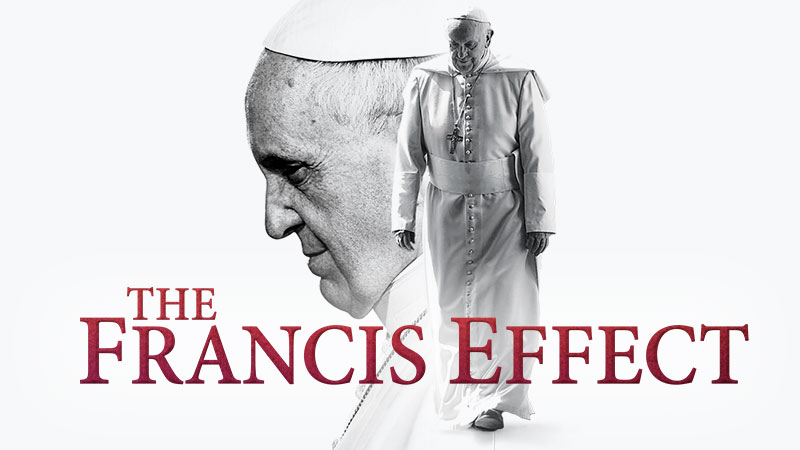 How to understand Pope Francis? Despite the apparent dyspepsia his arrival has caused among some of the unafflictedly comfortable, it really shouldn’t be that difficult to get him right, wouldn’t you think?
Here’s a tip: I recently watched a DVD of The Francis Effect, which I suspect is probably the best single video introduction to the life, ideas and mission of Pope Francis currently available.
Produced by Salt + Light, the Toronto/Montreal-based Catholic television network, the film is a skillful blending of both Catholic and non-Catholic voices ranging from four Cardinals (Sean O’Malley, Donald Wuerl, Oscar Maradiaga, and Thomas Collins), several journalists (Diane Sawyer, Scott Pelley, Anderson Cooper, Fr. Matt Malone), and an economist (Charles Clark), among numerous other folk.
Skillfully narrated by writer, producer and director Sebastian Gomes, the composite effect is an exciting and deeply thoughtful portrait of Bergoglio the man, his historical context as “the pope of Vatican II” (as Cardinal Wuerl describes him), and his vision for moving the Church from mere self-preservation to missionary outreach.
Beginning from an insight of Karl Rahner, SJ–one of the most influential Roman Catholic thinkers of the 20th Century–that Vatican II was the beginning of a fundamental transformation of the Church into a fully global religion–the film’s on-camera witnesses help explain how the person and ministry of Pope Francis should be seen as part of the continuing realization of that shift.
The film begins with the historic resignation of Benedict XVI and the subsequent “surprise” of Francis, then moves on to the new and highly transparent way of communicating Francis has initiated, the nature and significance of his “blueprint” (Evangelii Gaudium), his call to overcome the “globalization of indifference” by reaching out to the peripheries (i.e, the borders of economic, political, physical and social exclusion), and finally his reforming mandate.
Without becoming a lesson in theology, the film happily offers numerous insights into the deeper significance of Pope Francis’ agenda and style of evangelization. “With Evangelii Gaudium, he’s simply put down on paper what he’s already been doing,” Cardinal Donald Wuerl comments. “He’s a pastor who looks a lot like Jesus.”
Theologian Josephine Lombardi notes that Francis has called for a profound theology of women and an increase in the number of women in high-profile positions in the Church. She also comments on his spontaneity and the way seminarians can benefit from observing that unusual quality in a high-profile Church leader.
On the Pope’s Jesuit origins as a source of his reforming zeal, Fr. Matt Malone (editor of America magazine) points out that every religious order is typically focused on reform. Perhaps more important in light of Francis’ comments about “going out to the peripheries”, he observes, is the fact that the Jesuits are accustomed to working on the margins of society. Economist Charles Clark strikingly describes Francis as “the only world leader who knows the poor,” one who is aware of the many kinds of poverty–social, political, spiritual–in addition to the material kind.
Purchasers of the DVD version of the documentary also receive two additional discs of interviews conducted for the project, among them a striking conversation with Fr. Thomas Rosica, its executive producer and the CEO of Salt and Light TV. In February 2013, Fr. Rosica received a call from Fr. Federico Lombardi to become the English-language media coordinator for the Vatican Press Office immediately after Pope Benedict XVI’s resignation. He and his colleagues were astonished as they watched over 6,000 journalists from around the world descend upon Rome in the days following that event. “Given the rather imperfect state of the Vatican’s press relations prior to Benedict’s resignation, we realized this event was an opportunity for a remarkable teaching moment.”
As fully five weeks of Vatican briefings ensued, Fr. Rosica and the other press office team felt a groundswell of global interest in the advent of a new pope. And then the great surprise happened: Cardinal Bergoglio, an Argentine and yet with European roots, a highly educated man and yet of great simplicity in his manner, became Francis.
“Francis is not afraid of anyone,” Rosica underlines, “he’s very much his own man. He reminds me of the verse from 1 John, ‘In perfect love, there is no fear’. He’s bold, a risk-taker who seems to work in perfect freedom. And he has invited the world into the beauty of the Church.”
This change in papal style frankly amounts to a change in substance, as in the way the world now relates to the Church but also, Rosica notes, in the way the Church now relates to the world. “If this doesn’t sound too Italian to say, I imagine our communications philosophy to look increasingly like Bernini’s beautiful colonnade around the front of St. Peter’s Square: that is, open, welcoming to everyone.”
And as for Pope Francis himself, “Even to millions far away, it’s as though he’s speaking to each person individually: cor ad cor loquitur, he speaks heart to heart,” as Rosica puts it. “Francis is bringing many people back to life.”
Poverty, economic inequality, consumerism, unemployment, underemployment, living wage
Previous Post
July 31, 2017
Jesus the Imagination
Next Post
August 21, 2017 The Word from Dr. Lowdown
Browse Our Archives
Select a Category Alternative economics, worker and family empowerment, the spirituality of work, the economy of sharing Art Care for Our Common Home Catholic imagination Catholic Social Teaching Christian Friendship Christian Persecution Community building, models or forms of community, radical hospitality Corporal & Spiritual Works of Mercy Daniel Schwindt Dorothy Day, Peter Maurin, CW aims and means, spirituality Elias Crim Grace Potts Greg Guest Josh Brumfield Mark Gordon Matthew Cooper Mercy Michael Stafford Paul Grenier Peace, nonviolent resistance, conscience and conscientious objection Pope Francis Poverty, economic inequality, consumerism, unemployment, underemployment, living wage Racial Reconciliation Radical Christianity Stan Goff Uncategorized
Select a Month October 2020 September 2020 August 2020 June 2020 May 2020 April 2020 March 2020 February 2020 January 2020 December 2019 November 2019 October 2019 September 2019 June 2018 May 2018 April 2018 October 2017 August 2017 July 2017 May 2017 April 2017 March 2017 January 2017 December 2016 November 2016 October 2016 September 2016 August 2016 July 2016 June 2016 May 2016 April 2016 March 2016 February 2016 January 2016
Follow Us!
TAKE THE
Religious Wisdom Quiz
Who said, "Give us this day our daily bread"?
Select your answer to see how you score.
Isaiah Paul David Jesus
Related posts from The Dorothy Option

A Catholic Mom's Response to Fr. Meeks

A Beautiful Memoir of Waging Peace

Guest Post: A Letter from a TLM Catholic...

TRENDING AT PATHEOS Catholic

Rejecting Doom: Christian Hope And Human Action
Christianity is a religion of hope. We are to have hope and...

It’s What Comes From Within Which Matters
One of the most difficult things for us to understand is why...

Why I Choose the Eucharist Over the Sermon
Choose the Eucharist, Not the Sermon What are we supposed to get...

5 Design Elements Found in Spiritually Rooted Homes
Putting Spirituality Into Home Decor Our homes are more than our living...

Credo: A Story of God Told with the...
About 10 years ago, I began to imagine a personal "Credo" that...

The Anatomy of Divine Revelation in Catholic Thought
The claim that God has made Himself known to human beings is...
view all Catholic blogs
Ad-Free & Subscriber Log-In Subscription Support
- About Us
- 2026 Calendar
- Videos
- Podcasts
- Library of World Religions
- Faith In Media Tracker
- Advertise With Us
- Write for Us
- Privacy Policy
- Terms of Service
- Do Not Sell My Data
- Contact Us
- Radiant Digital
- Manage Newsletter Subscriptions
- Unsubscribe From Notifications
- Sitemap
Copyright 2008-2026, Patheos. All rights reserved.
Subscription Support Ad-Free & Subscriber Log-In
Follow Patheos