
BuddhistCatholicContemplativeEvangelicalGeneral ChristianHinduJewishLatter-day SaintMuslimNew VisionsProgressive Christian
Beliefs
- Buddhist
- Catholic
- Contemplative
- Evangelical
- General Christian
- Hindu
- Jewish
- Latter-day Saint
- More Voices
- Muslim
- New Visions
- Pagan
- Progressive Christian
Topics
- Religion News
- Food and Religion
- Sports and Religion
- Religious Art
- Religious Music and Entertainment
- Religious Events
- History and Religion
- Style and Religion
- Politics and Religion
- Women in Religion
- Recreation Outdoors and Religion
- Business Finance and Religion
- Careers Workplace and Religion
- Education and Religion
- Family Parenting and Religion
- Health Fitness and Religion
- Home and Religion
- Relationships and Religion
- Technology and Religion
- Travel and Religion
Columnists
- Buddhist Columnists
- Business Finance and Religion Columnists
- Careers Workplace and Religion Columnists
- Catholic Columnists
- Contemplative Columnists
- Education and Religion Columnists
- Evangelists Columnists
- Family Parenting and Religion Columnists
- General Christian Columnists
- Health Fitness and Religion Columnists
- Hindu Columnists
- History and Religion Columnists
- Home and Religion Columnists
- Jewish Columnists
- More Voices Columnists
- Latter Day Columnists
- Muslim Columnists
- New Visions Columnists
- Nonreligious Columnists
- Pagan Columnists
- Politics and Religion Columnists
- Progressive Columnists
- Recreation Outdoors and Religion Columnists
- Relationships and Religion Columnists
- Religion News Columnists
- Religious Art Columnists
- Religious Events Columnists
- Religious Music and Entertainment Columnists
- Sports and Religion Columnists
- Style and Religion Columnists
- Technology and Religion Columnists
- Travel and Religion Columnists
- Women in Religion Columnists
Resource Library
- 2026 Calendar
- Library of World Religions
- The 100 Most Holy Places on Earth
- Patheos Answers
- Podcasts
- Videos
- Faith Leaders Database
- Anglican Episcopalian
- Bahai
- Baptist
- Buddhism
- Christianity
- Confucianism
- Eastern Orthodoxy
- Hinduism
- Holiness and Pentecostal
- ISKCON
- Islam
- Judaism
- Lutheran
- Methodist
- The Church of Jesus Christ of Latter-day Saints
- New Age
- Paganism
- Presbytarian and Reformed
- Protestantism
- Religion Behind the Scenes
- Roman Catholic
- Scientology
- Shia Islam
- Sikhism
- Sufism
- Sunni Islam
- Taoism
- Zen
- See all religions
Research Tools
 Ad-Free & Subscriber Log-In Subscription Support
Ad-Free & Subscriber Log-In Subscription Support
Follow Patheos 

- Trending:
- Forgiveness
- |
- Marriage
- |
- Consciousness
- |
- Death Penalty
- |
- Election
- |
- Halloween
 The Dorothy Option
- Home
- Catholic
- Does The Environment Have Rights?
Does The Environment Have Rights?
Last updated on: April 4, 2016 at 8:24 am by Daniel Schwindt
Does The Environment Have Rights? 2016-04-04T08:24:13-05:00 Daniel Schwindt
Patheos Explore the world's faith through different perspectives on religion and spirituality! Patheos has the views of the prevalent religions and spiritualities of the world.
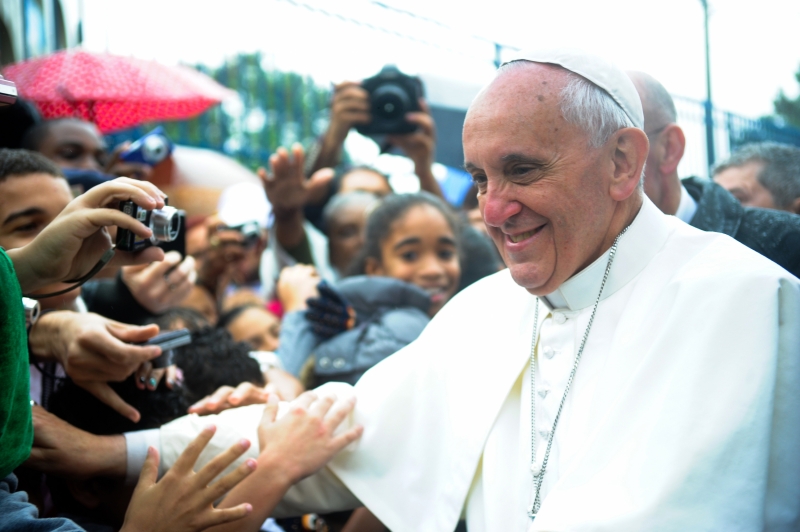
Source: Wikimedia Commons
Obviously Pope Francis thinks so. As he told the UN back in 2015: “It must be stated that a true ‘right of the environment’ does exist.”
I remember those words from when he spoke them, and haven’t thought much about them since. But today I stumbled upon an article over at Crux, written by a Thomas D. Williams, titled “Perhaps Pope Francis should ask, ‘Who Am I to Fudge?’ ” wherein he states:
“As a theologian, I confess that I cringe when I hear the pope tell the United Nations that the environment has rights (a philosophically unsustainable proposal).”
This got me thinking again about the subject of right, or more specifically, the subject of subjective right, as opposed to objective right.
Objective right is, from the point of view of Thomistic philosophy, that which is due another. In this sense, “right” is simply the maintenance of justice between parties.
Subjective right, on the other hand, is the lawful and inviolable power of doing, omitting, acquiring, possessing, or alienating something.
Objective right is more universal and is closely related to the notion of justice. It obviously implies relation and therefore cannot be “individualized.” Subjective right, since it deals with the power of doing this or that, can be.
Now here’s the thing: the relation between the two concepts is hierarchical. If we forget that, we end up either distorting the meaning of the concept of right, or else truncating it.
Turning to Henri Grenier’s Manual of Thomistic Philosophy:
“Right, in the strict and formal meaning of the term, is objective right. The moral power is called right only as it is concerned with objective right, i.e., with a just thing. A person has this power, i.e., subjective right, only because first the thing is due to him in accordance with law, i.e., only because objective right first exists. Hence this inviolable power is called right only by extrinsic denomination, i.e., only by analogy of attribution.”
The problem that occurs when you ignore objective right and make subjective right out to be primary,
“it follows that the juridical order consists in a certain autonomy, independence, and liberty. For subjective right is not measured by the just thing, but the just thing is measured by the inviolable faculty, which is a certain liberty…This gives rise to errors among moderns, who speak of liberty of speech, liberty of worship, economic liberty…without any consideration of their relation to the common good.”
In short, if you forget the distinction between objective and subjective right, or if you forget which one is primary, you wind up with an exaggerated notion of subjective, individualistic, “rights,” and lose the ability to deal with right as it relates to the common good. In fact, if you lose objective right as primary, you lose the ability to deal with the common good at all.
Even when it comes to private property, which is a valid principle, it must be remembered that the dominion an individual has over the portion of Creation which he “owns,” this ownership is itself subordinate to the universal destination of goods.
Thus, when Pope Francis spoke of the “right of the environment,” it’s a bit condescending to treat him as if he were making Creation into a person and then attributing subjective rights to this Creation-person, which would be absurd.
I can’t be sure, but I suspect that when Francis speaks of rights he is doing so within the more ancient and more “philosophically sustainable” paradigm that teaches right primarily as the flip-side of duty.
Mankind has a duty to respect nature for what is it—a divine gift conveying not only material benefit but metaphysical meaning. Insofar as this duty is real, it is likewise legitimate to say that the environment has a real “right” to be respected.
Admitting this fact does not require that we elevate the environment to the status of person, nor does it degrade man to the status of the environment. It speaks to the profound dignity of man as a being with responsibilities—that the mere existence of a duty on his part has the power to convey a right on that toward which it is directed.
Of course, if you don’t understand this, and if you adhere to the novel, humanistic version of rights as a list of entitlements people claim against one another, then I could see how the Pope’s words might make you cringe. But the fact that you cringe says more about your theology than it does the Pope’s.
“As a theologian,” Williams should know better. But the fact that his most notable published work is titled “Who Is My Neighbor? Personalism and the Foundations of Human Rights,” we should be surprised that he doesn’t. “Personalism,” as I’ve explained elsewhere, is the manifestation of precisely this error about justice.
As you may or may not know, Crux recently joined forces with the Knights of Columbus. I hope this is not the outcome of that merger, and that this sort of writing, which seems to me to be one of those obnoxious “preemptive rebuttals” to a yet-to-be-released Church document (we saw them in droves before Laudato Si’), is not to become a regular occurrence at John Allen’s respectable outlet.
Previous Post

April 1, 2016
Can We Just Grow Jobs?
Next Post

April 5, 2016 Art For An Integral Ecology
Browse Our Archives
Select a Category Alternative economics, worker and family empowerment, the spirituality of work, the economy of sharing Art Care for Our Common Home Catholic imagination Catholic Social Teaching Christian Friendship Christian Persecution Community building, models or forms of community, radical hospitality Corporal & Spiritual Works of Mercy Daniel Schwindt Dorothy Day, Peter Maurin, CW aims and means, spirituality Elias Crim Grace Potts Greg Guest Josh Brumfield Mark Gordon Matthew Cooper Mercy Michael Stafford Paul Grenier Peace, nonviolent resistance, conscience and conscientious objection Pope Francis Poverty, economic inequality, consumerism, unemployment, underemployment, living wage Racial Reconciliation Radical Christianity Stan Goff Uncategorized
Select a Month October 2020 September 2020 August 2020 June 2020 May 2020 April 2020 March 2020 February 2020 January 2020 December 2019 November 2019 October 2019 September 2019 June 2018 May 2018 April 2018 October 2017 August 2017 July 2017 May 2017 April 2017 March 2017 January 2017 December 2016 November 2016 October 2016 September 2016 August 2016 July 2016 June 2016 May 2016 April 2016 March 2016 February 2016 January 2016
Follow Us!
TAKE THE
Religious Wisdom Quiz
What does the Bible teach about giving to the poor?
Select your answer to see how you score.
Insult them Ignore them Be generous Take from them
Related posts from The Dorothy Option

A Catholic Mom's Response to Fr. Meeks

Guest Post: A Letter from a TLM Catholic...

Shalom versus Pax: On Recovering Ivan Illich
TRENDING AT PATHEOS Catholic

Rejecting Doom: Christian Hope And Human Action
Christianity is a religion of hope. We are to have hope and...

It’s What Comes From Within Which Matters
One of the most difficult things for us to understand is why...

Why I Choose the Eucharist Over the Sermon
Choose the Eucharist, Not the Sermon What are we supposed to get...

5 Design Elements Found in Spiritually Rooted Homes
Putting Spirituality Into Home Decor Our homes are more than our living...

Credo: A Story of God Told with the...
About 10 years ago, I began to imagine a personal "Credo" that...

The Anatomy of Divine Revelation in Catholic Thought
The claim that God has made Himself known to human beings is...
view all Catholic blogs
Ad-Free & Subscriber Log-In Subscription Support
- About Us
- 2026 Calendar
- Videos
- Podcasts
- Library of World Religions
- Faith In Media Tracker
- Advertise With Us
- Write for Us
- Privacy Policy
- Terms of Service
- Do Not Sell My Data
- Contact Us
- Radiant Digital
- Manage Newsletter Subscriptions
- Unsubscribe From Notifications
- Sitemap
Copyright 2008-2026, Patheos. All rights reserved.
Subscription Support Ad-Free & Subscriber Log-In
Follow Patheos