
BuddhistCatholicContemplativeEvangelicalGeneral ChristianHinduJewishLatter-day SaintMuslimNew VisionsProgressive Christian
Beliefs
- Buddhist
- Catholic
- Contemplative
- Evangelical
- General Christian
- Hindu
- Jewish
- Latter-day Saint
- More Voices
- Muslim
- New Visions
- Pagan
- Progressive Christian
Topics
- Religion News
- Food and Religion
- Sports and Religion
- Religious Art
- Religious Music and Entertainment
- Religious Events
- History and Religion
- Style and Religion
- Politics and Religion
- Women in Religion
- Recreation Outdoors and Religion
- Business Finance and Religion
- Careers Workplace and Religion
- Education and Religion
- Family Parenting and Religion
- Health Fitness and Religion
- Home and Religion
- Relationships and Religion
- Technology and Religion
- Travel and Religion
Columnists
- Buddhist Columnists
- Business Finance and Religion Columnists
- Careers Workplace and Religion Columnists
- Catholic Columnists
- Contemplative Columnists
- Education and Religion Columnists
- Evangelists Columnists
- Family Parenting and Religion Columnists
- General Christian Columnists
- Health Fitness and Religion Columnists
- Hindu Columnists
- History and Religion Columnists
- Home and Religion Columnists
- Jewish Columnists
- More Voices Columnists
- Latter Day Columnists
- Muslim Columnists
- New Visions Columnists
- Nonreligious Columnists
- Pagan Columnists
- Politics and Religion Columnists
- Progressive Columnists
- Recreation Outdoors and Religion Columnists
- Relationships and Religion Columnists
- Religion News Columnists
- Religious Art Columnists
- Religious Events Columnists
- Religious Music and Entertainment Columnists
- Sports and Religion Columnists
- Style and Religion Columnists
- Technology and Religion Columnists
- Travel and Religion Columnists
- Women in Religion Columnists
Resource Library
- 2026 Calendar
- Library of World Religions
- The 100 Most Holy Places on Earth
- Patheos Answers
- Podcasts
- Videos
- Faith Leaders Database
- Anglican Episcopalian
- Bahai
- Baptist
- Buddhism
- Christianity
- Confucianism
- Eastern Orthodoxy
- Hinduism
- Holiness and Pentecostal
- ISKCON
- Islam
- Judaism
- Lutheran
- Methodist
- The Church of Jesus Christ of Latter-day Saints
- New Age
- Paganism
- Presbytarian and Reformed
- Protestantism
- Religion Behind the Scenes
- Roman Catholic
- Scientology
- Shia Islam
- Sikhism
- Sufism
- Sunni Islam
- Taoism
- Zen
- See all religions
Research Tools
 Ad-Free & Subscriber Log-In Subscription Support
Ad-Free & Subscriber Log-In Subscription Support
Follow Patheos 

- Trending:
- Forgiveness
- |
- Marriage
- |
- Consciousness
- |
- Death Penalty
- |
- Election
- |
- Halloween
 The Dorothy Option
- Home
- Catholic
- Catholic Artists Getting Re-enchanted
Catholic Artists Getting Re-enchanted
Last updated on: July 2, 2017 at 5:19 pm by Elias Crim
Catholic Artists Getting Re-enchanted 2017-07-02T17:19:57-05:00 Elias Crim
Patheos Explore the world's faith through different perspectives on religion and spirituality! Patheos has the views of the prevalent religions and spiritualities of the world.
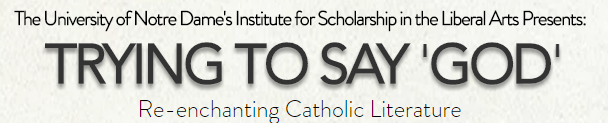 Like some hack sportswriter who skips the game but writes his piece by listening on the radio at home, I offer here a report on last week’s Trying to Say God conference at the University of Notre Dame, despite the fact I couldn’t make it there. (Family unexpectedly came in from out of town.)
Happily, I was able to listen to some of the presentations posted as audio files on SoundCloud, courtesy of that estimable Patheos blog, Sick Pilgrim, whose proprietors (Jessica Mesman Griffith and Jonathan Ryan) were co-sponsors of the Notre Dame event, along with Patheos, Image Journal, Notre Dame’s School of Arts and Letters, Our Sunday Visitor and the University of St. Michael’s College (University of Toronto).
Not every talk was recorded but after listening to a few, I had the sensation that I had wandered onto the shores of a new country, indeed a place of re-enchantment, just as the conference’s subtitle (“Re-enchanting Catholic Literature”) promised.
Oddly, this two-day event–a mix of readings and panel discussions–was occasioned by a literary crisis of sorts. “Catholic literary culture today might best be described as a funeral for multiple corpses. This, for living Catholic writers, makes for a rather depressing set of circumstances to enter into,” wrote Kaya Oakes in an essay for America Magazine in 2014. The founders of the Trying to Say God conference (who included David Griffith of the Interlochen Center for the Arts, Sam Rocha of the University of British Columbia, and Ken Garcia of Notre Dame, in addition to Ryan and Griffith), agreed with Oakes that the problem isn’t a lack of serious, talented, and faithful Catholic artists—it’s that we lack a Catholic arts culture. And with this conference, they decided to do something about it.
The remarkable keynote address (you can read it here or listen on SoundCloud here) was by Bishop Daniel Flores (whose Tolkienish Twitter handle is @amigodefrodo!) and took up the theme of the poverty of the Word, touching along the way on the work of Dante, Bernanos, Jean-Luc Marion and the Mexican author and activist Javier Sicilia. I’ve never heard a churchman offer such a combination of social reflection, theology and literary culture as this. It not only set a tone for the event but reads like an aesthetic/ethical manifesto for the future.
I’ve been a fan of Heather King’s writing for some time and her talk called “A Portable Kingdom: Writing Our Lives” was her guide to the literary life, constructed as a series of brilliant and hilarious “tips for tragic-comic living”, as she called it. She is a great witness, in my view.
The panel entitled “Finding the Sacred in the Profane: The Role of Vulgarity in Religious Art” featured the wonderful Patheos blogger Rebecca Bratten Weiss, John Farrell (contributing writer at Forbes), and Jonathan Ryan (who is also an acclaimed author of paranormal thrillers). This topic was almost emblematic of the conference itself, as the group reflected on the embodied and earthy nature of much great art, from Boccaccio and Bosch to Ulysses and the Big Lebowski, with side glances at Guardians of the Galaxy and Quentin Tarantino. That self-described Rabelaisian Catholic, Artur Rosman, must have been a kind of ghostly presence hovering in the background here.
Also in attendance was Brother Guy Consolmagno, the director of the Vatican Observatory and a known aficionado of science fiction. His delightful conversation with sci-fi novelist Tim Powers and Powers’ own talk, “Catholicism and the Rules of Fantasy” are both posted on SoundCloud.
Briefly, a few more delectable items on SoundCloud:
- “The New Abolitionists: Catholics Writing about Race” (panelists Karen Beattie, Jon Nilson, Christopher Pramuk, Marlena Graves)
- “Not Always Sweet: Beyond Liturgical Cupcakes in Catholic Women’s Writing” (Colleen Mitchell, Kaya Oakes, Leticia Adams, Sonja Corbit, Rebecca Bratten Weiss, Sarah Margaret Babbs, moderator: Jessica Mesman Griffith)
- “Notes from a Contemplative: Thomas Merton on the Art of Writing as Resistance and Protest” (Dave Griffith, Gordon Oyer, Kathleen Tarr, Cassidy Hall)
- “Rendering the World Strange: Folk Piety and Imagination” (Kevin M. Johnson, Jessica Mesman Griffith, David Russell Mosley)
And there’s yet more audio from this wonderful Burning Man-for-the-somewhat-pious event, although it was apparently not possible to record every talk and panel. Listening to the voices of these gifted, somewhat mad folk, you realize that beyond the ugly roar of our public life, wonderful work is getting done by Catholic artists and writers whose goal is not and cannot be to resemble Flannery O’Connor or J. F. Powers.
Instead, I’m close to saying there’s a new (or very old) Catholic sensibility at work here, perhaps partly a working-out of the Theology of the Body to finally address the broken and vulnerable body. Or maybe the sensibility that Sam Rocha (in his new collection Tell Them Something Beautiful) calls funk phenomenology:
“If you want to play the funk, you must be properly initiated and learn to dwell authentically with others. If you want to gain my personal trust and respect to be able to affectionately call me a ‘dirty Mexican,’ you will have to dwell with me. And to dwell with me, you must love me. When that day comes, we will be funky friends. I’d rather have a real, rude, funky-ass friend than a deodorized, thoroughly gentrified so-called ‘friend.’ The former is a friend I might die for.”
All thanks to the organizers for this real, funky-ass event!
Previous Post
May 16, 2017
The Life of "An Apostle of Charity"
Next Post
July 11, 2017 Why You Should Read (and Listen to) Sam Rocha
Browse Our Archives
Select a Category Alternative economics, worker and family empowerment, the spirituality of work, the economy of sharing Art Care for Our Common Home Catholic imagination Catholic Social Teaching Christian Friendship Christian Persecution Community building, models or forms of community, radical hospitality Corporal & Spiritual Works of Mercy Daniel Schwindt Dorothy Day, Peter Maurin, CW aims and means, spirituality Elias Crim Grace Potts Greg Guest Josh Brumfield Mark Gordon Matthew Cooper Mercy Michael Stafford Paul Grenier Peace, nonviolent resistance, conscience and conscientious objection Pope Francis Poverty, economic inequality, consumerism, unemployment, underemployment, living wage Racial Reconciliation Radical Christianity Stan Goff Uncategorized
Select a Month October 2020 September 2020 August 2020 June 2020 May 2020 April 2020 March 2020 February 2020 January 2020 December 2019 November 2019 October 2019 September 2019 June 2018 May 2018 April 2018 October 2017 August 2017 July 2017 May 2017 April 2017 March 2017 January 2017 December 2016 November 2016 October 2016 September 2016 August 2016 July 2016 June 2016 May 2016 April 2016 March 2016 February 2016 January 2016
Follow Us!
TAKE THE
Religious Wisdom Quiz
What city is considered holy by Christians, Jews, and Muslims alike?
Select your answer to see how you score.
Antioch Rome Jerusalem Paris
Related posts from The Dorothy Option

A Beautiful Memoir of Waging Peace

Guest Post: A Letter from a TLM Catholic...


How to Understand the Great Silence We're In
TRENDING AT PATHEOS Catholic

Rejecting Doom: Christian Hope And Human Action
Christianity is a religion of hope. We are to have hope and...

It’s What Comes From Within Which Matters
One of the most difficult things for us to understand is why...

Why I Choose the Eucharist Over the Sermon
Choose the Eucharist, Not the Sermon What are we supposed to get...

5 Design Elements Found in Spiritually Rooted Homes
Putting Spirituality Into Home Decor Our homes are more than our living...

Credo: A Story of God Told with the...
About 10 years ago, I began to imagine a personal "Credo" that...

The Anatomy of Divine Revelation in Catholic Thought
The claim that God has made Himself known to human beings is...
view all Catholic blogs
Ad-Free & Subscriber Log-In Subscription Support
- About Us
- 2026 Calendar
- Videos
- Podcasts
- Library of World Religions
- Faith In Media Tracker
- Advertise With Us
- Write for Us
- Privacy Policy
- Terms of Service
- Do Not Sell My Data
- Contact Us
- Radiant Digital
- Manage Newsletter Subscriptions
- Unsubscribe From Notifications
- Sitemap
Copyright 2008-2026, Patheos. All rights reserved.
Subscription Support Ad-Free & Subscriber Log-In
Follow Patheos