
BuddhistCatholicContemplativeEvangelicalGeneral ChristianHinduJewishLatter-day SaintMuslimNew VisionsProgressive Christian
Beliefs
- Buddhist
- Catholic
- Contemplative
- Evangelical
- General Christian
- Hindu
- Jewish
- Latter-day Saint
- More Voices
- Muslim
- New Visions
- Pagan
- Progressive Christian
Topics
- Religion News
- Food and Religion
- Sports and Religion
- Religious Art
- Religious Music and Entertainment
- Religious Events
- History and Religion
- Style and Religion
- Politics and Religion
- Women in Religion
- Recreation Outdoors and Religion
- Business Finance and Religion
- Careers Workplace and Religion
- Education and Religion
- Family Parenting and Religion
- Health Fitness and Religion
- Home and Religion
- Relationships and Religion
- Technology and Religion
- Travel and Religion
Columnists
- Buddhist Columnists
- Business Finance and Religion Columnists
- Careers Workplace and Religion Columnists
- Catholic Columnists
- Contemplative Columnists
- Education and Religion Columnists
- Evangelists Columnists
- Family Parenting and Religion Columnists
- General Christian Columnists
- Health Fitness and Religion Columnists
- Hindu Columnists
- History and Religion Columnists
- Home and Religion Columnists
- Jewish Columnists
- More Voices Columnists
- Latter Day Columnists
- Muslim Columnists
- New Visions Columnists
- Nonreligious Columnists
- Pagan Columnists
- Politics and Religion Columnists
- Progressive Columnists
- Recreation Outdoors and Religion Columnists
- Relationships and Religion Columnists
- Religion News Columnists
- Religious Art Columnists
- Religious Events Columnists
- Religious Music and Entertainment Columnists
- Sports and Religion Columnists
- Style and Religion Columnists
- Technology and Religion Columnists
- Travel and Religion Columnists
- Women in Religion Columnists
Resource Library
- 2026 Calendar
- Library of World Religions
- The 100 Most Holy Places on Earth
- Patheos Answers
- Podcasts
- Videos
- Faith Leaders Database
- Anglican Episcopalian
- Bahai
- Baptist
- Buddhism
- Christianity
- Confucianism
- Eastern Orthodoxy
- Hinduism
- Holiness and Pentecostal
- ISKCON
- Islam
- Judaism
- Lutheran
- Methodist
- The Church of Jesus Christ of Latter-day Saints
- New Age
- Paganism
- Presbytarian and Reformed
- Protestantism
- Religion Behind the Scenes
- Roman Catholic
- Scientology
- Shia Islam
- Sikhism
- Sufism
- Sunni Islam
- Taoism
- Zen
- See all religions
Research Tools
 Ad-Free & Subscriber Log-In Subscription Support
Ad-Free & Subscriber Log-In Subscription Support
Follow Patheos 

- Trending:
- Forgiveness
- |
- Marriage
- |
- Consciousness
- |
- Death Penalty
- |
- Election
- |
- Halloween
 The Dorothy Option
- Home
- Catholic
- Book Recommendation: Poor Relief in England by Marjorie McIntosh
Book Recommendation: Poor Relief in England by Marjorie McIntosh
Last updated on: February 29, 2016 at 11:05 am by Daniel Schwindt
Book Recommendation: Poor Relief in England by Marjorie McIntosh 2016-02-29T11:05:47-05:00 Daniel Schwindt
Patheos Explore the world's faith through different perspectives on religion and spirituality! Patheos has the views of the prevalent religions and spiritualities of the world.
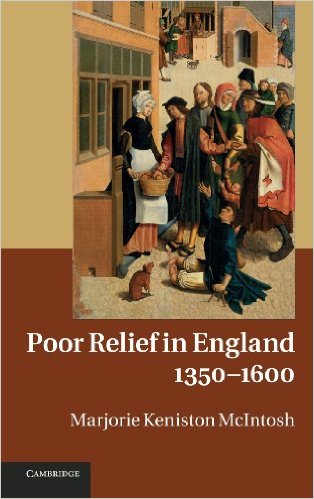 Consider this more of a friendly “book recommendation” than a “review.” I don’t wish to outline the book’s general shape, nor will I analyse its arguments in much detail. I only want to point it out as an up-to-date and valuable piece of research that sheds important light on the subject of poor relief.
I should emphasize that I am not pointing this book out primarily as fodder for the “Protestant vs. Catholic” debate. It may be useful in that area, but it is more interesting for what it can teach us about our assumptions regarding charity, welfare, and social attitudes toward the poor in history.
Published in 2012 (paperback in 2013), Marjorie Keniston McIntosh’s Poor Relief in England, 1350 – 1600 provides an extremely well-researched study of the transformation that took place in social attitudes as well as in social institutions through the Reformation in England, particularly as they pertain to poverty.
Essentially she describes the state of licensed begging, almshouses, laws, hospitals, and parish relief systems as they existed immediately prior to the Reformation, and then seeks to understand what happened during and after.
The operation of almshouses in England peaked in 1520 at 617.
“Across the next three decades, nearly half of those institutions were closed due to royal and Parliamentary policies that dissolved or appropriated resources from the religious bodies that had previously operated them. Although new foundations attempted to fill the gap, only two-thirds as many residential institutions were functioning in the 1560s as in the 1520s.” (p. 7)
She is essentially described a concentration of power into the hands of the State, which represents a “secularization” of poor relief which began predominately by obliterating the structures of relief that had previously existed. Where it did not obliterate them, it took ownership and control parish activities as they related to the poor.
Speaking of partish-based aid, McIntosh reports that, “from the mid sixteenth century onwards they were assigned additional, secular duties by Parliamentary legislation. In those respects they served in effect as arms of the state.” (p. 8)
This did not just mean a consolidation of ownership and a reduction in quantity of existing forms of aid–it also meant a reduction in diversity of forms that aid might take:
“Many forms of assistance to the poor were lost between 1536 and 1553 as secondary consequences of the closure of the monasteries and convents, the lay religious fraternities, and the chantries that provided masses for the dead. The crown confiscated the property of those institutions as well as much of the land and goods owned by the parishes, leaving only enough to support a simple Protestant service.” (pps. 19-20)
“The multiple arms of the pre-Reformation Catholic Church were heavily involved in helping the poor. When those forms of assistance were terminated in the mid sixteenth century, the total array of relief became less varied, offering fewer types of aid to people in need.” (p. 27)
One of the more interesting subjects covered in the study is transfer of supervision of poor houses and aid distribution from churchmen to “Justices of the Peace.” Although the responsibility to administer aid was still in the hands of the parishes, the oversight became the role of the JPs, which meant that decisions would hitherto be guided not by a theologically under-pinned morality of giving, but by the letter of the law, which meant that mercy was less of a virtue and more of an afterthought, if it factored in at all.
McIntosh also takes care to outline the change in attitude toward the poor as she finds it in legal verbiage. Rather than charity as a meritorious act, the new laws concerning the poor become much more concerned with control of aid recipients, placing much more emphasis on behavioral conditions the poor must meet, and implying that poverty was less a result of misfortune and more a moral short-coming on the part of the needy, an attitude McIntosh connects with the Puritan mentality.
Another valuable insight is McIntosh’s insistence that we not view “private charity” as something separate from public efforts to aid the poor when we are considering pre-Reformation poor relief. She rightly explains that the Catholic Church applied considerable pressure on its members and that the funds it distributed through its massive web of charitable organizations could not rightly be considered “voluntary charity” as we imagine today when we think of money freely given to American churches and then distributed from there to the poor.
The obvious inference is that the idea that religious charity was once a voluntary thing depending on the good-will of believers is a myth that survives only by the fact that our churches today are utterly powerless to assert comparable pressure on their members. We assume that the 14th century Church, which collected and distributed such massive incomes, must have done so based on generosity plain and simple, because we cannot imagine them wielding such a commanding presence in the economic lives the the population.
McIntosh is no writing a criticism of the Reformation, and she is not taking the Catholic side in any debate. In fact she seems to take the view that the post-Reformation consolidation of poor relief resulted in greater “efficiency” in the distribution of aid in the long run, and eventually led to the welfare state of today. As a distributist, that is not my view, but I don’t have to agree with her conclusions to value her research, which is quite good.
Poverty, economic inequality, consumerism, unemployment, underemployment, living wage

Next Post

March 3, 2016 Trump Trashtalk from the Fans
Browse Our Archives
Select a Category Alternative economics, worker and family empowerment, the spirituality of work, the economy of sharing Art Care for Our Common Home Catholic imagination Catholic Social Teaching Christian Friendship Christian Persecution Community building, models or forms of community, radical hospitality Corporal & Spiritual Works of Mercy Daniel Schwindt Dorothy Day, Peter Maurin, CW aims and means, spirituality Elias Crim Grace Potts Greg Guest Josh Brumfield Mark Gordon Matthew Cooper Mercy Michael Stafford Paul Grenier Peace, nonviolent resistance, conscience and conscientious objection Pope Francis Poverty, economic inequality, consumerism, unemployment, underemployment, living wage Racial Reconciliation Radical Christianity Stan Goff Uncategorized
Select a Month October 2020 September 2020 August 2020 June 2020 May 2020 April 2020 March 2020 February 2020 January 2020 December 2019 November 2019 October 2019 September 2019 June 2018 May 2018 April 2018 October 2017 August 2017 July 2017 May 2017 April 2017 March 2017 January 2017 December 2016 November 2016 October 2016 September 2016 August 2016 July 2016 June 2016 May 2016 April 2016 March 2016 February 2016 January 2016
Follow Us!
TAKE THE
Religious Wisdom Quiz
Which book of the Bible contains the most direct prophecies about the Messiah?
Select your answer to see how you score.
Psalms Isaiah Zechariah Micah
Related posts from The Dorothy Option
A New Catholic Voice for a New Economy
TRENDING AT PATHEOS Catholic

Rejecting Doom: Christian Hope And Human Action
Christianity is a religion of hope. We are to have hope and...

It’s What Comes From Within Which Matters
One of the most difficult things for us to understand is why...

Why I Choose the Eucharist Over the Sermon
Choose the Eucharist, Not the Sermon What are we supposed to get...

5 Design Elements Found in Spiritually Rooted Homes
Putting Spirituality Into Home Decor Our homes are more than our living...

Credo: A Story of God Told with the...
About 10 years ago, I began to imagine a personal "Credo" that...

The Anatomy of Divine Revelation in Catholic Thought
The claim that God has made Himself known to human beings is...
view all Catholic blogs
Ad-Free & Subscriber Log-In Subscription Support
- About Us
- 2026 Calendar
- Videos
- Podcasts
- Library of World Religions
- Faith In Media Tracker
- Advertise With Us
- Write for Us
- Privacy Policy
- Terms of Service
- Do Not Sell My Data
- Contact Us
- Radiant Digital
- Manage Newsletter Subscriptions
- Unsubscribe From Notifications
- Sitemap
Copyright 2008-2026, Patheos. All rights reserved.
Subscription Support Ad-Free & Subscriber Log-In
Follow Patheos