
BuddhistCatholicContemplativeEvangelicalGeneral ChristianHinduJewishLatter-day SaintMuslimNew VisionsProgressive Christian
Beliefs
- Buddhist
- Catholic
- Contemplative
- Evangelical
- General Christian
- Hindu
- Jewish
- Latter-day Saint
- More Voices
- Muslim
- New Visions
- Pagan
- Progressive Christian
Topics
- Religion News
- Food and Religion
- Sports and Religion
- Religious Art
- Religious Music and Entertainment
- Religious Events
- History and Religion
- Style and Religion
- Politics and Religion
- Women in Religion
- Recreation Outdoors and Religion
- Business Finance and Religion
- Careers Workplace and Religion
- Education and Religion
- Family Parenting and Religion
- Health Fitness and Religion
- Home and Religion
- Relationships and Religion
- Technology and Religion
- Travel and Religion
Columnists
- Buddhist Columnists
- Business Finance and Religion Columnists
- Careers Workplace and Religion Columnists
- Catholic Columnists
- Contemplative Columnists
- Education and Religion Columnists
- Evangelists Columnists
- Family Parenting and Religion Columnists
- General Christian Columnists
- Health Fitness and Religion Columnists
- Hindu Columnists
- History and Religion Columnists
- Home and Religion Columnists
- Jewish Columnists
- More Voices Columnists
- Latter Day Columnists
- Muslim Columnists
- New Visions Columnists
- Nonreligious Columnists
- Pagan Columnists
- Politics and Religion Columnists
- Progressive Columnists
- Recreation Outdoors and Religion Columnists
- Relationships and Religion Columnists
- Religion News Columnists
- Religious Art Columnists
- Religious Events Columnists
- Religious Music and Entertainment Columnists
- Sports and Religion Columnists
- Style and Religion Columnists
- Technology and Religion Columnists
- Travel and Religion Columnists
- Women in Religion Columnists
Resource Library
- 2026 Calendar
- Library of World Religions
- The 100 Most Holy Places on Earth
- Patheos Answers
- Podcasts
- Videos
- Faith Leaders Database
- Anglican Episcopalian
- Bahai
- Baptist
- Buddhism
- Christianity
- Confucianism
- Eastern Orthodoxy
- Hinduism
- Holiness and Pentecostal
- ISKCON
- Islam
- Judaism
- Lutheran
- Methodist
- The Church of Jesus Christ of Latter-day Saints
- New Age
- Paganism
- Presbytarian and Reformed
- Protestantism
- Religion Behind the Scenes
- Roman Catholic
- Scientology
- Shia Islam
- Sikhism
- Sufism
- Sunni Islam
- Taoism
- Zen
- See all religions
Research Tools
 Ad-Free & Subscriber Log-In Subscription Support
Ad-Free & Subscriber Log-In Subscription Support
Follow Patheos 

- Trending:
- Forgiveness
- |
- Marriage
- |
- Consciousness
- |
- Death Penalty
- |
- Election
- |
- Halloween
 The Dorothy Option
- Home
- Catholic
- After the Amazonian Synod: New Winds Blowing
After the Amazonian Synod: New Winds Blowing
Last updated on: October 31, 2019 at 12:57 pm by Elias Crim
After the Amazonian Synod: New Winds Blowing 2019-10-31T12:57:47-05:00 Elias Crim
Patheos Explore the world's faith through different perspectives on religion and spirituality! Patheos has the views of the prevalent religions and spiritualities of the world.
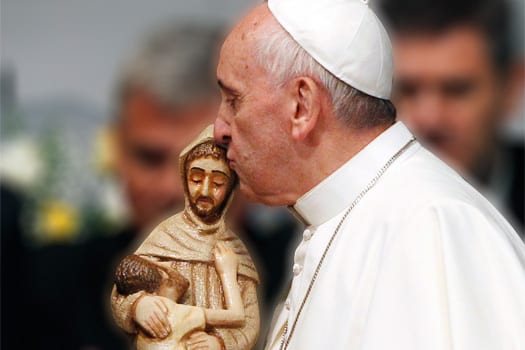
Image via BustedHalo.com.
While I may be in a distinct minority among American Catholics, my spirits are rising. Unlike many I know, I don’t feel fearful and defensive. Instead, I can feel fresh new winds (buenos aires, so to speak) blowing after the Amazonian Synod.
Somehow, miraculously, we have a pope whose vision of the Church’s hierarchy of problems is very different from that of his two predecessors. As he frequently indicates, Pope Francis is not focused primarily on addressing the Church itself and its internal operations. Instead, he wants the Church to look outwards at the burning planet and the cities full of the dying. And then demonstrate a sense of mercy by opening the largest “field hospital” we can manage.
The very name of Francis stands for another kind of church — simple and poor, open to all, and a great advocate for the earth and all of creation.
Part of this task is to de-paganize the Church. Not by fearful attacks on indigenous theology but by abandoning the Roman imperial style which Pope Gregory VII put into place in 1077, a date the great historian Yves Congar considered to be the greatest revolution in Church history. After a first millennium as a church community, the Church on this date began to resemble a monarchical and absolutist institution.
The scandals in recent years reached such a threshold as to lead to the resignation of Pope Benedict XVI who realized he no longer had the strength to heal them. Does his papacy symbolize the end of this Eurocentric, hierarchical phase of Church history and the beginning of something new?
A key figure in these new winds blowing is that of Leonardo Boff, the Brazilian theologian whose work on uniting integral ecology and a de-Marxified and widened form of liberation theology has been embraced by Pope Francis and others worldwide. On the Church’s troubles, Boff has written,
However bad its historical errors and mistakes have been, the church institution keeps the sacred memory of Jesus and the grammar of the Gospels. The church preaches liberation, knowing that the church itself does not free people; others do that. So it is worth staying in the church, as did Saint Francis, Dom Helder Camara, John XXIII, and the notable theologians who helped make the Second Vatican Council ….
If there is one book which captures the new situation for the Church after the Amazonian Synod, it may be Boff’s Francis of Rome, Francis of Assisi. Why is St. Francis so important in understanding this moment?
First, St. Francis was himself the living antithesis of the imperial church, a layman (he was never ordained a priest) proposing total renunciation, radical poverty, and extreme simplicity. He did not break with Rome but instead led a great revolution “from below,” from the peripheries.
Next, the centrality that St. Francis gave to the poor. As Boff points out, “He did not organize any works for the poor, but he lived with the poor and like the poor.” Pope Francis has noted that the problem of the poor cannot be resolved without the participation of the poor: it cannot be resolved by practicing philanthropy but by social justice.
Finally, St. Francis is the patron of ecology, the paradigm for a respectful kinship with all creatures at a time when life itself — all life — is threatened. He is also closer to indigenous peoples, who feel themselves to be part of nature, than to those whom Boff describes as “the sons and daughters of technical-scientific modernity, who regard nature as wild and at our disposal to be tamed and exploited.”
So what is this Church now arriving, the new ecclesial paradigm which is causing so much apprehension and anger in some, often quite affluent, quarters?
Boff suggests it is “the church as a huge network of Christian communities rooted in different cultures, some more ancient than Western culture, such as China, India, Japan, the tribal cultures of Africa, and the communitarian cultures of Latin America.”
What then has Pope Francis brought us that is really new?
Boff’s reply is a list: from church winter to church spring, from fortress to open house, from pope to bishop of Rome, from doctrine to encounter (a form of Pope John Paul II’s famous personalism), from exclusion to inclusion, from church to world, from the world to the poor.
European Christianity was once a spring of living water, Boff acknowledges. “But that glory made the church so proud that it did not enter into dialogue with the new realities that were arising in history, such as science, technology, nation states, democracies, modern freedoms, human rights, and rights of the poor.” And now that model is in its decline.
We want a church which does not exist for itself but for the world it is called to serve. It cannot be merely a Western phenomenon but must find its place within a new phase of humanity, the planetary phase. It must become, in Boff’s words, “a spiritual hearth again, where it is good to live together, struggle, and celebrate life with others in dialogue, in closeness, tenderness, and love.”
Previous Post

October 28, 2019
Intégrisme as anti-theology
Next Post
November 4, 2019 How I Became a Street Catholic
Browse Our Archives
Select a Category Alternative economics, worker and family empowerment, the spirituality of work, the economy of sharing Art Care for Our Common Home Catholic imagination Catholic Social Teaching Christian Friendship Christian Persecution Community building, models or forms of community, radical hospitality Corporal & Spiritual Works of Mercy Daniel Schwindt Dorothy Day, Peter Maurin, CW aims and means, spirituality Elias Crim Grace Potts Greg Guest Josh Brumfield Mark Gordon Matthew Cooper Mercy Michael Stafford Paul Grenier Peace, nonviolent resistance, conscience and conscientious objection Pope Francis Poverty, economic inequality, consumerism, unemployment, underemployment, living wage Racial Reconciliation Radical Christianity Stan Goff Uncategorized
Select a Month October 2020 September 2020 August 2020 June 2020 May 2020 April 2020 March 2020 February 2020 January 2020 December 2019 November 2019 October 2019 September 2019 June 2018 May 2018 April 2018 October 2017 August 2017 July 2017 May 2017 April 2017 March 2017 January 2017 December 2016 November 2016 October 2016 September 2016 August 2016 July 2016 June 2016 May 2016 April 2016 March 2016 February 2016 January 2016
Follow Us!
TAKE THE
Religious Wisdom Quiz
What miraculous event saved Daniel's friends from execution by fire?
Select your answer to see how you score.
They turned invisible They were hidden in a cave They were unharmed in a fiery furnace They outran horses
Related posts from The Dorothy Option

A Catholic Mom's Response to Fr. Meeks

A Beautiful Memoir of Waging Peace

Guest Post: A Letter from a TLM Catholic...

TRENDING AT PATHEOS Catholic

Rejecting Doom: Christian Hope And Human Action
Christianity is a religion of hope. We are to have hope and...

It’s What Comes From Within Which Matters
One of the most difficult things for us to understand is why...

Why I Choose the Eucharist Over the Sermon
Choose the Eucharist, Not the Sermon What are we supposed to get...

5 Design Elements Found in Spiritually Rooted Homes
Putting Spirituality Into Home Decor Our homes are more than our living...

Credo: A Story of God Told with the...
About 10 years ago, I began to imagine a personal "Credo" that...

The Anatomy of Divine Revelation in Catholic Thought
The claim that God has made Himself known to human beings is...
view all Catholic blogs
Ad-Free & Subscriber Log-In Subscription Support
- About Us
- 2026 Calendar
- Videos
- Podcasts
- Library of World Religions
- Faith In Media Tracker
- Advertise With Us
- Write for Us
- Privacy Policy
- Terms of Service
- Do Not Sell My Data
- Contact Us
- Radiant Digital
- Manage Newsletter Subscriptions
- Unsubscribe From Notifications
- Sitemap
Copyright 2008-2026, Patheos. All rights reserved.
Subscription Support Ad-Free & Subscriber Log-In
Follow Patheos