
BuddhistCatholicContemplativeEvangelicalGeneral ChristianHinduJewishLatter-day SaintMuslimNew VisionsProgressive Christian
Beliefs
- Buddhist
- Catholic
- Contemplative
- Evangelical
- General Christian
- Hindu
- Jewish
- Latter-day Saint
- More Voices
- Muslim
- New Visions
- Pagan
- Progressive Christian
Topics
- Religion News
- Food and Religion
- Sports and Religion
- Religious Art
- Religious Music and Entertainment
- Religious Events
- History and Religion
- Style and Religion
- Politics and Religion
- Women in Religion
- Recreation Outdoors and Religion
- Business Finance and Religion
- Careers Workplace and Religion
- Education and Religion
- Family Parenting and Religion
- Health Fitness and Religion
- Home and Religion
- Relationships and Religion
- Technology and Religion
- Travel and Religion
Columnists
- Buddhist Columnists
- Business Finance and Religion Columnists
- Careers Workplace and Religion Columnists
- Catholic Columnists
- Contemplative Columnists
- Education and Religion Columnists
- Evangelists Columnists
- Family Parenting and Religion Columnists
- General Christian Columnists
- Health Fitness and Religion Columnists
- Hindu Columnists
- History and Religion Columnists
- Home and Religion Columnists
- Jewish Columnists
- More Voices Columnists
- Latter Day Columnists
- Muslim Columnists
- New Visions Columnists
- Nonreligious Columnists
- Pagan Columnists
- Politics and Religion Columnists
- Progressive Columnists
- Recreation Outdoors and Religion Columnists
- Relationships and Religion Columnists
- Religion News Columnists
- Religious Art Columnists
- Religious Events Columnists
- Religious Music and Entertainment Columnists
- Sports and Religion Columnists
- Style and Religion Columnists
- Technology and Religion Columnists
- Travel and Religion Columnists
- Women in Religion Columnists
Resource Library
- 2026 Calendar
- Library of World Religions
- The 100 Most Holy Places on Earth
- Patheos Answers
- Podcasts
- Videos
- Faith Leaders Database
- Anglican Episcopalian
- Bahai
- Baptist
- Buddhism
- Christianity
- Confucianism
- Eastern Orthodoxy
- Hinduism
- Holiness and Pentecostal
- ISKCON
- Islam
- Judaism
- Lutheran
- Methodist
- The Church of Jesus Christ of Latter-day Saints
- New Age
- Paganism
- Presbytarian and Reformed
- Protestantism
- Religion Behind the Scenes
- Roman Catholic
- Scientology
- Shia Islam
- Sikhism
- Sufism
- Sunni Islam
- Taoism
- Zen
- See all religions
Research Tools
 Ad-Free & Subscriber Log-In Subscription Support
Ad-Free & Subscriber Log-In Subscription Support
Follow Patheos 

- Trending:
- Forgiveness
- |
- Marriage
- |
- Consciousness
- |
- Death Penalty
- |
- Election
- |
- Halloween
 The Diagonal Way
-
Category
- Home
- General Christian
- Religion News
- The Year of the Locust: A Sermon on War
The Year of the Locust: A Sermon on War
Last updated on: October 14, 2023 at 7:10 am by Anthony D Baker
The Year of the Locust: A Sermon on War 2023-10-14T07:10:25-05:00 Anthony D Baker
Patheos Explore the world's faith through different perspectives on religion and spirituality! Patheos has the views of the prevalent religions and spiritualities of the world.
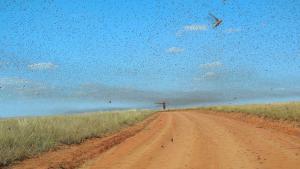
A swarm of locust in Madagascar. Image from Wikimedia Commons:
[[File:Swarm of Locusts.JPG|Swarm_of_Locusts]]
Today I have war on my mind. A week ago, a surprise attack on Jewish communities in the Gaza Strip ignited a war in the middle east on a scale I haven’t know in my lifetime. We are 18 months into a war in Ukraine that began with an invasion and ground troops such as hasn’t been seen in Europe since the second world war.
The prophet Joel writes with war on his mind. We know next to nothing about this seer of ancient Israel. He doesn’t begin with “in the year of King Someone,” or even “the word came to Joel, a shepherd from the town of Somewhere.” He just sets out into a lament. About locust and invading armies.
What the locust has eaten
In fact, we don’t even know if he’s talking about locust as a metaphor for armies of humans, or armies of humans as a metaphor for locust. To be honest, it sounds to me like he’s talking about locust.
What the cutting locust left,
the swarming locust has eaten.
What the swarming locust left,
the hopping locust has eaten,
and what the hopping locust left,
the destroying locust has eaten. (Joel 1:4)
I think he’s talking about locust.
Locust are grasshoppers, so flooded with serotonin that dormant potential switches on in the genotype. They armor up, lose their instinct for solitude, and become pixels of a swarming cloud that devours everything it can. Joel says it’s like living in a walled village when an army attacks. It all comes so quickly and in such numbers that they have scaled our walls and burned our homes before we even know they’re upon us.
Sin and repentance in the year of the locust
But the prophet suggests a very strange way of responding to this decimation. Repent. Put on sackcloth and sit in ashes. Sanctify a fast.
Repent? When the armies are attacking us? Fast? When our food supply has been utterly wiped out so that we’re searching for crumbs for the children? What is Joel telling us?
In order to understand what he means by repentance, we need to bring into view his very unique doctrine of sin. Hamartiology, in the technical vocabulary of systematic theology.
We’re accustomed to the prophets telling us about coming calamities or calamities that have, to quote a cheerleading movie from my sisters’ teenage years, “already been broughten.”
And we’re used to these prophets telling us why such things have fallen on Israel and Judah. It’s because of idolatry, unjust economic practices, turning from Torah and toward the gods of other nations. These are the sins that bring the Lord thundering in through the armies of Assyria or Babylon.
There are hints of that in Joel, but it’s nowhere near the theme of his address.
The economy of grace
Instead, at the heart of his lament are missing grain offerings. Damaged prayers. That is the sin: the morning after the locust have devoured their fields, the people cannot pray.
See, Joel assumes what I’ll call a circular economy of grace. God gives land and river and rain, and the land and river and rain give themselves to plant growth and the flourishing of animals. The plants and animals give themselves to one another, and among those animals are humans, we who hunt, gather, domesticate cattle, and farm vineyards and fields of grain. Israel then takes those gifts and brings them to back to God—the God whose gift-giving initiated all of this and keeps it running. With hands full of grain, they come and return thanks to YHWH.
But now all of that is disrupted. See what the locust have wrought?
The grain offering and the drink offering are cut off
from the house of the LORD.
The priests mourn,
the ministers of the LORD.
The fields are devastated,
the ground mourns;
for the grain is destroyed,
the wine dries up,
the oil fails.
Be dismayed, you farmers,
wail, you vinedressers,
over the wheat and the barley;
for the crops of the field are ruined.
The vine withers,
the fig tree droops.
Pomegranate, palm, and apple—
all the trees of the field are dried up;
surely, joy withers away
among the people. (1:9-12)
The circular economy of grace is broken. No one—not the plants or animals even—can find their place in it. Joy itself has withered like a stripped vine.
How the animals groan!
The herds of cattle wander about
because there is no pasture for them;
even the flocks of sheep are dazed.
Even the wild animals cry to you
because the watercourses are dried up,
and fire has devoured
the pastures of the wilderness. (1:18-20)
The sin of the year of the locust is that no one—not the ground, the wilderness, the plants, the animals, the humans— can give gifts to or receive gifts from God and one another. We come before God with nothing to give.
And here is what the prophet prescribes: pray holding nothing in your hands but ash and empty stalks. Make the emptiness of your bellies into a sanctified fast. Repentance is not for this prophet a matter of confessing sorrow for things done and left undone. It is how you pray when you are cut off from the circulation of grace and come before God empty.
Maybe that is what sin most centrally is. It can be and often is about things done and left undone, but that’s secondary: a connotation rather than a denotation, in philosophical vocabulary. Sin at its heart is what we call the powers within creation that pull us out of the economy of gift-exchange. The powers that overwhelm like locust, so that instead of greeting a friend with a loaf of bread, I cower before an army who scales the walls and devours anything that might have become a gift.
War and repentance
Last night in Gaza, as Sabbath began, thousands of Jews huddled together, wondering when the next swarm of terror will overtake them and their families. Who can keep Sabbath, keep faith, at time like this? Their Palestinian neighbors, living in prison cities, were too busy wondering where to flee from the Israeli air raids to listen to the prayer calls yesterday, or, for the Palestinian Christians, to celebrate the resurrection tomorrow.
In Ukraine next month, Orthodox Christian refugees will be too occupied with standing in bread lines to observe the beginning of the Nativity fast. Russian families will spend the season mourning the flood of serotonin that turned their children into a swarming army.
This is sin: forces of creation—decreation, really—that have pulled these created beings out of the grace economy. When you pray for Gaza, pray as though standing next to them with empty hands. And when it’s our time to endure devastating loss, let’s look for people around us who can call us to repent. To repent in this very Joeline way: let your emptiness become your prayer.
The years that the locust has eaten
Finally: lest we think God will leave us devastated while the locust have the last word, Joel gives us that remarkable promise: the Lord “will restore the years that the locust has eaten” (2:25).
This is not an optimism about next year’s harvest, about the sun coming out tomorrow. This is an eschatological hope: a refusal to let the swarming gracelessness devour our faith. Repentance, finally, is an eschatological act: I stand outside of the economy of grace, hands empty of the gifts I want to bring, and I offer to you, God, the eaten years that only you can give me back.
This is my prayer for those suffering from war today, and it is my prayer for all creatures everywhere who find themselves isolated from the circulation of grace. “O Lord, restore to us the years that the locust have eaten.”
Amen.
I preached this sermon in Seminary of the Southwest’s Christ Chapel, 10-13-2023.
Catholic
Religion News
Politics and Religion
Doctrines for Various Occasions
Previous Post

September 9, 2023
Does Saint Paul Believe in the Trinity?
Recent Comments
Browse Our Archives
Select a Category Church Fathers Doctrines for Various Occasions Ecotheology Eschatology Liturgical Seasons Prayer Theology and Literature Uncategorized
Select a Month October 2023 September 2023 August 2023 July 2023 June 2023 February 2023 January 2023 December 2022 November 2022 October 2022 September 2022 August 2022 July 2022 June 2022 May 2022 April 2022 March 2022 February 2022 January 2022 December 2021 November 2021 October 2021 September 2021
Follow Us!
TAKE THE
Religious Wisdom Quiz
Which Gospel begins "In the beginning was the Word"?
Select your answer to see how you score.
Mark Luke Matthew John
Related posts from The Diagonal Way

Does Saint Paul Believe in the Trinity?

Truth's Diagonal Dance (a reflection on Catherine Pickstock)
TRENDING AT PATHEOS General Christian

Seventy and Five Years Old: God Still Starts...
There is a small detail tucked into Genesis 12 that I skipped...

A Biblical Vision of Success in Christian Life...
The Concern and Quest Recent trends and tendencies I note around me...

Indigenous Peoples’ Day and the Church
Indigenous' Peoples Day or Columbus Day? Depending on where you live...

When Spiritual Growth Looks Like Losing Ground
Four Passive Spiritual Disciplines: An Introduction When I was a college freshman,...

Faith and Finding Your Current Season
“To everything there is a season,” Ecclesiastes tells us, “and a time...

Did Jesus Fear God's Wrath in Gethsemane?
That Time Jesus Was Terrified Before we begin, let me say at...
view all General Christian blogs
Ad-Free & Subscriber Log-In Subscription Support
- About Us
- 2026 Calendar
- Videos
- Podcasts
- Library of World Religions
- Faith In Media Tracker
- Advertise With Us
- Write for Us
- Privacy Policy
- Terms of Service
- Do Not Sell My Data
- Contact Us
- Radiant Digital
- Manage Newsletter Subscriptions
- Unsubscribe From Notifications
- Sitemap
Copyright 2008-2026, Patheos. All rights reserved.
Subscription Support Ad-Free & Subscriber Log-In
Follow Patheos