
BuddhistCatholicContemplativeEvangelicalGeneral ChristianHinduJewishLatter-day SaintMuslimNew VisionsProgressive Christian
Beliefs
- Buddhist
- Catholic
- Contemplative
- Evangelical
- General Christian
- Hindu
- Jewish
- Latter-day Saint
- More Voices
- Muslim
- New Visions
- Pagan
- Progressive Christian
Topics
- Religion News
- Food and Religion
- Sports and Religion
- Religious Art
- Religious Music and Entertainment
- Religious Events
- History and Religion
- Style and Religion
- Politics and Religion
- Women in Religion
- Recreation Outdoors and Religion
- Business Finance and Religion
- Careers Workplace and Religion
- Education and Religion
- Family Parenting and Religion
- Health Fitness and Religion
- Home and Religion
- Relationships and Religion
- Technology and Religion
- Travel and Religion
Columnists
- Buddhist Columnists
- Business Finance and Religion Columnists
- Careers Workplace and Religion Columnists
- Catholic Columnists
- Contemplative Columnists
- Education and Religion Columnists
- Evangelists Columnists
- Family Parenting and Religion Columnists
- General Christian Columnists
- Health Fitness and Religion Columnists
- Hindu Columnists
- History and Religion Columnists
- Home and Religion Columnists
- Jewish Columnists
- More Voices Columnists
- Latter Day Columnists
- Muslim Columnists
- New Visions Columnists
- Nonreligious Columnists
- Pagan Columnists
- Politics and Religion Columnists
- Progressive Columnists
- Recreation Outdoors and Religion Columnists
- Relationships and Religion Columnists
- Religion News Columnists
- Religious Art Columnists
- Religious Events Columnists
- Religious Music and Entertainment Columnists
- Sports and Religion Columnists
- Style and Religion Columnists
- Technology and Religion Columnists
- Travel and Religion Columnists
- Women in Religion Columnists
Resource Library
- 2026 Calendar
- Library of World Religions
- The 100 Most Holy Places on Earth
- Patheos Answers
- Podcasts
- Videos
- Faith Leaders Database
- Anglican Episcopalian
- Bahai
- Baptist
- Buddhism
- Christianity
- Confucianism
- Eastern Orthodoxy
- Hinduism
- Holiness and Pentecostal
- ISKCON
- Islam
- Judaism
- Lutheran
- Methodist
- The Church of Jesus Christ of Latter-day Saints
- New Age
- Paganism
- Presbytarian and Reformed
- Protestantism
- Religion Behind the Scenes
- Roman Catholic
- Scientology
- Shia Islam
- Sikhism
- Sufism
- Sunni Islam
- Taoism
- Zen
- See all religions
Research Tools
 Ad-Free & Subscriber Log-In Subscription Support
Ad-Free & Subscriber Log-In Subscription Support
Follow Patheos 

- Trending:
- Forgiveness
- |
- Marriage
- |
- Consciousness
- |
- Death Penalty
- |
- Election
- |
- Halloween
 The Diagonal Way
-
Category
- Home
- General Christian
- History and Religion
- How Does the Cross Save?
How Does the Cross Save?
Last updated on: July 22, 2023 at 6:53 am by Anthony D Baker
How Does the Cross Save? 2023-07-22T06:53:17-05:00 Anthony D Baker
Patheos Explore the world's faith through different perspectives on religion and spirituality! Patheos has the views of the prevalent religions and spiritualities of the world.
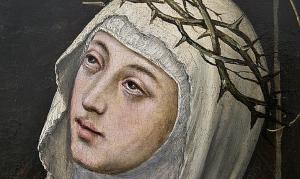
Catherine of Siena, from a detail of Pedro de Villegas’s _Saint Thomas Aquinas with Saint Catherine_, at the Museo de Bellas Artes de Sevilla. Catherine is often depicted with a crown of thorns, celebrating a mystical encounter she has with the cross.
At the center of Christian faith stands a great irony. The unwillingness of one man to save himself from a cross opens the path to salvation for all. How does this transference occur? Catherine of Siena (d. 1380) suggests that it all turns on desire.
Theories of the Cross
I have written about the mystery of the cross before. Contemplations of its saving power begin in the earliest writings of the New Testament. Think of Paul, aligning the cross with Israel’s Yom Kippur (Romans 3), or Mark (10:34) suggesting the metaphor of captivity and ransom.
By the Middle Ages, explanations of a theology of the cross had organized themselves into various theories. One of the most discussed was Anselm of Canterbury’s. Anselm (d. 1109) explained that humans, as the offenders of God’s holiness, needed to make amends. But as the offense of rejecting a holy God is infinite, finite humans were unable to. So the infinite God died the death of a finite human. The one who could make amends united himself with the one who should. The God-human satisfies the honor debt, since the infinitely holy God now receives the offering of a finite sacrifice.
Anselm’s theory can sound a little mechanical. It might seem here as if God were in a bind, needing the right lever to push to do a bit of work. But Anselm’s writing is actually much richer than this. He emphasizes God’s desire that we participate in the cross of Christ in a way that leads to our transformation. Contemplation and sacramental worship, he says, are the ways in which God’s desire for us takes shape in our desire for God.
Still, it’s easy to miss the richness, in part because the theory itself, the mechanism I suppose, is so clear. It’s easy to lift the explanation (God was both!) out of its contemplative context.
Catherine on the Work the Cross Does
For that reason, I want to offer Catherine of Siena’s commentary on Anselm as hitting just the right notes. I call it a commentary even though she does not in fact mention him. Catherine wrote 250 years later, and is most celebratory of the writings of Saint Paul, Augustine, and her Dominican hero Thomas Aquinas.
I’ve noted elsewhere a bit about her life and her engagement with Augustine in particular. For most of her short life, Catherine was unable to read or write. She learned an immense amount of theology by listening to oral readings. She wrote an impressive amount of letters and a thick mystical theological treatise almost entirely by dictation.
When she wrestles with the question of the cross’s saving power, she states the problem in an Anselmian way. “God, who is infinite, would have infinite love and infinite sorrow” for our sins. But this is not something we finite beings are able to give.
Desiring Christ
Catherine, though, does not take the simplest path out of the dilemma: God did it for us! This would mean the atonement has nothing to do with us, only something to do for us. Instead, she focuses on what we humans can do. We can participate in spiritual disciplines that bring finite sorrow, finite tears, and finite suffering.
And all of this human effort satisfies…. well, nothing, actually. What it does instead is take the focus off of ourselves and allow us to contemplate the sorrow and suffering of the God-human. Our finite desire to be in communion with the dying Jesus comes to share in the Son of God’s infinite desire for that same communion. “True contrition satisfies for sin and its penalty not by virtue of any finite suffering you may bear, but by virtue of your infinite desire.”
Our desire becomes what it is not—infinite—through what theology calls the communication of natures in Christ. He is the one who can do things humans do—love and suffer finitely—in the way that only God can do them. So his human love and suffering for us is also infinite. By loving attachment to Christ, along with all the sacrificial acts and sorrow that finite love entails, we find that our desire has gone infinite. Without ceasing to be human, we love in a Godlike way. In this way, Catherine says, “God was made human, and humanity was made God.”
The Way of Perfection
This contemplation of the work of the cross comes at the beginning of a chapter of her mystical treatise sometimes called “The Way of Perfection.” A later chapter metaphorizes the cross as a bridge–a way, still–that we walk across. The way of perfection, for Catherine, is not a lifelong attempt to overcome our finitude and human frailty. Instead, it is about letting our humanity walk in love alongside the one human who can make us Godlike. And for her, the centerpiece of this attachment is the story of the cross.
History and Religion
Doctrines for Various Occasions
Previous Post
July 8, 2023
Truth's Diagonal Dance (a reflection on Catherine Pickstock)
Next Post

August 5, 2023 Can Humans Be Holy?
Recent Comments
Browse Our Archives
Select a Category Church Fathers Doctrines for Various Occasions Ecotheology Eschatology Liturgical Seasons Prayer Theology and Literature Uncategorized
Select a Month October 2023 September 2023 August 2023 July 2023 June 2023 February 2023 January 2023 December 2022 November 2022 October 2022 September 2022 August 2022 July 2022 June 2022 May 2022 April 2022 March 2022 February 2022 January 2022 December 2021 November 2021 October 2021 September 2021
Follow Us!
TAKE THE
Religious Wisdom Quiz
Which Old Testament book does not mention God?
Select your answer to see how you score.
Song of Solomon Esther Ruth Ecclesiastes
Related posts from The Diagonal Way

The Year of the Locust: A Sermon on...
Does Saint Paul Believe in the Trinity?

Truth's Diagonal Dance (a reflection on Catherine Pickstock)
TRENDING AT PATHEOS General Christian

Seventy and Five Years Old: God Still Starts...
There is a small detail tucked into Genesis 12 that I skipped...

A Biblical Vision of Success in Christian Life...
The Concern and Quest Recent trends and tendencies I note around me...

Indigenous Peoples’ Day and the Church
Indigenous' Peoples Day or Columbus Day? Depending on where you live...

When Spiritual Growth Looks Like Losing Ground
Four Passive Spiritual Disciplines: An Introduction When I was a college freshman,...

Faith and Finding Your Current Season
“To everything there is a season,” Ecclesiastes tells us, “and a time...

Did Jesus Fear God's Wrath in Gethsemane?
That Time Jesus Was Terrified Before we begin, let me say at...
view all General Christian blogs
Ad-Free & Subscriber Log-In Subscription Support
- About Us
- 2026 Calendar
- Videos
- Podcasts
- Library of World Religions
- Faith In Media Tracker
- Advertise With Us
- Write for Us
- Privacy Policy
- Terms of Service
- Do Not Sell My Data
- Contact Us
- Radiant Digital
- Manage Newsletter Subscriptions
- Unsubscribe From Notifications
- Sitemap
Copyright 2008-2026, Patheos. All rights reserved.
Subscription Support Ad-Free & Subscriber Log-In
Follow Patheos