
BuddhistCatholicContemplativeEvangelicalGeneral ChristianHinduJewishLatter-day SaintMuslimNew VisionsProgressive Christian
Beliefs
- Buddhist
- Catholic
- Contemplative
- Evangelical
- General Christian
- Hindu
- Jewish
- Latter-day Saint
- More Voices
- Muslim
- New Visions
- Pagan
- Progressive Christian
Topics
- Religion News
- Food and Religion
- Sports and Religion
- Religious Art
- Religious Music and Entertainment
- Religious Events
- History and Religion
- Style and Religion
- Politics and Religion
- Women in Religion
- Recreation Outdoors and Religion
- Business Finance and Religion
- Careers Workplace and Religion
- Education and Religion
- Family Parenting and Religion
- Health Fitness and Religion
- Home and Religion
- Relationships and Religion
- Technology and Religion
- Travel and Religion
Columnists
- Buddhist Columnists
- Business Finance and Religion Columnists
- Careers Workplace and Religion Columnists
- Catholic Columnists
- Contemplative Columnists
- Education and Religion Columnists
- Evangelists Columnists
- Family Parenting and Religion Columnists
- General Christian Columnists
- Health Fitness and Religion Columnists
- Hindu Columnists
- History and Religion Columnists
- Home and Religion Columnists
- Jewish Columnists
- More Voices Columnists
- Latter Day Columnists
- Muslim Columnists
- New Visions Columnists
- Nonreligious Columnists
- Pagan Columnists
- Politics and Religion Columnists
- Progressive Columnists
- Recreation Outdoors and Religion Columnists
- Relationships and Religion Columnists
- Religion News Columnists
- Religious Art Columnists
- Religious Events Columnists
- Religious Music and Entertainment Columnists
- Sports and Religion Columnists
- Style and Religion Columnists
- Technology and Religion Columnists
- Travel and Religion Columnists
- Women in Religion Columnists
Resource Library
- 2026 Calendar
- Library of World Religions
- The 100 Most Holy Places on Earth
- Patheos Answers
- Podcasts
- Videos
- Faith Leaders Database
- Anglican Episcopalian
- Bahai
- Baptist
- Buddhism
- Christianity
- Confucianism
- Eastern Orthodoxy
- Hinduism
- Holiness and Pentecostal
- ISKCON
- Islam
- Judaism
- Lutheran
- Methodist
- The Church of Jesus Christ of Latter-day Saints
- New Age
- Paganism
- Presbytarian and Reformed
- Protestantism
- Religion Behind the Scenes
- Roman Catholic
- Scientology
- Shia Islam
- Sikhism
- Sufism
- Sunni Islam
- Taoism
- Zen
- See all religions
Research Tools
 Ad-Free & Subscriber Log-In Subscription Support
Ad-Free & Subscriber Log-In Subscription Support
Follow Patheos 

- Trending:
- Forgiveness
- |
- Marriage
- |
- Consciousness
- |
- Death Penalty
- |
- Election
- |
- Halloween
 The Diagonal Way
-
Category
- Home
- General Christian
- History and Religion
- Why do Christians say God is a Trinity?
Why do Christians say God is a Trinity?
Last updated on: June 24, 2023 at 6:50 am by Anthony D Baker
Why do Christians say God is a Trinity? 2023-06-24T06:50:44-05:00 Anthony D Baker
Patheos Explore the world's faith through different perspectives on religion and spirituality! Patheos has the views of the prevalent religions and spiritualities of the world.
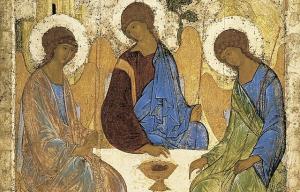
Detail from Andrei Rublev’s “Old Testament Trinity.” Courtesy of
Andrey Rublev – Св. Троица – Google Art Project.jpg
It’s Saturday: let’s talk about the Trinity. (Not for the first time in this column. Nor for the second.)
Actually let’s zoom in through an adjacent question: why do Christians baptize in the name of the Father, Son and Holy Spirit?
The easy answer to that one is “Jesus told us to.” But “Jesus said” or “the Bible says” is how theologians begin their contemplations, not how they end them. So: what is the meaning of the formula Jesus gives in Matthew 28:19? Can we get any ah-ha!s from it?
Was Jesus baptized in the Triune name?
Let’s take one more step back and look at Jesus own baptism.
And when Jesus had been baptized, just as he came up from the water, suddenly the heavens were opened to him and he saw the Spirit of God descending like a dove and alighting on him. And a voice from heaven said, “This is my Son, the Beloved, with whom I am well pleased.” (Matthew 3:16-17)
These verses show us the kind of relationships that Jesus is caught up in. The Spirit comes to rest on him. And when that Spirit lands, he can hear the voice of his parent: you are my beloved child.
These relationships guide Christ through his life. When the Spirit rests on him, he can hear the voice of the one he calls Father. The tragedy of the story comes on the cross, when Jesus can neither see the Spirit nor hear the Father. And the comedy comes on Easter morning, when, as Paul puts it, the Spirit comes from the Father to give life to the dead body. Easter is his baptism all over again: the Spirit rests, and the Son wakes up knowing that he is his Father’s beloved. Finally, at his ascension–which is like the endgame of baptism–the Spirit who descended to him now ascends, taking the Son along for the ride so both can rest in the arms of their loving source.
So Jesus’ baptism, like his entire life, has a trinitarian shape.
Wait… Does the Trinity only have one name?
OK. Good story, theologian. But isn’t the doctrine of the Trinity about more than that? Not just the incarnate Jesus’ experience, but the being of God? Isn’t it about weird quantum math of making three into one and one into three? The doctrine of the Trinity is the Shrödinger’s cat of theology.
Let’s pause there for a moment and return to the line from Matthew 28. “Baptizing them in the name of…”
What is the name of Father, Son, and Spirit? Notice the text does not say “names,” as if Jesus were telling us to make sure we mention all three. “The name.”
I suspect (and I’m not alone) that “the name” is the one God gave Moses in Exodus. A name so strange and new that Moses couldn’t quite pronounce it: the name YHWH. This YHWH is God and, as the shema from Deuteronomy reminds us, YHWH is one (6:4).
So we’ve got a gospel story that shows us three characters involved in God’s work, and a Jewish prayer reminding us that God is one (or “alone”). The very fact that the early Christian theologians interpreted the evangel with an eye on the shema is evidence that the Christian account of God did not originate as an anti- or post-Jewish doctrine. These are three persons with one ancient name.
So it is one, or three?
Back to the scene in the Jordan. “You are my beloved.” The one Jesus calls Father is one who loves. And God, whose name never changes, does not become love at that moment. God is love with no beginning and no end. Love is eternal in God. It is the being of the one God. And if God is love, this means that God has always been a lover, always had a beloved, always sent the Spirit of love to that beloved, and always awaited the return of that Spirit of love from that Beloved. Love is the being of the one God that was, is, and ever shall be a relationship of three.
Jesus’ baptism then is a story that happens in the Jordan, but beyond that a story that takes place in eternity. The word “God,” for Christians, means something like a parent who loves a child, and who sends their own Spirit to rest on that child.
This is why Father, Son, and Spirit only have one name. YHWH is the name of all 3—the last name you might say, and Paul more or less says this when he calls Jesus the Greek version of “Our YHWH.” We can only call him that, he tell us in the first letter to Corinth, if the Spirit of the holy one tells us that is his name.
Father, Son, Spirit: YHWH the lover, YHWH the beloved, and YHWH the love that moves and rests upon both. This is the eternal love story, the divine dance that gives shape to all of creation.
OK… but is the Trinity good news, or just weird math?
Fair question.
Notice how Saint Paul closes out his most difficult love letter, by which I mean 2 Corinthians. “The grace of the Lord Jesus Christ, the love of God, and the communion of the Holy Spirit be with all of you” (13:13).
Paul’s Trinity-shaped blessing asks that the grace, love, and communion of the three persons be with us all. He wants to include us in that dance of love that Jesus felt himself gathered into at the Jordan.
Knowing this God of love is “with us” helps us see why theologians made the math as weird as we did. We could have solved it differently. We could have said:
-
- God isn’t really one, but is instead three. (But then the Jews are wrong about God.)
- God used to be one, but became two at Christmas and three at Pentecost. (But then God changes names, and only the pre-Jesus Jews were right.)
- God is still one, but seems like three when God comes to gather us up. (But then the love of God is not really with us, as Paul wants us to know it is: receiving the Spirit that lets us stand with Christ and call God Father would be a deception. Those relationships would not be true to God’s being.)
No, there’s no getting around it. The God of Christianity is eternally the set of relationships that have one name.
What does Trinitarian baptism mean for us?
Pauls’ favorite metaphor for this is adoption. The divine parent has a single natural child, an only begotten. That only begotten receives eternally the Spirit of that parent’s love. And we, made in God’s image, are called by that same name and receive that same gift of love. That’s what happening at our baptism.
We get to stand alongside Jesus the Son in the Jordan, feel that same Spirit come to rest on us, and so hear God calling us “beloved child.” It’s as if the Spirit brings us adoption papers, Paul says: your birth name is not YHWH, but God loves you as if it were.
To baptize in the name of the Father, Son, and Holy Spirit is to let the love that is God’s eternal name engulf each life that comes to share in this faith. Remember Easter, the day that God said “love” so strongly and clearly that even death could not block its power? That God, Paul says, wants to give life to your mortal body also. If you’re ready for that.
You are God’s beloved child. And if you will look for the moments when God’s Spirit descends and rests on you, then I believe you will hear the voice of the divine parent saying “You are my beloved.” That, I hope, you will find to be good news.
Adapted from a sermon at All Saints Episcopal Church, Austin
Trinity Sunday 2023
Catholic
History and Religion
Family, Parenting and Religion
Doctrines for Various Occasions
Previous Post

February 15, 2023
The Flood: Our Gospel for an Age of Planetary Emergency
Next Post

July 8, 2023 Truth's Diagonal Dance (a reflection on Catherine Pickstock)
Recent Comments
Browse Our Archives
Select a Category Church Fathers Doctrines for Various Occasions Ecotheology Eschatology Liturgical Seasons Prayer Theology and Literature Uncategorized
Select a Month October 2023 September 2023 August 2023 July 2023 June 2023 February 2023 January 2023 December 2022 November 2022 October 2022 September 2022 August 2022 July 2022 June 2022 May 2022 April 2022 March 2022 February 2022 January 2022 December 2021 November 2021 October 2021 September 2021
Follow Us!
TAKE THE
Religious Wisdom Quiz
Which city is known as the "City of Palms" in the Bible?
Select your answer to see how you score.
Jerusalem Damascus Jericho Bethany
Related posts from The Diagonal Way

The Year of the Locust: A Sermon on...

Does Saint Paul Believe in the Trinity?


TRENDING AT PATHEOS General Christian

Seventy and Five Years Old: God Still Starts...
There is a small detail tucked into Genesis 12 that I skipped...

A Biblical Vision of Success in Christian Life...
The Concern and Quest Recent trends and tendencies I note around me...

Indigenous Peoples’ Day and the Church
Indigenous' Peoples Day or Columbus Day? Depending on where you live...

When Spiritual Growth Looks Like Losing Ground
Four Passive Spiritual Disciplines: An Introduction When I was a college freshman,...

Faith and Finding Your Current Season
“To everything there is a season,” Ecclesiastes tells us, “and a time...

Did Jesus Fear God's Wrath in Gethsemane?
That Time Jesus Was Terrified Before we begin, let me say at...
view all General Christian blogs
Ad-Free & Subscriber Log-In Subscription Support
- About Us
- 2026 Calendar
- Videos
- Podcasts
- Library of World Religions
- Faith In Media Tracker
- Advertise With Us
- Write for Us
- Privacy Policy
- Terms of Service
- Do Not Sell My Data
- Contact Us
- Radiant Digital
- Manage Newsletter Subscriptions
- Unsubscribe From Notifications
- Sitemap
Copyright 2008-2026, Patheos. All rights reserved.
Subscription Support Ad-Free & Subscriber Log-In
Follow Patheos