
BuddhistCatholicContemplativeEvangelicalGeneral ChristianHinduJewishLatter-day SaintMuslimNew VisionsProgressive Christian
Beliefs
- Buddhist
- Catholic
- Contemplative
- Evangelical
- General Christian
- Hindu
- Jewish
- Latter-day Saint
- More Voices
- Muslim
- New Visions
- Pagan
- Progressive Christian
Topics
- Religion News
- Food and Religion
- Sports and Religion
- Religious Art
- Religious Music and Entertainment
- Religious Events
- History and Religion
- Style and Religion
- Politics and Religion
- Women in Religion
- Recreation Outdoors and Religion
- Business Finance and Religion
- Careers Workplace and Religion
- Education and Religion
- Family Parenting and Religion
- Health Fitness and Religion
- Home and Religion
- Relationships and Religion
- Technology and Religion
- Travel and Religion
Columnists
- Buddhist Columnists
- Business Finance and Religion Columnists
- Careers Workplace and Religion Columnists
- Catholic Columnists
- Contemplative Columnists
- Education and Religion Columnists
- Evangelists Columnists
- Family Parenting and Religion Columnists
- General Christian Columnists
- Health Fitness and Religion Columnists
- Hindu Columnists
- History and Religion Columnists
- Home and Religion Columnists
- Jewish Columnists
- More Voices Columnists
- Latter Day Columnists
- Muslim Columnists
- New Visions Columnists
- Nonreligious Columnists
- Pagan Columnists
- Politics and Religion Columnists
- Progressive Columnists
- Recreation Outdoors and Religion Columnists
- Relationships and Religion Columnists
- Religion News Columnists
- Religious Art Columnists
- Religious Events Columnists
- Religious Music and Entertainment Columnists
- Sports and Religion Columnists
- Style and Religion Columnists
- Technology and Religion Columnists
- Travel and Religion Columnists
- Women in Religion Columnists
Resource Library
- 2026 Calendar
- Library of World Religions
- The 100 Most Holy Places on Earth
- Patheos Answers
- Podcasts
- Videos
- Faith Leaders Database
- Anglican Episcopalian
- Bahai
- Baptist
- Buddhism
- Christianity
- Confucianism
- Eastern Orthodoxy
- Hinduism
- Holiness and Pentecostal
- ISKCON
- Islam
- Judaism
- Lutheran
- Methodist
- The Church of Jesus Christ of Latter-day Saints
- New Age
- Paganism
- Presbytarian and Reformed
- Protestantism
- Religion Behind the Scenes
- Roman Catholic
- Scientology
- Shia Islam
- Sikhism
- Sufism
- Sunni Islam
- Taoism
- Zen
- See all religions
Research Tools
 Ad-Free & Subscriber Log-In Subscription Support
Ad-Free & Subscriber Log-In Subscription Support
Follow Patheos 

- Trending:
- Forgiveness
- |
- Marriage
- |
- Consciousness
- |
- Death Penalty
- |
- Election
- |
- Halloween
 The Diagonal Way
-
Category
- Home
- General Christian
- Religious Music & Entertainment
- Resonating the Mountain: Some Good Ecotheology in The Rings of Power
Resonating the Mountain: Some Good Ecotheology in The Rings of Power
Last updated on: September 21, 2022 at 11:27 am by Anthony D Baker
Resonating the Mountain: Some Good Ecotheology in The Rings of Power 2022-09-21T11:27:22-05:00 Anthony D Baker
Patheos Explore the world's faith through different perspectives on religion and spirituality! Patheos has the views of the prevalent religions and spiritualities of the world.
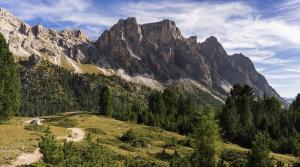
“Mountain” by barnyz is licensed under CC BY-NC-ND 2.0
I am, like many of you, watching The Rings of Power, basically as soon as Amazon releases each episode. So far I’m loving it. I want to reflect a bit here on “resonating,” a practice that comes up in Episode 2.
Getting Tolkien Right
Getting Tolkien right matters. It matters especially to many of my generation, for whom the books became a kind of well-shared secret passport to a magical world. We’re all still a bit scarred from the havoc that’s been wrought on our beloved Jedi-verse, even (especially!) by its creator. (Though series like Obi-Wan are doing some good work redeeming it. That Disney money sometimes goes to good use.) But Star Wars is adolescent in comparison with the grown up mythology of Middle Earth. Tolkien’s world is rich, deep, wise, ancient, and inexaustible.
Not to say that the author himself need remain the emperor of his own mythopoetic land. A quick social media search for #Wolkien will show you plenty of intense fans who are angry about what the production and casting has done to Dr. Tolkien’s male Anglo-Saxon world. What they’ve forgotten, I suspect, is that Tolkien was a scholar of literature, history, language evolutions, and people migrations. I think he would have loved the implied ur-mythos of a diverse middle Earth. What ancient patterns of migration, refuge, and trade might have brought dark- and light-skined elves and dwarves into the same villages? What social and political energies might undergird the tendency of Harfoots—ancestors of Hobbits—to place females among the males as wise prophets and community leaders? Tolkien would have loved those curiosities. And he would have raised an accusatory eyebrow at the small-mindedness of his rabid defenders.
Resonating the Mountain
My favorite bit of dialogue so far involves one of those characters. Disa, the dark-skinned dwarf-princess against whom much of the anti-Wolkien ire seems to be directed, explains to Elrond how the dwarves go about preparing stone for mining. She tells him about resonating, which he has not heard of before. “It’s when we sing to the stone,” she explains.
You see, a mountain’s like a person. It’s a long and ever-changing story made of countless small parts: earth and ore, air and water. Sing to it properly, and each of those parts will reflect your song back to you, telling you its story. Showing you what might be hidden, where to mine, where to tunnel, and where to leave the mountain untouched.
In a later episode we get to see and hear her resonating a new bit of stone.
This has always seemed to me an explored avenue in Tolkien’s stories. I imagine that I’ve forgotten a passage somewhere that hints at the the pre-history of dwarf culture. And I’ll admit (shame!) that I’ve never finished The Silmarillion, though I’ve found the bits I have read to be stunning in their beauty and imagination. But the dwarves show up in Tolkien’s stories mostly as lovable males with rapacious appetites as a tragic flaw. The way they attack poor Bilbo’s larder if the first chapter of The Hobbit is the way they attack earth and mountain, lusting after the veins of gold and hidden jewels it contains. But surely there’s a better way to be a dwarf? Can the dwarves’ mining industry lend itself, as Wendell Berry might ask, to “kindly use?”
Resonating in Ecotheology
The question matters for more than just Tolkien fandom, obviously. If the dwarves forget the song of the mountain, they are mirrors of humans, who have built a modern world on such choral amnesia. The water and air and soil and stone of our planet is remarkably adaptable. It’s almost ceaselessly generous in its invitations to its inhabitants to build and dwell within its environs. But like rude company, we dwellers have taken advantage of the earth’s generosity. And with tragic results. We’re like guests who barge into each room of our host’s house, disregarding closed doors, so that we can begin rearranging the furniture to fit our taste.
Disa’s song tradition, as such, has some rather profound ecotheological connections. Her practice echoes many of the Psalms. Psalm 19, for instance, says that the heavens, the day, and the night, all speak a silent language of God’s glory. “Their voice goes out through all the earth,and their words to the end of the world.” Psalm 42 says that the voice of God can be heard in the roar of a waterfall, as “deep calls to deep.” And of course the Psalter is itself a choral collection, inviting gathered Jews and Christians to “resonate” these hymns of creation into the sacred spaces they inhabit.
An Invitation to Sing
So there is something deeply theological in the practice of singing to God’s creation and then waiting for it to sing back. Waiting for it to tell us its story. For the story of the mountain and the river is God’s own epic song, transposed into colloquial adventures like a fireside narrative from time out of mind, changing slightly in each recounting.
Right there on Amazon Prime, then, in the music of a dark-skinned dwarf princess, is an invitation to us humans to live differently. To sing, and to ask the spaces around us sing back. To ask them to open themselves generously to our habitations, desires, and plans, so long as our use is kindly. And also to ask them to tell us where to let the earth pursue its own ends without human alteration. For the earth is not ours, but the Lord’s. And everything in it.
Religious Music & Entertainment
Previous Post

September 7, 2022
Summer 2022 Reading
Next Post
September 26, 2022 All I Know of Holiness
Browse Our Archives
Select a Category Church Fathers Doctrines for Various Occasions Ecotheology Eschatology Liturgical Seasons Prayer Theology and Literature Uncategorized
Select a Month October 2023 September 2023 August 2023 July 2023 June 2023 February 2023 January 2023 December 2022 November 2022 October 2022 September 2022 August 2022 July 2022 June 2022 May 2022 April 2022 March 2022 February 2022 January 2022 December 2021 November 2021 October 2021 September 2021
Follow Us!
TAKE THE
Religious Wisdom Quiz
Who was cast into a fiery furnace but was unharmed?
Select your answer to see how you score.
Shadrach, Meshach, and Abednego Moses, Aaron, and Joshua Elijah and Elisha Daniel
Related posts from The Diagonal Way

The Year of the Locust: A Sermon on...
The Flood: Our Gospel for an Age of...
What I've Been Reading Lately: End of the...
Advent Is When Christians Talk about Hope. But...
TRENDING AT PATHEOS General Christian

Seventy and Five Years Old: God Still Starts...
There is a small detail tucked into Genesis 12 that I skipped...

A Biblical Vision of Success in Christian Life...
The Concern and Quest Recent trends and tendencies I note around me...

Indigenous Peoples’ Day and the Church
Indigenous' Peoples Day or Columbus Day? Depending on where you live...

When Spiritual Growth Looks Like Losing Ground
Four Passive Spiritual Disciplines: An Introduction When I was a college freshman,...

Faith and Finding Your Current Season
“To everything there is a season,” Ecclesiastes tells us, “and a time...

Did Jesus Fear God's Wrath in Gethsemane?
That Time Jesus Was Terrified Before we begin, let me say at...
view all General Christian blogs
Ad-Free & Subscriber Log-In Subscription Support
- About Us
- 2026 Calendar
- Videos
- Podcasts
- Library of World Religions
- Faith In Media Tracker
- Advertise With Us
- Write for Us
- Privacy Policy
- Terms of Service
- Do Not Sell My Data
- Contact Us
- Radiant Digital
- Manage Newsletter Subscriptions
- Unsubscribe From Notifications
- Sitemap
Copyright 2008-2026, Patheos. All rights reserved.
Subscription Support Ad-Free & Subscriber Log-In
Follow Patheos