
BuddhistCatholicContemplativeEvangelicalGeneral ChristianHinduJewishLatter-day SaintMuslimNew VisionsProgressive Christian
Beliefs
- Buddhist
- Catholic
- Contemplative
- Evangelical
- General Christian
- Hindu
- Jewish
- Latter-day Saint
- More Voices
- Muslim
- New Visions
- Pagan
- Progressive Christian
Topics
- Religion News
- Food and Religion
- Sports and Religion
- Religious Art
- Religious Music and Entertainment
- Religious Events
- History and Religion
- Style and Religion
- Politics and Religion
- Women in Religion
- Recreation Outdoors and Religion
- Business Finance and Religion
- Careers Workplace and Religion
- Education and Religion
- Family Parenting and Religion
- Health Fitness and Religion
- Home and Religion
- Relationships and Religion
- Technology and Religion
- Travel and Religion
Columnists
- Buddhist Columnists
- Business Finance and Religion Columnists
- Careers Workplace and Religion Columnists
- Catholic Columnists
- Contemplative Columnists
- Education and Religion Columnists
- Evangelists Columnists
- Family Parenting and Religion Columnists
- General Christian Columnists
- Health Fitness and Religion Columnists
- Hindu Columnists
- History and Religion Columnists
- Home and Religion Columnists
- Jewish Columnists
- More Voices Columnists
- Latter Day Columnists
- Muslim Columnists
- New Visions Columnists
- Nonreligious Columnists
- Pagan Columnists
- Politics and Religion Columnists
- Progressive Columnists
- Recreation Outdoors and Religion Columnists
- Relationships and Religion Columnists
- Religion News Columnists
- Religious Art Columnists
- Religious Events Columnists
- Religious Music and Entertainment Columnists
- Sports and Religion Columnists
- Style and Religion Columnists
- Technology and Religion Columnists
- Travel and Religion Columnists
- Women in Religion Columnists
Resource Library
- 2026 Calendar
- Library of World Religions
- The 100 Most Holy Places on Earth
- Patheos Answers
- Podcasts
- Videos
- Faith Leaders Database
- Anglican Episcopalian
- Bahai
- Baptist
- Buddhism
- Christianity
- Confucianism
- Eastern Orthodoxy
- Hinduism
- Holiness and Pentecostal
- ISKCON
- Islam
- Judaism
- Lutheran
- Methodist
- The Church of Jesus Christ of Latter-day Saints
- New Age
- Paganism
- Presbytarian and Reformed
- Protestantism
- Religion Behind the Scenes
- Roman Catholic
- Scientology
- Shia Islam
- Sikhism
- Sufism
- Sunni Islam
- Taoism
- Zen
- See all religions
Research Tools
 Ad-Free & Subscriber Log-In Subscription Support
Ad-Free & Subscriber Log-In Subscription Support
Follow Patheos 

- Trending:
- Forgiveness
- |
- Marriage
- |
- Consciousness
- |
- Death Penalty
- |
- Election
- |
- Halloween
 The Diagonal Way
-
Category
- Home
- General Christian
- Is Holiness Human? Lessons from Bulgakov
Is Holiness Human? Lessons from Bulgakov
Last updated on: April 20, 2022 at 7:00 am by Anthony D Baker
Is Holiness Human? Lessons from Bulgakov 2022-04-20T07:00:39-05:00 Anthony D Baker
Patheos Explore the world's faith through different perspectives on religion and spirituality! Patheos has the views of the prevalent religions and spiritualities of the world.
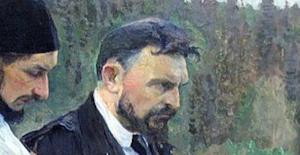
Bulgakov, in Nesterov’s portrait, “Philosophers.” Public Domain.
“Growth in holiness and ascent from grace to grace does not occur automatically, but actively… ‘synergistically,’ in Christ and with Christ….” —Sergei Bulgakov
Bulgakov and Me
As a Wesleyan, raised on a steady diet of sermons on sanctification in Nazarene Churches, there’s a certain retrospective obviousness to my finding my way to Bulgakov’s theology of deification.
I first heard the name Sergei Bulgakov from one of my professors, Gene Rogers. Gene was reading the Russian theologian in French translations in the 90s. That was before anyone else that I knew had heard of him. I’d studied Russian in college, and had enough French to fill in the gaps. So I decided to follow Gene’s direction and see what was happening there. This was around the time when Boris Jakim began translating the major works into English at an alarming pace. That helped more than a little.
When it was time to decide on my dissertation topic, my advisor and mentor John Milbank suggested I “do something on perfection.” I was not overjoyed by the idea, since I could imagine about 500 ideas that seemed more engaging and exciting to me. But he eventually convinced me. “It will be a way of giving the gift of the tradition to your Nazarenes, and the gift of Nazarene holiness to the tradition.”
By this time I’d read a good bit of Bulgakov, and knew that I wanted him to guide me in this work. John and Gene decided—perhaps with some begging on my part—to offer a team taught course on the “Russian School,” so I got to dig in with my classmates. I started getting excited about the way that that Bulgakov’s account of deification resonated with, but for me expanded and deepened, the teachings on holiness I’d grown up with.
Is Holiness for Humans?
We were made to share in God’s holiness. That’s something I suppose I’ve always implicitly believed, even through my agnostic period in early adulthood. It’s the heart of the Holiness Code in Leviticus, and the key theme of John Wesley’s preaching.
But the unsettling question for me was what to do about all the human energy. The hunger (literal and metaphorical), the distractions, the moods. Surely all that thick humanity has no place in a life that shares in God’s holiness. So what do we do with it? Is it the luggage that we learn to discard? Ought it be a source of guilt and/or shame until we do? But then isn’t shame also a human energy that serves ultimately just to identify the gap between my life and God’s?
This is where Bulgakov had some help for me. “The creature is not made to be immovable in the least. Even while participating in the eternity of God, it does not lose the temporal, creaturely character of its existence.” I was imagining holiness as a loss of human “mobility,” all those moods and changes that characterize me and not God. But what if all of that is a human way—can be a human way—of sharing God’s nature? What if God meant it when God created embodied humans who got hungry and sleepy and confused, and then called us “good?”
How to Participate in God
In that case, holiness doesn’t look like quietude. It’s not a shutting down of all that activity, but a patterning of it all with the character of God. This is why 2 Peter can describe all the “effort” we put into the formation of habits of goodness, knowledge, self-control, endurance, mutual affection, and love. On one level this advice is ridiculous: the author lists those characteristics because they are qualities of the divine nature (1:4-7). We’re bound to fail in our efforts of participation.
But Bulgakov helped me see that the outcome of Christian habit-formation is not to make myself less human and more divine, but rather to enjoy divine things in a humanly appropriate way. “This growth in holiness and ascent from grace to grace does not occur automatically, but actively, and, of course, “synergistically,” in Christ and with Christ….” I’m something like a child, invited to make pancakes with her parent. I’m not going to be particularly good at this holiness thing, but it’s going to make my day to discover that God wants my help!
Docetic Sanctification
The “in and with Christ” language here is important. To assume that more of God’s holiness means less of my own humanity is to tread on christological heresy. Because if that’s true for me, and my life is hid with God in Christ, then it must be true of Christ. And a whole lot of blood and ink was spilled in the early centuries of Christianity to make sure that by calling Jesus “divine” we weren’t calling him “nonhuman.” There’s actually a whole set of heresies there, which we could group under the umbrella of docetism.
So let’s call this problematic account of holiness “docetic sanctification.” It’s the notion that more holiness means less humanity. This is what Bulgakov helped free me from.
“Deification has no ceiling,” he tells us. Carrying on the tradition of Gregory of Nyssa, he wants us to know that holiness is never finished, because the God whose life we share in is unfinishable. So to be fully human is to go on enjoying those habits of mutual affection and the rest in saecula saeculorum (“world without end”).
Holiness beyond Enclaves
These are the ideas I explored in my dissertation, which I called Making Perfection: A Experiment in Theological Ontology. I then retooled them for my first book, Diagonal Advance: Perfection in Christian Theology. Bulgakov’s presence receded in the book, though he’s still there under the surface. I suppose I’m still leaning on him pretty heavily to fulfill the task my advisor gave me over two decades ago: to give an account of holiness to the broader Christian traditions, and to give the broader traditions to Christians in pursuit of holiness.
The Bulgakov quotes in the post come from a new translation of essays. In grad school I was focused on the books listed here.
Doctrines for Various Occasions
Previous Post

April 16, 2022
What is Resurrection?
Next Post
April 22, 2022 Hegel on the Way to Heaven
Browse Our Archives
Select a Category Church Fathers Doctrines for Various Occasions Ecotheology Eschatology Liturgical Seasons Prayer Theology and Literature Uncategorized
Select a Month October 2023 September 2023 August 2023 July 2023 June 2023 February 2023 January 2023 December 2022 November 2022 October 2022 September 2022 August 2022 July 2022 June 2022 May 2022 April 2022 March 2022 February 2022 January 2022 December 2021 November 2021 October 2021 September 2021
Follow Us!
TAKE THE
Religious Wisdom Quiz
Blessed are the peacemakers, for they will be called ____ of God.
Select your answer to see how you score.
Children Disciples Servants Friends
Related posts from The Diagonal Way

The Year of the Locust: A Sermon on...
Does Saint Paul Believe in the Trinity?

TRENDING AT PATHEOS General Christian

Seventy and Five Years Old: God Still Starts...
There is a small detail tucked into Genesis 12 that I skipped...

A Biblical Vision of Success in Christian Life...
The Concern and Quest Recent trends and tendencies I note around me...

Indigenous Peoples’ Day and the Church
Indigenous' Peoples Day or Columbus Day? Depending on where you live...

When Spiritual Growth Looks Like Losing Ground
Four Passive Spiritual Disciplines: An Introduction When I was a college freshman,...

Faith and Finding Your Current Season
“To everything there is a season,” Ecclesiastes tells us, “and a time...

Did Jesus Fear God's Wrath in Gethsemane?
That Time Jesus Was Terrified Before we begin, let me say at...
view all General Christian blogs
Ad-Free & Subscriber Log-In Subscription Support
- About Us
- 2026 Calendar
- Videos
- Podcasts
- Library of World Religions
- Faith In Media Tracker
- Advertise With Us
- Write for Us
- Privacy Policy
- Terms of Service
- Do Not Sell My Data
- Contact Us
- Radiant Digital
- Manage Newsletter Subscriptions
- Unsubscribe From Notifications
- Sitemap
Copyright 2008-2026, Patheos. All rights reserved.
Subscription Support Ad-Free & Subscriber Log-In
Follow Patheos