
BuddhistCatholicContemplativeEvangelicalGeneral ChristianHinduJewishLatter-day SaintMuslimNew VisionsProgressive Christian
Beliefs
- Buddhist
- Catholic
- Contemplative
- Evangelical
- General Christian
- Hindu
- Jewish
- Latter-day Saint
- More Voices
- Muslim
- New Visions
- Pagan
- Progressive Christian
Topics
- Religion News
- Food and Religion
- Sports and Religion
- Religious Art
- Religious Music and Entertainment
- Religious Events
- History and Religion
- Style and Religion
- Politics and Religion
- Women in Religion
- Recreation Outdoors and Religion
- Business Finance and Religion
- Careers Workplace and Religion
- Education and Religion
- Family Parenting and Religion
- Health Fitness and Religion
- Home and Religion
- Relationships and Religion
- Technology and Religion
- Travel and Religion
Columnists
- Buddhist Columnists
- Business Finance and Religion Columnists
- Careers Workplace and Religion Columnists
- Catholic Columnists
- Contemplative Columnists
- Education and Religion Columnists
- Evangelists Columnists
- Family Parenting and Religion Columnists
- General Christian Columnists
- Health Fitness and Religion Columnists
- Hindu Columnists
- History and Religion Columnists
- Home and Religion Columnists
- Jewish Columnists
- More Voices Columnists
- Latter Day Columnists
- Muslim Columnists
- New Visions Columnists
- Nonreligious Columnists
- Pagan Columnists
- Politics and Religion Columnists
- Progressive Columnists
- Recreation Outdoors and Religion Columnists
- Relationships and Religion Columnists
- Religion News Columnists
- Religious Art Columnists
- Religious Events Columnists
- Religious Music and Entertainment Columnists
- Sports and Religion Columnists
- Style and Religion Columnists
- Technology and Religion Columnists
- Travel and Religion Columnists
- Women in Religion Columnists
Resource Library
- 2026 Calendar
- Library of World Religions
- The 100 Most Holy Places on Earth
- Patheos Answers
- Podcasts
- Videos
- Faith Leaders Database
- Anglican Episcopalian
- Bahai
- Baptist
- Buddhism
- Christianity
- Confucianism
- Eastern Orthodoxy
- Hinduism
- Holiness and Pentecostal
- ISKCON
- Islam
- Judaism
- Lutheran
- Methodist
- The Church of Jesus Christ of Latter-day Saints
- New Age
- Paganism
- Presbytarian and Reformed
- Protestantism
- Religion Behind the Scenes
- Roman Catholic
- Scientology
- Shia Islam
- Sikhism
- Sufism
- Sunni Islam
- Taoism
- Zen
- See all religions
Research Tools
 Ad-Free & Subscriber Log-In Subscription Support
Ad-Free & Subscriber Log-In Subscription Support
Follow Patheos 

- Trending:
- Forgiveness
- |
- Marriage
- |
- Consciousness
- |
- Death Penalty
- |
- Election
- |
- Halloween
 The Diagonal Way
-
Category
- Home
- General Christian
- Angels: God’s Trustworthy Tempests
Angels: God’s Trustworthy Tempests
Last updated on: March 16, 2022 at 8:00 am by Anthony D Baker
Angels: God’s Trustworthy Tempests 2022-03-16T08:00:02-05:00 Anthony D Baker
Patheos Explore the world's faith through different perspectives on religion and spirituality! Patheos has the views of the prevalent religions and spiritualities of the world.
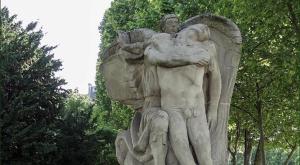
Photo found at https://www.eutouring.com/images_paris_statues_758.html
“The world of angels occupies in creation a place which makes it impossible to neglect its consideration without rendering the intelligibility of the universe impossible. . .” –Etienne Gilson
Angels in the Architecture
Just across the river from the Eiffel Tower, shaded by some trees, stands one of Paris’s more dramatic monuments. It’s not, that is, dramatic in terms of size, visibility, or even artistic design. The lines of the stone are soft and weathered. It’s difficult to make out the subject matter until the viewer stands up rather close.
The statue is of an angel preparing to fly. His body is tense, his wings spread. His face is firm and resolute, as if only the greatest concentration will allow him to complete his journey. He bears in his arms the limp and naked body of a man, head thrown back over the angel’s shoulder.
The engraving below identifies the imagery. The statue is dedicated to Paris’s Polish liberators in World War II. These remarkably courageous foreigners crossed Nazi territory after their own cities had fallen so they could help liberate occupied Paris.
Are We Done with Angels?
The image of Polish resistance as an angel is, of course, an allegory. Even the most stubbornly religious may be tempted simply to leave it at that. Unlike Islam, where belief in angelic agency is one of the five pillars of faith, Christianity tends to be rather modest about the place of these strange unbodied creatures in the grand scheme of things.
Of all the doctrines laid aside in modern Christianity, “angelology” is the most easily dismissed. Many of us will tolerate angelic appearances in the architecture of Europe or in the stained glass of the world’s churches. But we somehow will find them remarkably out of place in the architecture of contemporary Christian belief.
It is, quite simply, hard to believe in angels. A solitary and omnipotent inhabitant of heaven is perhaps more or less palatable. Even a trinity of names, signifying the relational essence of this being. But start over-peopling the celestial chambers with choirs and invisible armies, and most of us begin to grin a little nervously.
Still, the artistic allegory in Paris is compelling enough to pique my theological curiosity. I can’t help but think of the citizens of Kyiv these past weeks, cleaning antique hunting rifles as they await Russian tanks. The question of God’s involvement in human warfare is complex, of course. But this sculpture is not really about warfare. It’s about the courage and loyalty of strangers. Couldn’t there be actual angels in that architecture?
God’s Messengers
Angels, of course, make not uncommon appearances throughout the Bible. They guard the path to the tree of Life. One blocks Balaam’s road to Moab. One angel announces the conception, and several the birth, of the Christ child. They watch over the churches under the Roman persecution.
The Old Testament prophets, though, give us what may be the deepest truth of the biblical mystery of the angels. These visions of living creatures, flying and singing and surrounded with fire and light, are actually “visions of God” (Ezekiel 1:1-4). Each time these heavenly chambers fly open, it is because the God of Israel wishes to speak.
The dialogue they initiate, unsurprisingly, is nothing like a quiet morning chat over coffee. Instead, we read of violent gales from which emerge surreal beings flying “straight forward.” It’s as if God’s glory-filled personality were so expansive and excessive as to pressurize all of creation from the outside. The slightest opening onto earth might send this glory in upon us like a flood of oxygen into a vacuum.
Secondary Causes
The theologians of Middle Ages first gave systematic shape to an angelology. Taking cues from pagan religious philosophy, they connected questions about angels to questions about cause and effect relationships. Is it possible, they wondered, that God might cause things to happen, and that other, lesser beings might also cause them, differently?
This secondary causality is, actually, the way we speak of more familiar happenings. When a child learns the multiplication table, it is because of her own diligent efforts. On another level, though, it is “caused” by a good teacher, that teacher’s math curriculum, the efforts of the child’s parents. The father’s boss who agreed to switch him off of a second shift so he could help the child with homework . . .
What if God’s agency in the world were just as richly complicated as our own, and even more so? This would fit with the prophetic image of a divine presence that shows up in the world as spinning wheels, burning coals, and racing cherubim, all somehow “causing” the presence of God to burst in among us.
When the Christian contemplates God’s presence in the world, these theologians suggested, she is actually contemplating living presences. Ranging from the human to the angelic and beyond, these presences all act in countless ways to preserve and renew the created order. God, the primary cause, is in all the causes and effects of our world so deeply that we could never begin to parse out God’s action from our own.
The Untamed God
Is there, though, any benefit for us in continuing to believe in these super-human, sub-divine beings? Aside from the fact, I mean, that the Bible tells of them and theologians have found places for them in the great chain of being?
I suspect that the question of angels is really about what we think of God. A more domesticated, efficient God would not, surely, rely on such dramatic “messengers” to uphold the world’s existence. Or to carry important messages like peace on earth and the world’s salvation.
But the best stories of angels come from earlier eras of human culture that had no notion of God as efficient or civilized. That God intervenes in the world with constant surprise and prodigal displays. Burning bushes, parting seas, empty tombs.
It’s no coincidence that the extinction of angels from Christian belief parallels, historically, the age of rationalism and modern science. Once we began reducing both the universe and God to models that maximize economy of explanation, angels had to go.
Trustworthy Tempests
But this rich, complex, untamed cosmos is precisely what a belief in angels offers us. The atmosphere between God and us is positively thick with invisible energies and graces. These energies and graces are so distinct and purpose-filled as to have their own names and personalities. They are no more in our control than our own fellow human beings, and in fact less so. They are more like a violent gale than a friendly companion.
But, as personifications of divine grace, they are trustworthy tempests. They act in uncountable ways to answer our prayer that God’s “will be done on earth as it is in heaven.” They bring God’s words and actions to us and through us and beyond us. And if that day comes when, like the citizens of Paris or Kyiv, we find ourselves beyond all hope, they will bear up our fallen forms with a firm and resolute strength. A strength that could only come from God and God’s unseen hosts, even if it manifests in the miraculous presence of courageous strangers on earth.
Doctrines for Various Occasions
Previous Post

March 12, 2022
The Language Net
Next Post
March 19, 2022 Augustine’s God of Motion
Browse Our Archives
Select a Category Church Fathers Doctrines for Various Occasions Ecotheology Eschatology Liturgical Seasons Prayer Theology and Literature Uncategorized
Select a Month October 2023 September 2023 August 2023 July 2023 June 2023 February 2023 January 2023 December 2022 November 2022 October 2022 September 2022 August 2022 July 2022 June 2022 May 2022 April 2022 March 2022 February 2022 January 2022 December 2021 November 2021 October 2021 September 2021
Follow Us!
TAKE THE
Religious Wisdom Quiz
Blessed are the peacemakers, for they will be called ____ of God.
Select your answer to see how you score.
Children Disciples Servants Friends
Related posts from The Diagonal Way

The Year of the Locust: A Sermon on...

Does Saint Paul Believe in the Trinity?


TRENDING AT PATHEOS General Christian

Seventy and Five Years Old: God Still Starts...
There is a small detail tucked into Genesis 12 that I skipped...

A Biblical Vision of Success in Christian Life...
The Concern and Quest Recent trends and tendencies I note around me...

Indigenous Peoples’ Day and the Church
Indigenous' Peoples Day or Columbus Day? Depending on where you live...

When Spiritual Growth Looks Like Losing Ground
Four Passive Spiritual Disciplines: An Introduction When I was a college freshman,...

Faith and Finding Your Current Season
“To everything there is a season,” Ecclesiastes tells us, “and a time...

Did Jesus Fear God's Wrath in Gethsemane?
That Time Jesus Was Terrified Before we begin, let me say at...
view all General Christian blogs
Ad-Free & Subscriber Log-In Subscription Support
- About Us
- 2026 Calendar
- Videos
- Podcasts
- Library of World Religions
- Faith In Media Tracker
- Advertise With Us
- Write for Us
- Privacy Policy
- Terms of Service
- Do Not Sell My Data
- Contact Us
- Radiant Digital
- Manage Newsletter Subscriptions
- Unsubscribe From Notifications
- Sitemap
Copyright 2008-2026, Patheos. All rights reserved.
Subscription Support Ad-Free & Subscriber Log-In
Follow Patheos