
BuddhistCatholicContemplativeEvangelicalGeneral ChristianHinduJewishLatter-day SaintMuslimNew VisionsProgressive Christian
Beliefs
- Buddhist
- Catholic
- Contemplative
- Evangelical
- General Christian
- Hindu
- Jewish
- Latter-day Saint
- More Voices
- Muslim
- New Visions
- Pagan
- Progressive Christian
Topics
- Religion News
- Food and Religion
- Sports and Religion
- Religious Art
- Religious Music and Entertainment
- Religious Events
- History and Religion
- Style and Religion
- Politics and Religion
- Women in Religion
- Recreation Outdoors and Religion
- Business Finance and Religion
- Careers Workplace and Religion
- Education and Religion
- Family Parenting and Religion
- Health Fitness and Religion
- Home and Religion
- Relationships and Religion
- Technology and Religion
- Travel and Religion
Columnists
- Buddhist Columnists
- Business Finance and Religion Columnists
- Careers Workplace and Religion Columnists
- Catholic Columnists
- Contemplative Columnists
- Education and Religion Columnists
- Evangelists Columnists
- Family Parenting and Religion Columnists
- General Christian Columnists
- Health Fitness and Religion Columnists
- Hindu Columnists
- History and Religion Columnists
- Home and Religion Columnists
- Jewish Columnists
- More Voices Columnists
- Latter Day Columnists
- Muslim Columnists
- New Visions Columnists
- Nonreligious Columnists
- Pagan Columnists
- Politics and Religion Columnists
- Progressive Columnists
- Recreation Outdoors and Religion Columnists
- Relationships and Religion Columnists
- Religion News Columnists
- Religious Art Columnists
- Religious Events Columnists
- Religious Music and Entertainment Columnists
- Sports and Religion Columnists
- Style and Religion Columnists
- Technology and Religion Columnists
- Travel and Religion Columnists
- Women in Religion Columnists
Resource Library
- 2026 Calendar
- Library of World Religions
- The 100 Most Holy Places on Earth
- Patheos Answers
- Podcasts
- Videos
- Faith Leaders Database
- Anglican Episcopalian
- Bahai
- Baptist
- Buddhism
- Christianity
- Confucianism
- Eastern Orthodoxy
- Hinduism
- Holiness and Pentecostal
- ISKCON
- Islam
- Judaism
- Lutheran
- Methodist
- The Church of Jesus Christ of Latter-day Saints
- New Age
- Paganism
- Presbytarian and Reformed
- Protestantism
- Religion Behind the Scenes
- Roman Catholic
- Scientology
- Shia Islam
- Sikhism
- Sufism
- Sunni Islam
- Taoism
- Zen
- See all religions
Research Tools
 Ad-Free & Subscriber Log-In Subscription Support
Ad-Free & Subscriber Log-In Subscription Support
Follow Patheos 

- Trending:
- Forgiveness
- |
- Marriage
- |
- Consciousness
- |
- Death Penalty
- |
- Election
- |
- Halloween
 The Diagonal Way
-
Category
- Home
- General Christian
- What Fish Teach Me about Forgiveness
What Fish Teach Me about Forgiveness
Last updated on: February 19, 2022 at 8:29 am by Anthony D Baker
What Fish Teach Me about Forgiveness 2022-02-19T08:29:27-06:00 Anthony D Baker
Patheos Explore the world's faith through different perspectives on religion and spirituality! Patheos has the views of the prevalent religions and spiritualities of the world.
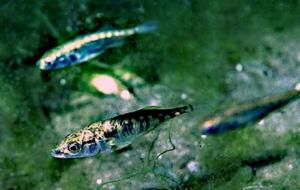
Two Stickleback Fish. Source: wikimedia.org nl:Gebruiker:GerardM/Ron Offermans
Forgiveness is front and center in any theology worth its name. How does it occur in human relationships? What does it mean to hope that it can occur in our relationship with God? Human life in time would be unbearable, said philosopher Hannah Arendt, without the capacity to make promises and then to forgive one another when we fail.
How, though, does that happen?
Let’s consider the human exchange first. Many therapists are—to my mind, rightly—skeptical of giving much time to talk of forgiveness. It can be a way to put the burden of reconciliation on the harmed one. For instance: my father beat me when he got drunk. (Hypothetically, let the reader understand. My actual father did neither. He’s probably reading this. Hi Dad. Thanks for not getting drunk and beating me.) My job is to forgive him and maintain my will to let it go, no matter how hard that is.
That makes forgiveness seem like a heroic effort of human will. Which is too much for any of us, let alone one who is suffering from abuse, betrayal, and all the lasting trauma that bad parenting can bring.
What then?
The Forgiving Fish
I’ve lately been learning about traces of virtue and vice in the animal kingdom. It’s the fascinating newish field of study that asks question like “Are elephants wise?” “Can chimpanzees sin?” “Can dogs experience empathy?” The fun, for me, is that I often learn as much about wisdom, sin, and empathy as I do about elephants, chimps, and dogs.
In an experiment in the 1980s, a scientist observed something remarkable in the behavior of stickleback fish. The small saltwater fish, as was already known, tend to investigate predators in pairs. If they are spotted and the predator turns on them, they cooperate to confuse it and escape.
Sometimes, though, one member of the scouting party betrays its partner. It drops a little behind, choosing its own safety over cooperative risk. When that happens, the lead fish drops back as well, realizing it has an untrustworthy companion.
Through a complex set-up with mirrors, the scientist tried something out. What if one fish saw its companion begin loyally, before dropping back in self-preservation? He discovered that the lead fish might actually give its cowardly partner another chance. It would approach the predator as if the partner might at any moment catch back up and reclaim its place in the committed partnership.
He’s Not His Worst Moment
Increasingly, scientists are observing behavior like that among animals. Creatures that disappoint, and so break the bonds of companionship, are sometimes given another shot. Generally, one faithful member makes a gesture. He or she acts as if the offending member were, after all, a trustworthy partner. When this happens, it can—but doesn’t always—open up surprising scenes of reconciliation where it seemed the relationship was doomed for permanent antagonism.
Studies like this can show us less complicated animals than we are, making forgiveness less complicated than we do. Humans agonize over the memories of harm. We try to seek out our authentic desires. Constantly running on hamsters wheels internally, and then externally with friends and therapists, we ruminate on the deed that brought the hurt. We name and rename the difficulty of wanting something good for our enemy.
But the simple little stickleback fish has a way of making it so simple. Maybe she’s got her own multilayered cerebral process, but I sort of doubt it. The fish “remembers” that her enemy was once better than he is right now. She “chooses” not to evaluate him entirely upon his worst moment. She would be in the right to lock him out from any future scenario of trust. And she simply gives him another shot.
Non-heroic Interventions
I don’t think we can learn all we need to learn about forgiveness from the stickleback fish. I’m glad we have more complex capacities for judgment. I don’t want to get eaten by a predator, and I don’t want to walk back into an abusive relationship. Whatever forgiveness looks like at its fullest, I’m certain it doesn’t look like an undefended return to one who truly is an enemy. While people can change, they often don’t. Forgiveness is not pretending we don’t have pre-frontal cortexes.
So we can’t learn all we need to learn from fish. But we can learn a lot. I think we’re still enough like them that they can show us where forgiveness can start. It can begin with a tiny experiment in trusting the untrustworthy one. We can try small and carefully considered interventions in an otherwise antagonist relationship. Non-heroic opportunities to push reset and see if the results surprise us.
Divine Forgiveness
This is not just the doorway to creaturely exchanges of forgiveness. The prophet Micah says— and I hope you’ll excuse the cheap metaphorical continuity— God “will cast all our sins to the bottom of the sea.” There’s a beautiful fish-like simplicity to that offering. God offers a gesture of reset in our antagonistic relationship. I remember that there is more to you than your worst moment. I’d like to forget that moment, and set out again. I want to hear God to say that to me. Often, in fact.
As I’ve written before, practicing this sort of gesture with one another gives us some traction in receiving divine forgiveness. Those sticklebacks—both the forgiver and the forgiven—will recognize a gesture of interventionist mercy the next time they see it. They’ve got some experience in the forgiveness game.
God can do this for us without the risk of harm. God can forgive completely, without keeping a leery eye on us. That’s more than we can muster, and more than we should try. But the simple and basic act is one I want to learn from. What if I responded to one who has harmed me–maybe just once, in a controlled and considered way– as if he were more than that moment of betrayal?
Doctrines for Various Occasions
Previous Post

February 16, 2022
Where Do We Go When We Die? A Reflection on Macrina
Next Post
February 23, 2022 Diagonal Forgiveness
Browse Our Archives
Select a Category Church Fathers Doctrines for Various Occasions Ecotheology Eschatology Liturgical Seasons Prayer Theology and Literature Uncategorized
Select a Month October 2023 September 2023 August 2023 July 2023 June 2023 February 2023 January 2023 December 2022 November 2022 October 2022 September 2022 August 2022 July 2022 June 2022 May 2022 April 2022 March 2022 February 2022 January 2022 December 2021 November 2021 October 2021 September 2021
Follow Us!
TAKE THE
Religious Wisdom Quiz
How many Beatitudes are in the Sermon on the Mount?
Select your answer to see how you score.
7 10 12 8
Related posts from The Diagonal Way

The Year of the Locust: A Sermon on...

Does Saint Paul Believe in the Trinity?


TRENDING AT PATHEOS General Christian

Seventy and Five Years Old: God Still Starts...
There is a small detail tucked into Genesis 12 that I skipped...

A Biblical Vision of Success in Christian Life...
The Concern and Quest Recent trends and tendencies I note around me...

Indigenous Peoples’ Day and the Church
Indigenous' Peoples Day or Columbus Day? Depending on where you live...

When Spiritual Growth Looks Like Losing Ground
Four Passive Spiritual Disciplines: An Introduction When I was a college freshman,...

Faith and Finding Your Current Season
“To everything there is a season,” Ecclesiastes tells us, “and a time...

Did Jesus Fear God's Wrath in Gethsemane?
That Time Jesus Was Terrified Before we begin, let me say at...
view all General Christian blogs
Ad-Free & Subscriber Log-In Subscription Support
- About Us
- 2026 Calendar
- Videos
- Podcasts
- Library of World Religions
- Faith In Media Tracker
- Advertise With Us
- Write for Us
- Privacy Policy
- Terms of Service
- Do Not Sell My Data
- Contact Us
- Radiant Digital
- Manage Newsletter Subscriptions
- Unsubscribe From Notifications
- Sitemap
Copyright 2008-2026, Patheos. All rights reserved.
Subscription Support Ad-Free & Subscriber Log-In
Follow Patheos