
BuddhistCatholicContemplativeEvangelicalGeneral ChristianHinduJewishLatter-day SaintMuslimNew VisionsProgressive Christian
Beliefs
- Buddhist
- Catholic
- Contemplative
- Evangelical
- General Christian
- Hindu
- Jewish
- Latter-day Saint
- More Voices
- Muslim
- New Visions
- Pagan
- Progressive Christian
Topics
- Religion News
- Food and Religion
- Sports and Religion
- Religious Art
- Religious Music and Entertainment
- Religious Events
- History and Religion
- Style and Religion
- Politics and Religion
- Women in Religion
- Recreation Outdoors and Religion
- Business Finance and Religion
- Careers Workplace and Religion
- Education and Religion
- Family Parenting and Religion
- Health Fitness and Religion
- Home and Religion
- Relationships and Religion
- Technology and Religion
- Travel and Religion
Columnists
- Buddhist Columnists
- Business Finance and Religion Columnists
- Careers Workplace and Religion Columnists
- Catholic Columnists
- Contemplative Columnists
- Education and Religion Columnists
- Evangelists Columnists
- Family Parenting and Religion Columnists
- General Christian Columnists
- Health Fitness and Religion Columnists
- Hindu Columnists
- History and Religion Columnists
- Home and Religion Columnists
- Jewish Columnists
- More Voices Columnists
- Latter Day Columnists
- Muslim Columnists
- New Visions Columnists
- Nonreligious Columnists
- Pagan Columnists
- Politics and Religion Columnists
- Progressive Columnists
- Recreation Outdoors and Religion Columnists
- Relationships and Religion Columnists
- Religion News Columnists
- Religious Art Columnists
- Religious Events Columnists
- Religious Music and Entertainment Columnists
- Sports and Religion Columnists
- Style and Religion Columnists
- Technology and Religion Columnists
- Travel and Religion Columnists
- Women in Religion Columnists
Resource Library
- 2026 Calendar
- Library of World Religions
- The 100 Most Holy Places on Earth
- Patheos Answers
- Podcasts
- Videos
- Faith Leaders Database
- Anglican Episcopalian
- Bahai
- Baptist
- Buddhism
- Christianity
- Confucianism
- Eastern Orthodoxy
- Hinduism
- Holiness and Pentecostal
- ISKCON
- Islam
- Judaism
- Lutheran
- Methodist
- The Church of Jesus Christ of Latter-day Saints
- New Age
- Paganism
- Presbytarian and Reformed
- Protestantism
- Religion Behind the Scenes
- Roman Catholic
- Scientology
- Shia Islam
- Sikhism
- Sufism
- Sunni Islam
- Taoism
- Zen
- See all religions
Research Tools
 Ad-Free & Subscriber Log-In Subscription Support
Ad-Free & Subscriber Log-In Subscription Support
Follow Patheos 

- Trending:
- Forgiveness
- |
- Marriage
- |
- Consciousness
- |
- Death Penalty
- |
- Election
- |
- Halloween
 The Diagonal Way
-
Category
- Home
- General Christian
- Habits, Not Resolutions, for the New Year
Habits, Not Resolutions, for the New Year
Last updated on: January 12, 2022 at 11:27 am by Anthony D Baker
Habits, Not Resolutions, for the New Year 2022-01-12T11:27:26-06:00 Anthony D Baker
Patheos Explore the world's faith through different perspectives on religion and spirituality! Patheos has the views of the prevalent religions and spiritualities of the world.
This January 1st, consider dropping the resolutions and spending time, instead, building new habits.

The End of Resolutions
Does anyone still do New Year’s resolutions? The mid-January jokes are predictable even as they strike home. The only mystery is whether the diet, gym membership, and library card usage will last a whole month, or just a week or two.
What, though, is the alternative, if we’re wise to the fact that resolutions are a recipe for failure and shame? Do we give up, join the joke, grow cynical about change, and make peace with all our uglier habits? If there’s something not right about an annual attempt to will ourselves into a better life, there’s something worse about giving up.
Metanoia
Christian culture values change. The New Testament word is metanoia, conversion. Maximus the Confessor likes the word because its root is nous, the Greek term for the heart, or the center of a person’s being. A metanoia is a turning of the whole person.
We’ve altered the English term “conversion” somewhat in public discourse, so that its first level of meaning is about choice of religion. I “converted,” one might say, to Judaism or to Methodism. But the biblical meaning is not primarily about choice. It’s rather about a whole nous-centered turning. We convert from something—sins, destructive behaviors—and toward something else—life, the way of Jesus.
Metanoia involves a reordering of actions. It’s accompanied by grief, as the old way of living passes out of ones life like a death. “Now I rejoice,” Paul says, “not because you were grieved, but because your grief led to metanoia” (2 Cor 7:9). It’s almost as if he is imagining a physical journey, from a familiar place to somewhere new. Anticipation, hope, grief.
All this is to say that there is a theologically appropriate impulse in our desire to make changes in our lives every January 1st. The trouble is not the desire to change, but the way we frame it.
Habits for Beings with Bodies
Let’s see if we can locate the difference in that framing. A resolution is an operation of the will. Resolutions are appropriate things to make. Humans are creatures with active wills, which is to say with an agency within us that moves us to respond to things we desire.
The trouble comes when we stop the process there. To resolve to do something is a good start. But on its own it is nothing but an assertion, a vocalization of will. A resolution is not enough, because humans are more than walking wills. Paul’s metanoia isn’t just a resolution, but awareness of grief and a desire to change so palpable as to take on physical characteristics.
Thomas Aquinas picked up from Aristotle that ancient adage about humans being creatures of habit. Virtues and vices, for Aristotle, are about the habits that shape the kind of person we’re becoming. Thomas takes up this language and says that sin and righteousness alike are matters of habit. So we are courageous not because we will, in a single intense moment, to have courage. We are courageous, rather, because over a lifetime we have developed the habit of courage. Likewise, we were cowardly that time, not because we willed cowardice, or failed to will courage. We cultivate habits of avoidance and instant gratification, and when the moment for courage comes, we fail to meet it.
Similarly we forgive, Thomas tells us, not because we can sweat ourselves though the heroic effort of not feeling a wound. No, the forgiving person is not the strong-willed hero, but the one who has spent time cultivating empathy and generosity. When the moment calls for an act of forgiveness, it feels no more heroic than a well-practiced pianist hitting the right key in a concert. She’s all practiced up: forgiving comes like muscle-memory.
Attention to habit reminds us that we are embodied beings. Our wills migrate through flesh and organs, and flesh and organs get hungry. They also get tired. They send messages to our wills of boredom, stress, or sadness. Bodies find themselves standing in front of pantries, or staring at social media feeds. And as much as we hope, every January 1st, that the will can command the body, more often the structure of obedience runs the other direction.
Designing for Metanoia
Some recent literature in neuro- and behavior science has helped me reshape some of my own habits. Writers like B. J. Fogg and Robert Kegan and Lisa Lahey may not see themselves as disciples of Thomas Aquinas, but to me they pick up where he left off. They help us see that failures to change behaviors are almost never a simple matter of lack of will. It is at least as much to do with the way that our bodies move around in our familiar spaces. About the resistance of our patterns to expansion or diversion. We don’t need new willful resolve; we need tiny shifts in the architecture of the familiar.
Resolutions can get the priority of grace mixed up, too. We might think, like Pelagius the monk, that our job is to earn God’s favor with our moral resolve. But attention to habits can be a way of letting the light back in. God wants to give me the gift of generosity. How might a small shift in the way I respond to strangers allow me to recognize that gift? Habits are ways of practicing, not earning, God’s grace.
Could we redesign the architecture of our lives so that we could receive this grace? So that our vices could die off, and virtue could grow? What would it look like to find the smallest step to address my habit of resentment? How might I place a prompt in front of me, so that I get some practice at gratitude? What does a daily habitualizing of forgiveness look like, so that when the moment of performance comes, I’m ready?
Those are the questions I’ll be working on this January. I’ll be spending some time with Thomas, Aristotle, and Dr. Fogg, and considering new ways to alter my habits. Instead of making heroic resolutions, I’ll be designing for tiny metanoias.
Many thanks to my colleague Steven Tomlinson for his wisdom on matters of habit formation.
Thanks, also, the editors of Feedspot, for naming my column among their top religion blogs!
Previous Post

December 29, 2021
Watch Night and Christian Freedom
Next Post
January 6, 2022 Gifts of the Magi
Browse Our Archives
Select a Category Church Fathers Doctrines for Various Occasions Ecotheology Eschatology Liturgical Seasons Prayer Theology and Literature Uncategorized
Select a Month October 2023 September 2023 August 2023 July 2023 June 2023 February 2023 January 2023 December 2022 November 2022 October 2022 September 2022 August 2022 July 2022 June 2022 May 2022 April 2022 March 2022 February 2022 January 2022 December 2021 November 2021 October 2021 September 2021
Follow Us!
TAKE THE
Religious Wisdom Quiz
True or False: The Gospel of John records seven miracles (signs) of Jesus.
Select your answer to see how you score.
TRUE FALSE
Related posts from The Diagonal Way
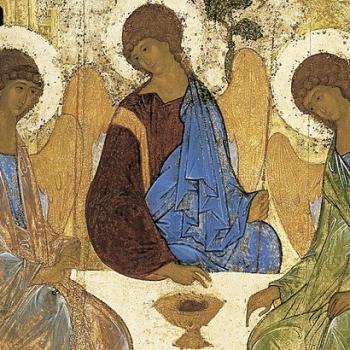
Why do Christians say God is a Trinity?
Advent Is When Christians Talk about Hope. But...
A New Theology for Thanksgiving

TRENDING AT PATHEOS General Christian

Seventy and Five Years Old: God Still Starts...
There is a small detail tucked into Genesis 12 that I skipped...

A Biblical Vision of Success in Christian Life...
The Concern and Quest Recent trends and tendencies I note around me...

Indigenous Peoples’ Day and the Church
Indigenous' Peoples Day or Columbus Day? Depending on where you live...

When Spiritual Growth Looks Like Losing Ground
Four Passive Spiritual Disciplines: An Introduction When I was a college freshman,...

Faith and Finding Your Current Season
“To everything there is a season,” Ecclesiastes tells us, “and a time...

Did Jesus Fear God's Wrath in Gethsemane?
That Time Jesus Was Terrified Before we begin, let me say at...
view all General Christian blogs
Ad-Free & Subscriber Log-In Subscription Support
- About Us
- 2026 Calendar
- Videos
- Podcasts
- Library of World Religions
- Faith In Media Tracker
- Advertise With Us
- Write for Us
- Privacy Policy
- Terms of Service
- Do Not Sell My Data
- Contact Us
- Radiant Digital
- Manage Newsletter Subscriptions
- Unsubscribe From Notifications
- Sitemap
Copyright 2008-2026, Patheos. All rights reserved.
Subscription Support Ad-Free & Subscriber Log-In
Follow Patheos