
BuddhistCatholicContemplativeEvangelicalGeneral ChristianHinduJewishLatter-day SaintMuslimNew VisionsProgressive Christian
Beliefs
- Buddhist
- Catholic
- Contemplative
- Evangelical
- General Christian
- Hindu
- Jewish
- Latter-day Saint
- More Voices
- Muslim
- New Visions
- Pagan
- Progressive Christian
Topics
- Religion News
- Food and Religion
- Sports and Religion
- Religious Art
- Religious Music and Entertainment
- Religious Events
- History and Religion
- Style and Religion
- Politics and Religion
- Women in Religion
- Recreation Outdoors and Religion
- Business Finance and Religion
- Careers Workplace and Religion
- Education and Religion
- Family Parenting and Religion
- Health Fitness and Religion
- Home and Religion
- Relationships and Religion
- Technology and Religion
- Travel and Religion
Columnists
- Buddhist Columnists
- Business Finance and Religion Columnists
- Careers Workplace and Religion Columnists
- Catholic Columnists
- Contemplative Columnists
- Education and Religion Columnists
- Evangelists Columnists
- Family Parenting and Religion Columnists
- General Christian Columnists
- Health Fitness and Religion Columnists
- Hindu Columnists
- History and Religion Columnists
- Home and Religion Columnists
- Jewish Columnists
- More Voices Columnists
- Latter Day Columnists
- Muslim Columnists
- New Visions Columnists
- Nonreligious Columnists
- Pagan Columnists
- Politics and Religion Columnists
- Progressive Columnists
- Recreation Outdoors and Religion Columnists
- Relationships and Religion Columnists
- Religion News Columnists
- Religious Art Columnists
- Religious Events Columnists
- Religious Music and Entertainment Columnists
- Sports and Religion Columnists
- Style and Religion Columnists
- Technology and Religion Columnists
- Travel and Religion Columnists
- Women in Religion Columnists
Resource Library
- 2026 Calendar
- Library of World Religions
- The 100 Most Holy Places on Earth
- Patheos Answers
- Podcasts
- Videos
- Faith Leaders Database
- Anglican Episcopalian
- Bahai
- Baptist
- Buddhism
- Christianity
- Confucianism
- Eastern Orthodoxy
- Hinduism
- Holiness and Pentecostal
- ISKCON
- Islam
- Judaism
- Lutheran
- Methodist
- The Church of Jesus Christ of Latter-day Saints
- New Age
- Paganism
- Presbytarian and Reformed
- Protestantism
- Religion Behind the Scenes
- Roman Catholic
- Scientology
- Shia Islam
- Sikhism
- Sufism
- Sunni Islam
- Taoism
- Zen
- See all religions
Research Tools
 Ad-Free & Subscriber Log-In Subscription Support
Ad-Free & Subscriber Log-In Subscription Support
Follow Patheos 

- Trending:
- Forgiveness
- |
- Marriage
- |
- Consciousness
- |
- Death Penalty
- |
- Election
- |
- Halloween
 The Diagonal Way
-
Category
- Home
- General Christian
- Gifts of the Magi
Gifts of the Magi
Last updated on: January 12, 2022 at 11:27 am by Anthony D Baker
Gifts of the Magi 2022-01-12T11:27:36-06:00 Anthony D Baker
Patheos Explore the world's faith through different perspectives on religion and spirituality! Patheos has the views of the prevalent religions and spiritualities of the world.
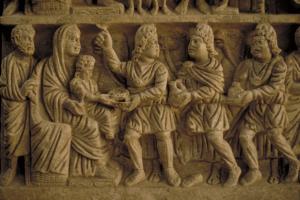
“Sarcophagus relief: Holy Family with the Adoration of the Magi” by MCAD Library is licensed under CC BY 2.0
For those opening this link expecting to read about combs and watch chains, I’m sorry to mislead. It’s Epiphany, and today’s column is about the theological implications of the story in Matthew’s Gospel. Today I am thinking about the post-birth narrative of the Magi who brought gifts to the Christ child.
Risks of the Magi
Matthew’s second chapter is heavy with risk and threat. Recall the elements: the Magi come to celebrate the astrological sign of a new king’s birth. Herod contracts them as informers. They present their gifts in Mary and Joseph’s house and then change routes, deceiving Herod. He is furious and murders all the infants in the region of Bethlehem. (In Matthew, Joseph and Mary are from Bethlehem, and migrate to Nazareth to avoid the ongoing murders of Jewish children. In Luke, they are already living in Nazareth, and wind up in Bethlehem as a result of the census.)
The astrologers from the East are the catalysts for all this high Matthean drama. Herod hears of their inquiries and sniffs insurrection. He can’t, obviously, allow another King of the Jews to usurp his authority. Especially not during a tax cycle, as in Luke’s account, when Caesar is counting on him to send funds back to Rome.
So the Magi are taking so many risks. They risk a long journey west, carrying valuables through foreign lands.They risk open inquiry about a prophesied king. Further, they take the unimaginable risk of defying a puppet king with a Roman Legion at his back.
Why? This is the central question of the story, and the center of the theology of Epiphany. The Magi take all these risks simply so they can give their gifts.
Exchanges of Gifts
Gifts are central to the biblical story, beginning with the opening chapter of Genesis. God creates a world, you might say, as an economy for gift-exchange. The creation of the world is not, I mean, a contract between two existing partners, mutually beneficial for both. Rather, God gives a gift that has existence written into it: I gift you with life. Now creation can come to be, and receive itself as a gift from the gift-giving God.
Similarly, the covenant with Abraham is not a contract with a pre-existing people from which God hopes for some benefit. The election of Israel is not God’s program for divine self-improvement. Instead, God creates the people, separates them out as God once separated land and water, and does so as an unanticipated gift. I will make you a people. As a people, Abraham’s children can enjoy the blessing of God.
Importantly, though, the gifts of life and election are not a one-and-done divine gift. God does not drop off the gift and walk away, as if life and blessing were creation’s or Israel’s to do what we like with. Rather, the gift inaugurates an exchange. “I will bless you, and make your name great, so that you will be a blessing” (Gen 12:2). I freely chose you; now freely chose me, and freely chose to give gifts of blessing to one another.
Creatures are gifts who receive themselves as gift-givers from the Giver of all gifts. That means that our entire existence is made to take shape as exchanges of blessing with one another and with God.
Gifts of the Magi
The nativity story has this same shape. God chooses Mary as a repetition of God’s choice of Abraham. Her submission and hymn of praise return gifts to the one who made her. She spreads the blessing through her womb, to Elizabeth and Zechariah. She gives the covenanted gift of blessing.
But the world of Caesar and Herod is hostile to this generous economy of exchanged blessings. Matthew chapter two is a long version of a short acknowledgment in John’s gospel: “He came to what was his own, and his own people did not accept him” (1:11). In Matthew, creation has lost sight of itself as an economy of blessing. Christ comes as true gift, and the Magi respond with true gifts. And true gifts are a threat to an economy of subjugation, occupation, and taxation. The Magi enter Judea as agents of subversion in an political landscape resistant to blessing.
So they follow the star, and risk so much, in order to restore to creation its proper economy. The true King of the Jews is the Lord of all creation. So wise non-Jews bring gifts to the King whose gifts they themselves already are. They sing a Gentile Magnificat: We bring gifts to the Giver! Let our gold, frankincense, and myrrh stand as a promissory note to all nations. God has freely gifted us with blessing. Let us find ourselves anew as godlike givers of gift, of mutual blessing!
The exchange of gifts is our creation, and it is our salvation. It’s what we find when we come to the house where Mary lays her child. That’s what Epiphany is all about, Charlie Brown.
Previous Post

January 1, 2022
Habits, Not Resolutions, for the New Year
Next Post
January 8, 2022 The Best Theology Books I Read in 2021
Browse Our Archives
Select a Category Church Fathers Doctrines for Various Occasions Ecotheology Eschatology Liturgical Seasons Prayer Theology and Literature Uncategorized
Select a Month October 2023 September 2023 August 2023 July 2023 June 2023 February 2023 January 2023 December 2022 November 2022 October 2022 September 2022 August 2022 July 2022 June 2022 May 2022 April 2022 March 2022 February 2022 January 2022 December 2021 November 2021 October 2021 September 2021
Follow Us!
TAKE THE
Religious Wisdom Quiz
True or False: Ezekiel was commanded to lie on his left side for 390 days and his right side for 40 days.
Select your answer to see how you score.
TRUE FALSE
Related posts from The Diagonal Way
Why do Christians say God is a Trinity?

Advent Is When Christians Talk about Hope. But...

A New Theology for Thanksgiving

TRENDING AT PATHEOS General Christian

Seventy and Five Years Old: God Still Starts...
There is a small detail tucked into Genesis 12 that I skipped...

A Biblical Vision of Success in Christian Life...
The Concern and Quest Recent trends and tendencies I note around me...

Indigenous Peoples’ Day and the Church
Indigenous' Peoples Day or Columbus Day? Depending on where you live...

When Spiritual Growth Looks Like Losing Ground
Four Passive Spiritual Disciplines: An Introduction When I was a college freshman,...

Faith and Finding Your Current Season
“To everything there is a season,” Ecclesiastes tells us, “and a time...

Did Jesus Fear God's Wrath in Gethsemane?
That Time Jesus Was Terrified Before we begin, let me say at...
view all General Christian blogs
Ad-Free & Subscriber Log-In Subscription Support
- About Us
- 2026 Calendar
- Videos
- Podcasts
- Library of World Religions
- Faith In Media Tracker
- Advertise With Us
- Write for Us
- Privacy Policy
- Terms of Service
- Do Not Sell My Data
- Contact Us
- Radiant Digital
- Manage Newsletter Subscriptions
- Unsubscribe From Notifications
- Sitemap
Copyright 2008-2026, Patheos. All rights reserved.
Subscription Support Ad-Free & Subscriber Log-In
Follow Patheos