
BuddhistCatholicContemplativeEvangelicalGeneral ChristianHinduJewishLatter-day SaintMuslimNew VisionsProgressive Christian
Beliefs
- Buddhist
- Catholic
- Contemplative
- Evangelical
- General Christian
- Hindu
- Jewish
- Latter-day Saint
- More Voices
- Muslim
- New Visions
- Pagan
- Progressive Christian
Topics
- Religion News
- Food and Religion
- Sports and Religion
- Religious Art
- Religious Music and Entertainment
- Religious Events
- History and Religion
- Style and Religion
- Politics and Religion
- Women in Religion
- Recreation Outdoors and Religion
- Business Finance and Religion
- Careers Workplace and Religion
- Education and Religion
- Family Parenting and Religion
- Health Fitness and Religion
- Home and Religion
- Relationships and Religion
- Technology and Religion
- Travel and Religion
Columnists
- Buddhist Columnists
- Business Finance and Religion Columnists
- Careers Workplace and Religion Columnists
- Catholic Columnists
- Contemplative Columnists
- Education and Religion Columnists
- Evangelists Columnists
- Family Parenting and Religion Columnists
- General Christian Columnists
- Health Fitness and Religion Columnists
- Hindu Columnists
- History and Religion Columnists
- Home and Religion Columnists
- Jewish Columnists
- More Voices Columnists
- Latter Day Columnists
- Muslim Columnists
- New Visions Columnists
- Nonreligious Columnists
- Pagan Columnists
- Politics and Religion Columnists
- Progressive Columnists
- Recreation Outdoors and Religion Columnists
- Relationships and Religion Columnists
- Religion News Columnists
- Religious Art Columnists
- Religious Events Columnists
- Religious Music and Entertainment Columnists
- Sports and Religion Columnists
- Style and Religion Columnists
- Technology and Religion Columnists
- Travel and Religion Columnists
- Women in Religion Columnists
Resource Library
- 2026 Calendar
- Library of World Religions
- The 100 Most Holy Places on Earth
- Patheos Answers
- Podcasts
- Videos
- Faith Leaders Database
- Anglican Episcopalian
- Bahai
- Baptist
- Buddhism
- Christianity
- Confucianism
- Eastern Orthodoxy
- Hinduism
- Holiness and Pentecostal
- ISKCON
- Islam
- Judaism
- Lutheran
- Methodist
- The Church of Jesus Christ of Latter-day Saints
- New Age
- Paganism
- Presbytarian and Reformed
- Protestantism
- Religion Behind the Scenes
- Roman Catholic
- Scientology
- Shia Islam
- Sikhism
- Sufism
- Sunni Islam
- Taoism
- Zen
- See all religions
Research Tools
 Ad-Free & Subscriber Log-In Subscription Support
Ad-Free & Subscriber Log-In Subscription Support
Follow Patheos 

- Trending:
- Forgiveness
- |
- Marriage
- |
- Consciousness
- |
- Death Penalty
- |
- Election
- |
- Halloween
 The Diagonal Way
-
Category
- Home
- General Christian
- Subjectivity is Truth: Returning to Kierkegaard
Subjectivity is Truth: Returning to Kierkegaard
Last updated on: December 15, 2021 at 1:00 pm by Anthony D Baker
Subjectivity is Truth: Returning to Kierkegaard 2021-12-15T13:00:15-06:00 Anthony D Baker
Patheos Explore the world's faith through different perspectives on religion and spirituality! Patheos has the views of the prevalent religions and spiritualities of the world.
“Subjectivity is truth.” That is the famous and famously cryptic sentence at the heart of Soren Kierkegaard’s very philosophical theology. It’s been back in my consciousness lately, though it’s been a few years since I’ve spent time with the elusive Dane. I’ve been reading some essays by Paul DeHart, a theologian at Vanderbilt, and Kierkegaard is one of the thinkers he often circles back to.
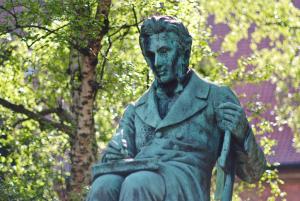
Kierkegaard and Me
It’s that way for many of us, it seems. Kierkegaard doesn’t like to let go. My journey with him began in college, and I remember it as an intense and exciting time of discovery. It was my senior year at Olivet Nazarene University, and our professor Craig Keen was leading a group of eager young evangelicals through the bulk of the texts. My classmates and I spent late nights in the library or in one another’s apartments, debating the odd vignettes of Either/Or and the surprising moves of the Concluding Unscientific Postscript. We tried to get inside Kierkegaard’s lifelong wrestling match with the Christian philosophy of the great G. W. F. Hegel. We puzzled through the key terms, trying to weave a coherent path through all we were learning. Faith, immediacy, the moment, repetition, paradox, contradiction. What did this playful, pugnacious writer mean by all this?
Within and around all those challenging ideas, there is, by philosophers’ standards, quite a lot of biographical intrigue. His sad love affair, a public argument with a pastor. His slightly too believable parables of a seducer. There was plenty there to keep the interest of 21 year-old holiness kids.
DeHart finds the center of Kierkegaard’s life and thought in “the restless will to be the self.” I think that’s a pretty good way of putting it. What’s more, that restless will is where his philosophy reveals a theological underbelly. “Subjectivity is truth” does not mean “individualism is the way,” or something Ayn Rand-ish like that. It means, instead, that there’s no discovery of the truth of the universe for humans without a turn inward. Without, that is, a courageous resolve to confront myself. This confrontation, in turn, becomes the surprising place where the God beyond my own will is revealed.
Stages on Life’s Way
A repeated motif in Kierkegaard’s writings describes this revelation through stages of life. They go something like this:
- Pursuing pleasure and immediate gratification, I am unreflective about my life. I assume I am living my life fully.
- As I begin to reflect, I suspect that I am not living my life, but my life is living me. I determine to live with moral intentionality, regardless of the lack of pleasure or reward such a life brings.
- I encounter God as a burst of grace within my restless struggle to live a good life. In a moment, or in a series of differently repeated moments more likely, I discover that my moral resolve was itself only preparation for the gift of life that God has for me. My turn within has opened me to the God beyond. I am not my own truth, but my subjective resolve has led me to truth.
Kierkegaard is sometimes called the father of existentialism. I think that’s not wrong, as long as we don’t make him into a mid- twentieth century Frenchman with a cigarette and no sense of humor. The turn inward is for him about what emerges as we pay attention to our existence, to our way of existing in the world. You might say that there’s a deep asceticism to Kierkegaard, though it’s not the asceticism of the desert fathers and mothers. He’s the desert father one would encounter in modern Copenhagen, going to the opera and sitting in a cafe reading the newspaper.
Kierkegaard on the Diagonal Way
For me, all of this makes him a companion on the diagonal way. Deep attention to the way I live in the world is the only trustworthy pathway toward God. “Inwardness,” he sometimes calls it. Kierkegaard never lets us rest with the easy assumption that God is lying around the world waiting to be discovered. Kierkegaard is not kind to the notion that a person, a church, or a culture can assume that God is on his/her/its side. This brings out some of his funniest or (and!) most vitriolic prose.
God is not “out there” to be found, because divinity shows up in the world in the paradox of a God-human. Truth shows up in the world as a treasure hidden in a field. Without the courage and resolve to go digging, we’ll see only the field. Just as the contemporaries of Jesus had to sit with hard or confusing teachings if they ever hoped to hear the divine voice speaking. The heart of the gospel, for Kierkegaard, is that God’s truth enters the world and makes things difficult.
Subjectivity is Truth
Prayer is difficult. Moral resolve is difficult. Faithfulness in marriage and family life is difficult. Loving one’s neighbor is difficult, before we even get to the question of strangers and enemies. But the greatest paradox of all, and the mysterious turn that delights and frustrates his readers, is that this difficult path is only a stage on life’s way. The dancer must train and retrain her steps, but this is all in service of the majestic leap from the dance floor. The Christian learns and relearns the habits of discipleship, but all this is in service of the moment of immediacy, the moment when God’s eternal gift bursts into our consciousness.
And still, avoidance of ourselves, our habits, our unique pathways of existence, is the surest way to avoid this surprise of divine presence. For Kierkegaard, the courage to face ourselves is the beginning of the courage to meet God. Our irreplaceable subjectivity is truth.
Previous Post

December 11, 2021
What is Hell?
Next Post
December 18, 2021 Does God Remember a Lost Future?
Browse Our Archives
Select a Category Church Fathers Doctrines for Various Occasions Ecotheology Eschatology Liturgical Seasons Prayer Theology and Literature Uncategorized
Select a Month October 2023 September 2023 August 2023 July 2023 June 2023 February 2023 January 2023 December 2022 November 2022 October 2022 September 2022 August 2022 July 2022 June 2022 May 2022 April 2022 March 2022 February 2022 January 2022 December 2021 November 2021 October 2021 September 2021
Follow Us!
TAKE THE
Religious Wisdom Quiz
We were commanded to send away our foreign wives and children to remain faithful to God. Who are we?
Select your answer to see how you score.
The Levites The standing army The returning exiles The Priests
Related posts from The Diagonal Way

What Have I Been Reading? My End of...


Grief and Hope in a Suffering Creation
God’s Faithfulness: A Sermon for Corpus Christi College,...
TRENDING AT PATHEOS General Christian

Seventy and Five Years Old: God Still Starts...
There is a small detail tucked into Genesis 12 that I skipped...

A Biblical Vision of Success in Christian Life...
The Concern and Quest Recent trends and tendencies I note around me...

Indigenous Peoples’ Day and the Church
Indigenous' Peoples Day or Columbus Day? Depending on where you live...

When Spiritual Growth Looks Like Losing Ground
Four Passive Spiritual Disciplines: An Introduction When I was a college freshman,...

Faith and Finding Your Current Season
“To everything there is a season,” Ecclesiastes tells us, “and a time...

Did Jesus Fear God's Wrath in Gethsemane?
That Time Jesus Was Terrified Before we begin, let me say at...
view all General Christian blogs
Ad-Free & Subscriber Log-In Subscription Support
- About Us
- 2026 Calendar
- Videos
- Podcasts
- Library of World Religions
- Faith In Media Tracker
- Advertise With Us
- Write for Us
- Privacy Policy
- Terms of Service
- Do Not Sell My Data
- Contact Us
- Radiant Digital
- Manage Newsletter Subscriptions
- Unsubscribe From Notifications
- Sitemap
Copyright 2008-2026, Patheos. All rights reserved.
Subscription Support Ad-Free & Subscriber Log-In
Follow Patheos