
BuddhistCatholicContemplativeEvangelicalGeneral ChristianHinduJewishLatter-day SaintMuslimNew VisionsProgressive Christian
Beliefs
- Buddhist
- Catholic
- Contemplative
- Evangelical
- General Christian
- Hindu
- Jewish
- Latter-day Saint
- More Voices
- Muslim
- New Visions
- Pagan
- Progressive Christian
Topics
- Religion News
- Food and Religion
- Sports and Religion
- Religious Art
- Religious Music and Entertainment
- Religious Events
- History and Religion
- Style and Religion
- Politics and Religion
- Women in Religion
- Recreation Outdoors and Religion
- Business Finance and Religion
- Careers Workplace and Religion
- Education and Religion
- Family Parenting and Religion
- Health Fitness and Religion
- Home and Religion
- Relationships and Religion
- Technology and Religion
- Travel and Religion
Columnists
- Buddhist Columnists
- Business Finance and Religion Columnists
- Careers Workplace and Religion Columnists
- Catholic Columnists
- Contemplative Columnists
- Education and Religion Columnists
- Evangelists Columnists
- Family Parenting and Religion Columnists
- General Christian Columnists
- Health Fitness and Religion Columnists
- Hindu Columnists
- History and Religion Columnists
- Home and Religion Columnists
- Jewish Columnists
- More Voices Columnists
- Latter Day Columnists
- Muslim Columnists
- New Visions Columnists
- Nonreligious Columnists
- Pagan Columnists
- Politics and Religion Columnists
- Progressive Columnists
- Recreation Outdoors and Religion Columnists
- Relationships and Religion Columnists
- Religion News Columnists
- Religious Art Columnists
- Religious Events Columnists
- Religious Music and Entertainment Columnists
- Sports and Religion Columnists
- Style and Religion Columnists
- Technology and Religion Columnists
- Travel and Religion Columnists
- Women in Religion Columnists
Resource Library
- 2026 Calendar
- Library of World Religions
- The 100 Most Holy Places on Earth
- Patheos Answers
- Podcasts
- Videos
- Faith Leaders Database
- Anglican Episcopalian
- Bahai
- Baptist
- Buddhism
- Christianity
- Confucianism
- Eastern Orthodoxy
- Hinduism
- Holiness and Pentecostal
- ISKCON
- Islam
- Judaism
- Lutheran
- Methodist
- The Church of Jesus Christ of Latter-day Saints
- New Age
- Paganism
- Presbytarian and Reformed
- Protestantism
- Religion Behind the Scenes
- Roman Catholic
- Scientology
- Shia Islam
- Sikhism
- Sufism
- Sunni Islam
- Taoism
- Zen
- See all religions
Research Tools
 Ad-Free & Subscriber Log-In Subscription Support
Ad-Free & Subscriber Log-In Subscription Support
Follow Patheos 

- Trending:
- Forgiveness
- |
- Marriage
- |
- Consciousness
- |
- Death Penalty
- |
- Election
- |
- Halloween
 The Diagonal Way
-
Category
- Home
- General Christian
- The Thrill of Mary the Godbearer
The Thrill of Mary the Godbearer
Last updated on: January 12, 2022 at 11:28 am by Anthony D Baker
The Thrill of Mary the Godbearer 2022-01-12T11:28:24-06:00 Anthony D Baker
Patheos Explore the world's faith through different perspectives on religion and spirituality! Patheos has the views of the prevalent religions and spiritualities of the world.
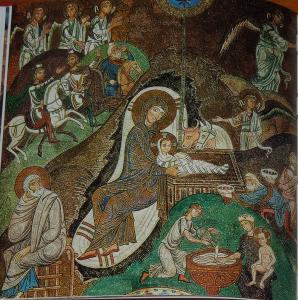
“Nativity Icon Mosaic” by bobosh_t is licensed under CC BY-SA 2.0
In this first week of Advent, I’m contemplating Mary the Godbearer. All who celebrate Christmas in one way or another, from priest to grandmother to toddler, are contemplating her. We’re waiting for the birth. Packing nine months gestation into four Sundays. For the next 24 days, we’re all pregnant with Emmanuel. We’re all Mary, this month.
On my wall at home I’ve hung an Orthodox icon of the Nativity. It’s a wild piece of art, as icons go. All around the border are dramatic scenes of the birth narrative: shepherds wondering at angel song, Magi en route, Joseph contemplating divorce, the swaddled child. And in the center Mary reclines peacefully, outlined in bright red in my version. The icon wants me to notice the child. But first it wants me to find myself in Mary.
The Thrill of Mary the Godbearer
A Marian piety is a good thing to have, whether you’re Roman Catholic, Protestant, or Eastern Orthodox. Fr. Sergei Bulgakov of the Russian Orthodox Church writes that Mary is a focal point of the Christian faith, as the figure of a human who is “forever conceiving God, holding him in her womb, giving birth to him.”
That’s what I want to be. I want to conceive, gestate, and birth God into the world. I want to be like Mary.
That notion, that a human can be a Godbearer, was both thrilling and offensive in the first centuries of Christianity. It generated a view of Jesus, in fact, that was eventually declared heretical. That view says that Jesus had a human being and a divine being, but only the human part was born from Mary. She is human-bearer, not Godbearer. It could be that the idea of God passing through not just humanity, but the body of the woman, made this doubly offensive. A later version said that we can call Mary Christotokos, Christbearer, but not Theotokos, Godbearer.
The argument against the first version, that Mary was only a humanbearer, was that if Mary only conceived and bore the human, then God is not actually with us in Jesus. Jesus, in that case, would have been sometimes human, sometimes divine, but never the union of both in a a single Person.
The argument against the second version, that Mary was Christbearer but not Godbearer, was that the second version was avoiding the issue and so not really worth arguing with.
It was an offensive idea. But it was also a thrilling idea, one I’ve written about before. That two ways of being that seem mutually resistant by definition, divine and human, are in fact not. The thrill is how God does not push aside a young powerless girl from Nazareth, but instead waits on her response. Divine saving work comes mediated through human agency. In Mary, a human conceives, bears, and delivers God into the world.
Thrilling: the possibility that all humans can find our calling in Mary the Godbearer. That we can bring into the world the One God of Israel, shaped by our own bodies.
Bodies Mediating Grace
Luke’s Gospel shows the thrill of this human mediation. Mary introduces grace through her body right away, as her story intersects with her another’s. Mary and the priest Zechariah have nearly identical stories, but the order is essential:
- Gabriel visits Zechariah. When the angel tells him that he and Elizabeth will give birth, he asks, “How will I know?” After all, “my wife is getting on in years.”
- Gabriel visits Mary. When the angel tell her that she will give birth, she asks, “How can this be, since I am a virgin?”
But the angel renders Zechariah mute for his response, whereas Mary gets a second chance to say “Here I am.” What is the difference?
It is not, I think, in their doubt-filled initial reply. While I love the beauty of Catholic venerations of the Blessed Virgin—pilgrimages, iconography, the Ave Maria—I find the dogma of Mary’s sinlessness to be theologically and historically questionable. I can write about that another time if you like.
It’s not the difference between Mary and Zechariah, but what happens next, that is the key.
- Mary visits Elizabeth
- Elizabeth’s child leaps in the womb
- Zechariah’s lips are opened
Luke is showing the centrality of Mary’s body, and the body of the one she carries. The child conceived in Elizabeth will “make ready a people prepared for the Lord.” In the visitation scene, though, the one who “makes people ready” is now Mary’s child. Pre-natal John leaps in the womb at pre-natal Jesus’ presence. Then Elizabeth goes back home, insists on the name the angel told to Zechariah, and suddenly her husband’s throat is healed. Body’s have mediated grace: Mary’s son has made a way.
Becoming Godbearers
Luke’s carefully ordered story reveals that Mary’s child is the homecoming of Israel’s faith, the presence of God that brings healing and hope and song for priest and virgin alike. Mary can sing her Magnificat because salvation is growing inside her. Zechariah can sing his praises again because salvation came near him when John jumped and Elizabeth brought the saving jump home.
And all that healing presence comes through a human body. That’s what I’m contemplating this Advent season. A human body that shapes Isreal’s God within it. A presence that can call up a saving jump in others it encounters. I’m contemplating Mary, as the Godbearer that I’d like to become.
Previous Post

November 27, 2021
When Jesus Celebrated Hanukkah
Next Post
December 4, 2021 What is Heaven?
Browse Our Archives
Select a Category Church Fathers Doctrines for Various Occasions Ecotheology Eschatology Liturgical Seasons Prayer Theology and Literature Uncategorized
Select a Month October 2023 September 2023 August 2023 July 2023 June 2023 February 2023 January 2023 December 2022 November 2022 October 2022 September 2022 August 2022 July 2022 June 2022 May 2022 April 2022 March 2022 February 2022 January 2022 December 2021 November 2021 October 2021 September 2021
Follow Us!
TAKE THE
Religious Wisdom Quiz
Who wasted his wealth and ended up feeding pigs?
Select your answer to see how you score.
The Good Samaritan The Pharisee The Sower The Prodigal Son
Related posts from The Diagonal Way
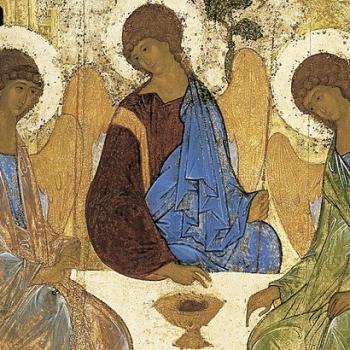
Why do Christians say God is a Trinity?
Advent Is When Christians Talk about Hope. But...
A New Theology for Thanksgiving

ROCOR: The (A) Russian Church Abroad
TRENDING AT PATHEOS General Christian

Seventy and Five Years Old: God Still Starts...
There is a small detail tucked into Genesis 12 that I skipped...

A Biblical Vision of Success in Christian Life...
The Concern and Quest Recent trends and tendencies I note around me...

Indigenous Peoples’ Day and the Church
Indigenous' Peoples Day or Columbus Day? Depending on where you live...

When Spiritual Growth Looks Like Losing Ground
Four Passive Spiritual Disciplines: An Introduction When I was a college freshman,...

Faith and Finding Your Current Season
“To everything there is a season,” Ecclesiastes tells us, “and a time...

Did Jesus Fear God's Wrath in Gethsemane?
That Time Jesus Was Terrified Before we begin, let me say at...
view all General Christian blogs
Ad-Free & Subscriber Log-In Subscription Support
- About Us
- 2026 Calendar
- Videos
- Podcasts
- Library of World Religions
- Faith In Media Tracker
- Advertise With Us
- Write for Us
- Privacy Policy
- Terms of Service
- Do Not Sell My Data
- Contact Us
- Radiant Digital
- Manage Newsletter Subscriptions
- Unsubscribe From Notifications
- Sitemap
Copyright 2008-2026, Patheos. All rights reserved.
Subscription Support Ad-Free & Subscriber Log-In
Follow Patheos