
BuddhistCatholicContemplativeEvangelicalGeneral ChristianHinduJewishLatter-day SaintMuslimNew VisionsProgressive Christian
Beliefs
- Buddhist
- Catholic
- Contemplative
- Evangelical
- General Christian
- Hindu
- Jewish
- Latter-day Saint
- More Voices
- Muslim
- New Visions
- Pagan
- Progressive Christian
Topics
- Religion News
- Food and Religion
- Sports and Religion
- Religious Art
- Religious Music and Entertainment
- Religious Events
- History and Religion
- Style and Religion
- Politics and Religion
- Women in Religion
- Recreation Outdoors and Religion
- Business Finance and Religion
- Careers Workplace and Religion
- Education and Religion
- Family Parenting and Religion
- Health Fitness and Religion
- Home and Religion
- Relationships and Religion
- Technology and Religion
- Travel and Religion
Columnists
- Buddhist Columnists
- Business Finance and Religion Columnists
- Careers Workplace and Religion Columnists
- Catholic Columnists
- Contemplative Columnists
- Education and Religion Columnists
- Evangelists Columnists
- Family Parenting and Religion Columnists
- General Christian Columnists
- Health Fitness and Religion Columnists
- Hindu Columnists
- History and Religion Columnists
- Home and Religion Columnists
- Jewish Columnists
- More Voices Columnists
- Latter Day Columnists
- Muslim Columnists
- New Visions Columnists
- Nonreligious Columnists
- Pagan Columnists
- Politics and Religion Columnists
- Progressive Columnists
- Recreation Outdoors and Religion Columnists
- Relationships and Religion Columnists
- Religion News Columnists
- Religious Art Columnists
- Religious Events Columnists
- Religious Music and Entertainment Columnists
- Sports and Religion Columnists
- Style and Religion Columnists
- Technology and Religion Columnists
- Travel and Religion Columnists
- Women in Religion Columnists
Resource Library
- 2026 Calendar
- Library of World Religions
- The 100 Most Holy Places on Earth
- Patheos Answers
- Podcasts
- Videos
- Faith Leaders Database
- Anglican Episcopalian
- Bahai
- Baptist
- Buddhism
- Christianity
- Confucianism
- Eastern Orthodoxy
- Hinduism
- Holiness and Pentecostal
- ISKCON
- Islam
- Judaism
- Lutheran
- Methodist
- The Church of Jesus Christ of Latter-day Saints
- New Age
- Paganism
- Presbytarian and Reformed
- Protestantism
- Religion Behind the Scenes
- Roman Catholic
- Scientology
- Shia Islam
- Sikhism
- Sufism
- Sunni Islam
- Taoism
- Zen
- See all religions
Research Tools
 Ad-Free & Subscriber Log-In Subscription Support
Ad-Free & Subscriber Log-In Subscription Support
Follow Patheos 

- Trending:
- Forgiveness
- |
- Marriage
- |
- Consciousness
- |
- Death Penalty
- |
- Election
- |
- Halloween
 The Diagonal Way
-
Category
- Home
- General Christian
- The Cross as the Meaning of Suffering
The Cross as the Meaning of Suffering
Last updated on: January 12, 2022 at 11:33 am by Anthony D Baker
The Cross as the Meaning of Suffering 2022-01-12T11:33:03-06:00 Anthony D Baker
Patheos Explore the world's faith through different perspectives on religion and spirituality! Patheos has the views of the prevalent religions and spiritualities of the world.
The posts in this column contemplate our diagonal connection to God. I have written here, I mean, about the way that our life in time slopes upward into the eternal life of God. Is that too optimistic? Can these contemplations bear the weight of suffering? Should we even try to offer a meaning of suffering? Let’s take a moment to consider how the diagonal way might also be the way of the cross.
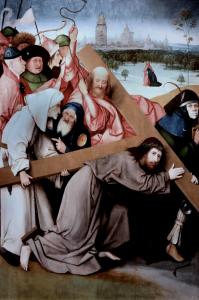
Hieronymous Bosch, _Carrying the Cross_, 1490
Why Do We Talk about Suffering?
There’s an irony to our worst pains: they defy description, and yet we can’t stop talking about them. Whether we deal with pain by calling a friend or writing a country song, humans seem driven to put the unspeakable into words.
“There’s a grief that can’t be spoken,” Marius sings in Les Miserables. And yet he keeps singing it: he speaks the unspeakable into song. The chorus of a classic tragedy sings long refrains about how the pain on stage resists language.
A recent issue of the journal Modern Theology took up this question. The issue featured a debate between Rowan Williams and David Bentley Hart, two of the greatest living theologians by any estimation. Williams had just written a book, The Tragic Imagination, and Hart challenged it, in the spirit of good, friendly, constructive banter. Hart took offense in particular at the William’s insistence that even tragedy never quite finds the end of language. Hart thinks that some suffering defies the impulse to speak. Williams argued back that a theologically informed imagination can’t give up on the hope that all suffering could one day make its way into words. Williams, by my estimation, got the better of the argument. If you’re keeping score.
Is Suffering the End of Meaning?
Suffering is like—feels like—the world attempting to escape meaning. It makes us aware that everything doesn’t actually happen for a reason, at least not in the sense that we tend to use that banal proverb. Some things defy reason. The death of a child or young person. A betrayal by a trusted friend or spouse. A hurricane that brings an island to its knees.
Still, the hope that all of this will eventually be “wordable” is consistent with the Christian insistence that “all things were made through Logos,” God’s original and originating Word. All things are likewise redeemed through this same Word: that’s the whole gospel right there. If a thing were utterly and conclusively unspeakable, then it would be utterly unredeemable. And Christians are charged with hoping nothing is like that.
So we speak. We don’t try to speak the ultimate and divine Logos itself, but rather our limited human-sized moments of meaning. We speak what the Greek theologians call our “little logoi.” Tiny words.
How Do We Make Meaning of the Cross?
Not that it’s easy. At the center of the Christian redemption story is the cross, and Dr. King noted that it is “difficult to see the love of God in such a shameful tragedy.” He could have said “meaning” just as easily where he said love. Difficult, but the preacher keeps preaching. The late James Cone connected King’s observation with the lament of Emmett Till’s mother over the death of her son. “Lord, you gave your Son to remedy a condition, but who knows but what the death of my only son might bring an end to lynching.” There was no meaning to the lynching. And yet she is prepared to try making some, just as Saint Paul and Dr. King attempted to make difficult meaning of the cross.
Nicholas of Cusa (d. 1464) called this halting attempt to put the unspeakable into words “conjecture.” “Every human affirmation about what is true is a conjecture.” (1.2) That’s always the case because our lives share in the great and changeless truth—Logos, meaningfulness—without being equal to it. For Nicholas that means whether the object or moment we encounter brings us joy or sorrow, we are never fully encountering its truth. To name the meaning of this birth, this death, this peaceful moment, requires a risky and creative use of language. It requires a conjecture.
These conjectures may use metaphor: perhaps the Friday of Jesus’ death was like the Day of Atonement, Saint Paul says. Perhaps my son’s suffering could be vicarious like your Son’s was, Emmett’s mother prays. Or, when we’re utterly at a loss, we may simply conjecture out loud on the event’s unspeakability, like Marius and the chorus of Oedipus Rex.
The Cross and the Diagonal Way
The diagonal way is our human attempt to share in divine meaning. This attempt is at its most challenging in the midst of overwhelming tragedy.
But the diagonal way is also the way of the cross. Not so much the cross planted in the ground, but angled over shoulders, first of Jesus then of Simon. On the road up the hill. From that angle, its beams are neither pointing directly up at the heavens or down at the ground. Instead they trace a line from the steps just in front of their bearer, and another from the steps just behind, toward a hazy horizon on either side. There is no transcendent sky that is not also linked with the dust of the road. But neither is there any patch of road that is not also touched by a ray of heavenly light.
On those diagonals of the cross, we conjecture on divine meaning. It’s never clear. It has no direct path to the heavenly Logos. It’s like Mrs. Till Bradley’s halting attempt to understand her loss. But she will try. She will use the language of the dusty path up the tragic hill to say what can’t possibly be said. A Christian can do no less. Because only what is taken up by Word can be healed.
So we pray our pain Godward, toward what we hope is a final, meaningful horizon.
Doctrines for Various Occasions
Previous Post

October 6, 2021
Sin (and Sociopaths. And Vampires)
Next Post
October 13, 2021 Can a Place Make Us Holy?
Browse Our Archives
Select a Category Church Fathers Doctrines for Various Occasions Ecotheology Eschatology Liturgical Seasons Prayer Theology and Literature Uncategorized
Select a Month October 2023 September 2023 August 2023 July 2023 June 2023 February 2023 January 2023 December 2022 November 2022 October 2022 September 2022 August 2022 July 2022 June 2022 May 2022 April 2022 March 2022 February 2022 January 2022 December 2021 November 2021 October 2021 September 2021
Follow Us!
TAKE THE
Religious Wisdom Quiz
What does "Beersheba" mean?
Select your answer to see how you score.
Valley of Water House of the King Well of the Oath Blessed Field
Related posts from The Diagonal Way

The Year of the Locust: A Sermon on...
Does Saint Paul Believe in the Trinity?

TRENDING AT PATHEOS General Christian

Seventy and Five Years Old: God Still Starts...
There is a small detail tucked into Genesis 12 that I skipped...

A Biblical Vision of Success in Christian Life...
The Concern and Quest Recent trends and tendencies I note around me...

Indigenous Peoples’ Day and the Church
Indigenous' Peoples Day or Columbus Day? Depending on where you live...

When Spiritual Growth Looks Like Losing Ground
Four Passive Spiritual Disciplines: An Introduction When I was a college freshman,...

Faith and Finding Your Current Season
“To everything there is a season,” Ecclesiastes tells us, “and a time...

Did Jesus Fear God's Wrath in Gethsemane?
That Time Jesus Was Terrified Before we begin, let me say at...
view all General Christian blogs
Ad-Free & Subscriber Log-In Subscription Support
- About Us
- 2026 Calendar
- Videos
- Podcasts
- Library of World Religions
- Faith In Media Tracker
- Advertise With Us
- Write for Us
- Privacy Policy
- Terms of Service
- Do Not Sell My Data
- Contact Us
- Radiant Digital
- Manage Newsletter Subscriptions
- Unsubscribe From Notifications
- Sitemap
Copyright 2008-2026, Patheos. All rights reserved.
Subscription Support Ad-Free & Subscriber Log-In
Follow Patheos