
BuddhistCatholicContemplativeEvangelicalGeneral ChristianHinduJewishLatter-day SaintMuslimNew VisionsProgressive Christian
Beliefs
- Buddhist
- Catholic
- Contemplative
- Evangelical
- General Christian
- Hindu
- Jewish
- Latter-day Saint
- More Voices
- Muslim
- New Visions
- Pagan
- Progressive Christian
Topics
- Religion News
- Food and Religion
- Sports and Religion
- Religious Art
- Religious Music and Entertainment
- Religious Events
- History and Religion
- Style and Religion
- Politics and Religion
- Women in Religion
- Recreation Outdoors and Religion
- Business Finance and Religion
- Careers Workplace and Religion
- Education and Religion
- Family Parenting and Religion
- Health Fitness and Religion
- Home and Religion
- Relationships and Religion
- Technology and Religion
- Travel and Religion
Columnists
- Buddhist Columnists
- Business Finance and Religion Columnists
- Careers Workplace and Religion Columnists
- Catholic Columnists
- Contemplative Columnists
- Education and Religion Columnists
- Evangelists Columnists
- Family Parenting and Religion Columnists
- General Christian Columnists
- Health Fitness and Religion Columnists
- Hindu Columnists
- History and Religion Columnists
- Home and Religion Columnists
- Jewish Columnists
- More Voices Columnists
- Latter Day Columnists
- Muslim Columnists
- New Visions Columnists
- Nonreligious Columnists
- Pagan Columnists
- Politics and Religion Columnists
- Progressive Columnists
- Recreation Outdoors and Religion Columnists
- Relationships and Religion Columnists
- Religion News Columnists
- Religious Art Columnists
- Religious Events Columnists
- Religious Music and Entertainment Columnists
- Sports and Religion Columnists
- Style and Religion Columnists
- Technology and Religion Columnists
- Travel and Religion Columnists
- Women in Religion Columnists
Resource Library
- 2026 Calendar
- Library of World Religions
- The 100 Most Holy Places on Earth
- Patheos Answers
- Podcasts
- Videos
- Faith Leaders Database
- Anglican Episcopalian
- Bahai
- Baptist
- Buddhism
- Christianity
- Confucianism
- Eastern Orthodoxy
- Hinduism
- Holiness and Pentecostal
- ISKCON
- Islam
- Judaism
- Lutheran
- Methodist
- The Church of Jesus Christ of Latter-day Saints
- New Age
- Paganism
- Presbytarian and Reformed
- Protestantism
- Religion Behind the Scenes
- Roman Catholic
- Scientology
- Shia Islam
- Sikhism
- Sufism
- Sunni Islam
- Taoism
- Zen
- See all religions
Research Tools
 Ad-Free & Subscriber Log-In Subscription Support
Ad-Free & Subscriber Log-In Subscription Support
Follow Patheos 

- Trending:
- Forgiveness
- |
- Marriage
- |
- Consciousness
- |
- Death Penalty
- |
- Election
- |
- Halloween

- Home
- New Visions
- Home and Religion
- Love the World or Don’t Love the World
Love the World or Don’t Love the World
Last updated on: November 5, 2025 at 5:40 pm by Karl J. Forehand
Love the World or Don’t Love the World 2025-11-05T17:40:55-06:00 Karl J. Forehand
Patheos Explore the world's faith through different perspectives on religion and spirituality! Patheos has the views of the prevalent religions and spiritualities of the world.
Love the World or Don’t Love the World
One of the things we do for influential people is make excuses for them or try to explain what they really meant when they say something that doesn’t align with our worldview, or when people get upset by what that person said. This is clearly evident with our current President. His supporters say they like him because he says what he means, but when he says something outlandish, they don’t accept it, yet they can’t disagree with him, so they rely on the classic phrase they learned in religion and say, “This is what he really meant.”
We start noticing these contradictions even as young children. Children question whether a God who says ‘do not kill’ is justified when He slaughters masses of people, commits genocide against groups, and once killed the entire world. Sunday school teachers and those repeating what they hear from the pulpit quickly learn to make assumptions or repeat the party line to those they teach. Saying “What that means is…” is often a defense mechanism more than an educated response.
When simple explanations fall short, they resort to the standard escape hatch of “God’s ways are not our ways” and emphasize that we cannot truly explain God, even though that is precisely what Bible teachers and scholars claim to do — speak for and clarify God.
When we overlook the contradictions in Scripture, we reveal that we’re uncomfortable with uncertainty and prefer order, even though it is in our uncertainties that we learn, grow, and discover new things. In uncertainty, we find clarity, even if that clarity sometimes destroys our worldview and beliefs.
Let me see if I can illustrate a very central, essential doctrinal stance that is contradictory when we look closely – Love the World / Don’t Love the World.
Most of the passages in this blog are quotes from the Gospel of John and 1 John in the New Testament, as recorded in the New American Standard Bible (NASB). I don’t think it’s worth the time to argue whether the John in the gospel is the same as the one who wrote 1 John (pronounced 1st John). I also don’t have time to consider the fact that it was probably written in Rome, and the Apostle John may have been illiterate and uneducated. My assumption (belief), based on my research and understanding, is that the gospels were written by people other than the apostles, but we don’t have time for that right now.
I also interpreted Greek words from the NASB lexicon, which I accessed from Bible Hub. I encourage you to do this, even in church, type in “Lexicon John 3:16” on your phone, or whatever verse you are studying. Several options will display a screen like the one below, which will help you study the language in which the New Testament was written.
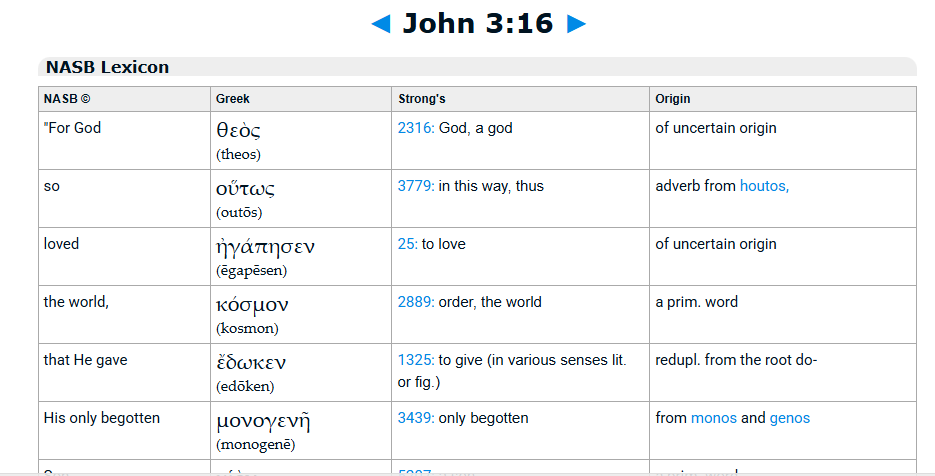
Image screen prints from biblehub.com
The first column shows the English word or phrase from the translation, as indicated in the heading. In this case, I chose NASB. The second column displays how the Greek word appears, and the word in parentheses is the transliteration, or how it is pronounced. If the transliteration has a slightly different spelling, it is usually due to various tenses, especially with verbs. The third column assists with this by providing a concise definition, along with a link to the Strong’s number assigned to the Greek word and, often, the root Greek word. Clicking that link opens the door to see how and where the word is used. This is often worth the time to help us navigate centuries of assumptions.
Back to our example: Love the World / Don’t Love the World and John 3:16a (NASB) “For God so loved the world…”
Theos is the most common word for God in the New Testament. God is the noun in this sentence. It is the same noun John used in the first chapter of John, where it says, archē
logos logos theon logos theos (In the beginning was the Word, and the Word was with God, and the Word was God).
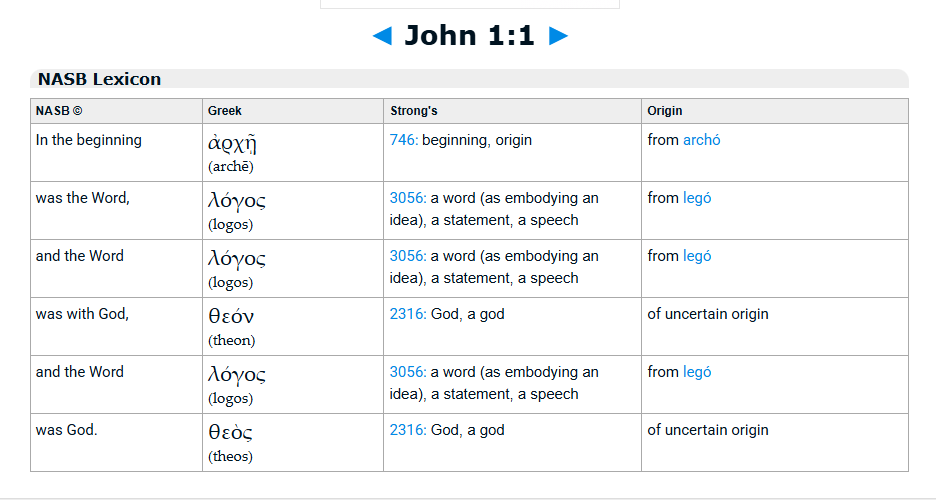
Back to John 3:16.
What did God do? He loved (ēgapēsen is the past tense of Agape). This is the love usually attributed to God, and the highest form of love, unconditional. As with most things, it can be used to control and dismiss injustice when abused people are forced to forgive quickly.
God loved what? The Universe (world). Kosmon, is the direct object form of Kosmos, which becomes in English, Cosmos. Initially, it meant order, adornment, or universe. Since the established definition by Pythagorus (570-490 BCE), it has meant “The Universe which is seen as a perfectly ordered and harmonious system,” including all its inhabitants.
Left to its own devices, this verse could have served humanity quite well. Even though it is a verse about salvation and drives people to evangelize, it starts with a straightforward statement that God, whom John equates to the creator of the universe, and Jesus, who loves the universe and everything in it. This includes our neighbors, enemies, and political opponents, as well as the large animals, microscopic mycelia, and every aspect of the physical world.
A New Can of Worms – 1 John 2:15
However, then someone else (possibly another John) wrote a few letters, titled 1 John, 2 John, and 3 John (pronounced 1st John, etc.). 1 John 2:15 begins, “Do not love the world or anything in the world.” He then discussed what is generally understood as the three types of sin (lust of the flesh, lust of the eyes, and pride of life) as “all that is in the world” (1 John 2:16).
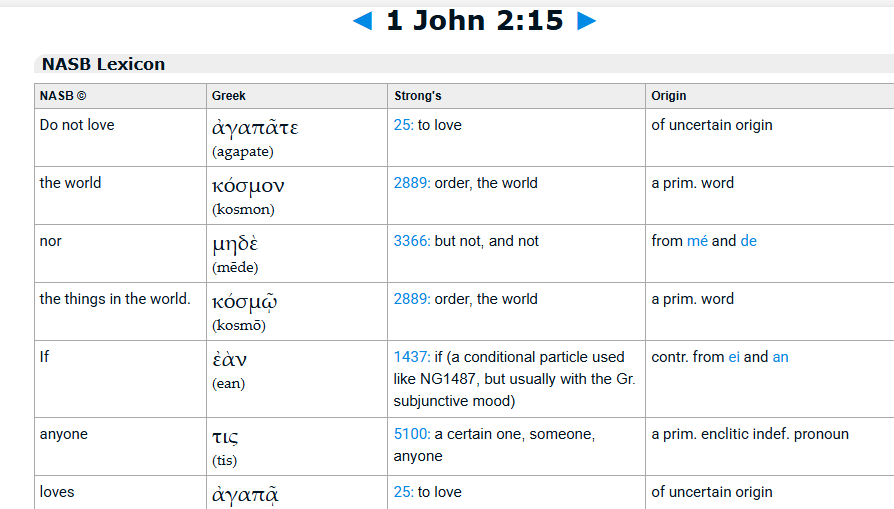
We could dance around that for days, wondering which part of these few verses to take the most seriously. I am quietly content that these two Johns have a different idea about what it means to love the world and everything in it, because we are part of that world, no matter how much preachers yell and scream and try to segregate it. “We are the world,” or more accurately, we are part of “all its inhabitants (remember the Kosmos?).
The reason this contradiction matters is that throughout Christian history, we’ve allowed ourselves to segregate everyone outside our specific organizations, often calling them “the world.” Using this type of verse and conflicting Old Testament texts, we justified waging war against others by staying committed to the idea that we were right and that God was on our side. We have judged some violence and injustice as acceptable, even though John believed that Jesus said God so loved the universe and everything in it.
No matter how we interpret the response of John 3:16, Africans were enslaved, and indigenous people were wiped out by colonizers in the US and the British Empire, because of verses like this that permit us not to love “the world” and everything/everybody in it. Religious wars have been ongoing since the inception of Christianity, particularly since its union with the Roman Empire around 400 CE.
Who is My Neighbor – Luke 10:29?
Just like the lawyer in this passage, we ask, “Who is my neighbor?” to simplify our little worlds, as we ignore most of the larger cosmos around us, not really caring whether they live, die, or thrive. God fearing Christians, devout Jews, and committed Muslims, along with all manner of differing faiths, have adopted this double standard by redefining the universe mostly to mean “Me and my tribe.”
In my opinion, it is commonly found among religious people, as they generally believe they are right and that God is on their side. Consequently, they often use their holy books, which are frequently contradictory, and they themselves choose how the scales of justice are administered.
I was helping a child with math at the school where I volunteer. He was a little flustered and rushing through the approaches and strategies to math. At times, I had to pull him back and discuss the fundamental principle we were dealing with. If he didn’t get the base principle, he may learn a lot of techniques, but he won’t know how to apply the rules that govern mathematics.
The Way Forward
My hope for everyone around the world, especially for those of a religious faith, is that before you act, you return to the core principle shared by most religions: to love like “God,” embracing the universe and everything within it, Agape the Cosmos!
Before we search for the contradictory verses that justify our position and offer an escape, we must understand what John was saying in the first part of John 3:16. If God exists, to be like God means to love my neighbor whom I disagree with politically, love my queer neighbor even if I’m straight, love people of different races and countries, recognize my privilege, and even love the people at the church down the street that we split from. We must love and respect the animals and land we inherited or stole and work to reverse the negative impacts of our “success.”
Because there are contradictions even among holy book writers, we can’t just pick the verse that suits us and works to our advantage. We have to consider every quote, even from sacred books, and test them against our logic, reasoning, and conscience to determine what is best for all of humanity and every part of the universe.
I don’t think I need religion, but it is imperative that I love the world and everything in it! Its survival, as well as the survival of our organizations, depends on this simple understanding. We have a corporate, universal responsibility to love the universe and everything in it.
Be where you are, Be who you are, Be at peace!
Karl Forehand
Progressive Christian
Home and Religion
Family, Parenting and Religion
Previous Post

November 3, 2025
A Decade of Deconstruction: I Don't Need Church Drugs
Next Post

November 6, 2025 A Decade of Deconstruction: I Don’t Need a Shepherd
Browse Our Archives
Select a Category Abuse Addiction Advent adventure Alpha Male Animals Answers Attachment Attitude authenticity Authenticty Authentiicity Awareness being Bible Black Community BLM body awarenss book Books Bravery Bullying Bypassing Certainty Certianty Chamge change children Christianity Christmas Church Comfort community Compaasion Compassion Complementarian Complementarianism Conditioning Consciousness Contemplation Control Conversation Converstations Covid-19 Creation Darkness Death Debate deconstruction demons depression desert Devil Disciples discussion Divine dreams Easter Eclipse Empathy Essence evolution evolve faith fatherhood Fear fiction Flood Focus Focusing Focussing Future Genesis Goals God Gratitude grief growth Guns Hate healing Health Heart Hell Holiday Hypnosis ignorance Improvement infallible Inner Child Integrity Intuition Jesus Jezebel Journey King LGBTQ+ Love MAGA Marriage meditation Men Mercy Message metaphysical Mindfulness Misogyny Mourning Music Mystic mystical Narcissism Nationalism Nature New Year Novel Nutrition Organization other Pain Pandemic parenting Pastors Patriarchy Patriotism Personal Growth Plan Poet poets Police politics Power practice praise Prayer presence pro-life Problem Solving Progress prolife Prophet prophets Purity Culture Purpose Queer Questions Racism Rape Rapture reconstruction Recovery Religion Resolutions Restoration Resurrection Retribution Reviews Root Cause Sanctuary Satan SBC Scripture Seeking Self-Care Self-esteem Seminary Sex Shadow shame social justice social media solitude Spirits Spirituality stillness Story Survivor Thanksgiving Theologians Theology Tradition Trauma travel Trump Uncategorized Unchurching Universe Violence Vision Voice Volunteer Vulnerability War Women Word worship Writing
Select a Month September 2026 August 2026 June 2026 May 2026 April 2026 March 2026 February 2026 November 2025 October 2025 September 2025 August 2025 July 2025 June 2025 May 2025 April 2025 March 2025 February 2025 January 2025 December 2024 November 2024 October 2024 September 2024 August 2024 July 2024 June 2024 May 2024 April 2024 March 2024 February 2024 January 2024 December 2023 November 2023 October 2023 September 2023 August 2023 July 2023 June 2023 May 2023 April 2023 March 2023 February 2023 January 2023 December 2022 November 2022 October 2022 September 2022 August 2022 July 2022 June 2022 May 2022 April 2022 March 2022 February 2022 January 2022 December 2021 November 2021 October 2021 September 2021 August 2021 July 2021 June 2021 May 2021 April 2021 March 2021 February 2021 January 2021 December 2020 November 2020 October 2020 September 2020 August 2020 July 2020 June 2020
Follow Us!
TAKE THE
Religious Wisdom Quiz
Which Gospel is written by a doctor?
Select your answer to see how you score.
Mark John Matthew Luke
Books by This Author Books by The Desert Sanctuary
Related posts from The Desert Sanctuary
Top 10 Questions I Have for God
Laura Forehand / Sherri Bothwell Death of the...
The Murderous God and His Army
TRENDING AT PATHEOS New Visions

In "Irreplaceable," our book on vocation and technology, Trevor Sutton and I...

I was strolling through the top floor of the brand new Parthenon...

What Does Gêvâh Mean For Kimberley Guifoyle &...
This week, a lot of the news is focused on Kimberly Guilfoyle....

INNER CIRCLE: Profound Mystery (Of Christ In All...
Ephesians 5:31-32 “For this reason, a man will leave his father and...

Do Not Rejoice When Your Enemy Falls: The...
Turning an execution into a public spectacle is a disturbing expression of...

'The Chosen' S6 Trailer: The Passion Gets Very...
Not many watching 'The Chosen' worry about spoilers, but just because they...
view all New Visions blogs
Ad-Free & Subscriber Log-In Subscription Support
- About Us
- 2026 Calendar
- Videos
- Podcasts
- Library of World Religions
- Faith In Media Tracker
- Advertise With Us
- Write for Us
- Privacy Policy
- Terms of Service
- Do Not Sell My Data
- Contact Us
- Radiant Digital
- Manage Newsletter Subscriptions
- Unsubscribe From Notifications
- Sitemap
Copyright 2008-2026, Patheos. All rights reserved.
Subscription Support Ad-Free & Subscriber Log-In
Follow Patheos