
BuddhistCatholicContemplativeEvangelicalGeneral ChristianHinduJewishLatter-day SaintMuslimNew VisionsProgressive Christian
Beliefs
- Buddhist
- Catholic
- Contemplative
- Evangelical
- General Christian
- Hindu
- Jewish
- Latter-day Saint
- More Voices
- Muslim
- New Visions
- Pagan
- Progressive Christian
Topics
- Religion News
- Food and Religion
- Sports and Religion
- Religious Art
- Religious Music and Entertainment
- Religious Events
- History and Religion
- Style and Religion
- Politics and Religion
- Women in Religion
- Recreation Outdoors and Religion
- Business Finance and Religion
- Careers Workplace and Religion
- Education and Religion
- Family Parenting and Religion
- Health Fitness and Religion
- Home and Religion
- Relationships and Religion
- Technology and Religion
- Travel and Religion
Columnists
- Buddhist Columnists
- Business Finance and Religion Columnists
- Careers Workplace and Religion Columnists
- Catholic Columnists
- Contemplative Columnists
- Education and Religion Columnists
- Evangelists Columnists
- Family Parenting and Religion Columnists
- General Christian Columnists
- Health Fitness and Religion Columnists
- Hindu Columnists
- History and Religion Columnists
- Home and Religion Columnists
- Jewish Columnists
- More Voices Columnists
- Latter Day Columnists
- Muslim Columnists
- New Visions Columnists
- Nonreligious Columnists
- Pagan Columnists
- Politics and Religion Columnists
- Progressive Columnists
- Recreation Outdoors and Religion Columnists
- Relationships and Religion Columnists
- Religion News Columnists
- Religious Art Columnists
- Religious Events Columnists
- Religious Music and Entertainment Columnists
- Sports and Religion Columnists
- Style and Religion Columnists
- Technology and Religion Columnists
- Travel and Religion Columnists
- Women in Religion Columnists
Resource Library
- 2026 Calendar
- Library of World Religions
- The 100 Most Holy Places on Earth
- Patheos Answers
- Podcasts
- Videos
- Faith Leaders Database
- Anglican Episcopalian
- Bahai
- Baptist
- Buddhism
- Christianity
- Confucianism
- Eastern Orthodoxy
- Hinduism
- Holiness and Pentecostal
- ISKCON
- Islam
- Judaism
- Lutheran
- Methodist
- The Church of Jesus Christ of Latter-day Saints
- New Age
- Paganism
- Presbytarian and Reformed
- Protestantism
- Religion Behind the Scenes
- Roman Catholic
- Scientology
- Shia Islam
- Sikhism
- Sufism
- Sunni Islam
- Taoism
- Zen
- See all religions
Research Tools
 Ad-Free & Subscriber Log-In Subscription Support
Ad-Free & Subscriber Log-In Subscription Support
Follow Patheos 

- Trending:
- Forgiveness
- |
- Marriage
- |
- Consciousness
- |
- Death Penalty
- |
- Election
- |
- Halloween

- Home
- New Visions
- Home and Religion
- How Beliefs Emerge from Trauma
How Beliefs Emerge from Trauma
Last updated on: September 14, 2025 at 11:19 am by Karl J. Forehand
How Beliefs Emerge from Trauma 2025-09-14T11:19:37-06:00 Karl J. Forehand
Patheos Explore the world's faith through different perspectives on religion and spirituality! Patheos has the views of the prevalent religions and spiritualities of the world.
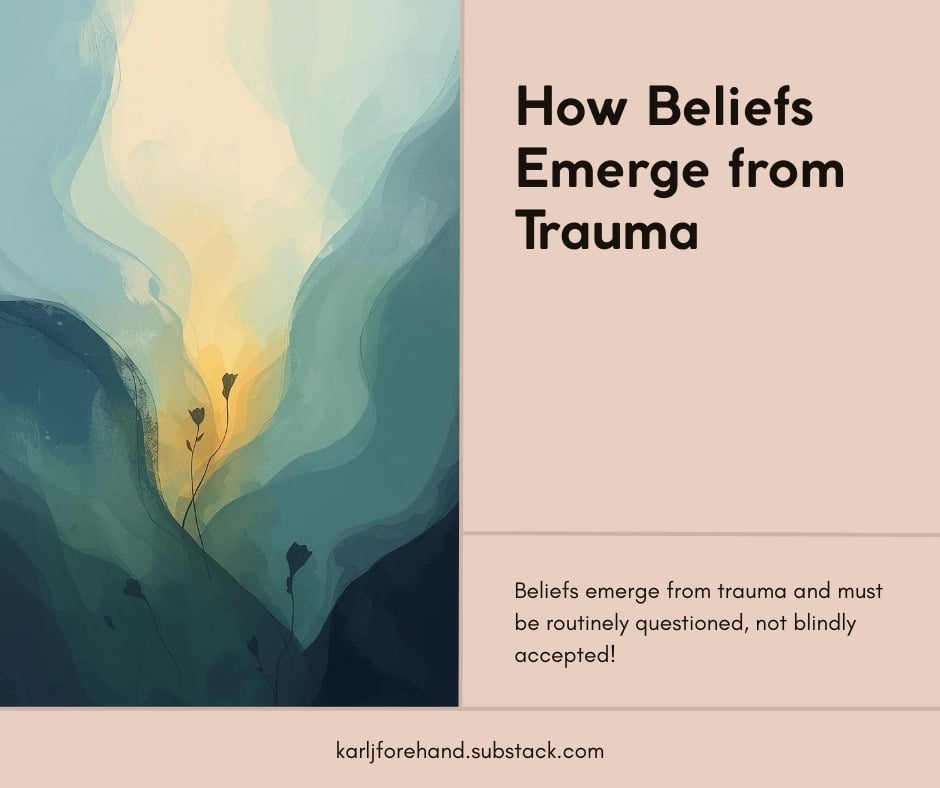
Generated by Canva
How Beliefs Emerge from Trauma
We tend to think of our beliefs as coming from an eternal being or a perfect, unchanging place in history that has somehow stayed undisturbed, pure, and holy for thousands of years. The obvious problem with this view is that since the Reformation 500 years ago, when Protestants separated from Catholics, belief systems have split into more than 180 major Protestant denominations, along with thousands of independent groups and possibly tens of thousands of variations.[1]
Every belief system and movement believes that they are right and that God is on their side.
So, where do our belief systems come from, if not from an authentic and eternal source?
Before we get to that question, it might help us understand why we need beliefs in the first place. As I mentioned earlier, beliefs aren’t facts, and they aren’t the truth. We can’t prove them in a scientific lab, and even archaeological discoveries sometimes raise more questions than they answer. My belief (chuckling to myself) is that they are simply assumptions. Sometimes we inherit them, and sometimes we make them up to give ourselves comfort from fear.
Why we think we need belief systems
Belief systems give us an interpretation of the world, even though they are often simple, made-up, and sometimes illogical. They create an illusion of being a framework for understanding right and wrong. They also help us feel connected by uniting around shared values and beliefs (assumptions).
So, when we are in a crisis and struggle to think clearly and don’t have time to research and learn on our own, we depend on groups and systems (parties/denominations/organizations) to give clear definitions, where we can agree or disagree, which determines our standing within the group and strengthens our sense of belonging. Sometimes, these groups are even helpful in solving our immediate problems, even if they don’t address the more troubling long-term issues.
Where beliefs really come from
My friends, Dorthy and Steve Halley, from The Family Peace Initiative, explain it through their River of Cruelty model. They mainly use this model in Battery Intervention groups and frequently in connection with prison and parole offices. It is a highly effective program for unraveling the connections between the ways we are cruel and the cruelty we experience.
Please see this link for a more detailed explanation of this process, or follow along for a summary.
Our own experiences. The ways we experience cruelty are varied and can be confusing because sometimes cruelty is hidden within our social understandings and the agreements we casually accept with others. Many of these stem from childhood trauma, but we can also be profoundly affected in adulthood when people violate rules and fail to treat us as we expected.
High-control religions and families often create these negative experiences, not usually out of malicious intent, but because they aim to exert control. Shadow messages about our worth and status frequently start to develop in these environments.
Adverse Feelings: A common saying when discussing trauma is “It’s not just about what happened to us, but how we experienced it.” The negative feelings drive us to respond with a need to survive. The survival strategies designed to protect us from dangerous animals often activate automatically, causing us to increase our defenses subconsciously.
Defense Systems: To cope with intense emotions, individuals develop defense mechanisms that can lead to issues over time. These might include behaviors such as aggression, repression of feelings, or self-centeredness.
Unintended Consequences: While defense systems might provide temporary relief from negative feelings, they can lead to unintended negative effects that harm a person’s relationships and well-being. This may include being cruel to others. We often overreact to everyday situations, which then complicate our lives and relationships with others.
Beliefs and Attitudes: Underlying these defense mechanisms are beliefs and attitudes that maintain the cycle of cruelty, such as a need for control or the belief that showing vulnerability is a weakness. With spiritual beliefs, we don’t develop them when everything is peaceful and aligned; we form them because we experience cruelty, pain, or insecurity, as our nervous systems crave regulation.
Below is a graphic that shows this process more clearly. As you can see, it is a process that is more circular than linear. But don’t miss the point that beliefs and attitudes are formed in the midst of our struggles.
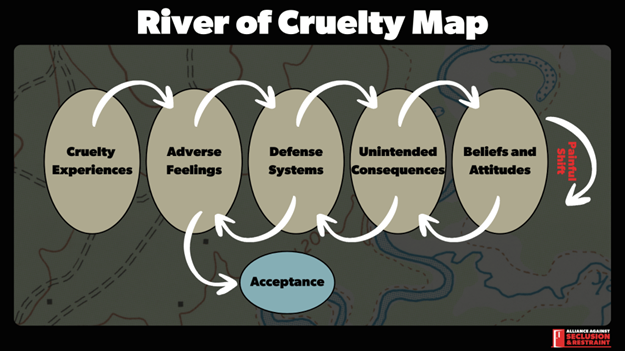
https://endseclusion.org/2025/08/29/the-river-of-cruelty-my-experience/
Completing the Circle
Community groups and religious organizations step in when they see us going through this river of cruelty. I never want to accuse groups or organizations of having bad intentions, but sometimes their understanding is limited. They usually ask us to accept the group approach to the problem, which they sometimes label as “sin.” The assumption they make is that if we are all centered around the same belief, then the issues will resolve themselves, maybe even miraculously.
When myths and stories are told about the group’s way of navigating life, they sometimes turn into sacred texts, giving a feeling of security by insisting they are right and that God supports them.
Although history shows that these types of communities and groups can provide a sense of regulation and immediate relief, they often fail to address the long-term problems.
A Way forward
As FPI explains, problems only start to be resolved when we can use different types of restorative practices that require focused effort and a certain level of expert understanding of the core issues we face.
They prescribe the following, which I offer in summary:
- Recognize the cruelty they have experienced and inflicted on others.
- Addressing the “River of Cruelty” by first confronting shadow messages, challenging the negative, often unconscious messages received during childhood that contribute to harmful behaviors.
- Accept responsibility for healing both the trauma experienced and the trauma inflicted on others.
- Develop healthy coping mechanisms and learn new ways to manage emotions and respond to challenging situations without resorting to cruelty.
- Break the cycle through accountability without shame.
- Hold individuals accountable for their actions without resorting to shame or humiliation.
- Develop the ability to understand and respond to both our own emotions and the emotions of others in a healthy way through an “Enlightened Witness.”
- Cultivate a culture of safety and respect by practicing personal responsibility.
As a former pastor with big ideas about what the church could achieve, I don’t hold any negative feelings if people choose to get involved in a faith community. I ask that we be realistic about what these groups can accomplish. While they may provide us with a sense of relief and stability, which is helpful, they are usually not equipped to address the trauma and cruelty we’ve endured, along with our cruelty toward others.
Exiting the River of Cruelty is like swimming upstream, recovering from our wounds, and doing the hard work of putting our lives back together.
Beliefs emerge from trauma and must be routinely questioned, not blindly accepted!
Be where you are, Be who you are, Be at peace!
Karl Forehand
Progressive Christian
Home and Religion
Family, Parenting and Religion
Previous Post

September 13, 2025
Shouldn’t Communication Be Better?
Next Post

September 18, 2025 Losing the Plot
Browse Our Archives
Select a Category Abuse Addiction Advent adventure Alpha Male Animals Answers Attachment Attitude authenticity Authenticty Authentiicity Awareness being Bible Black Community BLM body awarenss book Books Bravery Bullying Bypassing Certainty Certianty Chamge change children Christianity Christmas Church Comfort community Compaasion Compassion Complementarian Complementarianism Conditioning Consciousness Contemplation Control Conversation Converstations Covid-19 Creation Darkness Death Debate deconstruction demons depression desert Devil Disciples discussion Divine dreams Easter Eclipse Empathy Essence evolution evolve faith fatherhood Fear fiction Flood Focus Focusing Focussing Future Genesis Goals God Gratitude grief growth Guns Hate healing Health Heart Hell Holiday Hypnosis ignorance Improvement infallible Inner Child Integrity Intuition Jesus Jezebel Journey King LGBTQ+ Love MAGA Marriage meditation Men Mercy Message metaphysical Mindfulness Misogyny Mourning Music Mystic mystical Narcissism Nationalism Nature New Year Novel Nutrition Organization other Pain Pandemic parenting Pastors Patriarchy Patriotism Personal Growth Plan Poet poets Police politics Power practice praise Prayer presence pro-life Problem Solving Progress prolife Prophet prophets Purity Culture Purpose Queer Questions Racism Rape Rapture reconstruction Recovery Religion Resolutions Restoration Resurrection Retribution Reviews Root Cause Sanctuary Satan SBC Scripture Seeking Self-Care Self-esteem Seminary Sex Shadow shame social justice social media solitude Spirits Spirituality stillness Story Survivor Thanksgiving Theologians Theology Tradition Trauma travel Trump Uncategorized Unchurching Universe Violence Vision Voice Volunteer Vulnerability War Women Word worship Writing
Select a Month September 2026 August 2026 June 2026 May 2026 April 2026 March 2026 February 2026 November 2025 October 2025 September 2025 August 2025 July 2025 June 2025 May 2025 April 2025 March 2025 February 2025 January 2025 December 2024 November 2024 October 2024 September 2024 August 2024 July 2024 June 2024 May 2024 April 2024 March 2024 February 2024 January 2024 December 2023 November 2023 October 2023 September 2023 August 2023 July 2023 June 2023 May 2023 April 2023 March 2023 February 2023 January 2023 December 2022 November 2022 October 2022 September 2022 August 2022 July 2022 June 2022 May 2022 April 2022 March 2022 February 2022 January 2022 December 2021 November 2021 October 2021 September 2021 August 2021 July 2021 June 2021 May 2021 April 2021 March 2021 February 2021 January 2021 December 2020 November 2020 October 2020 September 2020 August 2020 July 2020 June 2020
Follow Us!
TAKE THE
Religious Wisdom Quiz
Who was the Ethiopian eunuch reading when Philip approached his chariot?
Select your answer to see how you score.
The Psalms Isaiah the prophet Jeremiah the prophet The book of Moses
Books by This Author Books by The Desert Sanctuary
Related posts from The Desert Sanctuary
We Don't Need a God, We Need People


Did My Tradition Get It Right?
TRENDING AT PATHEOS New Visions

In "Irreplaceable," our book on vocation and technology, Trevor Sutton and I...

I was strolling through the top floor of the brand new Parthenon...

What Does Gêvâh Mean For Kimberley Guifoyle &...
This week, a lot of the news is focused on Kimberly Guilfoyle....

INNER CIRCLE: Profound Mystery (Of Christ In All...
Ephesians 5:31-32 “For this reason, a man will leave his father and...

Do Not Rejoice When Your Enemy Falls: The...
Turning an execution into a public spectacle is a disturbing expression of...

'The Chosen' S6 Trailer: The Passion Gets Very...
Not many watching 'The Chosen' worry about spoilers, but just because they...
view all New Visions blogs
Ad-Free & Subscriber Log-In Subscription Support
- About Us
- 2026 Calendar
- Videos
- Podcasts
- Library of World Religions
- Faith In Media Tracker
- Advertise With Us
- Write for Us
- Privacy Policy
- Terms of Service
- Do Not Sell My Data
- Contact Us
- Radiant Digital
- Manage Newsletter Subscriptions
- Unsubscribe From Notifications
- Sitemap
Copyright 2008-2026, Patheos. All rights reserved.
Subscription Support Ad-Free & Subscriber Log-In
Follow Patheos