
BuddhistCatholicContemplativeEvangelicalGeneral ChristianHinduJewishLatter-day SaintMuslimNew VisionsProgressive Christian
Beliefs
- Buddhist
- Catholic
- Contemplative
- Evangelical
- General Christian
- Hindu
- Jewish
- Latter-day Saint
- More Voices
- Muslim
- New Visions
- Pagan
- Progressive Christian
Topics
- Religion News
- Food and Religion
- Sports and Religion
- Religious Art
- Religious Music and Entertainment
- Religious Events
- History and Religion
- Style and Religion
- Politics and Religion
- Women in Religion
- Recreation Outdoors and Religion
- Business Finance and Religion
- Careers Workplace and Religion
- Education and Religion
- Family Parenting and Religion
- Health Fitness and Religion
- Home and Religion
- Relationships and Religion
- Technology and Religion
- Travel and Religion
Columnists
- Buddhist Columnists
- Business Finance and Religion Columnists
- Careers Workplace and Religion Columnists
- Catholic Columnists
- Contemplative Columnists
- Education and Religion Columnists
- Evangelists Columnists
- Family Parenting and Religion Columnists
- General Christian Columnists
- Health Fitness and Religion Columnists
- Hindu Columnists
- History and Religion Columnists
- Home and Religion Columnists
- Jewish Columnists
- More Voices Columnists
- Latter Day Columnists
- Muslim Columnists
- New Visions Columnists
- Nonreligious Columnists
- Pagan Columnists
- Politics and Religion Columnists
- Progressive Columnists
- Recreation Outdoors and Religion Columnists
- Relationships and Religion Columnists
- Religion News Columnists
- Religious Art Columnists
- Religious Events Columnists
- Religious Music and Entertainment Columnists
- Sports and Religion Columnists
- Style and Religion Columnists
- Technology and Religion Columnists
- Travel and Religion Columnists
- Women in Religion Columnists
Resource Library
- 2026 Calendar
- Library of World Religions
- The 100 Most Holy Places on Earth
- Patheos Answers
- Podcasts
- Videos
- Faith Leaders Database
- Anglican Episcopalian
- Bahai
- Baptist
- Buddhism
- Christianity
- Confucianism
- Eastern Orthodoxy
- Hinduism
- Holiness and Pentecostal
- ISKCON
- Islam
- Judaism
- Lutheran
- Methodist
- The Church of Jesus Christ of Latter-day Saints
- New Age
- Paganism
- Presbytarian and Reformed
- Protestantism
- Religion Behind the Scenes
- Roman Catholic
- Scientology
- Shia Islam
- Sikhism
- Sufism
- Sunni Islam
- Taoism
- Zen
- See all religions
Research Tools
 Ad-Free & Subscriber Log-In Subscription Support
Ad-Free & Subscriber Log-In Subscription Support
Follow Patheos 

- Trending:
- Forgiveness
- |
- Marriage
- |
- Consciousness
- |
- Death Penalty
- |
- Election
- |
- Halloween

- Home
- Catholic
- History and Religion
- The Canon, Papal Infallibility and the Assumption of Mary
The Canon, Papal Infallibility and the Assumption of Mary
Last updated on: May 27, 2025 at 7:02 am by Nicholas Gulda
The Canon, Papal Infallibility and the Assumption of Mary 2025-05-27T07:02:53-05:00 Nicholas Gulda
Patheos Explore the world's faith through different perspectives on religion and spirituality! Patheos has the views of the prevalent religions and spiritualities of the world.

A number of weeks back, I responded to a post on a Protestant, Orthodox and Catholic debate page on Facebook. Briefly, it attempted to downplay the role that the Catholic Church had in establishing the Canon of the New Testament. It is a historical fact that certain Books that are accepted by all Christians now (2 Peter, Hebrews, Revelation, etc.), were not universally accepted by Christians until the fourth and even into the fifth centuries. Given this fact, I asked how he knew that those Books were inspired Scripture?
While I didn’t get a response from the original poster, I did receive a comment from a Protestant user who asked how I knew that the Assumption of Mary and Papal Infallibility were inspired? I was a bit confused, as Catholics don’t typically refer to dogmas (such as the two mentioned above) as “inspired”, but rather as “divinely revealed”[1]. What the interlocutor seems to have meant is that just as the Canon of the New Testament is not given within the pages of the Bible itself, so they imply that neither Papal Infallibility nor the Assumption of Mary are either.
The argument itself seems to presuppose the validity of Sola Scriptura, a doctrine universally rejected by Catholic and Eastern Orthodox Christians. What I plan to show (in this article and the next) is that viewed through the lens of Tradition and the teaching authority of the Catholic Church, there is sufficient evidence for both dogmas in the Bible; more so than there is for the Canon of Scripture at least. Why accept the one and not the others? The current article will focus on Papal Infallibility, while the subsequent one will focus on the Assumption of Mary.
Papal Infallibility
To be more concise, this article presupposes that the reader is aware that Papal Infallibility is only claimed under certain circumstances, and that not every utterance of a pope can be classified as infallible. Furthermore, it is not necessarily an exhaustive appeal to the entirety of the Bible but rather focuses on one passage. Traditionally, and within the document that defines the dogma, Matthew 16, Luke 22, and John 21 are utilized as evidence for the papal prerogatives. This post will focus on Lk 22 and the concept of Papal Infallibility. The text reads: “And the Lord said: Simon, Simon, behold Satan hath desired to have you, that he may sift you as wheat: 32 But I have prayed for thee, that thy faith fail not: and thou, being once converted, confirm thy brethren” (31-32).
It is this idea that the faith of St. Peter cannot fail and that he has the duty of confirming the brethren that has caught the attention of exegetes throughout the history of the Church. Modern scholars such as Msgr. Van Noort, see an implicit infallibility of St. Peter in this text. “If Peter were to be made equal to this task,” he says, “the very minimum required was that he be necessarily free from error [i.e. infallible] at least at such times as he would be actually instructing his brothers in the faith with the maximum of his authority”. [2] That, albeit an oversimplification, is papal infallibility in a nutshell. This of course presupposes the link between Bishop of Rome and St. Peter, and the latter’s abiding presence there in his successors[3], all of which is laid out in Pastor Aeternus before the teaching on Papal Infallibility.
This link no doubt existed in the mind of Pope St. Leo the Great (r. A.D. 440-461). As A. Edward Siecienski observes, “for Leo and his heirs this prayer was meant specifically for Peter, whose task-‘to strengthen his brothers in the faith’ required a special grace”.[4] Thus the formula that Pope St. Hormisdas (r. A.D. 514-523) sent to eastern Bishops in the wake of the Acacian Schism contained the claim, with reference to the words of Christ to St. Peter in Mt. 16:18, that “their truth has been proven by the course of history, for in the apostolic see [Rome] the Catholic religion has always been kept unsullied”.[5]
In the next century, Pope St. Agatho (r. A.D. 678-681) would reaffirm the purity of the Roman Church, telling the then Byzantine Emperor that it:
“has never erred from the path of the apostolic tradition, nor has she been depraved by yielding to heretical innovations, but from the beginning she has received the Christian faith from her founders, the princes of the Apostles of Christ, and remains undefiled unto the end, according to the divine promise of the Lord and Saviour himself, which he uttered in the holy Gospels to the prince of his disciples: saying, ‘Peter, Peter, behold, Satan hath desired to have you, that he might sift you as wheat; but I have prayed for thee, that (thy) faith fail not. And when thou art converted, strengthen thy brethren.’ Let your tranquil Clemency therefore consider, since it is the Lord and Saviour of all, whose faith it is, that promised that Peter’s faith should not fail and exhorted him to strengthen his brethren, how it is known to all that the Apostolic pontiffs [i.e. the Popes], the predecessors of my littleness, have always confidently done this very thing….”
Note the infallibility claimed and the reference to Lk 22.[6] A similar idea is expressed by Theodore Abu Qurrah, a 9th century Bishop of Haran living under Islamic rule. In the full citation we get all three of the traditional papal passages. In order to be concise here, I have only included the reference to Lk 22:
“…in the same way, when he [i.e. Christ] spoke his last words to St. Peter, ‘Have compassion, at that time, and strengthen your brethren; and your faith will not be lost,’ he meant by this nothing other than the holders of his seat. Yet another indication of this is the fact that among the apostles it was St. Peter alone who lost his faith and denied Christ, which Christ may have allowed to happen to Peter so as to teach us that it was not Peter that he meant by these words. Moreover, we know of no apostle who fell and needed St. Peter to strengthen him. If someone says that Christ meant by these words only St. Peter himself [and the apostles themselves], this person causes the church to lack someone to strengthen it after the death of St. Peter. How could this happen, especially when we see all the sifting of the church that came from Satan after the apostles’ death? All of this indicates that Christ did not mean [them] by these words. Indeed, everyone knows that the heretics attacked the church only after the death of the apostles…. If he meant by these words in the gospel only St. Peter [and the apostles themselves], then after [them] the church would have been deprived of comfort and would have had no one to deliver her from those heretics, whose heresies are truly ‘the gates of hell,’ which Christ said would not overcome the church. Accordingly, there is no doubt that he meant by these words nothing other than the holders of the seat of St. Peter [i.e. the Bishops of Rome], who have continually strengthened their brethren and will not cease to do so as long as this present age lasts.”[7]
As is clear from the context, Theodore speaks of the Bishops of Rome and how this text promises to St. Peter (and by extension his successors) “a special grace”, to borrow Sicienski’s Siecienski phrase above. Here, before the East-West Schism in A.D.1054, the doctrine laid out at Vatican I (A.D. 1869) is anticipated.[8] From the eleventh century and beyond, the evidence increases significantly.[9]
Thanks for reading! Please consider sharing or hitting the like button below!
[1] “The source of [the pope’s] Infallibility is the supernatural assistance of the Holy Ghost, Who protects the supreme teacher of the Church from error. This assistance must be distinguished from Revelation by which some truths or others are communicated by God to the bearer of Revelation; and from Inspiration, which is positive influence effected by God over an author, of such a nature that God Himself is the principal author of the writing, and the ideas are consequently the Word of God”. Ludwig Ott, Fundamentals of Catholic Dogma (Tan, 1960), 286-87.
[2] Monsignor G. Van Noort, Dogmatic Theology, Vol. 2: Christ’s Church, (Mercier Press, 1961), pp. 296-297. My emphasis.
[3] As Msgr. Van Noort also notes, “Strengthening in the faith is no less necessary for later generations: in fact it is even more necessary for them than for the apostles and the first Christians….But if this office is perpetual, so must the aid Christ prayed for be perpetual” Ibid., p. 297.
[4] A. Edward Siecienski, the Papacy and the Orthodox (Oxford University Press, 2017), p. 138.
[5] https://www.catholic.com/magazine/online-edition/that-time-the-eastern-churches-accepted-papal-infallibility (5/20/2025).
[6] https://ccel.org/ccel/schaff/npnf214/npnf214.xiii.v.html, cf. https://origin.web.fordham.edu/halsall/sbook1e.asp and the comments there.
[7] https://www.patheos.com/blogs/thecrossroads/2019/01/theodore-abu-qurrah-and-the-papacy/ (accessed 4/24/2025). My emphasis here.
[8] Cf. James Likoudis, The Divine Primacy of the Bishop of Rome and Modern Eastern Orthodoxy (St. Martin de Porres Lay Dominican Community, 2002), pp. 117-118.
[9] Cf. Ott, Fundamentals, p. 289.
Previous Post
February 24, 2025
A Clarification on Constantinople IV and Luke 10:16
Next Post
August 5, 2025 Why the Assumption of Mary Stands on Biblical Ground
Recent Comments
"Hello Amanda Ingalls, thanks for commenting! For what it's worth to you, in Catholicism there ..."
Why the Assumption of Mary Stands ..."
"Mother Mary is a Goddess, because She is already worshipped as one."
Why the Assumption of Mary Stands ..."
"Sorry for this late post, I'm a Protestant evangelical and I don't question that the ..."
Three Reasons to Believe that St. ..."
"I'm not Catholic and have, over decades of study, become quite "progressive" in theology, treating ..."
Modern Scholarship on Peter in Rome
Browse Our Archives
Select a Category Book Reviews Byzantium Catholicism Islam Spain The Canon The Crusades The Papacy Uncategorized
Select a Month August 2025 May 2025 February 2025 August 2024 April 2024 February 2024 October 2023 September 2023 August 2023 July 2023 June 2023 May 2023 April 2023 March 2023 January 2023 December 2022 November 2022 October 2022 September 2022 January 2022 January 2021 December 2020 August 2020 December 2019 April 2019 March 2019 February 2019 January 2019
TAKE THE
Religious Wisdom Quiz
Which animal did Jesus ride into Jerusalem on, fulfilling prophecy?
Select your answer to see how you score.
Donkey Horse Ox Camel
Related posts from The Crossroads
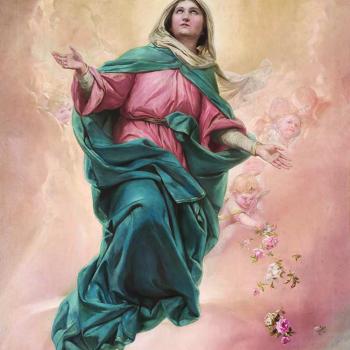
Why the Assumption of Mary Stands on Biblical...
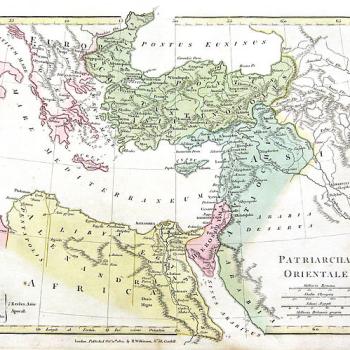
A Clarification on Constantinople IV and Luke 10:16
Luke 10:16 and the Question of Authority
Three Reasons to Believe that St. Peter Went...
TRENDING AT PATHEOS Catholic

Rejecting Doom: Christian Hope And Human Action
Christianity is a religion of hope. We are to have hope and...

It’s What Comes From Within Which Matters
One of the most difficult things for us to understand is why...

Why I Choose the Eucharist Over the Sermon
Choose the Eucharist, Not the Sermon What are we supposed to get...

5 Design Elements Found in Spiritually Rooted Homes
Putting Spirituality Into Home Decor Our homes are more than our living...

Credo: A Story of God Told with the...
About 10 years ago, I began to imagine a personal "Credo" that...

The Anatomy of Divine Revelation in Catholic Thought
The claim that God has made Himself known to human beings is...
view all Catholic blogs
What Are Your Thoughts?leave a comment
Ad-Free & Subscriber Log-In Subscription Support
- About Us
- 2026 Calendar
- Videos
- Podcasts
- Library of World Religions
- Faith In Media Tracker
- Advertise With Us
- Write for Us
- Privacy Policy
- Terms of Service
- Do Not Sell My Data
- Contact Us
- Radiant Digital
- Manage Newsletter Subscriptions
- Unsubscribe From Notifications
- Sitemap
Copyright 2008-2026, Patheos. All rights reserved.
Subscription Support Ad-Free & Subscriber Log-In
Follow Patheos