
BuddhistCatholicContemplativeEvangelicalGeneral ChristianHinduJewishLatter-day SaintMuslimNew VisionsProgressive Christian
Beliefs
- Buddhist
- Catholic
- Contemplative
- Evangelical
- General Christian
- Hindu
- Jewish
- Latter-day Saint
- More Voices
- Muslim
- New Visions
- Pagan
- Progressive Christian
Topics
- Religion News
- Food and Religion
- Sports and Religion
- Religious Art
- Religious Music and Entertainment
- Religious Events
- History and Religion
- Style and Religion
- Politics and Religion
- Women in Religion
- Recreation Outdoors and Religion
- Business Finance and Religion
- Careers Workplace and Religion
- Education and Religion
- Family Parenting and Religion
- Health Fitness and Religion
- Home and Religion
- Relationships and Religion
- Technology and Religion
- Travel and Religion
Columnists
- Buddhist Columnists
- Business Finance and Religion Columnists
- Careers Workplace and Religion Columnists
- Catholic Columnists
- Contemplative Columnists
- Education and Religion Columnists
- Evangelists Columnists
- Family Parenting and Religion Columnists
- General Christian Columnists
- Health Fitness and Religion Columnists
- Hindu Columnists
- History and Religion Columnists
- Home and Religion Columnists
- Jewish Columnists
- More Voices Columnists
- Latter Day Columnists
- Muslim Columnists
- New Visions Columnists
- Nonreligious Columnists
- Pagan Columnists
- Politics and Religion Columnists
- Progressive Columnists
- Recreation Outdoors and Religion Columnists
- Relationships and Religion Columnists
- Religion News Columnists
- Religious Art Columnists
- Religious Events Columnists
- Religious Music and Entertainment Columnists
- Sports and Religion Columnists
- Style and Religion Columnists
- Technology and Religion Columnists
- Travel and Religion Columnists
- Women in Religion Columnists
Resource Library
- 2026 Calendar
- Library of World Religions
- The 100 Most Holy Places on Earth
- Patheos Answers
- Podcasts
- Videos
- Faith Leaders Database
- Anglican Episcopalian
- Bahai
- Baptist
- Buddhism
- Christianity
- Confucianism
- Eastern Orthodoxy
- Hinduism
- Holiness and Pentecostal
- ISKCON
- Islam
- Judaism
- Lutheran
- Methodist
- The Church of Jesus Christ of Latter-day Saints
- New Age
- Paganism
- Presbytarian and Reformed
- Protestantism
- Religion Behind the Scenes
- Roman Catholic
- Scientology
- Shia Islam
- Sikhism
- Sufism
- Sunni Islam
- Taoism
- Zen
- See all religions
Research Tools
 Ad-Free & Subscriber Log-In Subscription Support
Ad-Free & Subscriber Log-In Subscription Support
Follow Patheos 

- Trending:
- Forgiveness
- |
- Marriage
- |
- Consciousness
- |
- Death Penalty
- |
- Election
- |
- Halloween

- Home
- Catholic
- History and Religion
- The Donation of Constantine and the Papacy (Pope St. Leo I)
The Donation of Constantine and the Papacy (Pope St. Leo I)
Last updated on: April 3, 2024 at 11:52 am by Nicholas Gulda
The Donation of Constantine and the Papacy (Pope St. Leo I) 2024-04-03T11:52:31-05:00 Nicholas Gulda
Patheos Explore the world's faith through different perspectives on religion and spirituality! Patheos has the views of the prevalent religions and spiritualities of the world.
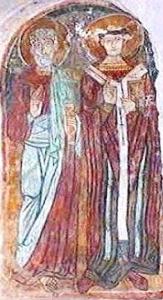
In the previous article, the 8th c. forgery known as the Donation of Constantine was discussed. More specifically, a claim made by a Protestant debater that the papacy was established (seemingly ex nihilo) on the basis of that document. There the Donation was placed in its proper historical context, and a distinction was made between temporal and spiritual authority. It was argued that the Donation is better seen through the lens of this distinction, on which the Popes from St. Gelasius (d. A.D. 496) on have made. Furthermore, it was argued that the Donation of Constantine contains nothing with respect to papal primacy that was not being proclaimed by the Popes themselves centuries earlier, at least from the time of St. Damasus (d. 384).
Between the latter two Popes reigned one of the most well-known of all, St. Leo I (r. A.D. 440 – 461). The present article takes the “nothing new” argument from the previous one, and focuses on Leo who was known to have a robust sense of the prerogatives attached to the bishopric of Rome, by virtue of its connection to St. Peter the Apostle. With this in mind, the present article raises the question: if, as the Protestant interlocutor claimed, papal authority was established by the 8th c. Donation, how does one explain the view(s) taken by Pope St. Leo I in the 5th c.?
Spotlight on Pope St. Leo I
In one of his works on the primacy of the Bishop of Rome, Dr. James Likoudis quotes an early twentieth-century Russian Orthodox church historian (V.V. Bolotov) on St. Leo I’s view of his own office. Keeping in mind the question just posed, here is what is written:
“This primatus, this principatus, of the apostle Peter is not a temporary but permanent institution. He governs the Church visibly through his successor. The relation borne by Roman bishops to St. Peter, the chief of the Apostles, is a close reproduction, in its depths and in all it involves, of the consortium potentiae of St. Peter with Christ…In the same way the whole construction of the Church reproduces, according to Leo the Great, the diversity of the relations that existed between the Apostles. Though all were chosen equally, there was not equality of authority amongst them; so in the same way the Bishops, equal amongst themselves in sacerdotal dignity, are not so in canonical rights, nor are they equal in their participation in the Government of the Church. This administration over all the Churches is incumbent upon the Bishop of Rome, principaliter, ex jure divine [principally, by divine right]…The episcopatus universalis [universal bishopric] of the sovereign pontiff of Rome, as taught by St. Leo the Great, does not exclude the equality of the hierarchy, that is to say, the sacramental equality of all bishops but only the plenitude potestatis [the fullness of power]…It could never become necessary to condemn a Bishop of Rome; he might have his shortcomings but they are compensated for and rectified by the merits of Peter. A Roman Pontiff can never really fail in any serious degree”.[1]
However unwelcome V.V. Bolotov’s analysis of Pope Leo’s understanding of the papacy may be to his modern Eastern Orthodox co-religionists (if online amateur apologists be a useful standard), it is not an uncommon historical opinion, even among non-Catholic Christians.[2] Even the Encyclopedia Brittanica’s entry on Pope Leo I affirms that he was “a master exponent of papal supremacy”, and that he “was devoted to safeguarding orthodoxy and to securing the unity of the Western church under papal supremacy”. That being the case, why exactly is the Donation of Constantine relevant to a discussion on the origins of the papacy? Can we really not all at least find common ground in the claim that Pope St. Leo I was “a master exponent of papal supremacy”?[3]
[1] In James Likoudis, The Divine Primacy of the Bishop of Rome and Modern Eastern Orthodoxy (New Hope: St. Martin de Porres Lay Dominican Community, 2002), pp. 69-70. Brackets in Likoudis.
[2] Cf. Bruce L. Shelley, Church History in Plain Language (Nashville: Thomas Nelson Publishers, 1995), pp. 132-135, 137-139.
[3] For an analysis of Leo’s understanding of the papacy through the lens of his own writings see Robert Eno, The Rise of the Papacy (Eugene: Wipf and Stock Publishers, 1990), pp. 102-117). The author is Catholic, but Leo’s works are cited from by number.
Previous Post
February 12, 2024
The Donation of Constantine and the Papacy:
Next Post
August 1, 2024 Three Reasons to Believe that St. Peter Went to Rome
Recent Comments
"Hello Amanda Ingalls, thanks for commenting! For what it's worth to you, in Catholicism there ..."
Why the Assumption of Mary Stands ..."
"Mother Mary is a Goddess, because She is already worshipped as one."
Why the Assumption of Mary Stands ..."
"Sorry for this late post, I'm a Protestant evangelical and I don't question that the ..."
Three Reasons to Believe that St. ..."
"I'm not Catholic and have, over decades of study, become quite "progressive" in theology, treating ..."
Modern Scholarship on Peter in Rome
Browse Our Archives
Select a Category Book Reviews Byzantium Catholicism Islam Spain The Canon The Crusades The Papacy Uncategorized
Select a Month August 2025 May 2025 February 2025 August 2024 April 2024 February 2024 October 2023 September 2023 August 2023 July 2023 June 2023 May 2023 April 2023 March 2023 January 2023 December 2022 November 2022 October 2022 September 2022 January 2022 January 2021 December 2020 August 2020 December 2019 April 2019 March 2019 February 2019 January 2019
TAKE THE
Religious Wisdom Quiz
What does "Gad" mean in Hebrew?
Select your answer to see how you score.
Chosen One Warrior Joyful Fortune
Related posts from The Crossroads
Why the Assumption of Mary Stands on Biblical...
The Canon, Papal Infallibility and the Assumption of...
A Clarification on Constantinople IV and Luke 10:16
Luke 10:16 and the Question of Authority
TRENDING AT PATHEOS Catholic

Rejecting Doom: Christian Hope And Human Action
Christianity is a religion of hope. We are to have hope and...

It’s What Comes From Within Which Matters
One of the most difficult things for us to understand is why...

Why I Choose the Eucharist Over the Sermon
Choose the Eucharist, Not the Sermon What are we supposed to get...

5 Design Elements Found in Spiritually Rooted Homes
Putting Spirituality Into Home Decor Our homes are more than our living...

Credo: A Story of God Told with the...
About 10 years ago, I began to imagine a personal "Credo" that...

The Anatomy of Divine Revelation in Catholic Thought
The claim that God has made Himself known to human beings is...
view all Catholic blogs
What Are Your Thoughts?leave a comment
Ad-Free & Subscriber Log-In Subscription Support
- About Us
- 2026 Calendar
- Videos
- Podcasts
- Library of World Religions
- Faith In Media Tracker
- Advertise With Us
- Write for Us
- Privacy Policy
- Terms of Service
- Do Not Sell My Data
- Contact Us
- Radiant Digital
- Manage Newsletter Subscriptions
- Unsubscribe From Notifications
- Sitemap
Copyright 2008-2026, Patheos. All rights reserved.
Subscription Support Ad-Free & Subscriber Log-In
Follow Patheos