
BuddhistCatholicContemplativeEvangelicalGeneral ChristianHinduJewishLatter-day SaintMuslimNew VisionsProgressive Christian
Beliefs
- Buddhist
- Catholic
- Contemplative
- Evangelical
- General Christian
- Hindu
- Jewish
- Latter-day Saint
- More Voices
- Muslim
- New Visions
- Pagan
- Progressive Christian
Topics
- Religion News
- Food and Religion
- Sports and Religion
- Religious Art
- Religious Music and Entertainment
- Religious Events
- History and Religion
- Style and Religion
- Politics and Religion
- Women in Religion
- Recreation Outdoors and Religion
- Business Finance and Religion
- Careers Workplace and Religion
- Education and Religion
- Family Parenting and Religion
- Health Fitness and Religion
- Home and Religion
- Relationships and Religion
- Technology and Religion
- Travel and Religion
Columnists
- Buddhist Columnists
- Business Finance and Religion Columnists
- Careers Workplace and Religion Columnists
- Catholic Columnists
- Contemplative Columnists
- Education and Religion Columnists
- Evangelists Columnists
- Family Parenting and Religion Columnists
- General Christian Columnists
- Health Fitness and Religion Columnists
- Hindu Columnists
- History and Religion Columnists
- Home and Religion Columnists
- Jewish Columnists
- More Voices Columnists
- Latter Day Columnists
- Muslim Columnists
- New Visions Columnists
- Nonreligious Columnists
- Pagan Columnists
- Politics and Religion Columnists
- Progressive Columnists
- Recreation Outdoors and Religion Columnists
- Relationships and Religion Columnists
- Religion News Columnists
- Religious Art Columnists
- Religious Events Columnists
- Religious Music and Entertainment Columnists
- Sports and Religion Columnists
- Style and Religion Columnists
- Technology and Religion Columnists
- Travel and Religion Columnists
- Women in Religion Columnists
Resource Library
- 2026 Calendar
- Library of World Religions
- The 100 Most Holy Places on Earth
- Patheos Answers
- Podcasts
- Videos
- Faith Leaders Database
- Anglican Episcopalian
- Bahai
- Baptist
- Buddhism
- Christianity
- Confucianism
- Eastern Orthodoxy
- Hinduism
- Holiness and Pentecostal
- ISKCON
- Islam
- Judaism
- Lutheran
- Methodist
- The Church of Jesus Christ of Latter-day Saints
- New Age
- Paganism
- Presbytarian and Reformed
- Protestantism
- Religion Behind the Scenes
- Roman Catholic
- Scientology
- Shia Islam
- Sikhism
- Sufism
- Sunni Islam
- Taoism
- Zen
- See all religions
Research Tools
 Ad-Free & Subscriber Log-In Subscription Support
Ad-Free & Subscriber Log-In Subscription Support
Follow Patheos 

- Trending:
- Forgiveness
- |
- Marriage
- |
- Consciousness
- |
- Death Penalty
- |
- Election
- |
- Halloween

- Home
- Catholic
- History and Religion
- The Donation of Constantine and the Papacy:
The Donation of Constantine and the Papacy:
Last updated on: February 12, 2024 at 8:39 am by Nicholas Gulda
The Donation of Constantine and the Papacy: 2024-02-12T08:39:59-06:00 Nicholas Gulda
Patheos Explore the world's faith through different perspectives on religion and spirituality! Patheos has the views of the prevalent religions and spiritualities of the world.
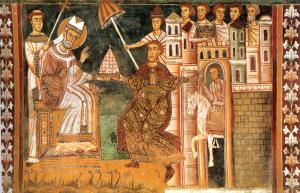
A little way back, I had set my mind to writing a series of three articles which all dealt with a few questionable claims levelled against the Catholic side in a recorded debate entitled Calvary Chapel vs Catholicism. The first was tackled in the article Catharism, Calvary Chapel, and Catholicism and its companion article. Having been preoccupied for some time, I decided to run down the remaining claims (incidental to the debate itself) in a pair of articles. The present then, will deal with the claim that the papacy was founded upon the forged Donation of Constantine. A follow-up will address the claim that the Apostle Peter never made it to Rome.
In order to facilitate things, I have transcribed the comments made by Rob Yardley, who at the time was associated with Calvary Chapel Costa Mesa. Starting at about 22 minutes, Mr. Yardley brings up the 8th-century forgery known as the Donation of Constantine. He does this in order to rebut the Catholic claim that the Bishops of Rome exist in an unbroken succession from the time of St. Peter until the present day. After bringing up the document, Yardley seems to insinuate that it was forged in an attempt “to establish the Pope’s authority” (22:42). In the preceding remarks, he betrays a belief that the papacy is an eighth-century invention (though he mistakenly attributes the document to the ninth.) Later, he pointedly asks Catholic apologist Tim Staples, “Did the Popes use [the Donation of Constantine] to establish their authority?”, to which the latter replies in the negative.
I would like to take the space that remains to make two points. The first is that it is necessary to make a distinction between what kind of authority is in question. It seems from the context that the debaters have the primacy of the Bishop of Rome in the ecclesiastical (i.e. spiritual) sphere in mind, and hence their respective positions. However, it is beneficial to differentiate between the spiritual and temporal powers. This is important because, as we will see below, the significance of the Donation of Constantine lies in the fact that it was used primarily to establish the latter. The second point then is that there is nothing bestowed on the Pope in the 8th century Donation that was not already proclaimed by earlier Popes, Church Councils, and Church Fathers.[1] But before making these arguments, a few words on the document itself will be helpful.
A Medieval Forgery
That the Donation of Constantine is a forgery is agreed upon by everyone one today, and that has been the case since the humanist Lorenzo Valla proved it to be so in the 15th century. Along with the first part which contains the legendary healing of the Emperor Constantine by Pope St. Sylvester, it forms the work known to scholars as the Constantutum Constantini.[2] Modern scholarship dates the document to the second half of the 8th c., a time concurrent with the rise of the Carolingian dynasty in A.D. 751. Most believe it to have come from Rome (either from within or from without of the papal curia). Others believe that it emanated from France. The place of composition would seem to bear on the motivations of the forger.[3] This brings us to our first point.
The Two Swords
Since at least the time of Pope St. Gelasius (d. A.D. 496) and his theory of the two swords, the Popes have made a distinction between the temporal and spiritual powers. Thus, when we discuss Yardley’s claim that the Popes utilized the Donation of Constantine “to establish their authority”, it is important to ask what kind of authority is in question? The debaters appear focused on the spiritual power, and Catholic apologist Tim Staples rejects Yardley’s claim from that vantage point. But if we keep in mind the temporal power and the historical context of the Donation, it is possible to affirm that it was indeed utilized to bolster the Pope’s temporal authority. Hence, it is noteworthy that the pertinence of the forgery to studies of the Medieval Papacy lies not in the Pope’s claim to ecclesiastical primacy, but rather to the relationship between State and Church which came to a head during the Investiture Controversy (11th c. – 12th c. A.D.)[4]
Nothing New
With respect to the ecclesiastical primacy claimed by the Bishops of Rome, Yardley seems to imply that this was something created ex nihilo in the 8th century.[5] For argument’s sake, let us run with that misconception. One who is going to posit the papacy as an outright invention might opt for an earlier origin, given that the Popes from the time of St. Damasus onward are on the record affirming that, “…the Holy Roman Church has been placed at the forefront not by the conciliar decisions of other Churches, but has received the primacy by the evangelic voice of our Lord and Savior, who says: ‘You are Peter, and upon this rock I will build My Church….”[6] Then, of course, there is the problem that St. Damasus cites the Gospel itself (1st c. A.D.). Moreover, there are bits and pieces of an Ante-Nicene Roman primacy to be found, as Tim Staples pointed out to Rob Yardley.
As Pope St. Nicholas I (d. A.D. 867) stated emphatically to the Byzantine Emperor Michael III, “These privileges [of the Roman Church] have been established by the mouth of Jesus Christ itself. It is not councils that have granted them. They have only honoured and preserved them….”[7] In a similar vein, when in the Donation of Constantine the Emperor decrees that the Pope “shall have the supremacy as well over the four chief seats [of] Antioch, Alexandria, Constantinople and Jerusalem, as also over all the churches of God in the whole world”, he concedes nothing new to the Pope except that which he already received directly from the Lord Jesus Christ.
[1] With respect to the latter two, this was a point that Mr. Staples brought up.
[2] Rojas Donat, and de Toro, José Miguel, “La ‘Donación de Constantino’: un debate historiográfico multisecular,” Revista de historia 30 no. 1 (2023): p. 2
[3] Donat and de Toro, “Donación”, pp. 3-17, esp. pp. 3-4, 9.
[4] Encyclopaedia Britannica. “Donation of Constantine.” In Britannica Concise Encyclopedia. Britannica Digital Learning, 2017; G., A. “Donation of Constantine.” In The Classical Tradition, edited by Anthony Grafton, Glenn W. Most, and Salvatore Settis. Harvard University Press, 2010; Kapsalis, Athanasios. “The False-Donation of Constantine.” Saint Emperor Constantine and Christianity – The Centre of Church Studies, 2013, p. 95; Montero, J.A. Cabrera, and Angelo Di Berardino. “DONATION of CONSTANTINE.” In Encyclopedia of Ancient Christianity. InterVarsity Press, 2014. Cf. Arnold-Baker, Charles. “False Decretals (or Pseudo-Isidore).” In The Companion to British History, Routledge. Routledge, 2001.
[5] He does not actually make the temporal/ spiritual distinction, as I indicated earlier.
[6] Williams A. Jurgens, The Faith of the Early Fathers Volume 1, (Collegeville: The Liturgical Press, 1970), pg. 404. Jurgens acknowledges that “opinion is still divided” on whether or not this citation belongs to the Decree of Damasus or the later Gelasian Decree, though he opts for the former. Cf. Robert Eno, The Rise of the Papacy, p. 30.
[7] In S. Herbert Scott, The Eastern Churches and the Papacy, (London: Sheed & Ward, 1928), p. 327.

About Nicholas Gulda
Nicholas Gulda is a High School teacher who resides in the Archdiocese of Detroit. He received his M.A. in History from Oakland University in 2021, where he wrote a thesis on the crusades of James 1 of Aragon. He is a Catholic convert. You can read more about the author here.
Previous Post
October 10, 2023
Catharism, Calvary Chapel, and Catholicism (Some Primary Sources)
Next Post
April 3, 2024 The Donation of Constantine and the Papacy (Pope St. Leo I)
Recent Comments
"Hello Amanda Ingalls, thanks for commenting! For what it's worth to you, in Catholicism there ..."
Why the Assumption of Mary Stands ..."
"Mother Mary is a Goddess, because She is already worshipped as one."
Why the Assumption of Mary Stands ..."
"Sorry for this late post, I'm a Protestant evangelical and I don't question that the ..."
Three Reasons to Believe that St. ..."
"I'm not Catholic and have, over decades of study, become quite "progressive" in theology, treating ..."
Modern Scholarship on Peter in Rome
Browse Our Archives
Select a Category Book Reviews Byzantium Catholicism Islam Spain The Canon The Crusades The Papacy Uncategorized
Select a Month August 2025 May 2025 February 2025 August 2024 April 2024 February 2024 October 2023 September 2023 August 2023 July 2023 June 2023 May 2023 April 2023 March 2023 January 2023 December 2022 November 2022 October 2022 September 2022 January 2022 January 2021 December 2020 August 2020 December 2019 April 2019 March 2019 February 2019 January 2019
TAKE THE
Religious Wisdom Quiz
The heavens declare God's glory without speech or words. Which psalm proclaims creation's silent testimony?
Select your answer to see how you score.
Psalm 104 Psalm 8 Psalm 148 Psalm 19
Related posts from The Crossroads
The Canon, Papal Infallibility and the Assumption of...
A Clarification on Constantinople IV and Luke 10:16
Luke 10:16 and the Question of Authority
Three Reasons to Believe that St. Peter Went...
TRENDING AT PATHEOS Catholic

Rejecting Doom: Christian Hope And Human Action
Christianity is a religion of hope. We are to have hope and...

It’s What Comes From Within Which Matters
One of the most difficult things for us to understand is why...

Why I Choose the Eucharist Over the Sermon
Choose the Eucharist, Not the Sermon What are we supposed to get...

5 Design Elements Found in Spiritually Rooted Homes
Putting Spirituality Into Home Decor Our homes are more than our living...

Credo: A Story of God Told with the...
About 10 years ago, I began to imagine a personal "Credo" that...

The Anatomy of Divine Revelation in Catholic Thought
The claim that God has made Himself known to human beings is...
view all Catholic blogs
What Are Your Thoughts?leave a comment
Ad-Free & Subscriber Log-In Subscription Support
- About Us
- 2026 Calendar
- Videos
- Podcasts
- Library of World Religions
- Faith In Media Tracker
- Advertise With Us
- Write for Us
- Privacy Policy
- Terms of Service
- Do Not Sell My Data
- Contact Us
- Radiant Digital
- Manage Newsletter Subscriptions
- Unsubscribe From Notifications
- Sitemap
Copyright 2008-2026, Patheos. All rights reserved.
Subscription Support Ad-Free & Subscriber Log-In
Follow Patheos