
BuddhistCatholicContemplativeEvangelicalGeneral ChristianHinduJewishLatter-day SaintMuslimNew VisionsProgressive Christian
Beliefs
- Buddhist
- Catholic
- Contemplative
- Evangelical
- General Christian
- Hindu
- Jewish
- Latter-day Saint
- More Voices
- Muslim
- New Visions
- Pagan
- Progressive Christian
Topics
- Religion News
- Food and Religion
- Sports and Religion
- Religious Art
- Religious Music and Entertainment
- Religious Events
- History and Religion
- Style and Religion
- Politics and Religion
- Women in Religion
- Recreation Outdoors and Religion
- Business Finance and Religion
- Careers Workplace and Religion
- Education and Religion
- Family Parenting and Religion
- Health Fitness and Religion
- Home and Religion
- Relationships and Religion
- Technology and Religion
- Travel and Religion
Columnists
- Buddhist Columnists
- Business Finance and Religion Columnists
- Careers Workplace and Religion Columnists
- Catholic Columnists
- Contemplative Columnists
- Education and Religion Columnists
- Evangelists Columnists
- Family Parenting and Religion Columnists
- General Christian Columnists
- Health Fitness and Religion Columnists
- Hindu Columnists
- History and Religion Columnists
- Home and Religion Columnists
- Jewish Columnists
- More Voices Columnists
- Latter Day Columnists
- Muslim Columnists
- New Visions Columnists
- Nonreligious Columnists
- Pagan Columnists
- Politics and Religion Columnists
- Progressive Columnists
- Recreation Outdoors and Religion Columnists
- Relationships and Religion Columnists
- Religion News Columnists
- Religious Art Columnists
- Religious Events Columnists
- Religious Music and Entertainment Columnists
- Sports and Religion Columnists
- Style and Religion Columnists
- Technology and Religion Columnists
- Travel and Religion Columnists
- Women in Religion Columnists
Resource Library
- 2026 Calendar
- Library of World Religions
- The 100 Most Holy Places on Earth
- Patheos Answers
- Podcasts
- Videos
- Faith Leaders Database
- Anglican Episcopalian
- Bahai
- Baptist
- Buddhism
- Christianity
- Confucianism
- Eastern Orthodoxy
- Hinduism
- Holiness and Pentecostal
- ISKCON
- Islam
- Judaism
- Lutheran
- Methodist
- The Church of Jesus Christ of Latter-day Saints
- New Age
- Paganism
- Presbytarian and Reformed
- Protestantism
- Religion Behind the Scenes
- Roman Catholic
- Scientology
- Shia Islam
- Sikhism
- Sufism
- Sunni Islam
- Taoism
- Zen
- See all religions
Research Tools
 Ad-Free & Subscriber Log-In Subscription Support
Ad-Free & Subscriber Log-In Subscription Support
Follow Patheos 

- Trending:
- Forgiveness
- |
- Marriage
- |
- Consciousness
- |
- Death Penalty
- |
- Election
- |
- Halloween

- Home
- Catholic
- History and Religion
- Does 1 Corinthians 10 prove that St. Peter is not the “rock” upon which Christ built His Church?
Does 1 Corinthians 10 prove that St. Peter is not the “rock” upon which Christ built His Church?
Last updated on: February 13, 2023 at 2:01 pm by Nicholas Gulda
Does 1 Corinthians 10 prove that St. Peter is not the “rock” upon which Christ built His Church? 2023-02-13T14:01:54-06:00 Nicholas Gulda
Patheos Explore the world's faith through different perspectives on religion and spirituality! Patheos has the views of the prevalent religions and spiritualities of the world.
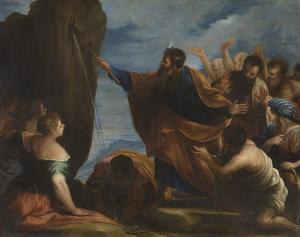
Moses and the Water from the Rock, Juan Antonio de Frías (17th c.)
“ [2] And all in Moses were baptized, in the cloud, and in the sea: [3] And did all eat the same spiritual food, [4] And all drank the same spiritual drink; (and they drank of the spiritual rock that followed them, and the rock was Christ.)” (1 Cor. 10, DRB).
A while back I had an exchange on a Facebook group that hosts debate/dialogue between Protestant, Eastern Orthodox, and Catholic Christians. This particular interaction was with an individual who seemed to fit more into the “fundamentalist” camp within Evangelical Protestantism. From memory (and perhaps allowing for a bit of poetic license), this person brought forth 1 Corinthians 10 (above) as evidence that proved that St. Peter could not possibly be the “rock” upon which Jesus built His Church in Mt. 16:18. This of course was not a linguistic argument based upon analyzing the original Greek, but rather one relying on this individual’s belief that only God is referred to as a Rock in Scripture, therefore Mt. 16:18 must necessarily refer to Jesus as the “rock” in that verse. The rest of this post will concern itself with demonstrating that Jesus being the Rock identified by St. Paul in 1 Corinthians 10, and St. Peter being the “rock” that Jesus says He will build his Church upon are not mutually exclusive propositions.
To begin, even if it were granted that every other example of someone being called a rock in Scripture was in reference to God, that would not necessarily mean that St. Peter is not the “rock” in question in Mt. 16:18. It might merely be the one example in Scripture where someone other than God is delineated as such. But that does not seem to be the case, and I pointed my interlocutor to Isaiah 51: 2-3, where Abraham is said to be “the rock whence you are hewn” (DRB). When my opponent tried to deny this fact, I pointed them to a number of Protestant commentaries which agree with that interpretation. They insisted that only God is referred to in Scripture as rock [except for when Peter and Abraham are!][1] And that is more or less where the conversation ended.
What I wish to show below is three examples of Early Church Fathers – in this case fellow Latins – who saw that the facts that the Rock in 1 Cor. 10 refers to Christ, and that the “rock” in Mt. 16 to St. Peter, were in complete harmony. What is more their words are in perfect keeping with a modern Catholic author who noted that “St. Peter’s ‘rock-ness’ is derived from Christ”. In the same vein, another wrote that “God is called rock in Deuteronomy 32:4, and the name is now given to Peter, who shares in God’s rock-ness”. Such was the view of these Latin Fathers as well:
St. Ambrose of Milan (d. A.D. 397):
“Christ is a Rock—for they drank of the spiritual rock that followed them: and the Rock was Christ [1 Corinthians 10:4]. He did not deny the Grace of even this title to His Disciple, so that he is a true Peter [cf. Saint Matthew 16:18; Saint John 1:42], because from the Rock he has the firmness of constancy, the steadfastness of faith”.[2]
St. Maximus of Turin (d. ca. A.D. 465):
“On account of his faithfulness Peter is told… [cites Mt. 16:17-18]. Although he used to be called Simon, then, he is named Peter on account of his faithfulness. We read what the Apostle says of the Lord Himself: ‘They drank from the spiritual rock, but the rock was Christ.’ Rightly, then, inasmuch as Christ is a rock, is Simon named Peter, in order that he who shared with the Lord in faith might be at one with the Lord as well in the Lord’s name – that just as a Christian is so called from Christ, the apostle Peter would similarly receive his name from Christ the rock”.[3]
Pope St. Leo the Great (r. A.D. 440-61):
“For their stability [i.e. the successors of St. Peter] which the rock himself [i.e. St. Peter] was given by that Rock, Christ, he conveyed also to his successors, and wheresoever any steadfastness is apparent, there without doubt is to be seen the strength of the shepherd” (Sermon 5.4).
“[Christ to St. Peter:] Although I am the indestructible rock and the cornerstone … you, too, you are rock for my power strengthens you so that that which I am by my own power will be held in common by you as well by participation” (Sermon 83.1).[4]
On Sermon 5.4 above, Robert Eno writes: “Notice that Leo does not deny that Christ is the primary referent for the rock as symbol but he emphasizes all the more the dignity of Peter who was deemed worthy to share this quality with the Lord”.[5] Thus in the eyes of Catholic commentators—both ancient and contemporary—, there is no inherent contradiction in the Rock of 1 Cor. 10 referring to His chief disciple as “rock” in Mt. 16:18. On the contrary, as the above authors have stated in one way or another, Peter is rock in a derivative sense, and this is from his Master.
[1] Cf. Isa. 51: 2-3, Mt. 16:18.
[2] Saint Ambrose of Milan, Exposition of the Holy Gospel According to Saint Luke, trans. Theodosia Tomkinson (Etna: Center For Traditionalist Orthodox Studies, 2003), 235. NB: Book VI: 97. Cf. https://www.angelfire.com/ny4/djw/ambrose.petrineprimacy.html (accessed 1/29/2023).
[3] St. Maximus of Turin, Sermon 80. In The Sermons of St. Maximus of Turin, trans. Boniface Ramsey, O.P., ACW 50 (New York: Newman Press, 1989), 193. My emphasis.
[4] Pope St. Leo the Great, Sermo 5.4, Sermo 83.1. In Robert Eno, The Rise of the Papacy (Eugene: Wipf and Stock Publishers, 1990), 109. Cf. Eno’s commentary there.
[5] Eno, Rise of the Papacy, 109.
Education and Religion
Previous Post
December 7, 2022
Ethiopian Orthodoxy and the Immaculate Conception
Next Post
March 2, 2023 In What Sense is Scripture Sufficient?
Recent Comments
"Hello Amanda Ingalls, thanks for commenting! For what it's worth to you, in Catholicism there ..."
Why the Assumption of Mary Stands ..."
"Mother Mary is a Goddess, because She is already worshipped as one."
Why the Assumption of Mary Stands ..."
"Sorry for this late post, I'm a Protestant evangelical and I don't question that the ..."
Three Reasons to Believe that St. ..."
"I'm not Catholic and have, over decades of study, become quite "progressive" in theology, treating ..."
Modern Scholarship on Peter in Rome
Browse Our Archives
Select a Category Book Reviews Byzantium Catholicism Islam Spain The Canon The Crusades The Papacy Uncategorized
Select a Month August 2025 May 2025 February 2025 August 2024 April 2024 February 2024 October 2023 September 2023 August 2023 July 2023 June 2023 May 2023 April 2023 March 2023 January 2023 December 2022 November 2022 October 2022 September 2022 January 2022 January 2021 December 2020 August 2020 December 2019 April 2019 March 2019 February 2019 January 2019
TAKE THE
Religious Wisdom Quiz
True or False: Mark is the only Gospel that records Jesus asking 'Who touched my clothes?' after power went out from him.
Select your answer to see how you score.
TRUE FALSE
Related posts from The Crossroads
The Canon, Papal Infallibility and the Assumption of...
A Clarification on Constantinople IV and Luke 10:16
Luke 10:16 and the Question of Authority
Three Reasons to Believe that St. Peter Went...
TRENDING AT PATHEOS Catholic

Rejecting Doom: Christian Hope And Human Action
Christianity is a religion of hope. We are to have hope and...

It’s What Comes From Within Which Matters
One of the most difficult things for us to understand is why...

Why I Choose the Eucharist Over the Sermon
Choose the Eucharist, Not the Sermon What are we supposed to get...

5 Design Elements Found in Spiritually Rooted Homes
Putting Spirituality Into Home Decor Our homes are more than our living...

Credo: A Story of God Told with the...
About 10 years ago, I began to imagine a personal "Credo" that...

The Anatomy of Divine Revelation in Catholic Thought
The claim that God has made Himself known to human beings is...
view all Catholic blogs
What Are Your Thoughts?leave a comment
Ad-Free & Subscriber Log-In Subscription Support
- About Us
- 2026 Calendar
- Videos
- Podcasts
- Library of World Religions
- Faith In Media Tracker
- Advertise With Us
- Write for Us
- Privacy Policy
- Terms of Service
- Do Not Sell My Data
- Contact Us
- Radiant Digital
- Manage Newsletter Subscriptions
- Unsubscribe From Notifications
- Sitemap
Copyright 2008-2026, Patheos. All rights reserved.
Subscription Support Ad-Free & Subscriber Log-In
Follow Patheos