
BuddhistCatholicContemplativeEvangelicalGeneral ChristianHinduJewishLatter-day SaintMuslimNew VisionsProgressive Christian
Beliefs
- Buddhist
- Catholic
- Contemplative
- Evangelical
- General Christian
- Hindu
- Jewish
- Latter-day Saint
- More Voices
- Muslim
- New Visions
- Pagan
- Progressive Christian
Topics
- Religion News
- Food and Religion
- Sports and Religion
- Religious Art
- Religious Music and Entertainment
- Religious Events
- History and Religion
- Style and Religion
- Politics and Religion
- Women in Religion
- Recreation Outdoors and Religion
- Business Finance and Religion
- Careers Workplace and Religion
- Education and Religion
- Family Parenting and Religion
- Health Fitness and Religion
- Home and Religion
- Relationships and Religion
- Technology and Religion
- Travel and Religion
Columnists
- Buddhist Columnists
- Business Finance and Religion Columnists
- Careers Workplace and Religion Columnists
- Catholic Columnists
- Contemplative Columnists
- Education and Religion Columnists
- Evangelists Columnists
- Family Parenting and Religion Columnists
- General Christian Columnists
- Health Fitness and Religion Columnists
- Hindu Columnists
- History and Religion Columnists
- Home and Religion Columnists
- Jewish Columnists
- More Voices Columnists
- Latter Day Columnists
- Muslim Columnists
- New Visions Columnists
- Nonreligious Columnists
- Pagan Columnists
- Politics and Religion Columnists
- Progressive Columnists
- Recreation Outdoors and Religion Columnists
- Relationships and Religion Columnists
- Religion News Columnists
- Religious Art Columnists
- Religious Events Columnists
- Religious Music and Entertainment Columnists
- Sports and Religion Columnists
- Style and Religion Columnists
- Technology and Religion Columnists
- Travel and Religion Columnists
- Women in Religion Columnists
Resource Library
- 2026 Calendar
- Library of World Religions
- The 100 Most Holy Places on Earth
- Patheos Answers
- Podcasts
- Videos
- Faith Leaders Database
- Anglican Episcopalian
- Bahai
- Baptist
- Buddhism
- Christianity
- Confucianism
- Eastern Orthodoxy
- Hinduism
- Holiness and Pentecostal
- ISKCON
- Islam
- Judaism
- Lutheran
- Methodist
- The Church of Jesus Christ of Latter-day Saints
- New Age
- Paganism
- Presbytarian and Reformed
- Protestantism
- Religion Behind the Scenes
- Roman Catholic
- Scientology
- Shia Islam
- Sikhism
- Sufism
- Sunni Islam
- Taoism
- Zen
- See all religions
Research Tools
 Ad-Free & Subscriber Log-In Subscription Support
Ad-Free & Subscriber Log-In Subscription Support
Follow Patheos 

- Trending:
- Forgiveness
- |
- Marriage
- |
- Consciousness
- |
- Death Penalty
- |
- Election
- |
- Halloween

- Home
- Catholic
- History and Religion
- The Apostolic Foundation of the Roman Church
The Apostolic Foundation of the Roman Church
Last updated on: October 9, 2022 at 9:57 am by Nicholas Gulda
The Apostolic Foundation of the Roman Church 2022-10-09T09:57:52-05:00 Nicholas Gulda
Patheos Explore the world's faith through different perspectives on religion and spirituality! Patheos has the views of the prevalent religions and spiritualities of the world.
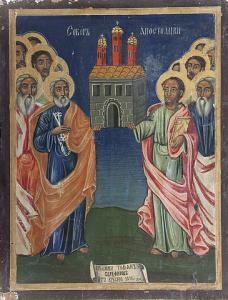
The dual apostolicity of the Roman church was a fact well known to the Early Church Fathers. Not only did Peter and Paul labor there, but they were also ultimately martyred in the imperial capital making their residence permanent in a certain sense.[1] This apostolic pedigree became a useful tool for second and third century apologists such as Irenaeus of Lyons and Gaius in combatting Gnosticism.[2] Thus the appearance of the first extant episcopal lists of the bishops of Rome around this time.[3] However, given what is known about the Roman church from earlier sources, – especially St. Paul’s Epistle to the Romans (ca. A.D. 57) – at least one modern historian has questioned the witness of these two early churchmen.
The question that this article raises is in what sense did these two authors mean that Sts. Peter and Paul “founded” the Roman church? Since it can be gathered from the Epistle to the Romans that Paul had not yet been there, that Peter was not there at that time (or had not been there yet), and that there was already an existing Christian community there,[4] the question remains whether these two early witnesses were mistaken, or whether they meant that the two Apostles “founded” the church in Rome in a qualified sense.
The first, St. Irenaeus, was a Greek Father who became the bishop of Lyon in France. He composed his well known Against Heresies (ca. A.D. 189) in order to counter the various sects of Gnosticism that were numerous in his time, which all threatened the Apostolic preaching. In Book III, chapter 4 he says the following:
“2. Since, however, it would be very tedious, in such a volume as this, to reckon up the successions of all the Churches, we do put to confusion all those who, in whatever manner, whether by an evil self-pleasing, by vainglory, or by blindness and perverse opinion, assemble in unauthorized meetings; [we do this, I say,] by indicating that tradition derived from the apostles, of the very great, the very ancient, and universally known Church founded and organized at Rome by the two most glorious apostles, Peter and Paul; as also [by pointing out] the faith preached to men, which comes down to our time by means of the successions of the bishops. For it is a matter of necessity that every Church should agree with this Church, on account of its preeminent authority [potiorem principalitatem].
3. The blessed apostles, then, having founded and built up the Church, committed into the hands of Linus the office of the episcopate.”[5]
The question of Roman primacy aside, in what sense was does Irenaeus mean that Peter and Paul “founded” the Roman church? “Here…”, writes Oscar Cullmann, “occurs at least one error: the Roman church in any case was not founded by Paul”. He goes on to refer to the Epistle to the Romans as evidence, and asserts that “this at once calls in question the historical trustworthiness of the statement”. While Cullmann is discussing literary sources on the subject of Peter’s martyrdom (of which he points out this text says nothing),[6] it seems that he has taken the word “founded” in the strict sense here.
Daniel O’Connor gives a more nuanced interpretation on the concept that this community was “founded” by an Apostle. “The relation of Peter to the founding of such a community would be then”, he asserts, “little more than the giving of the apostolic blessing to what had already taken place”.[7] In a similar vein, Robert Eno actually goes further and hits the nail on the head: “If by founder is meant that Peter was the first preacher of Christianity in Rome, then Peter should not be called the founder. He no doubt also [like Paul] arrived in a pre-existing Christian community in Rome. But they, Peter and Paul, are still considered the founders, the foundational stones, of the Roman Church in a moral, if not absolutely literal, historical sense”.[8]
To my mind, this approximates what Irenaeus means above by stating that Peter and Paul “founded and built up the Church” in Rome. Surely he could not have been more ignorant than moderns about the origins of the Roman community? He too had access to the Epistle of the Romans, and he was in communication with Pope Victor during the Quartodeciman Controversy. It seems reasonable that he would be well aware of the origins of the Roman church, was familiar with its apostolic pedigree (as were his contemporaries), and utilized that in his argument against his gnostic opponents.
It is in this same sense that I believe Gaius makes an identical claim. In his Disputation with Proclus (ca. A.D. 198/ 217), which is preserved in Eusebius, he writes that he “can point out the trophies of the Apostles. For if you are willing to go to the Vatican or the Ostian Way, you will find the trophies of those who founded this Church”.[9] Here Gaius is countering an argument from his opponent that Hierapolis could claim the relics of Philip (and his daughters).[10] Gaius receives a similar comment from Cullmann that Irenaeus did, when he writes that “this statement, in spite of its historical inaccuracy had become a fixed tradition”.[11] It seems more reasonable to conclude that both authors (and the tradition) are not speaking of a foundation in the strict sense, but rather of one like Eno suggests above. This accords with the words of Tertullian (d. A.D. 220), who wrote of Rome: “How happy is its church, on which apostles [i.e Peter and Paul] poured forth all their doctrine along with their blood!”[12]
[1] Robert Eno, The Rise of the Papacy (Eugene: Wipf and Stock, 1990), 25; Tertullian, Prescription against Heretics, ch. 36.
[2] Daniel O’Connor, Peter in Rome: The Literary, Liturgical, and Archeological Evidence (New York: Columbia University Press, 1969), 29, 95-96. Cf. Oscar Cullmann, Peter: Disciple, Apostle, Martyr, trans. Floyd V. Filson (Waco: Baylor University Press, 2011), 117.
[3] O’Connor, Peter in Rome, 28-29.
[4] O’Connor, Peter in Rome, 8-10
[5] Translated by Alexander Roberts and William Rambaut. From Ante-Nicene Fathers, Vol. 1. Edited by Alexander Roberts, James Donaldson, and A. Cleveland Coxe. (Buffalo, NY: Christian Literature Publishing Co., 1885.) Revised and edited for New Advent by Kevin Knight. <http://www.newadvent.org/fathers/0103303.htm>. Retrieved 10/8/2022. My emphasis.
[6] Cullmann, Peter, 116.
[7] O’Connor, Peter in Rome, 10. The passage of Irenaeus is not under discussion here it should be pointed out. Rather, it is the Epistle to the Romans.
[8] Eno, Rise of the Papacy, 18.
[9] In William Jurgens, Faith of the Early Fathers Vol. 1 (Collegeville, The Liturgical Press, 1970), 44. My emphasis.
[10] O’Callaghan, Peter in Rome, 96-97. For a discussion on the meaning of “trophies” in this text see pp.97-101. Cf. Cullmann, Peter, 117-121.
[11] Cullmann, Peter, 117-118.
[12] Prescription against Heretics, ch. 36. Translated by Peter Holmes. From Ante-Nicene Fathers, Vol. 3. Edited by Alexander Roberts, James Donaldson, and A. Cleveland Coxe. (Buffalo, NY: Christian Literature Publishing Co., 1885.) Revised and edited for New Advent by Kevin Knight. <http://www.newadvent.org/fathers/0311.htm>. Accessed 10/8/2022.
Previous Post

October 1, 2022
Patriarch Kirill and the Idea of Combatants as Martyrs
Next Post
October 15, 2022 Did St. Basil the Great Teach Sola Scriptura?
Browse Our Archives
Select a Category Book Reviews Byzantium Catholicism Islam Spain The Canon The Crusades The Papacy Uncategorized
Select a Month August 2025 May 2025 February 2025 August 2024 April 2024 February 2024 October 2023 September 2023 August 2023 July 2023 June 2023 May 2023 April 2023 March 2023 January 2023 December 2022 November 2022 October 2022 September 2022 January 2022 January 2021 December 2020 August 2020 December 2019 April 2019 March 2019 February 2019 January 2019
TAKE THE
Religious Wisdom Quiz
Besides Samuel, Elkanah and Hannah had this many children.
Select your answer to see how you score.
8 5 2 0
Related posts from The Crossroads
Why the Assumption of Mary Stands on Biblical...
The Canon, Papal Infallibility and the Assumption of...
Luke 10:16 and the Question of Authority
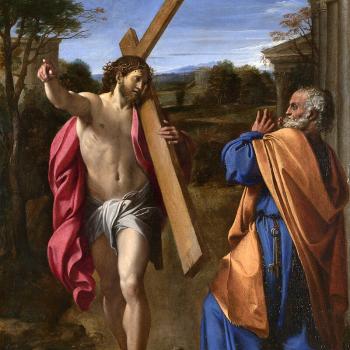
Three Reasons to Believe that St. Peter Went...
TRENDING AT PATHEOS Catholic

Rejecting Doom: Christian Hope And Human Action
Christianity is a religion of hope. We are to have hope and...

It’s What Comes From Within Which Matters
One of the most difficult things for us to understand is why...

Why I Choose the Eucharist Over the Sermon
Choose the Eucharist, Not the Sermon What are we supposed to get...

5 Design Elements Found in Spiritually Rooted Homes
Putting Spirituality Into Home Decor Our homes are more than our living...

Credo: A Story of God Told with the...
About 10 years ago, I began to imagine a personal "Credo" that...

The Anatomy of Divine Revelation in Catholic Thought
The claim that God has made Himself known to human beings is...
view all Catholic blogs
Ad-Free & Subscriber Log-In Subscription Support
- About Us
- 2026 Calendar
- Videos
- Podcasts
- Library of World Religions
- Faith In Media Tracker
- Advertise With Us
- Write for Us
- Privacy Policy
- Terms of Service
- Do Not Sell My Data
- Contact Us
- Radiant Digital
- Manage Newsletter Subscriptions
- Unsubscribe From Notifications
- Sitemap
Copyright 2008-2026, Patheos. All rights reserved.
Subscription Support Ad-Free & Subscriber Log-In
Follow Patheos