
BuddhistCatholicContemplativeEvangelicalGeneral ChristianHinduJewishLatter-day SaintMuslimNew VisionsProgressive Christian
Beliefs
- Buddhist
- Catholic
- Contemplative
- Evangelical
- General Christian
- Hindu
- Jewish
- Latter-day Saint
- More Voices
- Muslim
- New Visions
- Pagan
- Progressive Christian
Topics
- Religion News
- Food and Religion
- Sports and Religion
- Religious Art
- Religious Music and Entertainment
- Religious Events
- History and Religion
- Style and Religion
- Politics and Religion
- Women in Religion
- Recreation Outdoors and Religion
- Business Finance and Religion
- Careers Workplace and Religion
- Education and Religion
- Family Parenting and Religion
- Health Fitness and Religion
- Home and Religion
- Relationships and Religion
- Technology and Religion
- Travel and Religion
Columnists
- Buddhist Columnists
- Business Finance and Religion Columnists
- Careers Workplace and Religion Columnists
- Catholic Columnists
- Contemplative Columnists
- Education and Religion Columnists
- Evangelists Columnists
- Family Parenting and Religion Columnists
- General Christian Columnists
- Health Fitness and Religion Columnists
- Hindu Columnists
- History and Religion Columnists
- Home and Religion Columnists
- Jewish Columnists
- More Voices Columnists
- Latter Day Columnists
- Muslim Columnists
- New Visions Columnists
- Nonreligious Columnists
- Pagan Columnists
- Politics and Religion Columnists
- Progressive Columnists
- Recreation Outdoors and Religion Columnists
- Relationships and Religion Columnists
- Religion News Columnists
- Religious Art Columnists
- Religious Events Columnists
- Religious Music and Entertainment Columnists
- Sports and Religion Columnists
- Style and Religion Columnists
- Technology and Religion Columnists
- Travel and Religion Columnists
- Women in Religion Columnists
Resource Library
- 2026 Calendar
- Library of World Religions
- The 100 Most Holy Places on Earth
- Patheos Answers
- Podcasts
- Videos
- Faith Leaders Database
- Anglican Episcopalian
- Bahai
- Baptist
- Buddhism
- Christianity
- Confucianism
- Eastern Orthodoxy
- Hinduism
- Holiness and Pentecostal
- ISKCON
- Islam
- Judaism
- Lutheran
- Methodist
- The Church of Jesus Christ of Latter-day Saints
- New Age
- Paganism
- Presbytarian and Reformed
- Protestantism
- Religion Behind the Scenes
- Roman Catholic
- Scientology
- Shia Islam
- Sikhism
- Sufism
- Sunni Islam
- Taoism
- Zen
- See all religions
Research Tools
 Ad-Free & Subscriber Log-In Subscription Support
Ad-Free & Subscriber Log-In Subscription Support
Follow Patheos 

- Trending:
- Forgiveness
- |
- Marriage
- |
- Consciousness
- |
- Death Penalty
- |
- Election
- |
- Halloween

- Home
- Catholic
- History and Religion
- The Origins of the Denial of Peter’s Roman Sojourn
The Origins of the Denial of Peter’s Roman Sojourn
Last updated on: September 5, 2022 at 11:32 am by Nicholas Gulda
The Origins of the Denial of Peter’s Roman Sojourn 2022-09-05T11:32:19-05:00 Nicholas Gulda
Patheos Explore the world's faith through different perspectives on religion and spirituality! Patheos has the views of the prevalent religions and spiritualities of the world.
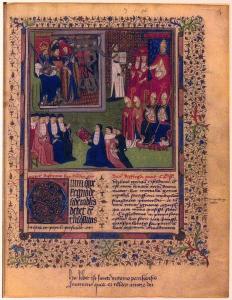
Miniature from a 15th c. manuscript of the Defensor pacis showing its author presenting the work (Wikipedia, “Defensor pacis”, public domain)
Background:
For the first thirteen centuries of Christianity it was accepted as a given that the Apostle Peter, before the end of his life, came to Rome, labored there for a period, and ultimately was martyred there. It was not until the advent of the Waldensian sect in the High Middle Ages that the first doubts on this question were expressed, and this seemingly in connection with their assertion that the Sacred Scriptures were the only means for determining Christian faith and practice.[1] Though an examination of the literary evidence is beyond the scope of this post, it should be noted that the New Testament itself does allude to this fact, albeit in a cryptic way in 1 Peter 5:13.[2]
The argument from silence expressed by the Waldensians was echoed by Marsilius of Padua in his fourteenth century political work entitled Defensor pacis (The Defender of the Peace).[3] In the early sixteenth century, an explicit denial of Peter’s Roman sojourn was expressed in an anonymous work published under the pseudonym Ulricus Venelus Minhoniensis.[4] Jumping ahead to the twentieth century, the scholarly consensus favored an affirmation of the ancient tradition.[5] Here it seems to remain at present.
Marsilius of Padua and the Defensor pacis
Marsilius was born in Padua in northern Italy ca. 1275, later becoming the rector of the University of Paris around the year 1313. In the conflict between the German Emperor Henry VII (and later Ludwig IV) and the papacy over their political activity in northern Italy, Marsilius sided with the former, which placed him within the Ghibelline camp regarding the controversy. Marsilius left Paris for Nuremburg in 1326, and after 1328 spent the remainder of his life in the service of Ludwig IV at the imperial court in Munich. This then is the political backdrop to the Defensor pacis (1324).[6]
The work consists of three Discourses, and it is in the second where the author expressed doubts pertaining to the Apostle Peter’s stay in Rome. In chapter 16 (section 16) we read the following:
“Since, therefore, it is plain and agreed from Scripture that Paul was at Rome for two years, and there received all the gentiles who wished to convert and preached to them, it is certain that he was the bishop of Rome specifically, since he carried out the office of a pastor there, holding the authority for this from Christ, the commandment by revelation, and the consent of the other apostles by election. Whereas with regard to Saint Peter (and in this the second of our propositions will become apparent), I say that it cannot be convincingly established on the basis of Holy Scripture that he was the Roman bishop specifically; and what is more, that he was ever at Rome.”[7]
In the previous section, he had argued [rather unconvincingly] that “the Roman bishops are more the successors of the apostle Paul than of Peter, especially in the episcopal see of Rome.”[8] In the above text, he more or less continues with this line of argumentation, culminating in the doubt “that he was ever at Rome”. The question of whether or not Peter is to be considered a Bishop of Rome is treated independently by modern scholars, from that of his labor and eventual martyrdom in the imperial capital. The focus of the present post of course is on the origin of the latter assertion. It is worth pointing out that like the Waldensians before him, Marsilius justifies his skepticism on the [alleged] silence of Scripture, especially that of Acts and Romans.[9] Whether or not Holy Writ is silent on the matter is the subject of contemporary scholarly debate, but the majority argue that 1 Peter 5:13 is indeed a reference to Peter’s having composed his epistle at Rome. That 1 Peter was written by the Apostle from Rome was the view of various Early Church Fathers, beginning with Papias of Hierapolis (c. A.D. 60 – c. 130).[10]
Whether or not one accepts that Scripture is silent on the matter, it has nevertheless been the constant tradition of the Catholic Church that Peter did indeed come to the capital at the end of his life, and suffer martyrdom there; a tradition reflected in the writings of the Early Church Fathers stretching back to the end of the first century, long before the Canon of Scripture was being hammered out in the fourth and fifth centuries.
The Papal Response:
Marsilius of Padua was excommunicated by Pope John XXII on April 9, 1327.[11] With respect to the Defensor pacis as a whole, John XXII condemned five propositions as being “contrary to Sacred Scripture and opposed to the Catholic faith, heretical, or analogous to heresy, and erroneous” in the bull Licet iuxta doctrinam, dated October 23, 1327. Marsilius and his possible co-author John of Jandun were also declared to be “heretics, indeed, manifest and notorious arch-heretics”.[12] “By the order of Benedict XII [r. 1334 – 1342],” notes Denzinger, “Defensor pacis was again subjected to an examination that Clement VI [r. 1342 – 1352] concluded in 1343….” For his part, Clement remarked in that year that “we have almost never read a worse heretic than that Marsilius. For we have extracted from the mandate of Benedict our predecessor on a certain book of his more than 240 heretical articles”.[13] Whether or not his skepticism of Peter’s Roman sojourn was one of the 240, I have not been able to uncover. Nevertheless, it would seem that doubting (let alone denying) Peter’s stay in Rome would run a Catholic afoul of Vatican I’s teaching on the papacy, namely, the dogma that “the successors of Peter in the Primacy are the bishops of Rome”.[14]
Notes:
[1] Oscar Cullmann, Peter: Disciple, Apostle, Martyr. Trans. Floyd V. Filson (Waco: Baylor University Press, 2011), 71-72; Daniel O’Connor, Peter in Rome: the Literary, Liturgical, and Archeological Evidence (New York: Columbia University Press, 1969), 3.
[2] For detailed literary analyses of extant evidence, including the New Testament, see Cullmann, Peter, 79-123; O’Connor, Peter in Rome, 8-40. As the Encyclopedia Britannica notes, “If Peter did write 1 Peter, the mention of ‘Babylon’ in 5:13 is fairly reliable evidence that Peter resided at some time in the capital city. If Peter was not the author of the first epistle that bears his name, the presence of this cryptic reference witnesses at least to a tradition of the late 1st or early 2nd century.” (https://www.britannica.com/biography/Saint-Peter-the-Apostle/Tradition-of-Peter-in-Rome, accessed 9/4/2022).
[3] Cullmann, Peter, 72-73; O’Connor, Peter in Rome, 3.
[4] Cullmann, Peter, 73, cf. n. 5.
[5] Cullmann, Peter, 75-78; O’Connor, Peter in Rome, 4-7.
[6] The biographical information above has been culled from the Introduction of a contemporary English translation of the Defensor Pacis: Marsilius of Padua, The Defender of the Peace, trans. Annabel Brett (New York: Cambridge University Press), xi-xiii. The citations that follow are taken from Brett’s translation.
[7] Marsilius of Padua, The Defender of the Peace, 332. My emphasis.
[8] Marsilius of Padua, The Defender of the Peace, 331.
[9] Marsilius of Padua, The Defender of the Peace, 332. Discussions on these two sources can be found in Cullmann, Peter, 79-83; O’Connor, Peter in Rome, 8-11.
[10] Joseph MacRory, St. Mark, in The Catholic Encyclopedia Vol. 9 (New York: Robert Appleton Company, 1910). Accessed Sept. 4, 2022 at http://www.newadvent.org/cathen/09672c.htm
[11] Louis, Salembier, Marsilius of Padua in, The Catholic Encyclopedia Vol. 9 (New York: Robert Appleton Company, 1910). Accessed online, Sept. 4, 2022, at http://www.newadvent.org/cathen/09719c.htm.
[12] Heinrich Denzinger, Compendium of Creeds, Definitions, and Declarations on Matters of Faith and Morals, ed. Peter Hunermann (San Francisco: Ignatius Press, 2012), 295-296. Cf. Salembier, Marsilius of Padua.
[13] Cited in the Introduction of Marsilius of Padua, The Defender of the Peace, xi.
[14] Ludwig Ott, “Fundamentals of Catholic Dogma, ed. James C. Bastible, trans. Patrick Lynch (Rockford: Tan Books and Publishers, 1974), 282-283.
Previous Post

January 2, 2022
Mary, Mother of God and the Council of Ephesus:
Next Post
September 11, 2022 September 11, a 1998 Fatwa, and an Unfortunate Comment
Browse Our Archives
Select a Category Book Reviews Byzantium Catholicism Islam Spain The Canon The Crusades The Papacy Uncategorized
Select a Month August 2025 May 2025 February 2025 August 2024 April 2024 February 2024 October 2023 September 2023 August 2023 July 2023 June 2023 May 2023 April 2023 March 2023 January 2023 December 2022 November 2022 October 2022 September 2022 January 2022 January 2021 December 2020 August 2020 December 2019 April 2019 March 2019 February 2019 January 2019
TAKE THE
Religious Wisdom Quiz
Who said, "Lord, to whom shall we go? You have the words of eternal life"?
Select your answer to see how you score.
Peter Paul James John
Related posts from The Crossroads
Why the Assumption of Mary Stands on Biblical...
The Canon, Papal Infallibility and the Assumption of...
A Clarification on Constantinople IV and Luke 10:16
Luke 10:16 and the Question of Authority
TRENDING AT PATHEOS Catholic

Rejecting Doom: Christian Hope And Human Action
Christianity is a religion of hope. We are to have hope and...

It’s What Comes From Within Which Matters
One of the most difficult things for us to understand is why...

Why I Choose the Eucharist Over the Sermon
Choose the Eucharist, Not the Sermon What are we supposed to get...

5 Design Elements Found in Spiritually Rooted Homes
Putting Spirituality Into Home Decor Our homes are more than our living...

Credo: A Story of God Told with the...
About 10 years ago, I began to imagine a personal "Credo" that...

The Anatomy of Divine Revelation in Catholic Thought
The claim that God has made Himself known to human beings is...
view all Catholic blogs
Ad-Free & Subscriber Log-In Subscription Support
- About Us
- 2026 Calendar
- Videos
- Podcasts
- Library of World Religions
- Faith In Media Tracker
- Advertise With Us
- Write for Us
- Privacy Policy
- Terms of Service
- Do Not Sell My Data
- Contact Us
- Radiant Digital
- Manage Newsletter Subscriptions
- Unsubscribe From Notifications
- Sitemap
Copyright 2008-2026, Patheos. All rights reserved.
Subscription Support Ad-Free & Subscriber Log-In
Follow Patheos