
BuddhistCatholicContemplativeEvangelicalGeneral ChristianHinduJewishLatter-day SaintMuslimNew VisionsProgressive Christian
Beliefs
- Buddhist
- Catholic
- Contemplative
- Evangelical
- General Christian
- Hindu
- Jewish
- Latter-day Saint
- More Voices
- Muslim
- New Visions
- Pagan
- Progressive Christian
Topics
- Religion News
- Food and Religion
- Sports and Religion
- Religious Art
- Religious Music and Entertainment
- Religious Events
- History and Religion
- Style and Religion
- Politics and Religion
- Women in Religion
- Recreation Outdoors and Religion
- Business Finance and Religion
- Careers Workplace and Religion
- Education and Religion
- Family Parenting and Religion
- Health Fitness and Religion
- Home and Religion
- Relationships and Religion
- Technology and Religion
- Travel and Religion
Columnists
- Buddhist Columnists
- Business Finance and Religion Columnists
- Careers Workplace and Religion Columnists
- Catholic Columnists
- Contemplative Columnists
- Education and Religion Columnists
- Evangelists Columnists
- Family Parenting and Religion Columnists
- General Christian Columnists
- Health Fitness and Religion Columnists
- Hindu Columnists
- History and Religion Columnists
- Home and Religion Columnists
- Jewish Columnists
- More Voices Columnists
- Latter Day Columnists
- Muslim Columnists
- New Visions Columnists
- Nonreligious Columnists
- Pagan Columnists
- Politics and Religion Columnists
- Progressive Columnists
- Recreation Outdoors and Religion Columnists
- Relationships and Religion Columnists
- Religion News Columnists
- Religious Art Columnists
- Religious Events Columnists
- Religious Music and Entertainment Columnists
- Sports and Religion Columnists
- Style and Religion Columnists
- Technology and Religion Columnists
- Travel and Religion Columnists
- Women in Religion Columnists
Resource Library
- 2026 Calendar
- Library of World Religions
- The 100 Most Holy Places on Earth
- Patheos Answers
- Podcasts
- Videos
- Faith Leaders Database
- Anglican Episcopalian
- Bahai
- Baptist
- Buddhism
- Christianity
- Confucianism
- Eastern Orthodoxy
- Hinduism
- Holiness and Pentecostal
- ISKCON
- Islam
- Judaism
- Lutheran
- Methodist
- The Church of Jesus Christ of Latter-day Saints
- New Age
- Paganism
- Presbytarian and Reformed
- Protestantism
- Religion Behind the Scenes
- Roman Catholic
- Scientology
- Shia Islam
- Sikhism
- Sufism
- Sunni Islam
- Taoism
- Zen
- See all religions
Research Tools
 Ad-Free & Subscriber Log-In Subscription Support
Ad-Free & Subscriber Log-In Subscription Support
Follow Patheos 

- Trending:
- Forgiveness
- |
- Marriage
- |
- Consciousness
- |
- Death Penalty
- |
- Election
- |
- Halloween

- Home
- Catholic
- History and Religion
- The “Ascension of Isaiah” and the Martyrdom of St. Peter
The “Ascension of Isaiah” and the Martyrdom of St. Peter
Last updated on: September 25, 2022 at 2:51 pm by Nicholas Gulda
The “Ascension of Isaiah” and the Martyrdom of St. Peter 2022-09-25T14:51:32-05:00 Nicholas Gulda
Patheos Explore the world's faith through different perspectives on religion and spirituality! Patheos has the views of the prevalent religions and spiritualities of the world.
Background:
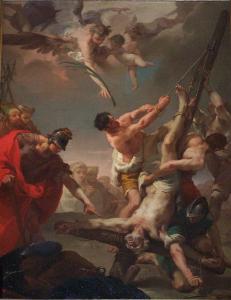
According to tradition, the Apostle Peter eventually came to the imperial capital, labored there for a time, and was ultimately martyred there by the Roman authorities. From a strictly historical perspective, Peter’s martyrdom at Rome is so well attested to in the ancient literary sources that the Lutheran theologian Oscar Cullman concluded that, “were we to demand for all facts of ancient history a greater degree of probability, we should have to strike from our history books a large proportion of their contents”.[1] The question that the present article hope to address is whether or not this belief is reflected in the Ascension of Isaiah. According Cullmann, it is a source that has not historically received the attention that it merits.[2]
The Ascension of Isaiah
As per the Encyclopedia Britannica, the Ascension of Isaiah is a pseudepigraphal compilation of three separate works, the final form of which came from the hands of a Christian editor in the second century A.D. The first, the Martyrdom of Isaiah, is a Jewish work produced in the early first century. The second, Testament of Hezekiah, is a Christian work dated towards to the end of the first century, and the third, the Ascension of Isaiah, is another Christian work belonging to the early second century.[3] It is the third work in the compilation which potentially sheds light on the question of St. Peter’s martyrdom. The text in question reads as follows:
“2. After it is consummated, Beliar the great ruler, the king of this world, will descend, who hath ruled it since it came into being; yea, he will descend from his firmament in the likeness of a man, a lawless king, the slayer of his mother: who himself (even) this king 3. Will persecute the plant which the Twelve Apostles of the Beloved have planted. Of the Twelve one will be delivered into his hands.”[4]
Interpretation of the Text
Commentators are agreed that “Beliar” (Belial) is a reference to the Roman Emperor Nero in the above passage. As the Anglican scholar Robert Charles notes, “soon after the death of Nero the myth became current that (a) Nero had not really died, but was still living; and (b) that he would soon return from the East to take vengeance on Rome”.[5] This conviction developed into the notion of Nero redivivus, that is, the belief that Satan would bring Nero back to life.[6] It seems that the latter is meant by the author (especially given the date), and Daniel O’Connor suggests “that there is evidence here of a flowing together of two ideas and a compromise. On the one hand, Nero is seen as Antichrist, and on the other, the Devil appears to be the Antichrist”.[7]
Given that Nero is signified by the name “Beliar”, what of the “plant”, and who is the one of the Twelve delivered into the hands of Nero?
O’Connor lays out the interpretation of the entire text succinctly:
“If the passage is read without prejudice, the most convincing interpretation is that ‘Beliar’ is a cryptic name for Nero; ‘the plant’ stands for the Church; and Peter is the one of ‘the Twelve’ who is ‘delivered into his hands’…. The reason why Peter is not named may be explained from the standpoint of style. As in many passages pertaining to predictions of the future, this detail is omitted, that is, Acts 15:25, 26 and more clearly in Mark 14:18 (Matt. 26:21): ‘Truly, I say to you, one of you will betray me, one who is eating with me’”.[8]
Cullmann goes further than viewing the text merely as a possible reference to the martyrdom of Peter,[9] stating that it is “very probable”. “Paul, however, cannot be meant here,” he continues, “for according to ch. 3:17 the author uses the phrase ‘the Twelve’ in the narrowest sense. In that case this passage probably refers to Peter”.[10] Finally, Charles has no hesitations: “This work…is the first and oldest document that testifies to the martyrdom of St. Peter at Rome”.[11] While I would note that there is earlier literary evidence, — especially 1 Clement (ca. A.D. 96) — [12] it is hard to disagree that this passage in the Ascension is a reference to the martyrdom of the Prince of the Apostles at the imperial capital.
[1] Oscar Cullmann, Peter: Disciple, Apostle, Martyr, trans. Floyd V. Filson (Waco: Baylor University Press, 2011), 114.
[2] Cullmann, Peter, 112-113.
[3] “The Ascension of Isaiah”, at britannica.com (accessed 9/24/2022).
[4] Ascension of Isaiah: Translated from the Ethiopic Version, Which, Together with the New Greek Fragment, The Latin Versions and the Latin Translation of the Slavonic, is Here Published in Full, ed. R.H. Charles (London: Adam and Charles Black, 1900), 24-26. Cf. Daniel O’Connor, Peter in Rome: The Literary, Liturgical, and Archeological Evidence (New York: Columbia University Press, 1969), 68. HathiTrust.
[5] Ascension of Isaiah, lvii.
[6] Charles, Ascension of Isaiah, lxvi. Cf. O’Connor, Peter in Rome, 68.
[7] O’Connor, Peter in Rome, 68. Charles is adamant: “From this passage it is manifest that the belief in Nero being still alive had already been abandoned”. He suggests two options: “Either Beliar must come in the form of the dead Nero , or Nero must be recalled to life by a Satanic miracle . The first course is adopted by the writer of the Ascension…” (Ascension of Isaiah, lxx).
[8] O’Connor, Peter in Rome, 69.
[9] O’Connor, Peter in Rome, 68-69. He concludes: “As is stands the information is too vague to serve as a strong argument for the martyrdom of Peter in Rome, but, on the other hand, the possibility that the passage does contain a cryptic reference to his martyrdom is so convincing that the evidence certainly ought to be proposed and considered” (p.70).
[10] Cullmann, Peter, 112.
[11] Ascension of Isaiah, xii.
[12] Cf. Cullmann, Peter, 79-113’ O’Connor, Peter in Rome, 61-86. On 1 Clement, the latter concludes: “Despite the objections of those who deny that Clement had any knowledge of Peter’s martyrdom in Rome…and those who see in I Clement 5 and 6 the beginning of the Roman legend of Peter and Paul, it is most probable Clement believed, on the basis of written or oral tradition or both, that Peter and Paul (in that order) died at about the same time in Rome during the persecution under Nero” (p. 86).
Previous Post

September 17, 2022
Rome, Babylon, and 1 Peter 5:13 Revisited
Next Post
October 1, 2022 Patriarch Kirill and the Idea of Combatants as Martyrs
Browse Our Archives
Select a Category Book Reviews Byzantium Catholicism Islam Spain The Canon The Crusades The Papacy Uncategorized
Select a Month August 2025 May 2025 February 2025 August 2024 April 2024 February 2024 October 2023 September 2023 August 2023 July 2023 June 2023 May 2023 April 2023 March 2023 January 2023 December 2022 November 2022 October 2022 September 2022 January 2022 January 2021 December 2020 August 2020 December 2019 April 2019 March 2019 February 2019 January 2019
TAKE THE
Religious Wisdom Quiz
True or False: Mark is the only Gospel that records Jesus asking 'Who touched my clothes?' after power went out from him.
Select your answer to see how you score.
TRUE FALSE
Related posts from The Crossroads
Why the Assumption of Mary Stands on Biblical...
The Canon, Papal Infallibility and the Assumption of...
A Clarification on Constantinople IV and Luke 10:16
Luke 10:16 and the Question of Authority
TRENDING AT PATHEOS Catholic

Rejecting Doom: Christian Hope And Human Action
Christianity is a religion of hope. We are to have hope and...

It’s What Comes From Within Which Matters
One of the most difficult things for us to understand is why...

Why I Choose the Eucharist Over the Sermon
Choose the Eucharist, Not the Sermon What are we supposed to get...

5 Design Elements Found in Spiritually Rooted Homes
Putting Spirituality Into Home Decor Our homes are more than our living...

Credo: A Story of God Told with the...
About 10 years ago, I began to imagine a personal "Credo" that...

The Anatomy of Divine Revelation in Catholic Thought
The claim that God has made Himself known to human beings is...
view all Catholic blogs
Ad-Free & Subscriber Log-In Subscription Support
- About Us
- 2026 Calendar
- Videos
- Podcasts
- Library of World Religions
- Faith In Media Tracker
- Advertise With Us
- Write for Us
- Privacy Policy
- Terms of Service
- Do Not Sell My Data
- Contact Us
- Radiant Digital
- Manage Newsletter Subscriptions
- Unsubscribe From Notifications
- Sitemap
Copyright 2008-2026, Patheos. All rights reserved.
Subscription Support Ad-Free & Subscriber Log-In
Follow Patheos