
BuddhistCatholicContemplativeEvangelicalGeneral ChristianHinduJewishLatter-day SaintMuslimNew VisionsProgressive Christian
Beliefs
- Buddhist
- Catholic
- Contemplative
- Evangelical
- General Christian
- Hindu
- Jewish
- Latter-day Saint
- More Voices
- Muslim
- New Visions
- Pagan
- Progressive Christian
Topics
- Religion News
- Food and Religion
- Sports and Religion
- Religious Art
- Religious Music and Entertainment
- Religious Events
- History and Religion
- Style and Religion
- Politics and Religion
- Women in Religion
- Recreation Outdoors and Religion
- Business Finance and Religion
- Careers Workplace and Religion
- Education and Religion
- Family Parenting and Religion
- Health Fitness and Religion
- Home and Religion
- Relationships and Religion
- Technology and Religion
- Travel and Religion
Columnists
- Buddhist Columnists
- Business Finance and Religion Columnists
- Careers Workplace and Religion Columnists
- Catholic Columnists
- Contemplative Columnists
- Education and Religion Columnists
- Evangelists Columnists
- Family Parenting and Religion Columnists
- General Christian Columnists
- Health Fitness and Religion Columnists
- Hindu Columnists
- History and Religion Columnists
- Home and Religion Columnists
- Jewish Columnists
- More Voices Columnists
- Latter Day Columnists
- Muslim Columnists
- New Visions Columnists
- Nonreligious Columnists
- Pagan Columnists
- Politics and Religion Columnists
- Progressive Columnists
- Recreation Outdoors and Religion Columnists
- Relationships and Religion Columnists
- Religion News Columnists
- Religious Art Columnists
- Religious Events Columnists
- Religious Music and Entertainment Columnists
- Sports and Religion Columnists
- Style and Religion Columnists
- Technology and Religion Columnists
- Travel and Religion Columnists
- Women in Religion Columnists
Resource Library
- 2026 Calendar
- Library of World Religions
- The 100 Most Holy Places on Earth
- Patheos Answers
- Podcasts
- Videos
- Faith Leaders Database
- Anglican Episcopalian
- Bahai
- Baptist
- Buddhism
- Christianity
- Confucianism
- Eastern Orthodoxy
- Hinduism
- Holiness and Pentecostal
- ISKCON
- Islam
- Judaism
- Lutheran
- Methodist
- The Church of Jesus Christ of Latter-day Saints
- New Age
- Paganism
- Presbytarian and Reformed
- Protestantism
- Religion Behind the Scenes
- Roman Catholic
- Scientology
- Shia Islam
- Sikhism
- Sufism
- Sunni Islam
- Taoism
- Zen
- See all religions
Research Tools
 Ad-Free & Subscriber Log-In Subscription Support
Ad-Free & Subscriber Log-In Subscription Support
Follow Patheos 

- Trending:
- Forgiveness
- |
- Marriage
- |
- Consciousness
- |
- Death Penalty
- |
- Election
- |
- Halloween

- Home
- Catholic
- History and Religion
- September 11, a 1998 Fatwa, and an Unfortunate Comment
September 11, a 1998 Fatwa, and an Unfortunate Comment
Last updated on: September 13, 2022 at 6:45 am by Nicholas Gulda
September 11, a 1998 Fatwa, and an Unfortunate Comment 2022-09-13T06:45:23-05:00 Nicholas Gulda
Patheos Explore the world's faith through different perspectives on religion and spirituality! Patheos has the views of the prevalent religions and spiritualities of the world.
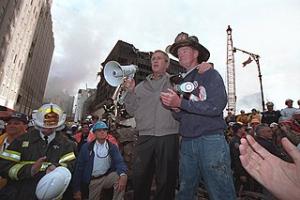
President George W. Bush’s speech at Ground Zero, Friday, Sept. 14, 2001.
Introduction:
Today on the memorial of September 11, 2022 many Americans (as well as others) reflect upon a major tragedy that took the lives of many, and provoked a major paradigm shift with respect to U.S. foreign policy. The ripples of that horrible day still affect countless individuals, as well as the world as a whole. The purpose of this article is to shed some light on the “why”, to explore some of the religious rhetoric leading up to that day from those responsible for the attack, and to see the effect of a remark made in the aftermath by then President George W. Bush. The intent is to provide information, not to make moral judgments.
A Primer on Jihad
In the broadest sense, the word itself simply means “to strive”[1], and Islamic scholars posit two senses in which this struggle may occur. The first, often referred to as the “greater jihad” simply refers to the individual Muslim’s interior struggle over their own faults.[2] Alternatively, it can refer the Islamic conception of a religious war, otherwise known as the “lesser jihad”. It is the latter which the non-Muslim typically envisions when the word is invoked.
Medieval Islam traditionally separated the world into two spheres: the Dar al-Islam (the House of Islam) and the Dar al-Harb (House of War). The former consisted of those territories under Islamic rule, while the latter referred to those not subject to a Muslim polity. Assuming the existence of a Caliph, it was the duty of the Muslim world (not that of individual Muslims) to expand the Dar al-Islam until it inhabited the entire known world. This has been termed as the “offensive jihad”, and the goal was to have every nation and every people subject to Islamic rule. That is not to say that those who inhabited the Dar al-Islam would be forced to convert to Islam; on the contrary Islamic law (shari’a) carves out an inferior yet protected status for “People of the Book”, namely Jews and Christians. These non-Muslim dhimmis – which later came to include Zoroastrians and Hindus – were allowed to keep their respective religions (with some limitations) in exchange for payment of a poll tax (jizya). In any event, this offensive and expansive jihad could only be authorized by a Caliph. Alternatively, “defensive jihad” was the duty of every individual Muslim to engage in. Since it was defensive in nature, it did not need the authorization of the Caliph.
Jumping forward to the modern era, the concept of the Dar al-Harb has largely become obsolete.[3] Moreover, following the schema of Rudolph Peters, the relatively unified view of jihad in the classical period eventually bifurcated into the two opposing camps that exist today; the modernist and fundamentalist notions of jihad. While the “modernists” tend to view jihad in strictly defensive terms, the “fundamentalists” still accept the possibility of an offensive religious war. The claims of the Islamic State (which did not even exist in 2001) notwithstanding, most from the “fundamentalist” camp recognize that the last Islamic Caliphate to exist was that of the Ottoman Empire, and it was abolished in 1924. As such, any notion of an offensive jihad remains in the realm of the hypothetical since there is no Caliph who can authorize it. For those “fundamentalists” who attacked the World Trade Center and Pentagon, they believed they were engaged in a defensive jihad. But how could this be?
The Fatwa of February 23, 1998
As Peters explains, the arrival of U.S. forces in the Arabian Peninsula following the American occupation of Kuwait in 1990 divided the Muslim world. One noteworthy critic was Usama bin Laden, who in 1996 issued a declaration of war against the U.S., and later in 1998, was one of five fundamentalist signatories on a fatwa published on February 23.[4]
In this document, three justifications are given for prosecuting the jihad. First, the occupation of the Peninsula and its use as a base from which to launch operations into Islamic controlled Iraq; second, [alleged] devastation and massacres on Iraqis perpetrated “by the crusader-Zionist alliance”, and the intent to “annihilate what is left of this people and to humiliate their Muslim neighbors”; and “third, if the Americans’ aims behind these wars are religious and economic, the aim is also to serve the Jews’ petty state and divert attention from its occupation of Jerusalem and the murder of Muslims there”. This then was the Gulf War as seen through the lens of Islamic extremists, or at the very least how they wished to portray it to the ummah (the Islamic community). “On that basis, and in compliance with God’s order”, the document continues, “we issue the following fatwa to all Muslims: Killing Americans and their allies–civilians and military–is an individual duty for every Muslim who is capable of it and in every country in which it is possible to do so. This will continue until al-Aqṣā Mosque and the Holy Mosque [in Mecca] have been liberated from their grip, and their armies have moved out of all the lands of Islam, being defeated and unable to threaten any Muslim.”[5]
As Peters indicates, “this fatwa heralded an intensification of the attacks on American targets, such as the bomb attacks on the U.S. embassies in Dar es Salaam and Nairobi (August 7, 1998), on the USS Cole in the harbour of Aden (October 5, 2000), and finally, on September 11, the attacks on the World Trade Center in New York and the Pentagon in Washington, D.C.” He goes on to explain how the majority of Muslim scholars opposed the attacks, especially on the grounds that civilians were targeted, and how the various objections were countered by a minority of extremists.[6]
An Unfortunate Comment
In the fatwa of February 23, 1998, it is hard to miss the religious motivation attributed to the military actions of the United States. Besides references to “the crusader legions”, and “the crusader-Zionist alliance”, the author explicitly suggests that “the Americans’ aims behind these wars are religious and economic”.[7] While there may or may not have been religious motives for individual troops, it would be a hard case to make that America entered the First Gulf War for religious reasons. Nevertheless, it was perceived and/or propagandized by the author as such. Unfortunately, a gaffe made by President George W. Bush on September 16, 2001 played right into this mischaracterization. Speaking to reporters that day, he stated that “this crusade, this war on terrorism is going to take a while”. Reacting to the international Muslim backlash, then White House Press Secretary Ari Fleischer tried to walk the comment back two days later, but it was too little too late. By October, Osama bin Laden had seized on Bush’s mistake to rally the Muslim world “to unite in the face of the Christian Crusade”.[8] Colloquial usage and propaganda aside, the Global War on Terror was most assuredly not a “crusade”.
[1] Cf. “Jihad” in The Oxford Dictionary of Islam, ed. John L. Esposito (New York: Oxford University Press, 2003).
[2] Cf. Ibid.
[3] Cf. “Dar al-Harb” in The Oxford Dictionary of Islam, ed. John L. Esposito (New York: Oxford University Press, 2003).
[4] The information above has been taken from Rudolph Peters, Jihad in Classical and Modern Islam (Princeton: Markus Wiener Publishers, 2008), pp. 174-175.
[5] In ibid, pp. 175-177.
[6] Ibid, 178-180. See here for a discussion of the attempted extremist rebuttal.
[7] In ibid, 175-176.
[8] “Crusading Rhetoric After 9/11”, in The Crusades: A Reader, trans. Bruno Scott James, ed. S.J. Allen and Emilie Amt (North York: University of Toronto Press, 2014), 415-418.
Previous Post
September 4, 2022
The Origins of the Denial of Peter’s Roman Sojourn
Next Post

September 17, 2022 Rome, Babylon, and 1 Peter 5:13 Revisited
Browse Our Archives
Select a Category Book Reviews Byzantium Catholicism Islam Spain The Canon The Crusades The Papacy Uncategorized
Select a Month August 2025 May 2025 February 2025 August 2024 April 2024 February 2024 October 2023 September 2023 August 2023 July 2023 June 2023 May 2023 April 2023 March 2023 January 2023 December 2022 November 2022 October 2022 September 2022 January 2022 January 2021 December 2020 August 2020 December 2019 April 2019 March 2019 February 2019 January 2019
TAKE THE
Religious Wisdom Quiz
What was the name of the field bought with Judas' betrayal money?
Select your answer to see how you score.
Aceldama Potter's Field Field of Blood Golgotha
Related posts from The Crossroads

Catharism, Calvary Chapel, and Catholicism (Some Primary Sources)
Catharism, Calvary Chapel, and Catholicism
Patriarch Kirill and the Idea of Combatants as...

Political Polarization at the Dawn of the Spanish...
TRENDING AT PATHEOS Catholic

Rejecting Doom: Christian Hope And Human Action
Christianity is a religion of hope. We are to have hope and...

It’s What Comes From Within Which Matters
One of the most difficult things for us to understand is why...

Why I Choose the Eucharist Over the Sermon
Choose the Eucharist, Not the Sermon What are we supposed to get...

5 Design Elements Found in Spiritually Rooted Homes
Putting Spirituality Into Home Decor Our homes are more than our living...

Credo: A Story of God Told with the...
About 10 years ago, I began to imagine a personal "Credo" that...

The Anatomy of Divine Revelation in Catholic Thought
The claim that God has made Himself known to human beings is...
view all Catholic blogs
Ad-Free & Subscriber Log-In Subscription Support
- About Us
- 2026 Calendar
- Videos
- Podcasts
- Library of World Religions
- Faith In Media Tracker
- Advertise With Us
- Write for Us
- Privacy Policy
- Terms of Service
- Do Not Sell My Data
- Contact Us
- Radiant Digital
- Manage Newsletter Subscriptions
- Unsubscribe From Notifications
- Sitemap
Copyright 2008-2026, Patheos. All rights reserved.
Subscription Support Ad-Free & Subscriber Log-In
Follow Patheos