
BuddhistCatholicContemplativeEvangelicalGeneral ChristianHinduJewishLatter-day SaintMuslimNew VisionsProgressive Christian
Beliefs
- Buddhist
- Catholic
- Contemplative
- Evangelical
- General Christian
- Hindu
- Jewish
- Latter-day Saint
- More Voices
- Muslim
- New Visions
- Pagan
- Progressive Christian
Topics
- Religion News
- Food and Religion
- Sports and Religion
- Religious Art
- Religious Music and Entertainment
- Religious Events
- History and Religion
- Style and Religion
- Politics and Religion
- Women in Religion
- Recreation Outdoors and Religion
- Business Finance and Religion
- Careers Workplace and Religion
- Education and Religion
- Family Parenting and Religion
- Health Fitness and Religion
- Home and Religion
- Relationships and Religion
- Technology and Religion
- Travel and Religion
Columnists
- Buddhist Columnists
- Business Finance and Religion Columnists
- Careers Workplace and Religion Columnists
- Catholic Columnists
- Contemplative Columnists
- Education and Religion Columnists
- Evangelists Columnists
- Family Parenting and Religion Columnists
- General Christian Columnists
- Health Fitness and Religion Columnists
- Hindu Columnists
- History and Religion Columnists
- Home and Religion Columnists
- Jewish Columnists
- More Voices Columnists
- Latter Day Columnists
- Muslim Columnists
- New Visions Columnists
- Nonreligious Columnists
- Pagan Columnists
- Politics and Religion Columnists
- Progressive Columnists
- Recreation Outdoors and Religion Columnists
- Relationships and Religion Columnists
- Religion News Columnists
- Religious Art Columnists
- Religious Events Columnists
- Religious Music and Entertainment Columnists
- Sports and Religion Columnists
- Style and Religion Columnists
- Technology and Religion Columnists
- Travel and Religion Columnists
- Women in Religion Columnists
Resource Library
- 2026 Calendar
- Library of World Religions
- The 100 Most Holy Places on Earth
- Patheos Answers
- Podcasts
- Videos
- Faith Leaders Database
- Anglican Episcopalian
- Bahai
- Baptist
- Buddhism
- Christianity
- Confucianism
- Eastern Orthodoxy
- Hinduism
- Holiness and Pentecostal
- ISKCON
- Islam
- Judaism
- Lutheran
- Methodist
- The Church of Jesus Christ of Latter-day Saints
- New Age
- Paganism
- Presbytarian and Reformed
- Protestantism
- Religion Behind the Scenes
- Roman Catholic
- Scientology
- Shia Islam
- Sikhism
- Sufism
- Sunni Islam
- Taoism
- Zen
- See all religions
Research Tools
 Ad-Free & Subscriber Log-In Subscription Support
Ad-Free & Subscriber Log-In Subscription Support
Follow Patheos 

- Trending:
- Forgiveness
- |
- Marriage
- |
- Consciousness
- |
- Death Penalty
- |
- Election
- |
- Halloween

- Home
- Catholic
- History and Religion
- Rome, Babylon, and 1 Peter 5:13 Revisited
Rome, Babylon, and 1 Peter 5:13 Revisited
Last updated on: September 17, 2022 at 10:37 pm by Nicholas Gulda
Rome, Babylon, and 1 Peter 5:13 Revisited 2022-09-17T22:37:59-05:00 Nicholas Gulda
Patheos Explore the world's faith through different perspectives on religion and spirituality! Patheos has the views of the prevalent religions and spiritualities of the world.
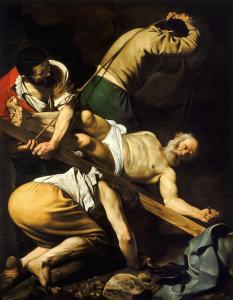
The Crucifixion of St. Peter, by Caravaggio
“The church that is in Babylon, elected together with you, saluteth you: and so doth my son Mark.”
(1 Peter 5:13, DRB)
Introduction:
In an older post, I had discussed the meaning of the reference to ‘Babylon’ in 1 Peter 5:13, and included the three most common interpretations of the text. The first, that it is a cryptic reference to Rome, is the oldest, has the support of ancient writers, and is the one favored by the majority of scholars today. The second interpretation argues for the literal Babylon in Mesopotamia, while the third suggests that it refers to a military base in Egypt. A concise argument for the first by Stephen J. Davis in his book The Early Coptic Papacy: The Egyptian Church and its Leadership in Late Antiquity was offered, as well as the testimonies of Papias of Hierapolis (d. ca. A.D. 130), Eusebius of Caesarea (d. A.D. 339), and also Jerome (d. 420). It was noted too that Erasmus of Rotterdam (d. 1536) was the first writer on record to question the fact that the reference to ‘Babylon’ in 1 Peter 5:13 signified the imperial capital [in keeping with Renaissance skepticism]. What follows then is a rehashing of the three interpretations, with further insight from two additional twentieth century (non-Catholic) scholars; Oscar Cullmann and Daniel O’Connor.[1] These will follow in order from what seems to be the least to the to the most probable, so far as purely historical arguments go.
An Egyptian Military Base
The first author to put forward the idea that the ‘Babylon’ mentioned in 1 Peter was a reference to a military base on the Nile appears to be the French scholar Théodore Reinach (d. 1928).[2] As O’Connor notes, the Greek Geographer Strabo (d. A.D. 23) refers to this encampment, but O’Connor suggests that it was relatively insignificant in the first century.[3] In any event, in Book XVII in The Geography of Strabo, we read:
“In sailing up the river we meet with Babylon, a strong fortress, built by some Babylonians who had taken refuge there, and had obtained permission from the [Egyptian] kings to establish a settlement in that place. At present it is an encampment for one of the three legions which garrison Egypt”.[4]
Ultimately, however, O’Connor concludes that “since there is no clear evidence tending in this direction [i.e. that ‘Babylon’ in 1 Peter refers to this base], it is not to be taken seriously”.[5] He agrees with Cullmann who wrote that “one can scarcely accept…the misguided idea that I Peter 5:13 refers to this rather obscure Babylon”.[6] Finally, it was said previously that for his part, Leo Davis also dismissed this idea for lack of evidence.
Babylon in Mesopotamia
This second position is arguably more defensible than the previous, but that is not saying much. For example, it is given as a possible interpretation in Dallas Theological Seminary’s The Bible Knowledge Commentary: New Testament, though the author favors the traditional view that it refers to Rome.[7] Additionally, it does find some support in the relatively late and “highly suspect” apocryphal Acts of Philip (4th c.).[8] Nevertheless, as O’Connor notes, “the evidence indicates that it is very doubtful whether Peter worked in this area, especially in light of the notation in the Talmud to the effect that Christians did not live in the vicinity until the third century”.[9] Based on similar arguments, Cullmann concluded that while the idea “cannot [be] completely exclude[d]…, it is not probable, and is not supported by later Christian tradition, which knows nothing of a missionary work of Peter in these regions”.[10] Davis is of the same opinion.[11]
‘Babylon’ as a Code Word for Rome
As previously stated, this is the traditional view which finds ample support in the Early Church Fathers, and was uncontested up until the time of Erasmus of Rotterdam (d. 1536).[12] It is also the view favored by the vast majority of scholars today.[13] Furthermore, this position accords with the utilization of ‘Babylon’ as a code word for Rome in The Book of Revelation (14:8; 16:19; 17:5; 18:2), as well as in various Jewish pseudepigraphal works.[14] Cullmann remarks that “the interpretation that the word ‘Babylon’ in 1 Peter 5:13 refers to Rome is doubtless the most natural, if we approach the passage without prejudice and without first taking into account the controversy concerning Peter’s stay in Rome”.[15] O’Connor similarly concludes that “since it is fairly obvious, however, that ‘Babylon’ in [1 Peter] 5:13 is a cryptic term for Rome, it may be said with confidence that by the end of the first century the tradition existed that Peter had lived in Rome and that he had written an epistle while there”.[16] This scholarly consensus is reflected in the Encyclopedia Britannica’s entry “St. Peter the Apostle”, which states: “If Peter did write 1 Peter, the mention of ‘Babylon’ in 5:13 is fairly reliable evidence that Peter resided at some time in the capital city. If Peter was not the author of the first epistle that bears his name, the presence of this cryptic reference witnesses at least to a tradition of the late 1st or early 2nd century”. Here, of course, the focus seems to be on authorship and Peter’s Roman sojourn, with the understanding that 1 Peter 5:13 refers to the Eternal City as a given. Therefore, a minority of objectors from the time of the Reformation until the present notwithstanding, the question appears to be more or less settled on strictly historical grounds.
[1] Cf. Oscar Cullmann, Peter: Disciple, Apostle, Martyr, trans. Floyd V. Filson (Waco: Baylor University Press, 2011), 72-78; Daniel O’Connor, Peter in Rome: The Literary, Liturgical, and Archeological Evidence (New York: Columbia University Press, 1969), 3-7.
[2] Cf. O’Connor, Peter in Rome, 15.
[3] O’Connor, Peter in Rome, 16, n. 49. Cullmann adds that the Jewish Historian Josephus also refers to this Babylon on the Nile (Peter, 87).
[4] Cf. O’Connor, Peter in Rome, 16, n. 49.
[5] O’Connor, Peter in Rome, 48-49. My emphasis.
[6] Cullmann, Peter, 87.
[7] Roger M. Raymer. 2004. 1 Peter. Bible Knowledge Series, edited by John F. Walvoord and Roy B. Zuck. Colorado Springs: Cook Communications Ministries, 857.
[8] “Here Philip is reported to have gone to the region of the Parthians and to have come upon Peter there. According to the oldest tradition, however, the apostle to the Parthians is Thomas”. O’Connor, Peter in Rome, 16.
[9] O’Connor, Peter in Rome, 16. Cf. Cullmann, Peter, 86.
[10] Cf. Cullmann, Peter, 86.
[11] Stephen J. Davis, The Early Coptic Papacy: The Egyptian Church and its Leadership in Late Antiquity (New York: AUC Press, 2017), 5.
[12] Joseph MacRory, “St. Mark”, in The Catholic Encyclopedia. Vol. 9 (New York: Robert Appleton Company, 1910). Retrieved 17 Sept. 2022 <http://www.newadvent.org/cathen/09672c.htm>.
[13] Davis, Coptic Papacy, 4-5.
[14] Cullmann, Peter, 85. With regards to the Jewish pseudepigraphal literature, he lists: Sibylline Oracles (V, 159), Apocalypse of Baruch (11:1), Fourth Esdras (3:1; 28:31) Cullmann, Peter, 85.
[15] Cullmann, Peter, 85-86.
[16] O’Connor, Peter in Rome, 18.
Previous Post

September 11, 2022
September 11, a 1998 Fatwa, and an Unfortunate Comment
Next Post
September 25, 2022 The "Ascension of Isaiah" and the Martyrdom of St. Peter
Browse Our Archives
Select a Category Book Reviews Byzantium Catholicism Islam Spain The Canon The Crusades The Papacy Uncategorized
Select a Month August 2025 May 2025 February 2025 August 2024 April 2024 February 2024 October 2023 September 2023 August 2023 July 2023 June 2023 May 2023 April 2023 March 2023 January 2023 December 2022 November 2022 October 2022 September 2022 January 2022 January 2021 December 2020 August 2020 December 2019 April 2019 March 2019 February 2019 January 2019
TAKE THE
Religious Wisdom Quiz
What does the Greek word 'Christos' mean?
Select your answer to see how you score.
Redeemer Anointed One Savior Lord
Related posts from The Crossroads
The Canon, Papal Infallibility and the Assumption of...
A Clarification on Constantinople IV and Luke 10:16
Luke 10:16 and the Question of Authority
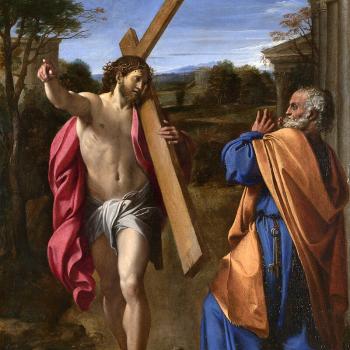
Three Reasons to Believe that St. Peter Went...
TRENDING AT PATHEOS Catholic

Rejecting Doom: Christian Hope And Human Action
Christianity is a religion of hope. We are to have hope and...

It’s What Comes From Within Which Matters
One of the most difficult things for us to understand is why...

Why I Choose the Eucharist Over the Sermon
Choose the Eucharist, Not the Sermon What are we supposed to get...

5 Design Elements Found in Spiritually Rooted Homes
Putting Spirituality Into Home Decor Our homes are more than our living...

Credo: A Story of God Told with the...
About 10 years ago, I began to imagine a personal "Credo" that...

The Anatomy of Divine Revelation in Catholic Thought
The claim that God has made Himself known to human beings is...
view all Catholic blogs
Ad-Free & Subscriber Log-In Subscription Support
- About Us
- 2026 Calendar
- Videos
- Podcasts
- Library of World Religions
- Faith In Media Tracker
- Advertise With Us
- Write for Us
- Privacy Policy
- Terms of Service
- Do Not Sell My Data
- Contact Us
- Radiant Digital
- Manage Newsletter Subscriptions
- Unsubscribe From Notifications
- Sitemap
Copyright 2008-2026, Patheos. All rights reserved.
Subscription Support Ad-Free & Subscriber Log-In
Follow Patheos