
BuddhistCatholicContemplativeEvangelicalGeneral ChristianHinduJewishLatter-day SaintMuslimNew VisionsProgressive Christian
Beliefs
- Buddhist
- Catholic
- Contemplative
- Evangelical
- General Christian
- Hindu
- Jewish
- Latter-day Saint
- More Voices
- Muslim
- New Visions
- Pagan
- Progressive Christian
Topics
- Religion News
- Food and Religion
- Sports and Religion
- Religious Art
- Religious Music and Entertainment
- Religious Events
- History and Religion
- Style and Religion
- Politics and Religion
- Women in Religion
- Recreation Outdoors and Religion
- Business Finance and Religion
- Careers Workplace and Religion
- Education and Religion
- Family Parenting and Religion
- Health Fitness and Religion
- Home and Religion
- Relationships and Religion
- Technology and Religion
- Travel and Religion
Columnists
- Buddhist Columnists
- Business Finance and Religion Columnists
- Careers Workplace and Religion Columnists
- Catholic Columnists
- Contemplative Columnists
- Education and Religion Columnists
- Evangelists Columnists
- Family Parenting and Religion Columnists
- General Christian Columnists
- Health Fitness and Religion Columnists
- Hindu Columnists
- History and Religion Columnists
- Home and Religion Columnists
- Jewish Columnists
- More Voices Columnists
- Latter Day Columnists
- Muslim Columnists
- New Visions Columnists
- Nonreligious Columnists
- Pagan Columnists
- Politics and Religion Columnists
- Progressive Columnists
- Recreation Outdoors and Religion Columnists
- Relationships and Religion Columnists
- Religion News Columnists
- Religious Art Columnists
- Religious Events Columnists
- Religious Music and Entertainment Columnists
- Sports and Religion Columnists
- Style and Religion Columnists
- Technology and Religion Columnists
- Travel and Religion Columnists
- Women in Religion Columnists
Resource Library
- 2026 Calendar
- Library of World Religions
- The 100 Most Holy Places on Earth
- Patheos Answers
- Podcasts
- Videos
- Faith Leaders Database
- Anglican Episcopalian
- Bahai
- Baptist
- Buddhism
- Christianity
- Confucianism
- Eastern Orthodoxy
- Hinduism
- Holiness and Pentecostal
- ISKCON
- Islam
- Judaism
- Lutheran
- Methodist
- The Church of Jesus Christ of Latter-day Saints
- New Age
- Paganism
- Presbytarian and Reformed
- Protestantism
- Religion Behind the Scenes
- Roman Catholic
- Scientology
- Shia Islam
- Sikhism
- Sufism
- Sunni Islam
- Taoism
- Zen
- See all religions
Research Tools
 Ad-Free & Subscriber Log-In Subscription Support
Ad-Free & Subscriber Log-In Subscription Support
Follow Patheos 

- Trending:
- Forgiveness
- |
- Marriage
- |
- Consciousness
- |
- Death Penalty
- |
- Election
- |
- Halloween

- Home
- Catholic
- History and Religion
- Francis Dvornik on Canon XXVIII of Chalcedon
Francis Dvornik on Canon XXVIII of Chalcedon
Last updated on: August 29, 2022 at 8:05 pm by Nicholas Gulda
Francis Dvornik on Canon XXVIII of Chalcedon 2022-08-29T20:05:38-05:00 Nicholas Gulda
Patheos Explore the world's faith through different perspectives on religion and spirituality! Patheos has the views of the prevalent religions and spiritualities of the world.
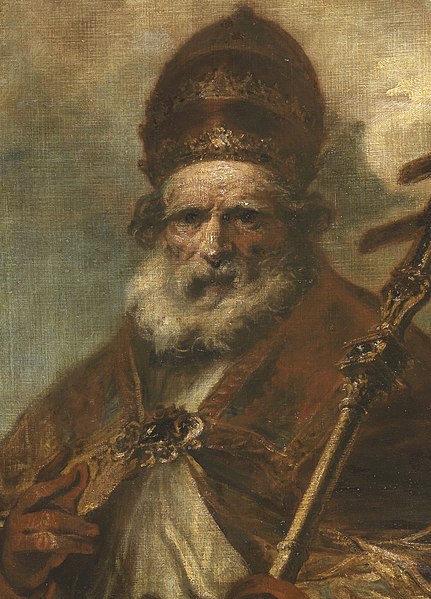
Pope St. Leo the Great, by Francisco de Herrera el Mozo, Museo de Prada.
(Wikimedia Commons)
The Council of Chalcedon was convened in A.D. 451 in order to combat the heresy of Monophysitism. While Nestorianism – condemned at the previous Council of Ephesus twenty years prior and historically attributed to Nestorius – held that Christ is two persons (one Divine and one human), Monophysitism swung to the opposite extreme. It posited that the human nature of Christ was swallowed up by the Divine one, leaving Christ with only a single nature after the Incarnation. In contrast to these views was the teaching of Pope St. Leo the Great in his famous Tome, and the Council of Chalcedon, which both taught that Christ is one Divine Person having two natures, one Divine and one human.
Apart from this controversy, the Council dealt with various other matters. Canon XXVIII involved the ranking of patriarchal sees, which was passed by a remnant of Eastern Bishops and was vigorously opposed by the Papal legates. It reads:
“Following in all things the decisions of the holy Fathers, and acknowledging the canon, which has been just read, of the One Hundred and Fifty Bishops beloved-of-God (who assembled in the imperial city of Constantinople, which is New Rome, in the time of the Emperor Theodosius of happy memory), we also do enact and decree the same things concerning the privileges of the most holy Church of Constantinople, which is New Rome. For the Fathers rightly granted privileges to the throne of old Rome, because it was the royal city. And the One Hundred and Fifty most religious Bishops, actuated by the same consideration, gave equal privileges (ἴσα πρεσβεῖα) to the most holy throne of New Rome, justly judging that the city which is honoured with the Sovereignty and the Senate, and enjoys equal privileges with the old imperial Rome, should in ecclesiastical matters also be magnified as she is, and rank next after her; so that, in the Pontic, the Asian, and the Thracian dioceses, the metropolitans only and such bishops also of the Dioceses aforesaid as are among the barbarians, should be ordained by the aforesaid most holy throne of the most holy Church of Constantinople; every metropolitan of the aforesaid dioceses, together with the bishops of his province, ordaining his own provincial bishops, as has been declared by the divine canons; but that, as has been above said, the metropolitans of the aforesaid Dioceses should be ordained by the archbishop of Constantinople, after the proper elections have been held according to custom and have been reported to him.”[1]
In the emboldened words above, we can see what Fr. Francis Dvornik referred to as “the principle of accommodation”; a concept which he dedicates a chapter to in his book Byzantium and the Roman Primacy. “In reality”, he writes, “this principle of accommodation to the political division of the Empire had been introduced by the Apostles themselves, and there were practical reasons why they did so.”[2] He goes on to demonstrate how this was so, but is careful to add that “this does not mean that the Apostles conferred upon the bishops residing in the capitals of the provinces any special rank superior to that of the other bishops of the same provinces. But since all of the economic, social and political life of the provinces of the Roman Empire were centralized in the capitals, it was altogether natural that the bishops of these cities should, little by little, come to be considered as the most important in the hierarchy of the province.”[3] This then explains how the concept of “Metropolitans” came about, and Dvornik points out that the Metropolitan status of a particular church was dependent not upon its being founded by an Apostle, but via the principle of accommodation.[4]
Rome was indeed the capital city of both Republic and Empire, but this changed when Constantine moved the capital of the Empire to Constantinople in A.D. 330. As Dvornik notes, though the church of Rome’s Petrine pedigree was never questioned in the East, this transfer of the capital gave Rome more of a reason to stress its unique link to St. Peter.[5] Prior to the Council of Chalcedon in 451, the Council of Constantinople in 381 had already exalted the see of Constantinople in its third Canon: “Because it is new Rome, the bishop of Constantinople is to enjoy the privileges of honour after the bishop of Rome.”[6] Though originally a regional council of the East, Constantinople I came to have Ecumenical status. Dvornik asserts that “Canon III was in no sense voted in order to weaken the prestige of Rome but only with a view to lessening the prestige of Alexandria in the Church of the East”[7], as it elevated Constantinople above the latter to second rank among the patriarchies. He sees no evidence of protest from the Roman church, and argues that its purpose was to relegate the internal affairs of the East.[8]
Fr. William Jurgens was not so sure. He argued that a Roman Synod presided by Pope St. Damasus in A.D. 382 had Canon III of Constantinople in mind. “Certainly,” he writes, “the explicit statement that Rome’s primacy is not based upon conciliar concession from other Churches would seem to be Damasus’ answer to Canon 3 of First Constantinople. If it is not his answer, it is certainly the answer he ought to have made!”[9] The text he refers to is from The Decree of Damasus, which reads in part:
“…the Holy Roman Church has been placed at the forefront not by the conciliar decisions of other Churches, but has received the primacy by the evangelic voice of our Lord and Savior, who says: ‘You are Peter, and upon this rock I will build My Church, and the gates of hell will not prevail against it; and I will give to you the keys of the kingdom of heaven, and whatever you shall have bound on earth will be bound in heaven, and whatever you shall have loosed on earth shall be loosed in heaven…’”[10]
Whatever the case, Canon XXVIII of Chalcedon undoubtedly brought protests from both the papal legates at Chalcedon, and later from Pope St. Leo himself. Thus, Leo wrote to the Byzantine Empress Pulcheria: “As for the resolution of the bishops which is contrary to the Nicene decree, I declare it to be invalid and annul it by the authority of the holy Apostle Peter.”[11] Here Leo references the sixth Canon of the Council of Nicaea (A.D. 325), which gave specific prerogatives to the patriarchates of Alexandria and Antioch.[12] To her husband the Emperor Marcian, the Pope wrote:
“Let the city of Constantinople have, as we desire, its high rank, and under the protection of God’s right hand, long enjoy your clemency’s rule. Yet things secular stand on a different basis from things divine: and there can be no sure building save on that rock which the Lord has laid for a foundation. …….
For the privileges of the churches determined by the canons of the holy Fathers, and fixed by the decrees of the Nicene Synod, cannot be overthrown by any unscrupulous act, nor disturbed by any innovation. And in the faithful execution of this task by the aid of Christ I am bound to display an unflinching devotion; for it is a charge entrusted to me, and it tends to my condemnation if the rules sanctioned by the Fathers and drawn up under the guidance of God’s Spirit at the Synod of Nicæa for the government of the whole Church are violated with my connivance (which God forbid), and if the wishes of a single brother have more weight with me than the common good of the Lord’s whole house.”[13]
For Dvornik, much like Canon III of Constantinople I, “Canon XXVIII [of Chalcedon] was essentially directed against Alexandria and the pretensions of its powerful patriarchs.”[14] Moreover, he argues that Leo was not objecting to the principle of accommodation per se, rather, “[w]hat bothered the Pope was that there was no mention in the canon of the apostolic and Petrine character of the see of Rome. The new measure was based solely on the principle of accommodation…. Because of this omission, the Pope set up in opposition to the principle of adaptation to the political divisions of the Empire, the principle of the apostolic and Petrine origin of a see.”[15] Had this detail been included in the Canon, he asserts, Leo would probably have approved it. When Byzantine prelates sought the Pope’s approval, stressing the apostolic pedigree of the Roman See, it was to no avail.[16] It would not be until the reign of Pope St. Hormisdas (r. 514-523) and the healing of the Acacian Schism that Rome would unofficially accept Constantinople as second in rank after Rome as a fait accompli.[17]
[1] Translated by Henry Percival. From Nicene and Post-Nicene Fathers, Second Series, Vol. 14. Edited by Philip Schaff and Henry Wace. (Buffalo, NY: Christian Literature Publishing Co., 1900.) Revised and edited for New Advent by Kevin Knight. <http://www.newadvent.org/fathers/3811.htm>.
[2] Francis Dvornik, Byzantium and the Roman Primacy, trans. Edwin A Quain, S.J. (New York: Fordham University Press, 1966), 29.
[3] Ibid, 30.
[4] Ibid, 31.
[5] Ibid, 28-29. “…the Churches of the East have never disputed Rome’s prestige which came to it from the fact that the Prince of the Apostles had lived and died and was buried there. But, until the fourth century, the Bishops of Rome never had any need to stress this fact.”
[6] Decrees of the Ecumenical Councils, ed. Norman P. Tanner. https://www.papalencyclicals.net/councils/ecum02.htm
[7] Dvornik, Byzantium, 45.
[8] Ibid, 44-45.
[9] Williams A. Jurgens, The Faith of the Early Fathers Volume 1, (Collegeville: The Liturgical Press, 1970), pg. 404.
[10] Ibid, 406. On pg. 404 Jurgens acknowledges that “opinion is still divided” on whether or not this citation belongs to the Decree of Damasus or the later Gelasian Decree, though he opts for the former.
[11] Ep. 105, in S. Herbert Scott, The Eastern Churches and the Papacy (London: Sheed & Ward, 1928), 198. Scott’s emphasis.
[12] Cf. Dvornik, Byzantium, 53.
[13] In John Charmley, “Leo The Great: Canon 28”, Newman Lectures, September 12, 2014, http://www.newmanlectures.co.uk/newman-blog/2014/8/24/leo-the-great-canon-28 (accessed 1/3/2021). Letter originally found at: https://www.ccel.org/ccel/schaff/npnf212.ii.iv.xcix.html
[14] Dvornik, Byzantium, 50.
[15] Ibid, 51-52.
[16] Ibid, 52.
[17] Ibid, 62.
Previous Post

December 23, 2020
Political Polarization at the Dawn of the Spanish Civil War
Next Post
January 2, 2022 Mary, Mother of God and the Council of Ephesus:
Browse Our Archives
Select a Category Book Reviews Byzantium Catholicism Islam Spain The Canon The Crusades The Papacy Uncategorized
Select a Month August 2025 May 2025 February 2025 August 2024 April 2024 February 2024 October 2023 September 2023 August 2023 July 2023 June 2023 May 2023 April 2023 March 2023 January 2023 December 2022 November 2022 October 2022 September 2022 January 2022 January 2021 December 2020 August 2020 December 2019 April 2019 March 2019 February 2019 January 2019
TAKE THE
Religious Wisdom Quiz
True or False: Mark is the only Gospel that records Jesus asking 'Who touched my clothes?' after power went out from him.
Select your answer to see how you score.
TRUE FALSE
Related posts from The Crossroads
Why the Assumption of Mary Stands on Biblical...
The Canon, Papal Infallibility and the Assumption of...
A Clarification on Constantinople IV and Luke 10:16
Luke 10:16 and the Question of Authority
TRENDING AT PATHEOS Catholic

Rejecting Doom: Christian Hope And Human Action
Christianity is a religion of hope. We are to have hope and...

It’s What Comes From Within Which Matters
One of the most difficult things for us to understand is why...

Why I Choose the Eucharist Over the Sermon
Choose the Eucharist, Not the Sermon What are we supposed to get...

5 Design Elements Found in Spiritually Rooted Homes
Putting Spirituality Into Home Decor Our homes are more than our living...

Credo: A Story of God Told with the...
About 10 years ago, I began to imagine a personal "Credo" that...

The Anatomy of Divine Revelation in Catholic Thought
The claim that God has made Himself known to human beings is...
view all Catholic blogs
Ad-Free & Subscriber Log-In Subscription Support
- About Us
- 2026 Calendar
- Videos
- Podcasts
- Library of World Religions
- Faith In Media Tracker
- Advertise With Us
- Write for Us
- Privacy Policy
- Terms of Service
- Do Not Sell My Data
- Contact Us
- Radiant Digital
- Manage Newsletter Subscriptions
- Unsubscribe From Notifications
- Sitemap
Copyright 2008-2026, Patheos. All rights reserved.
Subscription Support Ad-Free & Subscriber Log-In
Follow Patheos