
BuddhistCatholicContemplativeEvangelicalGeneral ChristianHinduJewishLatter-day SaintMuslimNew VisionsProgressive Christian
Beliefs
- Buddhist
- Catholic
- Contemplative
- Evangelical
- General Christian
- Hindu
- Jewish
- Latter-day Saint
- More Voices
- Muslim
- New Visions
- Pagan
- Progressive Christian
Topics
- Religion News
- Food and Religion
- Sports and Religion
- Religious Art
- Religious Music and Entertainment
- Religious Events
- History and Religion
- Style and Religion
- Politics and Religion
- Women in Religion
- Recreation Outdoors and Religion
- Business Finance and Religion
- Careers Workplace and Religion
- Education and Religion
- Family Parenting and Religion
- Health Fitness and Religion
- Home and Religion
- Relationships and Religion
- Technology and Religion
- Travel and Religion
Columnists
- Buddhist Columnists
- Business Finance and Religion Columnists
- Careers Workplace and Religion Columnists
- Catholic Columnists
- Contemplative Columnists
- Education and Religion Columnists
- Evangelists Columnists
- Family Parenting and Religion Columnists
- General Christian Columnists
- Health Fitness and Religion Columnists
- Hindu Columnists
- History and Religion Columnists
- Home and Religion Columnists
- Jewish Columnists
- More Voices Columnists
- Latter Day Columnists
- Muslim Columnists
- New Visions Columnists
- Nonreligious Columnists
- Pagan Columnists
- Politics and Religion Columnists
- Progressive Columnists
- Recreation Outdoors and Religion Columnists
- Relationships and Religion Columnists
- Religion News Columnists
- Religious Art Columnists
- Religious Events Columnists
- Religious Music and Entertainment Columnists
- Sports and Religion Columnists
- Style and Religion Columnists
- Technology and Religion Columnists
- Travel and Religion Columnists
- Women in Religion Columnists
Resource Library
- 2026 Calendar
- Library of World Religions
- The 100 Most Holy Places on Earth
- Patheos Answers
- Podcasts
- Videos
- Faith Leaders Database
- Anglican Episcopalian
- Bahai
- Baptist
- Buddhism
- Christianity
- Confucianism
- Eastern Orthodoxy
- Hinduism
- Holiness and Pentecostal
- ISKCON
- Islam
- Judaism
- Lutheran
- Methodist
- The Church of Jesus Christ of Latter-day Saints
- New Age
- Paganism
- Presbytarian and Reformed
- Protestantism
- Religion Behind the Scenes
- Roman Catholic
- Scientology
- Shia Islam
- Sikhism
- Sufism
- Sunni Islam
- Taoism
- Zen
- See all religions
Research Tools
 Ad-Free & Subscriber Log-In Subscription Support
Ad-Free & Subscriber Log-In Subscription Support
Follow Patheos 

- Trending:
- Forgiveness
- |
- Marriage
- |
- Consciousness
- |
- Death Penalty
- |
- Election
- |
- Halloween

- Home
- Catholic
- History and Religion
- Some Musings on Papal Infallibility
Some Musings on Papal Infallibility
Last updated on: August 29, 2022 at 8:10 pm by Nicholas Gulda
Some Musings on Papal Infallibility 2022-08-29T20:10:28-05:00 Nicholas Gulda
Patheos Explore the world's faith through different perspectives on religion and spirituality! Patheos has the views of the prevalent religions and spiritualities of the world.
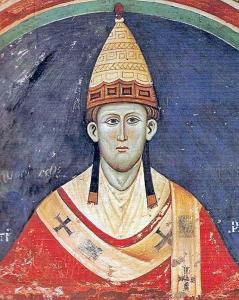
Pope Innocent III (r. 1198-1216).
(Wikimedia Commons)
In his work Innocent III and the Crown of Aragon: The Limits of Papal Authority, Damian Smith shares the words that Giovanni Capocci is supposed to have said to that Pope: ‘Your words are God’s words, but your works are those of the Devil.’ As Smith notes, Innocent III (d. 1216) had his supporters and critics, and while I am unfamiliar with Capocci, he was obviously a critic.[1] The book is broadly concerned with “consider[ing] how and to what extent the bishops were involved in papal government and how the pope attempted to redefine the functions and powers of the episcopate by use of those matters that were prerogatives of the Holy See”.[2] One of the interesting observations that he makes is that Innocent III used his own authority in safeguarding that of bishops in Aragon-Catalonia in their respective dioceses.[3] This has implications for the criticisms that came in the wake of the dogmas of papal supremacy and infallibility proclaimed at the First Vatican Council (1869-1870).
At the beginning of the twentieth-century and not long after the dogmas were defined, The Catholic Encyclopedia noted that, “[i]t is frequently objected by writers of the Anglican school that, by declaring the pope to possess an immediate episcopal jurisdiction over all the faithful, the Vatican Council destroyed the authority of the diocesan episcopate.”[4] It goes on to cite the Council itself:
“This power of the supreme pontiff in no way derogates from the ordinary immediate power of episcopal jurisdiction, in virtue of which the bishops, who, appointed by the Holy Spirit [Acts 20:28], have succeeded to the place of the Apostles as true pastors, feed and rule their several flocks, each the one which has been assigned to him: that power is rather maintained, confirmed and defended by the supreme pastor (Enchir., n. 1828).”[5]
But back to Giovanni Capocci. Upon reading his words, my mind recalled those of Jesus in The Gospel of St. Matthew, 23:2: “…The scribes and the Pharisees have sitten on the chair of Moses. [3] All things therefore whatsoever they shall say to you, observe and do: but according to their works do ye not; for they say, and do not.”[6] Both statements are similar in that there is a recognition of a legitimate authority to be listened to, contrasted but yet coexistent with a criticism of the actions of that authority. In Catholic thinking, the idea that a sinful Pope would utter ‘God’s words’ is not problematic, similar to the notion that Caiaphas’ sinfulness did not disrupt his ability to prophecy by virtue of his office as High Priest (Jn. 11:46-57).[7] This then brought my mind to two common misunderstandings of the Catholic dogma of papal infallibility: that of confusing the term impeccability with infallibility, and that of misunderstanding the scope of the pope’s infallibility.
The first is easy to clear up by defining terms. Impeccability refers to an inability to sin, and this is not a claim that the Catholic Church makes for Popes. While many Popes were holy men and a lot have been declared Saints, all Popes are sinners and as such are not impeccable. Infallibility on the other hand, signifies the inability to error. This is indeed a claim that the Catholic Church makes for the Pope but this is only within the very specific parameters laid out by the First Vatican Council. Not recognizing this fact leads to the second common misunderstanding of papal infallibility which mistakenly presupposes the charism applies to everything the Pope says. The limits of papal infallibility are spelled out in the fourth chapter of the First dogmatic constitution on the church of Christ, from the fourth session of Vatican I:
“we teach and define as a divinely revealed dogma that
when the Roman pontiff speaks EX CATHEDRA,
that is, when,
in the exercise of his office as shepherd and teacher of all Christians,
in virtue of his supreme apostolic authority,
he defines a doctrine concerning faith or morals to be held by the whole church,
he possesses,
by the divine assistance promised to him in blessed Peter,
that infallibility which the divine Redeemer willed his church to enjoy in defining doctrine concerning faith or morals.
Therefore, such definitions of the Roman pontiff are of themselves, and not by the consent of the church, irreformable.
So then, should anyone, which God forbid, have the temerity to reject this definition of ours: let him be anathema.”[8]
The explanation of what is meant by definitions ex cathedra are found in various works, but the following explanation from The Catholic Encyclopedia is helpful:
- “The pontiff must teach in his public and official capacity as pastor and doctor of all Christians, not merely in his private capacity as a theologian, preacher or allocutionist, nor in his capacity as a temporal prince or as a mere ordinary of the Diocese of Rome. It must be clear that he speaks as spiritual head of the Church universal.
- Then it is only when, in this capacity, he teaches some doctrine of faith or morals that he is infallible….
- Further [,] it must be sufficiently evident that he intends to teach with all the fullness and finality of his supreme Apostolic authority, in other words that he wishes to determine some point of doctrine in an absolutely final and irrevocable way, or to define it in the technical sense….
- Finally [,] for an ex cathedra decision it must be clear that the pope intends to bind the whole Church….”[9]
Thus, it is clear that according to Catholic teaching, not everything uttered by a Pope falls under the charism of infallibility. To return to Capocci once again, what exactly did he mean when he allegedly told Innocent III, ‘Your words are God’s words, but your works are those of the Devil’? As I am unfamiliar with him and with the works Smith was citing, I cannot say for certain. There may indeed be an echo of papal infallibility there. On the other hand, ‘God’s words’ may indicate a belief that the Pope speaks with the authority of God (“He that heareth you, heareth me…”).[10] In the absence of more information, Capocci’s comment certainly makes for interesting speculation nonetheless.
Thanks for reading! Please consider leaving a comment or subscribing.
[1] Damian J. Smith. Innocent III and the Crown of Aragon: The Limits of Papal Authority. (Burlington: Ashgate, 2004) Kindle, 1.
[2] Ibid, 6.
[3] Ibid, 263, cf. 200.
[4] George Joyce, “The Pope.” In The Catholic Encyclopedia,vol. 12*.* (New York: Robert Appleton Company, 1911). http://www.newadvent.org/cathen/12260a.htm . Accessed 7/31/20.
[5] Ibid, brackets are original to the citation. My emphasis.
[6] http://www.drbo.org/chapter/47023.htm (accessed 7/31/20). My emphasis.
[7] This is to speak in general terms rather than make a judgment with respect to Innocent III.
[8] https://www.papalencyclicals.net/councils/ecum20.htm (accessed 7/31/20).
[9] Patrick Toner “Infallibility.” In The Catholic Encyclopedia, vol. 7. (New York: Robert Appleton Company, 1910). http://www.newadvent.org/cathen/07790a.htm . Accessed 7/31/20. See also the discussion on the infallibility of the Church there. Cf. Ludwig Ott. Fundamentals of Catholic Dogma. (Rockford: Tan Books and Publishers, 1960), 286-287.
[10] Lk. 10:16.
Previous Post

December 9, 2019
Sahih Muslim and the Immaculate Conception
Next Post
August 9, 2020 Rome, Babylon, and 1 Peter 5:13
Browse Our Archives
Select a Category Book Reviews Byzantium Catholicism Islam Spain The Canon The Crusades The Papacy Uncategorized
Select a Month August 2025 May 2025 February 2025 August 2024 April 2024 February 2024 October 2023 September 2023 August 2023 July 2023 June 2023 May 2023 April 2023 March 2023 January 2023 December 2022 November 2022 October 2022 September 2022 January 2022 January 2021 December 2020 August 2020 December 2019 April 2019 March 2019 February 2019 January 2019
TAKE THE
Religious Wisdom Quiz
What does the Bible say is better than gold?
Select your answer to see how you score.
Bread Strength Wine Wisdom
Related posts from The Crossroads
Why the Assumption of Mary Stands on Biblical...

The Canon, Papal Infallibility and the Assumption of...
A Clarification on Constantinople IV and Luke 10:16
Luke 10:16 and the Question of Authority
TRENDING AT PATHEOS Catholic

Rejecting Doom: Christian Hope And Human Action
Christianity is a religion of hope. We are to have hope and...

It’s What Comes From Within Which Matters
One of the most difficult things for us to understand is why...

Why I Choose the Eucharist Over the Sermon
Choose the Eucharist, Not the Sermon What are we supposed to get...

5 Design Elements Found in Spiritually Rooted Homes
Putting Spirituality Into Home Decor Our homes are more than our living...

Credo: A Story of God Told with the...
About 10 years ago, I began to imagine a personal "Credo" that...

The Anatomy of Divine Revelation in Catholic Thought
The claim that God has made Himself known to human beings is...
view all Catholic blogs
Ad-Free & Subscriber Log-In Subscription Support
- About Us
- 2026 Calendar
- Videos
- Podcasts
- Library of World Religions
- Faith In Media Tracker
- Advertise With Us
- Write for Us
- Privacy Policy
- Terms of Service
- Do Not Sell My Data
- Contact Us
- Radiant Digital
- Manage Newsletter Subscriptions
- Unsubscribe From Notifications
- Sitemap
Copyright 2008-2026, Patheos. All rights reserved.
Subscription Support Ad-Free & Subscriber Log-In
Follow Patheos