
BuddhistCatholicContemplativeEvangelicalGeneral ChristianHinduJewishLatter-day SaintMuslimNew VisionsProgressive Christian
Beliefs
- Buddhist
- Catholic
- Contemplative
- Evangelical
- General Christian
- Hindu
- Jewish
- Latter-day Saint
- More Voices
- Muslim
- New Visions
- Pagan
- Progressive Christian
Topics
- Religion News
- Food and Religion
- Sports and Religion
- Religious Art
- Religious Music and Entertainment
- Religious Events
- History and Religion
- Style and Religion
- Politics and Religion
- Women in Religion
- Recreation Outdoors and Religion
- Business Finance and Religion
- Careers Workplace and Religion
- Education and Religion
- Family Parenting and Religion
- Health Fitness and Religion
- Home and Religion
- Relationships and Religion
- Technology and Religion
- Travel and Religion
Columnists
- Buddhist Columnists
- Business Finance and Religion Columnists
- Careers Workplace and Religion Columnists
- Catholic Columnists
- Contemplative Columnists
- Education and Religion Columnists
- Evangelists Columnists
- Family Parenting and Religion Columnists
- General Christian Columnists
- Health Fitness and Religion Columnists
- Hindu Columnists
- History and Religion Columnists
- Home and Religion Columnists
- Jewish Columnists
- More Voices Columnists
- Latter Day Columnists
- Muslim Columnists
- New Visions Columnists
- Nonreligious Columnists
- Pagan Columnists
- Politics and Religion Columnists
- Progressive Columnists
- Recreation Outdoors and Religion Columnists
- Relationships and Religion Columnists
- Religion News Columnists
- Religious Art Columnists
- Religious Events Columnists
- Religious Music and Entertainment Columnists
- Sports and Religion Columnists
- Style and Religion Columnists
- Technology and Religion Columnists
- Travel and Religion Columnists
- Women in Religion Columnists
Resource Library
- 2026 Calendar
- Library of World Religions
- The 100 Most Holy Places on Earth
- Patheos Answers
- Podcasts
- Videos
- Faith Leaders Database
- Anglican Episcopalian
- Bahai
- Baptist
- Buddhism
- Christianity
- Confucianism
- Eastern Orthodoxy
- Hinduism
- Holiness and Pentecostal
- ISKCON
- Islam
- Judaism
- Lutheran
- Methodist
- The Church of Jesus Christ of Latter-day Saints
- New Age
- Paganism
- Presbytarian and Reformed
- Protestantism
- Religion Behind the Scenes
- Roman Catholic
- Scientology
- Shia Islam
- Sikhism
- Sufism
- Sunni Islam
- Taoism
- Zen
- See all religions
Research Tools
 Ad-Free & Subscriber Log-In Subscription Support
Ad-Free & Subscriber Log-In Subscription Support
Follow Patheos 

- Trending:
- Forgiveness
- |
- Marriage
- |
- Consciousness
- |
- Death Penalty
- |
- Election
- |
- Halloween

- Home
- Catholic
- History and Religion
- Sahih Muslim and the Immaculate Conception
Sahih Muslim and the Immaculate Conception
Last updated on: August 29, 2022 at 8:15 pm by Nicholas Gulda
Sahih Muslim and the Immaculate Conception 2022-08-29T20:15:16-05:00 Nicholas Gulda
Patheos Explore the world's faith through different perspectives on religion and spirituality! Patheos has the views of the prevalent religions and spiritualities of the world.
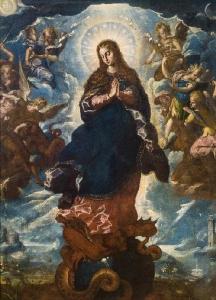
Inmaculada, Alonso Vázquez, Museo de Bellas Artes de Sevilla
(Wikimedia Commons).
This past summer, I was reading Jessica Coope’s monograph on the Martyrs of Córdoba. While discussing the religious climate in the ninth-century capital of al-Andalus, she says the following:
“…[B]y the ninth century a hadith was generally accepted which states that all babies are squeezed at birth by Satan (that is why they cry), but that Mary and Jesus escaped this contact with the devil; behind this tradition seems to lie an echo of the immaculate conception.”[1]
In Islam, a hadith is a saying that is believed to have been uttered by Muhammad, and passed down through a reliable chain of transmission called an isnad. The hadith that Coope refers to appears to be that found in Sahih Muslim (Book 30, Number 5837). It reads in full:
“Abu Huraira reported Allaah’s Messenger (sallAllaahu alayhi wa sallam) as saying: No child is born but he is pricked by the satan and he begins to weep because of the pricking of the satan except the son of Mary and his mother. Abu Huraira then said: You may recite if you so like (the verse):’ I seek Thy protection for her and her offspring against satan the accursed’ (iii. 36). This hadith has been narrated on the authority of Zuhri with the same chain of transmitters (and the words are):’ The newborn child is touched by the satan (when he comes in the world) and he starts crying because of the touch of satan.’ In the hadith transmitted on the authority of Shu’aib there is a slight variation of wording.”[2]
It is an interesting observation. In this hadith Christ and the Virgin Mary are clearly said to be exempt from what every human must endure. What is this prick by Satan? It cannot be the stain of original sin, for Islam has no such concept.[3] But a belief in original sin underlies the dogma of the Immaculate Conception of Mary, which is contained within the bull of Pope Pius IX, Ineffablis Deus:
“Wherefore, in humility and fasting, we unceasingly offered our private prayers as well as the public prayers of the Church to God the Father through his Son, that he would deign to direct and strengthen our mind by the power of the Holy Spirit. In like manner did we implore the help of the entire heavenly host as we ardently invoked the Paraclete. Accordingly, by the inspiration of the Holy Spirit, for the honor of the Holy and undivided Trinity, for the glory and adornment of the Virgin Mother of God, for the exaltation of the Catholic Faith, and for the furtherance of the Catholic religion, by the authority of Jesus Christ our Lord, of the Blessed Apostles Peter and Paul, and by our own: ‘We declare, pronounce, and define that the doctrine which holds that the most Blessed Virgin Mary, in the first instance of her conception, by a singular grace and privilege granted by Almighty God, in view of the merits of Jesus Christ, the Savior of the human race, was preserved free from all stain of original sin, is a doctrine revealed by God and therefore to be believed firmly and constantly by all the faithful.’[29]”[4]
What then does the hadith mean? I am unsure, but it is certainly not identical to the Immaculate Conception. Is Coope correct that “behind this tradition seems to lie an echo of the immaculate conception”? I am uncertain as well, but it is an interesting observation nonetheless; one that calls for some sort of explanation.
Thanks for reading! Please consider leaving a comment or subscribing.
[1] Jessica Coope. The Martyrs of Córdoba: Community and Family Conflict in an Age of Mass Conversion. (Lincoln: University of Nebraska Press, 1995), 45. Emphasis mine.
[2] http://www.sahihmuslim.com/sps/smm/sahihmuslim.cfm?scn=dspchaptersfull&BookID=30&ChapterID=994 , (accessed 12-8-2019). Emphasis mine.
[3] John L. Esposito. The Oxford Dictionary of Islam. (New York: Oxford University Press, 2003), 295.
[4] https://www.papalencyclicals.net/pius09/p9ineff.htm , (accessed 12-8-2019). Emphasis mine.
Previous Post

April 14, 2019
Saladin in Muslim Memory
Next Post
August 1, 2020 Some Musings on Papal Infallibility
Browse Our Archives
Select a Category Book Reviews Byzantium Catholicism Islam Spain The Canon The Crusades The Papacy Uncategorized
Select a Month August 2025 May 2025 February 2025 August 2024 April 2024 February 2024 October 2023 September 2023 August 2023 July 2023 June 2023 May 2023 April 2023 March 2023 January 2023 December 2022 November 2022 October 2022 September 2022 January 2022 January 2021 December 2020 August 2020 December 2019 April 2019 March 2019 February 2019 January 2019
TAKE THE
Religious Wisdom Quiz
What Christian holiday celebrates Jesus’ birth?
Select your answer to see how you score.
Pentecost Easter Good Friday Christmas
Related posts from The Crossroads
Why the Assumption of Mary Stands on Biblical...
The Canon, Papal Infallibility and the Assumption of...
Luke 10:16 and the Question of Authority
Three Reasons to Believe that St. Peter Went...
TRENDING AT PATHEOS Catholic

Rejecting Doom: Christian Hope And Human Action
Christianity is a religion of hope. We are to have hope and...

It’s What Comes From Within Which Matters
One of the most difficult things for us to understand is why...

Why I Choose the Eucharist Over the Sermon
Choose the Eucharist, Not the Sermon What are we supposed to get...

5 Design Elements Found in Spiritually Rooted Homes
Putting Spirituality Into Home Decor Our homes are more than our living...

Credo: A Story of God Told with the...
About 10 years ago, I began to imagine a personal "Credo" that...

The Anatomy of Divine Revelation in Catholic Thought
The claim that God has made Himself known to human beings is...
view all Catholic blogs
Ad-Free & Subscriber Log-In Subscription Support
- About Us
- 2026 Calendar
- Videos
- Podcasts
- Library of World Religions
- Faith In Media Tracker
- Advertise With Us
- Write for Us
- Privacy Policy
- Terms of Service
- Do Not Sell My Data
- Contact Us
- Radiant Digital
- Manage Newsletter Subscriptions
- Unsubscribe From Notifications
- Sitemap
Copyright 2008-2026, Patheos. All rights reserved.
Subscription Support Ad-Free & Subscriber Log-In
Follow Patheos