
BuddhistCatholicContemplativeEvangelicalGeneral ChristianHinduJewishLatter-day SaintMuslimNew VisionsProgressive Christian
Beliefs
- Buddhist
- Catholic
- Contemplative
- Evangelical
- General Christian
- Hindu
- Jewish
- Latter-day Saint
- More Voices
- Muslim
- New Visions
- Pagan
- Progressive Christian
Topics
- Religion News
- Food and Religion
- Sports and Religion
- Religious Art
- Religious Music and Entertainment
- Religious Events
- History and Religion
- Style and Religion
- Politics and Religion
- Women in Religion
- Recreation Outdoors and Religion
- Business Finance and Religion
- Careers Workplace and Religion
- Education and Religion
- Family Parenting and Religion
- Health Fitness and Religion
- Home and Religion
- Relationships and Religion
- Technology and Religion
- Travel and Religion
Columnists
- Buddhist Columnists
- Business Finance and Religion Columnists
- Careers Workplace and Religion Columnists
- Catholic Columnists
- Contemplative Columnists
- Education and Religion Columnists
- Evangelists Columnists
- Family Parenting and Religion Columnists
- General Christian Columnists
- Health Fitness and Religion Columnists
- Hindu Columnists
- History and Religion Columnists
- Home and Religion Columnists
- Jewish Columnists
- More Voices Columnists
- Latter Day Columnists
- Muslim Columnists
- New Visions Columnists
- Nonreligious Columnists
- Pagan Columnists
- Politics and Religion Columnists
- Progressive Columnists
- Recreation Outdoors and Religion Columnists
- Relationships and Religion Columnists
- Religion News Columnists
- Religious Art Columnists
- Religious Events Columnists
- Religious Music and Entertainment Columnists
- Sports and Religion Columnists
- Style and Religion Columnists
- Technology and Religion Columnists
- Travel and Religion Columnists
- Women in Religion Columnists
Resource Library
- 2026 Calendar
- Library of World Religions
- The 100 Most Holy Places on Earth
- Patheos Answers
- Podcasts
- Videos
- Faith Leaders Database
- Anglican Episcopalian
- Bahai
- Baptist
- Buddhism
- Christianity
- Confucianism
- Eastern Orthodoxy
- Hinduism
- Holiness and Pentecostal
- ISKCON
- Islam
- Judaism
- Lutheran
- Methodist
- The Church of Jesus Christ of Latter-day Saints
- New Age
- Paganism
- Presbytarian and Reformed
- Protestantism
- Religion Behind the Scenes
- Roman Catholic
- Scientology
- Shia Islam
- Sikhism
- Sufism
- Sunni Islam
- Taoism
- Zen
- See all religions
Research Tools
 Ad-Free & Subscriber Log-In Subscription Support
Ad-Free & Subscriber Log-In Subscription Support
Follow Patheos 

- Trending:
- Forgiveness
- |
- Marriage
- |
- Consciousness
- |
- Death Penalty
- |
- Election
- |
- Halloween

- Home
- Catholic
- History and Religion
- Book Review: Jihad in Classical and Modern Islam
Book Review: Jihad in Classical and Modern Islam
Last updated on: August 29, 2022 at 8:19 pm by Nicholas Gulda
Book Review: Jihad in Classical and Modern Islam 2022-08-29T20:19:10-05:00 Nicholas Gulda
Patheos Explore the world's faith through different perspectives on religion and spirituality! Patheos has the views of the prevalent religions and spiritualities of the world.

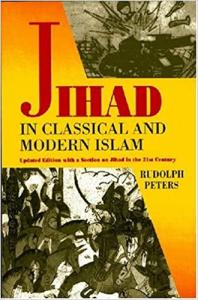
(Image from Amazon.com)
Rudolph Peters. Jihad in Classical and Modern Islam (Second Edition.) Princeton. Markus Wiener Publishers, 2008. vii – 183 pgs. Bibliography.
This work serves as an introduction to the Islamic doctrine of jihad (“struggle”), showing how the doctrine has been understood and explained by Muslims throughout the ages (vii.) It is composed as a reader, consisting of a number of essays by the author as well as primary sources on the topic by Muslim authors. For the most part, the work is organized chronologically, and it surveys the doctrine as espoused by medieval writers through those writing around the time of the terrorist attacks on the World Trade Center and Pentagon in 2001. It starts with a primer on jihad in its various forms.
In this primer, Peters introduces the reader to a handful of Koranic passages that deal with warfare, and he points out the ambiguity of the Koran when answering the question of whether jihad can be waged both offensively and defensively, or only the latter. The answer depends on the different hermeneutical principles deployed by Muslim scholars in interpreting the Sword Verses, the principle in which the later verses abrogate the earlier ones being the method applied from the earliest times (2.) According to this principle, jihad can (and must) be waged offensively, until the inhabited earth and the “Abode of Islam” are one and the same. While the first chapter is a microcosm of the entire collection since it has the same chronological scope, the rest move forward in sequence beginning with a sampling of hadiths from the Sahih of Muslim Ibn Hajjaj (chapter 2.)
These hadiths as well as the writings on jihad by Malik ibn Anas (ca. 710-796) that make up the third chapter, give readers a grounding in the classical doctrine. The latter is composed of passages that provide a motivation for jihad as well as discussions about martyrdom. Chapter 4 contains an entire chapter from Averroes’ (12th c.) work Al-Bidaya, which covers the legal aspects related to jihad. As Peters informs us, Al- Bidaya contains insights from all four schools of (Sunni) Islamic Jurisprudence, although Averroes himself belonged to the Malakite school, founded by the aforementioned Malik ibn Anas. Chapter 5 contains an excerpt from the Hanbalite scholar Ibn Taymiyya (d. 14th c.), dealing with religious and moral concerns related to the doctrine of jihad. Ibn Taymiyya’s explanation of the doctrine clearly contains both offensive and defensive components, and he goes so far as to say that jihad “is the best voluntary [religious] act that man can perform” (47.) Peters then brings us into the modern era with a fatwa that was published and distributed in multiple languages by the Ottoman Empire in 1914 (chapter 6.) The fatwa asks (and answers) lengthy, close-ended questions related to jihad in the historical context of Ottoman participation in World War I. What is noteworthy to Peters is the appeal to Muslims worldwide to participate in this jihad (55.) Moving forward through the chapters that cover the modern era, one cannot help but notice the introduction of a new concept of the doctrine of jihad spelled out in purely defensive terms by modern Islamic scholars.
Chapter 7 gives us the view of one of these, Mahmud Shaltut, who served as the Rector of Egypt’s Azhar University from 1958-1963. Shaltut begins by explaining the two methods of Koran interpretation. The first, which he calls “traditional”, involves the principle of abrogation. The second, which he advocates, “consists in collecting all the verses concerning a certain topic and analyzing them in their interrelation” (61.) Thus, it should come as no surprise that a different hermeneutical approach should produce an entirely different result; the explanation of the doctrine of jihad as an inherently defensive enterprise. With two incompatible views of jihad on the table, Peters adds an essay discussing both as they exist in modern Islam (chapter 8.)
In it, he divides modern conceptions of jihad into two camps: modernist and fundamentalist. The modernist authors use the historical context of the early Muslims being surrounded by hostile powers in order to explain why war against unbelievers was called for (112.) Since they argue that the relationship between the nations is essentially peaceful, new principles concerning when war was allowed developed (Ibid.) These principles, which are defensive in nature, are laid out in the essay utilizing an assortment of modernist authors. They are then juxtaposed with the arguments of the fundamentalist authors who argue for a “both/ and” approach (defensive and offensive.) These different understandings carry over into the final two chapters, which are essays by Peters focusing on modern Egypt.
The first discusses how understandings of the doctrine of jihad affected Egypt during the presidency of Anwar Sadat. Peters focuses on a number of Islamic movements which sprang up in the wake of the Arab-Israeli war, and following Egypt’s entrance into the world capitalist market (150 -151.) He draws a distinction between those groups which were reform oriented and desired to work within Egyptian law, and those that were revolutionary and justified violence as a means by which to establish a truly Islamic state (154.) The final article (chapter 10) discusses the doctrine of jihad at the turn of the 21st century. It includes the concept of a ‘globalized jihad’, while still focusing on Egypt, and picks up on threads from the previous article (171.) The thought of groups like al-Qaeda are discussed, and the article includes condemnations against (and justifications for) the September 11th, 2001 attacks on American civilians.
Altogether this work is a very useful survey of Islamic thought on the doctrine of jihad throughout history. It not only serves to ground the reader in the classical doctrine, but also gives them an understanding on how the doctrine is explained by contemporary Muslims. While the divergence of opinions expressed in the compilation may leave one who is searching for a definitive answer as to what exactly jihad is with a feeling of dissatisfaction, it nevertheless helps to explain current events where, on the one hand violence is perpetrated by Muslims under the banner of Islam, while on the other, such acts are subsequently condemned by other Muslims on those same grounds.
I hope you have enjoyed this review. Please consider subscribing to the e-mail list to be notified about recent posts.
Previous Post

March 9, 2019
Book Review: In God’s Path
Next Post
April 14, 2019 Saladin in Muslim Memory
Browse Our Archives
Select a Category Book Reviews Byzantium Catholicism Islam Spain The Canon The Crusades The Papacy Uncategorized
Select a Month August 2025 May 2025 February 2025 August 2024 April 2024 February 2024 October 2023 September 2023 August 2023 July 2023 June 2023 May 2023 April 2023 March 2023 January 2023 December 2022 November 2022 October 2022 September 2022 January 2022 January 2021 December 2020 August 2020 December 2019 April 2019 March 2019 February 2019 January 2019
TAKE THE
Religious Wisdom Quiz
Who is the "friend at midnight" in one of Jesus' parables?
Select your answer to see how you score.
A neighbor seeking bread A soldier An angel A fisherman
Related posts from The Crossroads

September 11, a 1998 Fatwa, and an Unfortunate...

Sahih Muslim and the Immaculate Conception


TRENDING AT PATHEOS Catholic

Rejecting Doom: Christian Hope And Human Action
Christianity is a religion of hope. We are to have hope and...

It’s What Comes From Within Which Matters
One of the most difficult things for us to understand is why...

Why I Choose the Eucharist Over the Sermon
Choose the Eucharist, Not the Sermon What are we supposed to get...

5 Design Elements Found in Spiritually Rooted Homes
Putting Spirituality Into Home Decor Our homes are more than our living...

Credo: A Story of God Told with the...
About 10 years ago, I began to imagine a personal "Credo" that...

The Anatomy of Divine Revelation in Catholic Thought
The claim that God has made Himself known to human beings is...
view all Catholic blogs
Ad-Free & Subscriber Log-In Subscription Support
- About Us
- 2026 Calendar
- Videos
- Podcasts
- Library of World Religions
- Faith In Media Tracker
- Advertise With Us
- Write for Us
- Privacy Policy
- Terms of Service
- Do Not Sell My Data
- Contact Us
- Radiant Digital
- Manage Newsletter Subscriptions
- Unsubscribe From Notifications
- Sitemap
Copyright 2008-2026, Patheos. All rights reserved.
Subscription Support Ad-Free & Subscriber Log-In
Follow Patheos