
BuddhistCatholicContemplativeEvangelicalGeneral ChristianHinduJewishLatter-day SaintMuslimNew VisionsProgressive Christian
Beliefs
- Buddhist
- Catholic
- Contemplative
- Evangelical
- General Christian
- Hindu
- Jewish
- Latter-day Saint
- More Voices
- Muslim
- New Visions
- Pagan
- Progressive Christian
Topics
- Religion News
- Food and Religion
- Sports and Religion
- Religious Art
- Religious Music and Entertainment
- Religious Events
- History and Religion
- Style and Religion
- Politics and Religion
- Women in Religion
- Recreation Outdoors and Religion
- Business Finance and Religion
- Careers Workplace and Religion
- Education and Religion
- Family Parenting and Religion
- Health Fitness and Religion
- Home and Religion
- Relationships and Religion
- Technology and Religion
- Travel and Religion
Columnists
- Buddhist Columnists
- Business Finance and Religion Columnists
- Careers Workplace and Religion Columnists
- Catholic Columnists
- Contemplative Columnists
- Education and Religion Columnists
- Evangelists Columnists
- Family Parenting and Religion Columnists
- General Christian Columnists
- Health Fitness and Religion Columnists
- Hindu Columnists
- History and Religion Columnists
- Home and Religion Columnists
- Jewish Columnists
- More Voices Columnists
- Latter Day Columnists
- Muslim Columnists
- New Visions Columnists
- Nonreligious Columnists
- Pagan Columnists
- Politics and Religion Columnists
- Progressive Columnists
- Recreation Outdoors and Religion Columnists
- Relationships and Religion Columnists
- Religion News Columnists
- Religious Art Columnists
- Religious Events Columnists
- Religious Music and Entertainment Columnists
- Sports and Religion Columnists
- Style and Religion Columnists
- Technology and Religion Columnists
- Travel and Religion Columnists
- Women in Religion Columnists
Resource Library
- 2026 Calendar
- Library of World Religions
- The 100 Most Holy Places on Earth
- Patheos Answers
- Podcasts
- Videos
- Faith Leaders Database
- Anglican Episcopalian
- Bahai
- Baptist
- Buddhism
- Christianity
- Confucianism
- Eastern Orthodoxy
- Hinduism
- Holiness and Pentecostal
- ISKCON
- Islam
- Judaism
- Lutheran
- Methodist
- The Church of Jesus Christ of Latter-day Saints
- New Age
- Paganism
- Presbytarian and Reformed
- Protestantism
- Religion Behind the Scenes
- Roman Catholic
- Scientology
- Shia Islam
- Sikhism
- Sufism
- Sunni Islam
- Taoism
- Zen
- See all religions
Research Tools
 Ad-Free & Subscriber Log-In Subscription Support
Ad-Free & Subscriber Log-In Subscription Support
Follow Patheos 

- Trending:
- Forgiveness
- |
- Marriage
- |
- Consciousness
- |
- Death Penalty
- |
- Election
- |
- Halloween

- Home
- Catholic
- History and Religion
- Book Review: In God’s Path
Book Review: In God’s Path
Last updated on: August 29, 2022 at 8:21 pm by Nicholas Gulda
Book Review: In God’s Path 2022-08-29T20:21:26-05:00 Nicholas Gulda
Patheos Explore the world's faith through different perspectives on religion and spirituality! Patheos has the views of the prevalent religions and spiritualities of the world.
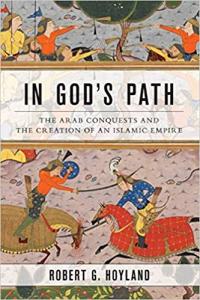

(Photo from Amazon.com)
Robert G. Hoyland. In God’s Path: The Arab Conquests and the Creation of an Islamic Empire. New York. Oxford University Press, 2015. 1-230 pgs. 3 Maps, 1 Appendix, 1 Timeline, Dramatis Personae, 2 Genealogical Tables, Bibliography, Index.
The main objective of this work is to give a more balanced account of the Arab conquests than that given by 9th century Arab historians. These are faulted not so much for what they do say, but rather for what they omit in portraying the conquests as a miraculous feat, absent any obstacles standing in the way (2.) Hoyland attempts to accomplish this by adding some missing pieces: the process, the voice of the conquered, the pre-history of the conquests, and a broader geographical scope which includes the fringes of the growing state (2-6.) The focus of the book is socio-economic, but it also includes elements of culture, warfare, and religion. It is organized chronologically, beginning in the pre-conquest Near East, and moves forward until C.E. 750 when the military expansion fizzles out (3.) Hoyland focuses on the testimonies of non-Muslim sources, since they are the earliest extant ones. The narrative begins, like other works (cf. Kennedy), by focusing on the pre-Islamic Arabian Peninsula, which was situated on the frontiers of Byzantium and Sassanian Persia.
Hoyland objects to Jan Retsö’s stereotypical portrayal of pre-Islamic Arabs as “nomadic, camel-rearing, religiously fanatical warriors”, noting that this was how they were depicted by settled peoples (22.) Rather, he argues that they were not a homogenous group, and that they only later forged a common “Arab” identity. In addressing the question of what drove the conquests, he suggests that the common push factor is the availability of Byzantine and Sassanian booty, while pull factors include economic and environmental distress in the Arabian Peninsula, along with Islam. He is critical of those like Johnston and Donner, who downplay religious violence associated with the conquest, arguing instead that religious violence was the norm in the Middle East at that time, giving the Roman/ Byzantine Empire as an example (63.) Against Gabrieli, Hoyland argues that these Arab soldiers were not undisciplined barbarians, instead they included seasoned veterans who had fought for the Byzantine or Sassanian armies (94.) He lessens the role played by religious zeal, and instead stresses that played by organization, due to a simple two-fold plan of emigration to a garrison and the waging of jihad (96.) For Hoyland, the speed of the conquest is not entirely exceptional, for he argues that conquests by nomads tend to happen this way, and cites the Mongols as a prime example. In doing this he is staying true to his goal of adding more balance to the accounts of the early Muslim historians, who portrayed the conquest as nothing less than a miraculous event. He does the same with their characterization of the fifth caliph, Mu’awiya.
Hoyland argues that the unflattering view of this first Umayyad caliph given by 9th century Muslim historians was a revision on their part, done to establish their own religious authority, while simultaneously avoiding the alienation of pro-Umayyad and pro-Alid factions (134.) The flip side of portraying Mu’awiya unfavorably is the idealized picture that exists of the first four (Rashidun) caliphs. The outgrowths of this compromise were Sunnism, made up of those who accepted the compromise, and Shiism, consisting of pro- ‘Alids who were unwilling to (134-135.) Hoyland is also critical of the views of Olig and Puin, Donner, and Nevo, who all call into question Mu’awiya’s sincerity in his adherence to Islam in one way or another. He argues against this from the caliph’s own words to the Emperor Heraclius, which were unambiguously Islamic, and distinctly non-ecumenical in nature (136.) Like Donner however, he attributes to al-Malik and his successors the forging of a distinct “Islamic society” (157.) This included the process by which the conquered peoples adopted the religion (Islam), and the identity (Arab), of the conquerors, transforming it in the process through cultural blending (158.) Furthermore, Hoyland tells us that the broadening of Arab identity allowed non-ethnic Arabs to claim it by attaching themselves to Arab tribes. He mentions that two avenues through which non-ethnic Arabs could rise to prominence were by military service in a now professionalized army, or through Islamic scholarship. Once the conquest had reached its peak, then began the process of making an Islamic civilization, which is the focus of the final chapter.
With the revolution of the Abbasids also came the metamorphosis from empire to commonwealth, through the process of fragmentation into autonomous realms. This commonwealth shared a common identity which Hoyland terms “Islamdom”, paralleling it to Christendom in Western Europe (209.) He suggests two processes whereby a unique Islamic culture was formed as being the Arabization and Islamization of the conquered areas. The role of the Arabic language is highlighted, as it became the common tongue of the Muslim commonwealth. But the construction of Islamic culture was not a one-way street through which the conquerors imposed their religion and culture on the conquered, as Hoyland notes. Rather, there was cultural sharing that occurred between the two groups, and modern scholarship has emphasized the contributions of the Sassanians, along with the long-recognized contributions of the Byzantines (230.)
One of the strengths of this book is the author’s ability to present a fuller picture of the conquest, which of course was one of his main goals. To give one example, he accepts the role played by religion in the conquest, but not as one of fueling a religious zeal. Rather, it was one that provided a worldview that had things in common with Christianity and Judaism thereby making it palatable to those in the ancient Near East, and through which the conquered could be integrated into the community, bringing benefits to it (228-229.) To give another example, Hoyland accepts that there was a strong military component that facilitated the conquest, but he gives weight also to the role played by non-military strategies, such as a measure of leniency extended to the conquered, economic incentives, and a certain level of autonomy, which were all given in exchange for cooperation (228.) A final strength of this work is the attention paid to a wide variety of non-Muslim sources from the outskirts of the empire, such as Byzantines, Persians, Copts, Armenians, Chinese, Indian, along with others. This makes for a unique narrative, giving the intended balance.
I hope you have enjoyed this review. Please consider subscribing to the e-mail list to be notified about recent posts.
Previous Post

February 25, 2019
The Burning of Basil the Bogomil
Next Post
March 16, 2019 Book Review: Jihad in Classical and Modern Islam
Browse Our Archives
Select a Category Book Reviews Byzantium Catholicism Islam Spain The Canon The Crusades The Papacy Uncategorized
Select a Month August 2025 May 2025 February 2025 August 2024 April 2024 February 2024 October 2023 September 2023 August 2023 July 2023 June 2023 May 2023 April 2023 March 2023 January 2023 December 2022 November 2022 October 2022 September 2022 January 2022 January 2021 December 2020 August 2020 December 2019 April 2019 March 2019 February 2019 January 2019
TAKE THE
Religious Wisdom Quiz
What is the correct order for putting off the old self and putting on the new self as described in Colossians?
Select your answer to see how you score.
Put to death earthly nature, rid yourself of anger/rage/malice, take off the old self, put on the new self, clothe yourself with compassion Clothe yourself with compassion, put on the new self, put to death earthly nature, rid yourself of anger Rid yourself of anger, take off the old self, put to death earthly nature, put on the new self Put on the new self, put to death earthly nature, clothe yourself with compassion, rid yourself of anger
Related posts from The Crossroads

September 11, a 1998 Fatwa, and an Unfortunate...
Sahih Muslim and the Immaculate Conception

Book Review: Jihad in Classical and Modern Islam
TRENDING AT PATHEOS Catholic

Rejecting Doom: Christian Hope And Human Action
Christianity is a religion of hope. We are to have hope and...

It’s What Comes From Within Which Matters
One of the most difficult things for us to understand is why...

Why I Choose the Eucharist Over the Sermon
Choose the Eucharist, Not the Sermon What are we supposed to get...

5 Design Elements Found in Spiritually Rooted Homes
Putting Spirituality Into Home Decor Our homes are more than our living...

Credo: A Story of God Told with the...
About 10 years ago, I began to imagine a personal "Credo" that...

The Anatomy of Divine Revelation in Catholic Thought
The claim that God has made Himself known to human beings is...
view all Catholic blogs
Ad-Free & Subscriber Log-In Subscription Support
- About Us
- 2026 Calendar
- Videos
- Podcasts
- Library of World Religions
- Faith In Media Tracker
- Advertise With Us
- Write for Us
- Privacy Policy
- Terms of Service
- Do Not Sell My Data
- Contact Us
- Radiant Digital
- Manage Newsletter Subscriptions
- Unsubscribe From Notifications
- Sitemap
Copyright 2008-2026, Patheos. All rights reserved.
Subscription Support Ad-Free & Subscriber Log-In
Follow Patheos