
BuddhistCatholicContemplativeEvangelicalGeneral ChristianHinduJewishLatter-day SaintMuslimNew VisionsProgressive Christian
Beliefs
- Buddhist
- Catholic
- Contemplative
- Evangelical
- General Christian
- Hindu
- Jewish
- Latter-day Saint
- More Voices
- Muslim
- New Visions
- Pagan
- Progressive Christian
Topics
- Religion News
- Food and Religion
- Sports and Religion
- Religious Art
- Religious Music and Entertainment
- Religious Events
- History and Religion
- Style and Religion
- Politics and Religion
- Women in Religion
- Recreation Outdoors and Religion
- Business Finance and Religion
- Careers Workplace and Religion
- Education and Religion
- Family Parenting and Religion
- Health Fitness and Religion
- Home and Religion
- Relationships and Religion
- Technology and Religion
- Travel and Religion
Columnists
- Buddhist Columnists
- Business Finance and Religion Columnists
- Careers Workplace and Religion Columnists
- Catholic Columnists
- Contemplative Columnists
- Education and Religion Columnists
- Evangelists Columnists
- Family Parenting and Religion Columnists
- General Christian Columnists
- Health Fitness and Religion Columnists
- Hindu Columnists
- History and Religion Columnists
- Home and Religion Columnists
- Jewish Columnists
- More Voices Columnists
- Latter Day Columnists
- Muslim Columnists
- New Visions Columnists
- Nonreligious Columnists
- Pagan Columnists
- Politics and Religion Columnists
- Progressive Columnists
- Recreation Outdoors and Religion Columnists
- Relationships and Religion Columnists
- Religion News Columnists
- Religious Art Columnists
- Religious Events Columnists
- Religious Music and Entertainment Columnists
- Sports and Religion Columnists
- Style and Religion Columnists
- Technology and Religion Columnists
- Travel and Religion Columnists
- Women in Religion Columnists
Resource Library
- 2026 Calendar
- Library of World Religions
- The 100 Most Holy Places on Earth
- Patheos Answers
- Podcasts
- Videos
- Faith Leaders Database
- Anglican Episcopalian
- Bahai
- Baptist
- Buddhism
- Christianity
- Confucianism
- Eastern Orthodoxy
- Hinduism
- Holiness and Pentecostal
- ISKCON
- Islam
- Judaism
- Lutheran
- Methodist
- The Church of Jesus Christ of Latter-day Saints
- New Age
- Paganism
- Presbytarian and Reformed
- Protestantism
- Religion Behind the Scenes
- Roman Catholic
- Scientology
- Shia Islam
- Sikhism
- Sufism
- Sunni Islam
- Taoism
- Zen
- See all religions
Research Tools
 Ad-Free & Subscriber Log-In Subscription Support
Ad-Free & Subscriber Log-In Subscription Support
Follow Patheos 

- Trending:
- Forgiveness
- |
- Marriage
- |
- Consciousness
- |
- Death Penalty
- |
- Election
- |
- Halloween

- Home
- Catholic
- History and Religion
- Theodore Abu Qurrah and the Papacy
Theodore Abu Qurrah and the Papacy
Last updated on: August 29, 2022 at 8:29 pm by Nicholas Gulda
Theodore Abu Qurrah and the Papacy 2022-08-29T20:29:55-05:00 Nicholas Gulda
Patheos Explore the world's faith through different perspectives on religion and spirituality! Patheos has the views of the prevalent religions and spiritualities of the world.

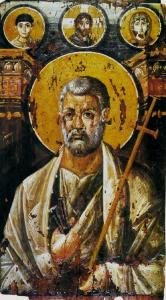 Icon of St. Peter, St. Catherine’s Monastery, 6th c.
(Wikimedia Commons)
Theodore Abu Qurrah was the Melkite Bishop of Haran (Upper Mesopotamia) who lived in the 9th century A.D. As such, he found himself living under Muslim rule. Besides being one of the first Christian authors to write in Arabic, he was also one of the first of these to defend Christianity from Islamic writers who sought to disprove it.[1] In the East, the three largest groups of Christians were Melkites, Nestorians, and Monophysites (now known as Miaphysites).[2] In this context, “Melkites” refers to those Christians who upheld the Christology of Pope St. Leo I and the Council of Chalcedon (451) that lived in the East. Keeping in mind that Theodore is writing in the time before the East-West Schism that resulted in the separation of what we now call Catholic and Eastern Orthodox Christians, he was (from the Catholic point of view), a Catholic Bishop. “Nestorians” then, were those Christians who rejected the Council of Ephesus (431), and thus departed from Catholic unity. They exist today and are known as the Assyrian Church of the East. “Monophysites” refers to those Christians who rejected the Council of Chalcedon, also departing from Catholic unity. They exist today and are typically referred to as Oriental Orthodox Christians (Copts, Ethiopians, etc. in communion with the non-Chalcedonian Patriarch of Alexandria.)
Because of his historical and demographic context, Theodore concerned himself first with defending Christianity, and more specifically, with determining which was the true Church. To answer that question, he used the Bishop of Rome as the reference point. Below you will see him deploy the three Petrine texts from the Gospels (Mt. 16: 18, Lk. 22:32, Jn. 21) that the Catholic Church has historically referenced in defending its teaching on the office of the Papacy.
This particular text is translated from Arabic into English by John C. Lamoreaux, and in reference to the brackets, he notes that, “[o]ne wonders whether the bracketed materials here and in what follows are not scribal interpolations and emendations – in short, attempts to bring Theodore more nearly into the fold of later [O]rthodox ecclesiology. Their presence clearly offends against the sense of Theodore’s argument, which requires the bishop of Rome alone as guarantor of the six councils [i.e. the first six Ecumenical Councils].”[3]
Here is the text:
“You should understand that the head of the apostles was St. Peter, he to whom Christ said, ‘You are the rock; and on this rock I shall build my church, and the gates of hell will not overcome it.’ After his resurrection, he also said to him three times, while on the shore of the sea of Tiberias, ‘Simon, do you love me? Feed my lambs, rams, and ewes.’ In another passage, he said to him, ‘Simon, Satan will ask to sift you like wheat, and I prayed that you not lose your faith; but you, at that time, have compassion on your brethren and strengthen them.’ Do you not see that St. Peter is the foundation of the church, selected to shepherd it, that those who believe in his faith will never lose their faith, and that he was ordered to have compassion on his brethren and strengthen them? As for Christ’s words, ‘I prayed for you, that you not lose your faith; but you, have compassion on your brethren, at that time, and strengthen them,’ we do not think that he meant St. Peter himself [and the apostles themselves]. Rather, he meant nothing other than the holders of the seat of St. Peter, that is, Rome, [and the holders of the seats of the apostles].
Just as when he said to the apostles, ‘I am with you always, until the end of the age,’ he did not mean just the apostles themselves, but also those who would be in charge of their seats and their flocks; in the same way, when he spoke his last words to St. Peter, ‘Have compassion, at that time, and strengthen your brethren; and your faith will not be lost,’ he meant by this nothing other than the holders of his seat. Yet another indication of this is the fact that among the apostles it was St. Peter alone who lost his faith and denied Christ, which Christ may have allowed to happen to Peter so as to teach us that it was not Peter that he meant by these words. Moreover, we know of no apostle who fell and needed St. Peter to strengthen him. If someone says that Christ meant by these words only St. Peter himself [and the apostles themselves], this person causes the church to lack someone to strengthen it after the death of St. Peter. How could this happen, especially when we see all the sifting of the church that came from Satan after the apostles’ death? All of this indicates that Christ did not mean [them] by these words. Indeed, everyone knows that the heretics attacked the church only after the death of the apostles – Paul of Samosata, Arius, Macedonius, Eunomius, Sabellius, Apollinaris, Origen, and others. If he meant by these words in the gospel only St. Peter [and the apostles themselves], then after [them] the church would have been deprived of comfort and would have had no one to deliver her from those heretics, whose heresies are truly ‘the gates of hell,’ which Christ said would not overcome the church. Accordingly, there is no doubt that he meant by these words nothing other than the holders of the seat of St. Peter, who have continually strengthened their brethren and will not cease to do so as long as this present age lasts.”
[4]
I hope you have enjoyed this post. Please consider subscribing to the e-mail list to be notified about recent posts.
[1] John C. Lamoreaux, Theodore Abu Qurrah (Library of the Christian East Vol. I), (Brigham Young University Press, Provo, UT: 2005), xii.
[2] Ibid.
[3] Ibid. Pg. 68 (emphasis mine.)
[4]Ibid. Pgs. 68-69
Previous Post

January 5, 2019
A Primer on the Crusades
Next Post
January 26, 2019 The New Testament Canon in the Fourth Century
Browse Our Archives
Select a Category Book Reviews Byzantium Catholicism Islam Spain The Canon The Crusades The Papacy Uncategorized
Select a Month August 2025 May 2025 February 2025 August 2024 April 2024 February 2024 October 2023 September 2023 August 2023 July 2023 June 2023 May 2023 April 2023 March 2023 January 2023 December 2022 November 2022 October 2022 September 2022 January 2022 January 2021 December 2020 August 2020 December 2019 April 2019 March 2019 February 2019 January 2019
TAKE THE
Religious Wisdom Quiz
In Revelation, how many elders sit on thrones around God's throne?
Select your answer to see how you score.
Seventy Seven Twelve Twenty-four
Related posts from The Crossroads
Why the Assumption of Mary Stands on Biblical...
The Canon, Papal Infallibility and the Assumption of...
A Clarification on Constantinople IV and Luke 10:16
Luke 10:16 and the Question of Authority
TRENDING AT PATHEOS Catholic

Rejecting Doom: Christian Hope And Human Action
Christianity is a religion of hope. We are to have hope and...

It’s What Comes From Within Which Matters
One of the most difficult things for us to understand is why...

Why I Choose the Eucharist Over the Sermon
Choose the Eucharist, Not the Sermon What are we supposed to get...

5 Design Elements Found in Spiritually Rooted Homes
Putting Spirituality Into Home Decor Our homes are more than our living...

Credo: A Story of God Told with the...
About 10 years ago, I began to imagine a personal "Credo" that...

The Anatomy of Divine Revelation in Catholic Thought
The claim that God has made Himself known to human beings is...
view all Catholic blogs
Ad-Free & Subscriber Log-In Subscription Support
- About Us
- 2026 Calendar
- Videos
- Podcasts
- Library of World Religions
- Faith In Media Tracker
- Advertise With Us
- Write for Us
- Privacy Policy
- Terms of Service
- Do Not Sell My Data
- Contact Us
- Radiant Digital
- Manage Newsletter Subscriptions
- Unsubscribe From Notifications
- Sitemap
Copyright 2008-2026, Patheos. All rights reserved.
Subscription Support Ad-Free & Subscriber Log-In
Follow Patheos