
BuddhistCatholicContemplativeEvangelicalGeneral ChristianHinduJewishLatter-day SaintMuslimNew VisionsProgressive Christian
Beliefs
- Buddhist
- Catholic
- Contemplative
- Evangelical
- General Christian
- Hindu
- Jewish
- Latter-day Saint
- More Voices
- Muslim
- New Visions
- Pagan
- Progressive Christian
Topics
- Religion News
- Food and Religion
- Sports and Religion
- Religious Art
- Religious Music and Entertainment
- Religious Events
- History and Religion
- Style and Religion
- Politics and Religion
- Women in Religion
- Recreation Outdoors and Religion
- Business Finance and Religion
- Careers Workplace and Religion
- Education and Religion
- Family Parenting and Religion
- Health Fitness and Religion
- Home and Religion
- Relationships and Religion
- Technology and Religion
- Travel and Religion
Columnists
- Buddhist Columnists
- Business Finance and Religion Columnists
- Careers Workplace and Religion Columnists
- Catholic Columnists
- Contemplative Columnists
- Education and Religion Columnists
- Evangelists Columnists
- Family Parenting and Religion Columnists
- General Christian Columnists
- Health Fitness and Religion Columnists
- Hindu Columnists
- History and Religion Columnists
- Home and Religion Columnists
- Jewish Columnists
- More Voices Columnists
- Latter Day Columnists
- Muslim Columnists
- New Visions Columnists
- Nonreligious Columnists
- Pagan Columnists
- Politics and Religion Columnists
- Progressive Columnists
- Recreation Outdoors and Religion Columnists
- Relationships and Religion Columnists
- Religion News Columnists
- Religious Art Columnists
- Religious Events Columnists
- Religious Music and Entertainment Columnists
- Sports and Religion Columnists
- Style and Religion Columnists
- Technology and Religion Columnists
- Travel and Religion Columnists
- Women in Religion Columnists
Resource Library
- 2026 Calendar
- Library of World Religions
- The 100 Most Holy Places on Earth
- Patheos Answers
- Podcasts
- Videos
- Faith Leaders Database
- Anglican Episcopalian
- Bahai
- Baptist
- Buddhism
- Christianity
- Confucianism
- Eastern Orthodoxy
- Hinduism
- Holiness and Pentecostal
- ISKCON
- Islam
- Judaism
- Lutheran
- Methodist
- The Church of Jesus Christ of Latter-day Saints
- New Age
- Paganism
- Presbytarian and Reformed
- Protestantism
- Religion Behind the Scenes
- Roman Catholic
- Scientology
- Shia Islam
- Sikhism
- Sufism
- Sunni Islam
- Taoism
- Zen
- See all religions
Research Tools
 Ad-Free & Subscriber Log-In Subscription Support
Ad-Free & Subscriber Log-In Subscription Support
Follow Patheos 

- Trending:
- Forgiveness
- |
- Marriage
- |
- Consciousness
- |
- Death Penalty
- |
- Election
- |
- Halloween

- Home
- Religion News
- Electing A Virtuous President Would Make Immunity Irrelevant
Electing A Virtuous President Would Make Immunity Irrelevant
Last updated on: July 16, 2024 at 2:39 pm by The Conversation
Electing A Virtuous President Would Make Immunity Irrelevant 2024-07-16T14:39:36-04:00 The Conversation
Patheos Explore the world's faith through different perspectives on religion and spirituality! Patheos has the views of the prevalent religions and spiritualities of the world.
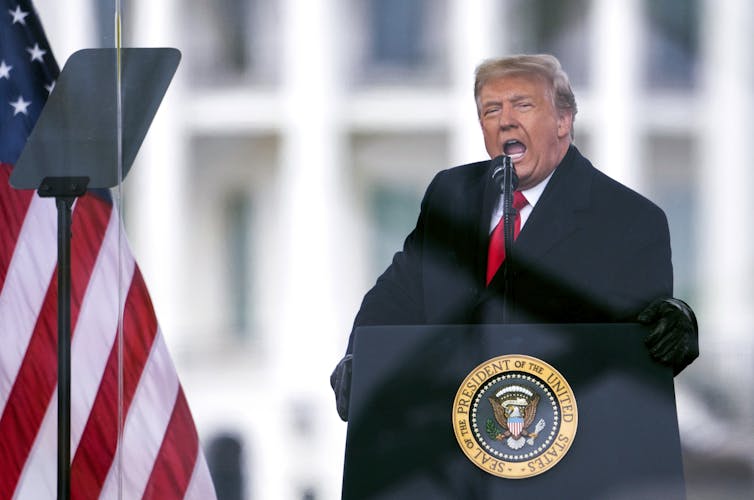
On July 1, 2024, the Supreme Court granted substantial immunity from criminal charges to former President Donald Trump.
AP Photo/Evan Vucci, File
By Michael Blake of University of Washington
The Supreme Court’s decision that grants presidents immunity from criminal prosecution for their “official acts” has been met by alarm by many legal scholars. Constitutional lawyer Michael Waldman referred to the decision as an “instruction manual for lawbreaking presidents,” while law professor Michael Dorf noted that the ruling would seemingly allow a president to openly sell pardons for bribes.
As a political philosopher whose work focuses on how political institutions are preserved, I am concerned about these implications of the court’s decision. I am, however, also worried about what the effects would be of the absence of such immunity.
Complexities of presidential prosecutions
The Supreme Court declared over 40 years ago that presidents are immune from civil liability for official acts. In the 1982 case Nixon v. Fitzgerald, the court determined that presidents cannot be sued for their official acts. The judges noted that allowing such lawsuits would “distract a president from his official duties,” to the detriment of the American polity itself.
These concerns seem to apply as easily to criminal prosecution as to civil liability. If responding to a lawsuit would make it more difficult for presidents to perform their job, so too could a criminal indictment.
In the present deeply partisan political world, such concerns become even more important. Whether or not one approves of the actions of Donald Trump, it is worth noting that what is done to one president could be done to others. Indictments might sometimes reflect partisan politics; they may, more often, be interpreted as politically motivated, thereby inflaming such partisanship.
These worries are demonstrated in some recent international examples. Many countries have recently prosecuted former leaders for acts undertaken in office. These include France, which recently convicted former President Nicolas Sarkozy for violations of campaign finance rules; and Israel, which has indicted current President Benjamin Netanyahu on corruption charges.
There have been positive and negative effects of such prosecutions. Political scientist Victor Menaldo notes that such prosecutions have sometimes led to cynicism about the impartiality of the legal system; they have also brought about a retrenchment of public support for authoritarian rule – and, in some cases, they have even been used by prosecuted leaders to buttress their political support. Leaders in Kenya and Brazil, for example, both returned to power after incarceration.
Additionally, Menaldo’s work has shown that such prosecutions have sometimes worsened political polarization. Concerned about the threat of future prosecutions, presidents have sometimes led assaults on the independence of the legal system – as Netanyahu has done since his own indictment.
It seems that any vision of presidential immunity comes with its own risks. So how can we think about the nature and limits of such immunity?
Presidents and the demands of virtue
One might ask, instead, a prior question: What might bind a president to the norms and rules of the law, short of a threat of criminal punishment?
A dominant theme in much political philosophy is the need for citizens to voluntarily act to uphold the norms and institutions that make up their political system. Philosopher John Rawls, for one, emphasized that societies can persist only if their citizens accept a moral duty to preserve and uphold the institutions of that society. Modern political philosopher Anna Stilz echoes these thoughts, arguing that anyone concerned with human rights ought to show loyalty to those political institutions without which human rights cannot exist.

President Richard Nixon was urged by his staff to ignore the Supreme Court ruling to hand over the recordings he had made, but he chose to resign.
AP Photo
The same is true of presidents. Since the time of Aristotle, philosophers have argued that political leaders are required to demonstrate particular political virtues. Chief among those is the willingness to prefer public success over private gain. The good leader helped others develop their potential – he did not simply pursue what was advantageous to himself.
Most presidents have had some occasion to demonstrate such habits of character. Richard Nixon, for example, was urged by his staff to simply ignore the Supreme Court ruling that told him to hand over the recordings he had made. His staff said, in essence, that the president could insist upon his authority as equal to that of the Supreme Court, even if that undermined the balance of powers between the executive and the judicial branches. Nixon disagreed with his staff and chose to resign rather than undermine the system itself.
What this means, though, is that the most effective guarantee against presidential lawbreaking has been, for over 200 years, the presidential belief that the law – and the system that produces such law – is worth taking seriously. Most presidents have tried with more or less success to preserve the norms and rules that constitute the political system itself.
The best defense against wrongful presidential acts may be the election of presidents who are virtuous enough to not do them or to resist the temptation to do such acts.
This article is republished from The Conversation, a nonprofit, independent news organization dedicated to unlocking the knowledge of experts for the public good. .

About Michael Blake
Michael Blake is a Professor of Philosophy, Public Policy and Governance at the University of Washington. You can read more about the author here.
Previous Post

July 12, 2024
Why The Olympic Games Are A ‘Civil Religious’ Ceremony
Next Post

July 26, 2024 What Is Catholic Integralism?
Browse Our Archives
Select a Category Buddhism Christianity Hinduism Islam Judaism Religion and society Uncategorized
Select a Month July 2024 March 2024 February 2024 January 2024 December 2023 November 2023 October 2023 September 2023 August 2023 July 2023 January 2023 August 2022 July 2022 April 2022 February 2022 January 2022 October 2021 July 2021 June 2021 May 2021 April 2021 March 2021 February 2021 January 2021 December 2020 November 2020 October 2020 September 2020 August 2020 July 2020 June 2020 May 2020
Follow Us!
TAKE THE
Religious Wisdom Quiz
What Christian group reads the Book of Mormon?
Select your answer to see how you score.
Jehovah’s Witnesses Latter-day Saints Pentecostals Baptists
Related posts from The Conversation


Why The Olympic Games Are A ‘Civil Religious’...

The Catholic Church Is Using The Olympics To...

How Christians Hold Differing Views On The Resurrection
TRENDING AT PATHEOS Religion News
Catholic Integralists believe that religious values – specifically Christian ones – should...

Electing A Virtuous President Would Make Immunity Irrelevant
Presidential immunity can bring with it many risks. So how can we...
Why The Olympic Games Are A ‘Civil Religious’...
Sporting events form a vital space where Americans display their 'civil religious...

After more than a decade of news, research updates, and insights on...

Q: Why do Southern Baptists and like-minded Protestants...
THE RELIGION GUY’S ANSWER: Why? Simple. Because they believe that’s what the...

THE QUESTION: Is gambling evil? THE RELIGION GUY’S ANSWER: Analysts anticipate a...
view all Religion News blogs
Ad-Free & Subscriber Log-In Subscription Support
- About Us
- 2026 Calendar
- Videos
- Podcasts
- Library of World Religions
- Faith In Media Tracker
- Advertise With Us
- Write for Us
- Privacy Policy
- Terms of Service
- Do Not Sell My Data
- Contact Us
- Radiant Digital
- Manage Newsletter Subscriptions
- Unsubscribe From Notifications
- Sitemap
Copyright 2008-2026, Patheos. All rights reserved.
Subscription Support Ad-Free & Subscriber Log-In
Follow Patheos