
BuddhistCatholicContemplativeEvangelicalGeneral ChristianHinduJewishLatter-day SaintMuslimNew VisionsProgressive Christian
Beliefs
- Buddhist
- Catholic
- Contemplative
- Evangelical
- General Christian
- Hindu
- Jewish
- Latter-day Saint
- More Voices
- Muslim
- New Visions
- Pagan
- Progressive Christian
Topics
- Religion News
- Food and Religion
- Sports and Religion
- Religious Art
- Religious Music and Entertainment
- Religious Events
- History and Religion
- Style and Religion
- Politics and Religion
- Women in Religion
- Recreation Outdoors and Religion
- Business Finance and Religion
- Careers Workplace and Religion
- Education and Religion
- Family Parenting and Religion
- Health Fitness and Religion
- Home and Religion
- Relationships and Religion
- Technology and Religion
- Travel and Religion
Columnists
- Buddhist Columnists
- Business Finance and Religion Columnists
- Careers Workplace and Religion Columnists
- Catholic Columnists
- Contemplative Columnists
- Education and Religion Columnists
- Evangelists Columnists
- Family Parenting and Religion Columnists
- General Christian Columnists
- Health Fitness and Religion Columnists
- Hindu Columnists
- History and Religion Columnists
- Home and Religion Columnists
- Jewish Columnists
- More Voices Columnists
- Latter Day Columnists
- Muslim Columnists
- New Visions Columnists
- Nonreligious Columnists
- Pagan Columnists
- Politics and Religion Columnists
- Progressive Columnists
- Recreation Outdoors and Religion Columnists
- Relationships and Religion Columnists
- Religion News Columnists
- Religious Art Columnists
- Religious Events Columnists
- Religious Music and Entertainment Columnists
- Sports and Religion Columnists
- Style and Religion Columnists
- Technology and Religion Columnists
- Travel and Religion Columnists
- Women in Religion Columnists
Resource Library
- 2026 Calendar
- Library of World Religions
- The 100 Most Holy Places on Earth
- Patheos Answers
- Podcasts
- Videos
- Faith Leaders Database
- Anglican Episcopalian
- Bahai
- Baptist
- Buddhism
- Christianity
- Confucianism
- Eastern Orthodoxy
- Hinduism
- Holiness and Pentecostal
- ISKCON
- Islam
- Judaism
- Lutheran
- Methodist
- The Church of Jesus Christ of Latter-day Saints
- New Age
- Paganism
- Presbytarian and Reformed
- Protestantism
- Religion Behind the Scenes
- Roman Catholic
- Scientology
- Shia Islam
- Sikhism
- Sufism
- Sunni Islam
- Taoism
- Zen
- See all religions
Research Tools
 Ad-Free & Subscriber Log-In Subscription Support
Ad-Free & Subscriber Log-In Subscription Support
Follow Patheos 

- Trending:
- Forgiveness
- |
- Marriage
- |
- Consciousness
- |
- Death Penalty
- |
- Election
- |
- Halloween

- Home
- Religion News
- Oscars 2024: Films are full of faith in unexpected places
Oscars 2024: Films are full of faith in unexpected places
Last updated on: March 7, 2024 at 12:12 pm by The Conversation
Oscars 2024: Films are full of faith in unexpected places 2024-03-07T12:12:09-04:00 The Conversation
Patheos Explore the world's faith through different perspectives on religion and spirituality! Patheos has the views of the prevalent religions and spiritualities of the world.

Seeing the light − at the movies.
igoriss/iStock via Getty Images
By David W. Stowe of Michigan State University
In some movies, religion hits viewers over the head – including films that take home the industry’s biggest prizes. No one could miss religion’s importance in “The Exorcist” or “Jesus Christ Superstar,” both nominated for Oscars 50 years ago. Martin Scorsese, whose “Killers of the Flower Moon” is up for 10 at the 2024 Academy Awards, is working on a new project on the life of Jesus.
Anyone can find a religious meaning in “Kundun,” Scorsese’s epic about the Dalai Lama’s youth, or “Fiddler on the Roof,” the story of life in a Russian Jewish shtetl at the turn of the 20th century. Cinematic Christ figures are a dime a dozen.
But for scholars of religion and popular culture like myself, movies that engage religion less directly are often more intriguing.
Free from illusion
Take the hugely influential science fiction franchise “The Matrix.” Depicting characters caught in a diabolical computer simulation, held prisoner to AI, the film feels particularly timely in 2024.
Seeing past illusions to a deeper cosmic reality, as the film’s protagonists must do, is of course a theme of many faiths. “The Matrix” is peppered with many other allusions to religion and mythology. Main character Neo, referred to as “the One,” is killed and resurrected. A hacker even tells him, “You’re my savior, man, my own personal Jesus Christ.” One central character is named Trinity. Another is called Morpheus, after the Greek god of dreams.
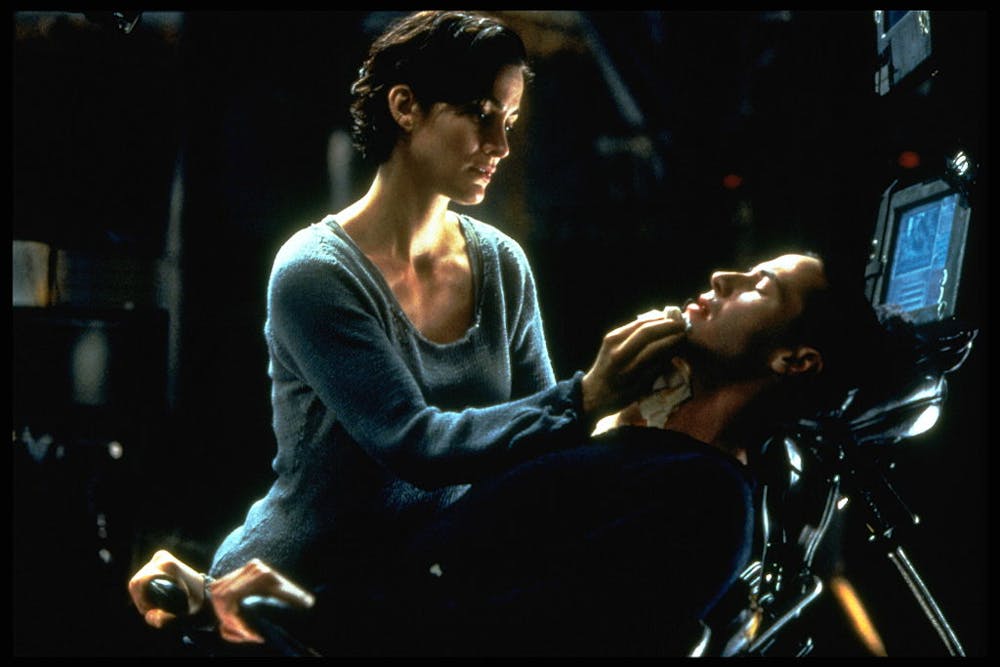
Carrie-Anne Moss and Keanu Reeves as Trinity and Neo in ‘The Matrix.’
Ronald Siemoneit/Sygma/Sygma via Getty Images
More specifically, religion scholars see explicit themes of Gnosticism, a variant of Christianity that flourished during the faith’s first few centuries. A central focus of Gnostic texts is attaining liberation from worldly illusion through direct inner knowledge of truth. Its teachings include stark dualism – light vs. dark, mind vs. body, good vs. evil – and belief in a hidden God operating in a hostile cosmos, both of which have analogues in “The Matrix.”
Buddhist themes are also unmistakable. The film begins with Neo waking up, both literally and figuratively, as he discovers the truth: Machines have trapped humanity in pods to harvest their energy. The world in which humans believe they are living is actually “the matrix,” an illusory world created to distract them.
“Buddha” means “awakened one,” and many viewers have drawn comparisons between Keanu Reeves’ character’s journey and Buddhism. Once awakened to reality, Neo is no longer bound to the illusions of ignorance and desire. Just as importantly, he must help other humans awaken and escape the cycle of suffering.
Spirits on screen
Even apart from specific allusions like these, cinema shares something important with religion.
Religion scholar R. Brent Rodriquez-Plate argues that films can function something like religions in the lives of their audiences, “playing God” by creating imaginary worlds – worlds that may make viewers see their real lives in a different light.

Visitors gaze at a clay model of Hayao Miyazaki’s film ‘Ponyo’ at an exhibition in Tokyo in 2008.
Yoshikazu Tsuno/AFP via Getty Images
That power is nowhere more evident than in animated films, which create vivid realms that live action can only dream of. In films like “Spirited Away” and “Howl’s Moving Castle,” legendary anime director Hayao Miyazaki creates his own mythic worlds populated with fanciful “yōkai”: creatures that are inspired by Japanese legends but not quite Shinto or Buddhist.
Many of Miyazaki’s films also include spirits that inhabit inanimate objects, which he associates with Japanese tradition. “In my grandparents’ time … it was believed that spirits (kami) existed everywhere – in trees, rivers, insects, wells, anything,” he once said. “My own religion, if you can call it that, has no practice, no Bible, no saints, only a desire to keep certain places and my own self as pure and holy as possible.”
“Princess Mononoke,” Miyazaki’s 1997 film set in medieval Japan, tells the story of a young prince drawn into an epic struggle between forest gods and humans who exploit natural resources. It’s a challenge religions have often ignored but are increasingly trying to engage: how to live responsibly in the natural world.
While the movie has an environmental message, it avoids oversimplifying the struggle to “good nature” besieged by “bad humans.” San, a human girl who leads an army of wolves, tries to kill the prince, while Iron Town provides support for lepers and outcasts, even as it degrades the environment.
A.O. Scott reviews ‘Princess Mononoke,’ which highlights environmental themes.
Birth and rebirth – and groundhogs
What about comedy, though? Can a religious film be funny? Could a romantic comedy have religious overtones?
Each February, many Americans celebrate Groundhog Day, waiting to see if the famous Punxsutawney Phil will see his shadow. But for some, Feb. 2 is a day to celebrate “Groundhog Day” – the film about the moral evolution of an arrogant Pittsburgh weatherman sent to report on the groundhog but forced to live the same day over and over again until he gets it right.
Given “Groundhog Day’s” cult-classic status, it evidently speaks to followers of many religions and none. But it’s hard to think of a film that better captures the concept of samsara: the Sanskrit term for the tedious human condition, with its endless cycles of birth and rebirth. Helping people find release from samsara is central to both Hinduism and Buddhism. Phil, the weatherman stuck reliving Feb. 2 over and over, is caught on such a treadmill.

Bill Murray, once again frozen in time on Feb. 2.
Columbia Pictures/Archive Photos/Moviepix via Getty Images
Only by gradually transforming himself into a more virtuous person – performing acts of merit among the people of Punxsutawney – does he finally escape from the nightmare of recurring Groundhog Days.
Director Harold Ramis was brought up Jewish but became a Buddhist who carried a laminated card, “The 5 Minute Buddhist”: a kind of cheat sheet of core ideas of Buddhism. So it’s not surprising to find them in his movie.
One is “pratītyasamutpāda,” another Sanskrit term: the idea that everything in the cosmos is linked by causal chains. All causes and effects are connected; nothing stands wholly apart on its own. By the end of “Groundhog Day,” the prideful Phil has fully connected with people in the quaint Pennsylvania village – and won his love, Rita – having learned how his own well-being depends on the well-being of everyone around him.
Close to awe
There’s one more way to think about religion in film. Apart from specific spiritual themes, a powerful movie can offer an almost religious experience.
Nathaniel Dorsky, an experimental filmmaker influenced by Buddhism, writes of cinema as a devotional experience. The act of sitting in darkness, watching an illuminated world flicker by, Dorsky says, may be as close to approaching the transcendent as many of us will come – getting a glimpse of something beyond our normal range of experience.
Of course, all these films can be enjoyed fully without reading them on this religious level. Some movie fans would object that these interpretations spoil the fun, and they may have a point. But part of the excitement of studying religion in popular culture is to be aware of its many permutations, hidden in plain view.
This article is republished from The Conversation, a nonprofit, independent news organization dedicated to unlocking the knowledge of experts for the public good. .

About David W. Stowe
David W. Stowe is Professor of Religious Studies at Michigan State University. You can read more about the author here.
Previous Post

March 2, 2024
Faith leaders have been protecting migrant rights for years
Next Post

March 20, 2024 Cherry Blossoms Show Appreciation Of Impermanence And Spring
Browse Our Archives
Select a Category Buddhism Christianity Hinduism Islam Judaism Religion and society Uncategorized
Select a Month July 2024 March 2024 February 2024 January 2024 December 2023 November 2023 October 2023 September 2023 August 2023 July 2023 January 2023 August 2022 July 2022 April 2022 February 2022 January 2022 October 2021 July 2021 June 2021 May 2021 April 2021 March 2021 February 2021 January 2021 December 2020 November 2020 October 2020 September 2020 August 2020 July 2020 June 2020 May 2020
Follow Us!
TAKE THE
Religious Wisdom Quiz
Who said, "I am not worthy to untie the strap of his sandals"?
Select your answer to see how you score.
Peter Paul John the Baptist Thomas
Related posts from The Conversation


Electing A Virtuous President Would Make Immunity Irrelevant

Why The Olympic Games Are A ‘Civil Religious’...

The Catholic Church Is Using The Olympics To...
TRENDING AT PATHEOS Religion News

Catholic Integralists believe that religious values – specifically Christian ones – should...

Electing A Virtuous President Would Make Immunity Irrelevant
Presidential immunity can bring with it many risks. So how can we...

Why The Olympic Games Are A ‘Civil Religious’...
Sporting events form a vital space where Americans display their 'civil religious...

After more than a decade of news, research updates, and insights on...

Q: Why do Southern Baptists and like-minded Protestants...
THE RELIGION GUY’S ANSWER: Why? Simple. Because they believe that’s what the...

THE QUESTION: Is gambling evil? THE RELIGION GUY’S ANSWER: Analysts anticipate a...
view all Religion News blogs
Ad-Free & Subscriber Log-In Subscription Support
- About Us
- 2026 Calendar
- Videos
- Podcasts
- Library of World Religions
- Faith In Media Tracker
- Advertise With Us
- Write for Us
- Privacy Policy
- Terms of Service
- Do Not Sell My Data
- Contact Us
- Radiant Digital
- Manage Newsletter Subscriptions
- Unsubscribe From Notifications
- Sitemap
Copyright 2008-2026, Patheos. All rights reserved.
Subscription Support Ad-Free & Subscriber Log-In
Follow Patheos