
BuddhistCatholicContemplativeEvangelicalGeneral ChristianHinduJewishLatter-day SaintMuslimNew VisionsProgressive Christian
Beliefs
- Buddhist
- Catholic
- Contemplative
- Evangelical
- General Christian
- Hindu
- Jewish
- Latter-day Saint
- More Voices
- Muslim
- New Visions
- Pagan
- Progressive Christian
Topics
- Religion News
- Food and Religion
- Sports and Religion
- Religious Art
- Religious Music and Entertainment
- Religious Events
- History and Religion
- Style and Religion
- Politics and Religion
- Women in Religion
- Recreation Outdoors and Religion
- Business Finance and Religion
- Careers Workplace and Religion
- Education and Religion
- Family Parenting and Religion
- Health Fitness and Religion
- Home and Religion
- Relationships and Religion
- Technology and Religion
- Travel and Religion
Columnists
- Buddhist Columnists
- Business Finance and Religion Columnists
- Careers Workplace and Religion Columnists
- Catholic Columnists
- Contemplative Columnists
- Education and Religion Columnists
- Evangelists Columnists
- Family Parenting and Religion Columnists
- General Christian Columnists
- Health Fitness and Religion Columnists
- Hindu Columnists
- History and Religion Columnists
- Home and Religion Columnists
- Jewish Columnists
- More Voices Columnists
- Latter Day Columnists
- Muslim Columnists
- New Visions Columnists
- Nonreligious Columnists
- Pagan Columnists
- Politics and Religion Columnists
- Progressive Columnists
- Recreation Outdoors and Religion Columnists
- Relationships and Religion Columnists
- Religion News Columnists
- Religious Art Columnists
- Religious Events Columnists
- Religious Music and Entertainment Columnists
- Sports and Religion Columnists
- Style and Religion Columnists
- Technology and Religion Columnists
- Travel and Religion Columnists
- Women in Religion Columnists
Resource Library
- 2026 Calendar
- Library of World Religions
- The 100 Most Holy Places on Earth
- Patheos Answers
- Podcasts
- Videos
- Faith Leaders Database
- Anglican Episcopalian
- Bahai
- Baptist
- Buddhism
- Christianity
- Confucianism
- Eastern Orthodoxy
- Hinduism
- Holiness and Pentecostal
- ISKCON
- Islam
- Judaism
- Lutheran
- Methodist
- The Church of Jesus Christ of Latter-day Saints
- New Age
- Paganism
- Presbytarian and Reformed
- Protestantism
- Religion Behind the Scenes
- Roman Catholic
- Scientology
- Shia Islam
- Sikhism
- Sufism
- Sunni Islam
- Taoism
- Zen
- See all religions
Research Tools
 Ad-Free & Subscriber Log-In Subscription Support
Ad-Free & Subscriber Log-In Subscription Support
Follow Patheos 

- Trending:
- Forgiveness
- |
- Marriage
- |
- Consciousness
- |
- Death Penalty
- |
- Election
- |
- Halloween

- Home
- General Christian
- Religion News
- Faith leaders have been protecting migrant rights for years
Faith leaders have been protecting migrant rights for years
Last updated on: March 2, 2024 at 1:53 pm by The Conversation
Faith leaders have been protecting migrant rights for years 2024-03-02T13:53:58-04:00 The Conversation
Patheos Explore the world's faith through different perspectives on religion and spirituality! Patheos has the views of the prevalent religions and spiritualities of the world.
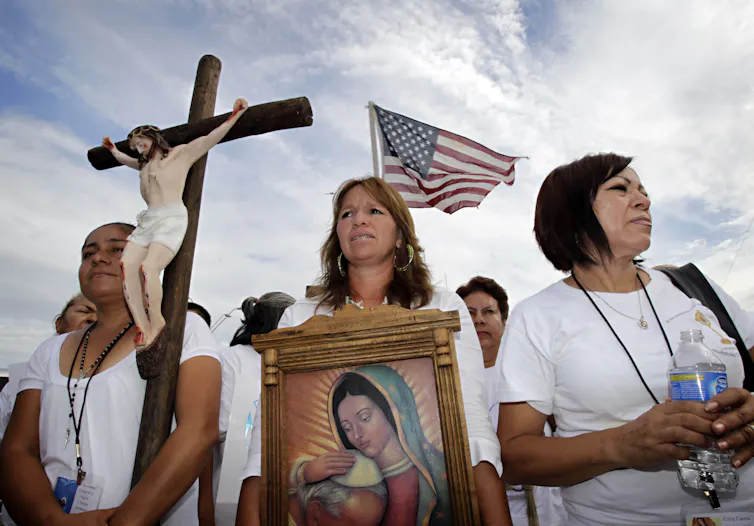
A 2010 protest in Phoenix by faith groups against Arizona’s new immigration law.
AP Photo/Matt York, File
By Brad Christerson, Biola University; Alexia Salvatierra, Fuller Theological Seminary, and Robert Chao Romero, University of California, Los Angeles
A convoy of far-right Christian nationalists calling themselves “God’s Army” have been staging rallies on the southern U.S. border against migrants.
Under the banner “Take Our Border Back,” rally participants are using dehumanizing language about an “invasion” and citing the “great replacement” conspiracy theory, which claims that a cabal of Western elites and Jews are promoting migration in order to replace white people and their political power with nonwhite immigrants.
Several prominent figures in the Christian right have offered faith-based justifications for anti-immigrant rhetoric and policies. The Christian right has asserted the need to protect the American culture and families from the alleged dangerous influence of Islam and from the supposed wave of hardened criminals crossing the southern border. Indeed, opinion surveys consistently show that white Christians, especially evangelicals, are among the most likely groups in the U.S. to hold anti-immigrant sentiments.
Yet our work with faith-based, pro-immigration advocacy groups points toward a different reality. As we argue in our new book, co-authored with sociologist Nancy Wang Yuen, “God’s Resistance: Mobilizing Faith to Defend Immigrants,” faith leaders, including some evangelicals, are central to the current movement to protect immigrant rights, and they have been for over a hundred years.
Faith-based movements for immigrant rights
Historically, Latinx Christian leaders have been at the forefront of immigrant rights in the U.S.. For example, Mexican-American Catholic leaders of the Jim Crow era such as Alonso Perales and Cleofas Calleros applied Catholic social teaching, such as the inherent equality of all human beings, to civil rights struggles.
They founded leading organizations like the League of United Latin American Citizens and the National Catholic Welfare Conference, which played key roles in landmark civil rights cases, such as Mendez v. Westminster and Hernandez v. Texas.
Mendez v. Westminster ruled in 1947 that segregation of Mexican-American children in schools is unconstitutional, which paved the way for the 1954 historic Brown v. Board of Education anti-segregation ruling. Hernandez v. Texas ruled in 1954 that Mexican Americans and all other racial groups in the United States had equal protection under the 14th Amendment.
Many people also don’t realize the centrality of Christian spirituality in the immigrant-led farmworkers movement in the 1960s. Key labor leaders such as Cesar Chavez and Delores Huerta incorporated Catholic social teaching as well as religious symbols and practices in their successful unionization of farmworkers. For example, Chavez led a 25-day “peregrinación” – a pilgrimage – in California from Delano to Sacramento, under the banner of Our Lady of Guadalupe, a star of David, and a cross, which ended on Easter Sunday. This pilgrimage was a key turning point in the success of the movement.
In the 1980s, faith leaders in the U.S. and Central America joined together in the Sanctuary Movement to effectively challenge the Reagan administration’s asylum policies toward those fleeing the civil wars in central America. The movement ultimately led to changes in asylum law; those fleeing the wars were eventually allowed to apply for asylum. It also was partially responsible for the termination of U.S. military funding for wars in El Salvador and Guatemala.
Some of the largest and most influential immigrant rights organizations that exist today, like the Southern California-based Central American Resource Center, Coalition for Humane Immigrant Rights, and National Day Laborers Organizing Network, were founded by Latinx people of faith during this era.
Our book documents this history and also analyzes the key role of faith-based organizations in challenging the Trump administration’s crackdown in immigration enforcement, which led to record-high levels of immigrant detention and family separations.
We conducted case studies of six faith-based immigrant advocacy organizations in Southern California from 2018 to 2020, two of which are multi-faith, two evangelical, one Catholic and one mainline Protestant. We found that faith groups possess unique advantages, which when working in coordination with secular organizations, add significant power to the movement for immigrant rights.
Religious language about justice
Christian scriptures, symbols and rituals can vividly express ideals of the “Kingdom of God” or “Beloved Community” in which all people are equally valued and have the right to thrive and be safe from violence.
We saw how this religiously inspired vision can provide motivation, clarity, hope and endurance in the long and often discouraging task of mobilizing for social change. Religious or spiritual practices provide strength in particular to marginalized communities, which an emerging group of scholars is calling “spiritual capital.” Lindsay Perez-Huber, a professor of education and counseling, in her study of undocumented Chicana students, defines spiritual capital as “a set of resources and skills rooted in a spiritual connection to a reality greater than oneself.” In other words, religious beliefs and spirituality can be a source of resilience when people need to persevere and resist in the face of injustice.
In pleas to officials, and during speeches at trainings, rallies and protests, we consistently heard references to sacred scriptures. We heard the biblical command in the book of Leviticus that “the foreigner residing among you must be treated as your native-born.” Advocates passionately recounted the experience of Jesus’ family as refugees fleeing state violence to Egypt, and references to Jesus’ statement in the book of Matthew that “I was an immigrant and you welcomed me.”
We also saw religious rituals combined with nonviolent direct action in fasts and hunger strikes, prayer vigils and worship songs at Immigration and Customs Enforcement (ICE) facilities and offices, calling on the power of God to set the captives free. For these participants, they were not only engaging in an act of political protest, but personally connecting with God’s spirit for justice in the world.
Faith as a bridge across social groups
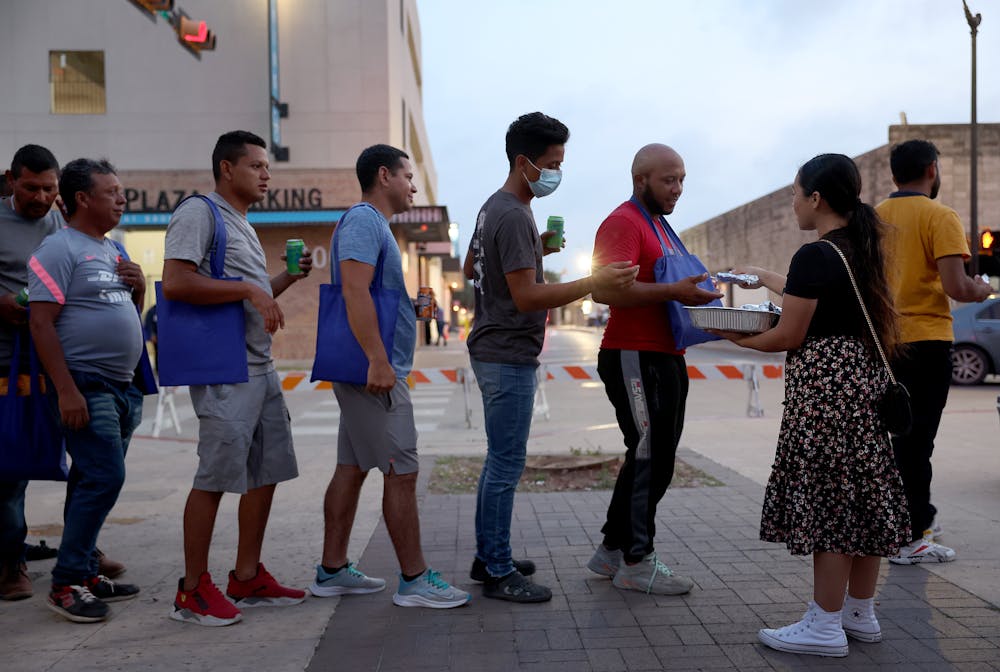
A church member hands out food to migrants on May 10, 2023, in Brownsville, Texas.
Joe Raedle/Getty Images
Our book also shows that faith-based groups bring immigrants into contact with non-immigrants, church attenders in contact with activists, and activists in contact with politicians who have faith commitments. These connections are crucial for building a broad movement for change.
Among the things we documented were church volunteers becoming personally connected to asylum seekers, detainees and their families as they helped provide access to housing, basic needs, jobs, transportation and legal support.
We witnessed faith leaders connecting undocumented young people with public officials who influence the policies that affect their lives, telling their personal stories to those decision-makers.
Faith leaders also had ongoing “ministerial” and “discipleship” relationships with fellow Christian believers who are ICE officials, members of congress, and city council members. These relationships influenced these officials at different times in key policy decisions.
In summary, our research shows that despite media attention to anti-immigration Christian groups, faith leaders and faith-based organizations have also played a central role in past and current movements for immigrant rights. Faith-rooted organizing has unique strengths that add significant power to movements for social change.
This article is republished from The Conversation, a nonprofit, independent news organization dedicated to unlocking the knowledge of experts for the public good. .
General Christian
Progressive Christian

About Brad Christerson
Brad Christerson is a professor of sociology at Biola University. This article is co-authored also by Alexia Salvatierra, Academic Dean, Centro Latino & Associate Professor of Mission and Global Transformation at Fuller Theological Seminary; and Robert Chao Romero, Associate Professor of Chicana/o and Central American Studies at University of California, Los Angeles. You can read more about the author here.
Previous Post

February 12, 2024
The divine matchmaker in Chinese mythology helps couples
Next Post

March 7, 2024 Oscars 2024: Films are full of faith in unexpected places
Browse Our Archives
Select a Category Buddhism Christianity Hinduism Islam Judaism Religion and society Uncategorized
Select a Month July 2024 March 2024 February 2024 January 2024 December 2023 November 2023 October 2023 September 2023 August 2023 July 2023 January 2023 August 2022 July 2022 April 2022 February 2022 January 2022 October 2021 July 2021 June 2021 May 2021 April 2021 March 2021 February 2021 January 2021 December 2020 November 2020 October 2020 September 2020 August 2020 July 2020 June 2020 May 2020
Follow Us!
TAKE THE
Religious Wisdom Quiz
What did Satan claim was the reason for Job’s faithfulness?
Select your answer to see how you score.
That God had blessed him with wealth and protection That Job was unaware of suffering That Job had personally seen God That Job was a prophet
Related posts from The Conversation


Electing A Virtuous President Would Make Immunity Irrelevant

Why The Olympic Games Are A ‘Civil Religious’...

The Catholic Church Is Using The Olympics To...
TRENDING AT PATHEOS Religion News

Catholic Integralists believe that religious values – specifically Christian ones – should...

Electing A Virtuous President Would Make Immunity Irrelevant
Presidential immunity can bring with it many risks. So how can we...

Why The Olympic Games Are A ‘Civil Religious’...
Sporting events form a vital space where Americans display their 'civil religious...

After more than a decade of news, research updates, and insights on...

Q: Why do Southern Baptists and like-minded Protestants...
THE RELIGION GUY’S ANSWER: Why? Simple. Because they believe that’s what the...

THE QUESTION: Is gambling evil? THE RELIGION GUY’S ANSWER: Analysts anticipate a...
view all Religion News blogs
Ad-Free & Subscriber Log-In Subscription Support
- About Us
- 2026 Calendar
- Videos
- Podcasts
- Library of World Religions
- Faith In Media Tracker
- Advertise With Us
- Write for Us
- Privacy Policy
- Terms of Service
- Do Not Sell My Data
- Contact Us
- Radiant Digital
- Manage Newsletter Subscriptions
- Unsubscribe From Notifications
- Sitemap
Copyright 2008-2026, Patheos. All rights reserved.
Subscription Support Ad-Free & Subscriber Log-In
Follow Patheos