
BuddhistCatholicContemplativeEvangelicalGeneral ChristianHinduJewishLatter-day SaintMuslimNew VisionsProgressive Christian
Beliefs
- Buddhist
- Catholic
- Contemplative
- Evangelical
- General Christian
- Hindu
- Jewish
- Latter-day Saint
- More Voices
- Muslim
- New Visions
- Pagan
- Progressive Christian
Topics
- Religion News
- Food and Religion
- Sports and Religion
- Religious Art
- Religious Music and Entertainment
- Religious Events
- History and Religion
- Style and Religion
- Politics and Religion
- Women in Religion
- Recreation Outdoors and Religion
- Business Finance and Religion
- Careers Workplace and Religion
- Education and Religion
- Family Parenting and Religion
- Health Fitness and Religion
- Home and Religion
- Relationships and Religion
- Technology and Religion
- Travel and Religion
Columnists
- Buddhist Columnists
- Business Finance and Religion Columnists
- Careers Workplace and Religion Columnists
- Catholic Columnists
- Contemplative Columnists
- Education and Religion Columnists
- Evangelists Columnists
- Family Parenting and Religion Columnists
- General Christian Columnists
- Health Fitness and Religion Columnists
- Hindu Columnists
- History and Religion Columnists
- Home and Religion Columnists
- Jewish Columnists
- More Voices Columnists
- Latter Day Columnists
- Muslim Columnists
- New Visions Columnists
- Nonreligious Columnists
- Pagan Columnists
- Politics and Religion Columnists
- Progressive Columnists
- Recreation Outdoors and Religion Columnists
- Relationships and Religion Columnists
- Religion News Columnists
- Religious Art Columnists
- Religious Events Columnists
- Religious Music and Entertainment Columnists
- Sports and Religion Columnists
- Style and Religion Columnists
- Technology and Religion Columnists
- Travel and Religion Columnists
- Women in Religion Columnists
Resource Library
- 2026 Calendar
- Library of World Religions
- The 100 Most Holy Places on Earth
- Patheos Answers
- Podcasts
- Videos
- Faith Leaders Database
- Anglican Episcopalian
- Bahai
- Baptist
- Buddhism
- Christianity
- Confucianism
- Eastern Orthodoxy
- Hinduism
- Holiness and Pentecostal
- ISKCON
- Islam
- Judaism
- Lutheran
- Methodist
- The Church of Jesus Christ of Latter-day Saints
- New Age
- Paganism
- Presbytarian and Reformed
- Protestantism
- Religion Behind the Scenes
- Roman Catholic
- Scientology
- Shia Islam
- Sikhism
- Sufism
- Sunni Islam
- Taoism
- Zen
- See all religions
Research Tools
 Ad-Free & Subscriber Log-In Subscription Support
Ad-Free & Subscriber Log-In Subscription Support
Follow Patheos 

- Trending:
- Forgiveness
- |
- Marriage
- |
- Consciousness
- |
- Death Penalty
- |
- Election
- |
- Halloween

- Home
- Religion News
- The divine matchmaker in Chinese mythology helps couples
The divine matchmaker in Chinese mythology helps couples
Last updated on: February 12, 2024 at 6:28 pm by The Conversation
The divine matchmaker in Chinese mythology helps couples 2024-02-11T21:32:09-04:00 The Conversation
Patheos Explore the world's faith through different perspectives on religion and spirituality! Patheos has the views of the prevalent religions and spiritualities of the world.
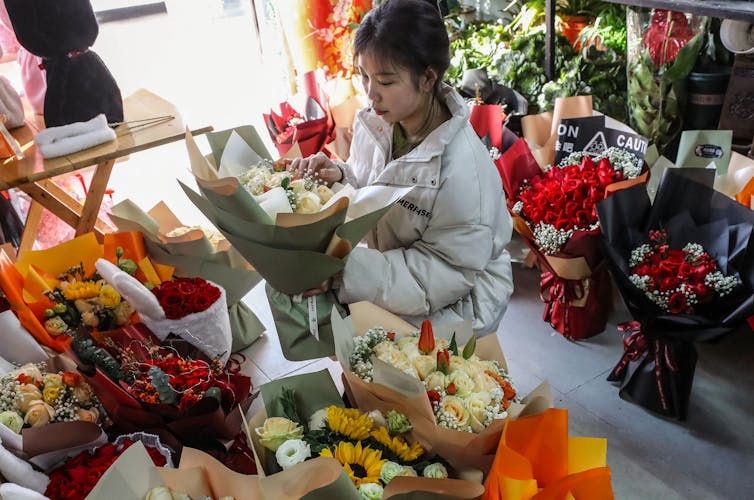
Looking for love − a store in Huaian, in China’s eastern Jiangsu province, selling flowers on Valentine’s Day.
STR/AFP via Getty Images
By Megan Bryson of University of Tennessee
In China, people celebrate Valentine’s Day on Feb. 14, but there are at least three holidays and cultural traditions centered on romantic love. A figure that ties together these other holidays is the Old Man Under the Moon – Yuexia Laoren in Mandarin, or Yuelao for short – who is believed to be a divine matchmaker.
In many cultures across the world, including China, parents traditionally arranged their children’s marriages, and love was not necessarily their main concern. In pre-modern China, daughters had little say over their marriage partners. Moreover, they were seen as belonging more to their future husbands’ families than to their birth families. Under these conditions, unmarried girls would pray to the Old Man Under the Moon for a happy marriage.
Girls could either make offerings at home or visit a temple where an image of the Old Man Under the Moon was enshrined. There are other figures in Chinese mythology, such as the “Weaving Maiden” and “Moon Goddess,” who are worshiped for good luck in love. But the Old Man Under the Moon is the most popular god of love and marriage. These days, the name Yuelao has even become a general term for “matchmaker.”
As a scholar of Chinese religious history, I know that understandings of gods can change over time. These days, men and women pray to the Old Man Under the Moon to find their own love match, while the Rabbit God takes care of devotees looking for same-sex romance.
The Old Man Under the Moon
The Old Man Under the Moon was first mentioned in a ninth-century short story called “Engagement Inn,” where he arranged marriages as a divine official.

The Old Man Under the Moon at Xiahai City God’s Temple in Dadaocheng, Taipei, Taiwan.
Sean Chiu via Wikimedia Commons, CC BY-NC-SA

In the story, an unmarried man named Wei Gu set out before sunrise to meet a matchmaker. He saw an old man reading a document by moonlight and tried to get a peek, but found that he could not decipher the script. The old man laughed and told Wei Gu that he was a divine bureaucrat in charge of human marriages, and his document was a marriage register written in an otherworldly script.
Wei Gu then asked about his own prospects, to which the old man replied that Wei Gu would get married, but it would take 14 years. Wei Gu then asked about a bag the old man was holding. The old man pulled a red cord out of the bag and explained that he used those to tie the feet of a future couple so that fate would bring them together.
In the centuries that followed, the Old Man Under the Moon became an increasingly popular figure in Chinese literature, drama and religion. His statue was enshrined in temples, where unmarried people and their relatives could pray and make offerings in the hope of finding a match.
Like other divine bureaucrats in charge of human affairs, the Old Man Under the Moon is rarely a temple’s central deity, but his icon appears in side halls alongside deities in charge of fertility and education.
Fittingly, he looks like an old man with a long white beard, and he holds the red cords that bind couples to each other. People looking to find a partner often leave red strings tied to tree branches, sometimes with short prayer texts attached to the strings, outside shrines to Old Man Under the Moon.

Those looking for love will pray to the Old Man Under the Moon and tie red threads.
Megan Bryson, CC BY
Heavenly romance
The Old Man Under the Moon can be worshiped year-round, but he has special ties to two holidays in the traditional Chinese calendar: the Double Seventh Festival and the Moon Festival. Valentine’s Day is a new addition to existing Chinese holidays celebrating love and marriage.
In Chinese culture, the most important holiday for romance is the Double Seventh Festival, which appropriately falls on the seventh day of the seventh lunar month. This festival commemorates the story of the star-crossed lovers Weaving Maiden and Cowherd, who live on separate constellations and can meet only once a year.
Unmarried girls make offerings to the Weaving Maiden in hopes of finding a good husband, in addition to saying prayers to Old Man. According to Taiwanese tradition, on the Double Seventh Festival, the Weaving Maiden compiles a list of all unmarried men and women to give to the Old Man Under the Moon. The Old Man then pairs up the single men and women in his marriage registry, binding their feet to seal their shared fate.
The Mid-Autumn Festival, or Moon Festival, on the 15th day of the eighth lunar month focuses on family togetherness, but it also includes romantic themes. Unmarried girls traditionally pray to the Moon Goddess Chang’e and to the divine matchmaker Old Man Under the Moon for a good husband. The Moon Festival is seen as the birthday of the Old Man Under the Moon, so temples sometimes have special events in his honor. The moon represents both wholeness and romance, making it a fitting symbol for the divine matchmaker.
Even the most important holiday on the Chinese calendar, Lunar New Year, can be a time to worship the Old Man Under the Moon. As celebrants set their intentions and goals for the new year, those looking for love and marriage will make a point of sending prayers to the Old Man Under the Moon.
The Rabbit God
Apart from the Old Man Under the Moon, another divine matchmaker in Chinese mythology is the Rabbit God, who has been worshiped as far back as the 18th century as a god of love between men.
Members of the LGBTQ+ community in Taiwan revived the worship of this deity as a same-sex counterpart to the Old Man Under the Moon. The Rabbit God binds same-sex couples, just as the Old Man Under the Moon binds couples of the opposite sex.
Same-sex couples in Taiwan can visit Wei Ming Tang temple, which is dedicated to the Rabbit God, to seek lasting romantic love and marriage. Worship of the Rabbit God can be done more openly in Taiwan, which is the only place in Asia where same-sex marriage is legal. LGBTQ+ relationships are frowned upon in mainland China.
The Old Man Under the Moon has long sustained the hope for romance and love in arranged marriages. Now that most people in Chinese culture find their own marriage partners, he offers hope that people will be able to find their match in a sea of possibilities. The Rabbit God offers the same hope for the LGBTQ+ community, especially in Taiwan.
This article is republished from The Conversation, a nonprofit, independent news organization dedicated to unlocking the knowledge of experts for the public good. .
Previous Post

January 22, 2024
Latin America’s colonial period was less Catholic
Next Post

March 2, 2024 Faith leaders have been protecting migrant rights for years
Browse Our Archives
Select a Category Buddhism Christianity Hinduism Islam Judaism Religion and society Uncategorized
Select a Month July 2024 March 2024 February 2024 January 2024 December 2023 November 2023 October 2023 September 2023 August 2023 July 2023 January 2023 August 2022 July 2022 April 2022 February 2022 January 2022 October 2021 July 2021 June 2021 May 2021 April 2021 March 2021 February 2021 January 2021 December 2020 November 2020 October 2020 September 2020 August 2020 July 2020 June 2020 May 2020
Follow Us!
TAKE THE
Religious Wisdom Quiz
I cleansed the temple in sixteen days and celebrated Passover so joyfully that we extended it another seven days. Who am I?
Select your answer to see how you score.
Asa Hezekiah Jehoshaphat Josiah
Related posts from The Conversation


Electing A Virtuous President Would Make Immunity Irrelevant

Why The Olympic Games Are A ‘Civil Religious’...

The Catholic Church Is Using The Olympics To...
TRENDING AT PATHEOS Religion News

Catholic Integralists believe that religious values – specifically Christian ones – should...

Electing A Virtuous President Would Make Immunity Irrelevant
Presidential immunity can bring with it many risks. So how can we...

Why The Olympic Games Are A ‘Civil Religious’...
Sporting events form a vital space where Americans display their 'civil religious...

After more than a decade of news, research updates, and insights on...

Q: Why do Southern Baptists and like-minded Protestants...
THE RELIGION GUY’S ANSWER: Why? Simple. Because they believe that’s what the...

THE QUESTION: Is gambling evil? THE RELIGION GUY’S ANSWER: Analysts anticipate a...
view all Religion News blogs
Ad-Free & Subscriber Log-In Subscription Support
- About Us
- 2026 Calendar
- Videos
- Podcasts
- Library of World Religions
- Faith In Media Tracker
- Advertise With Us
- Write for Us
- Privacy Policy
- Terms of Service
- Do Not Sell My Data
- Contact Us
- Radiant Digital
- Manage Newsletter Subscriptions
- Unsubscribe From Notifications
- Sitemap
Copyright 2008-2026, Patheos. All rights reserved.
Subscription Support Ad-Free & Subscriber Log-In
Follow Patheos