
BuddhistCatholicContemplativeEvangelicalGeneral ChristianHinduJewishLatter-day SaintMuslimNew VisionsProgressive Christian
Beliefs
- Buddhist
- Catholic
- Contemplative
- Evangelical
- General Christian
- Hindu
- Jewish
- Latter-day Saint
- More Voices
- Muslim
- New Visions
- Pagan
- Progressive Christian
Topics
- Religion News
- Food and Religion
- Sports and Religion
- Religious Art
- Religious Music and Entertainment
- Religious Events
- History and Religion
- Style and Religion
- Politics and Religion
- Women in Religion
- Recreation Outdoors and Religion
- Business Finance and Religion
- Careers Workplace and Religion
- Education and Religion
- Family Parenting and Religion
- Health Fitness and Religion
- Home and Religion
- Relationships and Religion
- Technology and Religion
- Travel and Religion
Columnists
- Buddhist Columnists
- Business Finance and Religion Columnists
- Careers Workplace and Religion Columnists
- Catholic Columnists
- Contemplative Columnists
- Education and Religion Columnists
- Evangelists Columnists
- Family Parenting and Religion Columnists
- General Christian Columnists
- Health Fitness and Religion Columnists
- Hindu Columnists
- History and Religion Columnists
- Home and Religion Columnists
- Jewish Columnists
- More Voices Columnists
- Latter Day Columnists
- Muslim Columnists
- New Visions Columnists
- Nonreligious Columnists
- Pagan Columnists
- Politics and Religion Columnists
- Progressive Columnists
- Recreation Outdoors and Religion Columnists
- Relationships and Religion Columnists
- Religion News Columnists
- Religious Art Columnists
- Religious Events Columnists
- Religious Music and Entertainment Columnists
- Sports and Religion Columnists
- Style and Religion Columnists
- Technology and Religion Columnists
- Travel and Religion Columnists
- Women in Religion Columnists
Resource Library
- 2026 Calendar
- Library of World Religions
- The 100 Most Holy Places on Earth
- Patheos Answers
- Podcasts
- Videos
- Faith Leaders Database
- Anglican Episcopalian
- Bahai
- Baptist
- Buddhism
- Christianity
- Confucianism
- Eastern Orthodoxy
- Hinduism
- Holiness and Pentecostal
- ISKCON
- Islam
- Judaism
- Lutheran
- Methodist
- The Church of Jesus Christ of Latter-day Saints
- New Age
- Paganism
- Presbytarian and Reformed
- Protestantism
- Religion Behind the Scenes
- Roman Catholic
- Scientology
- Shia Islam
- Sikhism
- Sufism
- Sunni Islam
- Taoism
- Zen
- See all religions
Research Tools
 Ad-Free & Subscriber Log-In Subscription Support
Ad-Free & Subscriber Log-In Subscription Support
Follow Patheos 

- Trending:
- Forgiveness
- |
- Marriage
- |
- Consciousness
- |
- Death Penalty
- |
- Election
- |
- Halloween

- Home
- Catholic
- Religion News
- Pope Francis called surrogacy ‘deplorable’
Pope Francis called surrogacy ‘deplorable’
Last updated on: January 10, 2024 at 8:59 pm by The Conversation
Pope Francis called surrogacy ‘deplorable’ 2024-01-10T20:59:53-04:00 The Conversation
Patheos Explore the world's faith through different perspectives on religion and spirituality! Patheos has the views of the prevalent religions and spiritualities of the world.
Pope Francis called surrogacy ‘deplorable’ – many women who become surrogates feel otherwise, while the parents who choose it find it humbling and miraculous

Pope Francis baptizes 16 infants in the Sistine Chapel on Jan. 7, 2024, in Vatican City.
Vatican Media via Vatican Pool/Getty Images
By Danielle Tumminio Hansen of Emory University
Pope Francis made headlines on Jan. 8, 2024, when he called for a global surrogacy ban, stating, “I deem deplorable the practice of so-called surrogate motherhood, which represents a grave violation of the dignity of the woman and the child, based on the exploitation of situations of the mother’s material needs.”
The use of surrogacy, in which a woman carries and delivers a child for someone else, has grown exponentially in recent years and is expected to continue to do so. While headlines often surface when celebrities like Paris Hilton grow their family using the technology, it also gets attention on the rare occasion a surrogate refuses to relinquish the child they carried, or when surrogates experience exploitation.
Such human rights violations appear to be the reason that Francis condemned the practice. But in so doing, I argue, the pope is failing to recognize how varied and nuanced the experiences of intended parents, surrogates and children are.
I have researched surrogacy for over a decade and have learned many things: Some women indeed become surrogates out of desperation and are abused in the process, as the pope says. But others, like the Christian ethicist Grace Kao, are thriving professionals who make the choice for altruistic reasons and never accept remuneration.
The complex reasons why women become surrogates and why parents choose to create families in this way make it nearly impossible to issue a universal conclusion about it. Instead, like many technologies, surrogacy’s ethical value is dependent upon the people and systems who use it.
Catholicism and surrogacy
While the pope framed his condemnation of surrogacy as a human rights abuse, the Catholic tradition has consistently opposed surrogacy, in vitro fertilization and abortion on the grounds that they violate natural law.
Natural law is a philosophy that states there are certain unchangeable parts of human nature that God endows. Catholic theologians who support this basic view extrapolate that intercourse within heterosexual marriage is the only acceptable way to reproduce, that life begins at conception, and that an embryo has a right to life from conception until natural death.
Hence, the Roman Catholic Church only encourages reproduction within the confines of heterosexual marriage, and when a heterosexual couple cannot conceive via intercourse, they are encouraged to adopt or remain childless.
The church has consistently condemned IVF because conception takes place outside of heterosexual intercourse. IVF results in the destruction of embryos and involves conception via a test tube. The church likewise has never supported surrogacy, so the pope’s recent assessment of surrogacy as “despicable” is consistent with the church’s overall views of reproduction.
Nonetheless, surrogacy is the only form of assisted reproduction documented in the Bible, unless one considers Mary’s conception of Jesus to be a form of assisted reproduction. In the Book of Genesis, the wife of Abraham begs her husband to have sex with her slave Hagar in order to procreate. Sarah abuses the slave and orchestrates both sex and procreation without Hagar’s consent.
Hagar eventually bears a son named Ishmael. Later, Sarah demands that both Hagar and Ishmael be cast out into the wilderness. Muslims regard Ishmael as a prophet and believe he and Abraham built the Kaaba in Mecca, Saudi Arabia.
Myths and fears
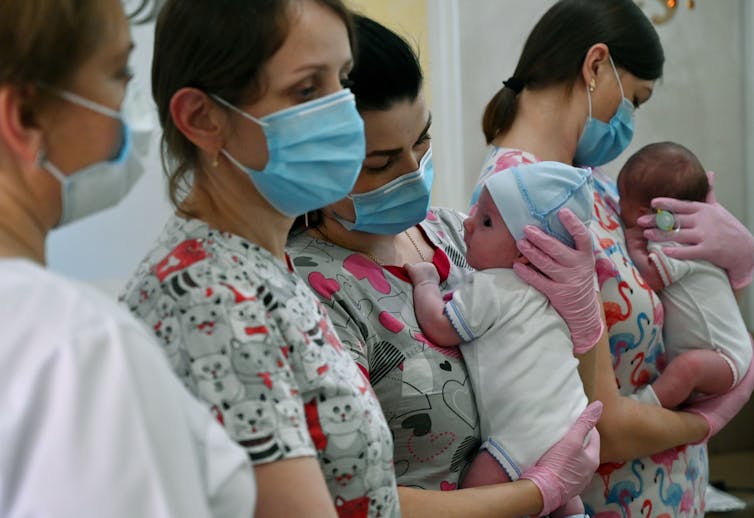
Nurses with babies born to Ukrainian surrogate mothers in Kyiv.
Sergei Supinsky/AFP via Getty Images
Fast forward to modern times, and surrogacy is now performed predominantly in high-priced in vitro fertilization centers in one of two ways. In “traditional surrogacy,” the fertilized egg belongs to the surrogate. In “gestational surrogacy,” which is more common today, the fertilized egg comes from either the intended mother or a donor.
In both cases, that egg combines with a sperm to become an embryo that grows in the surrogate’s womb and not the intended mother’s.
Gestational surrogacy may be preferable because it allows intended mothers to maintain a genetic connection with their child. Others may prefer it because of fears that a surrogate could lay claim to the child with whom she had a biological connection.
The concern that a surrogate will try to steal or adopt a child is one of many legal and ethical fears surrounding surrogacy. In the 1980s, the Baby M Case in the United States attracted much media attention because it tapped into these fears. In this situation, the surrogate, named Mary Beth Whitehead, attempted to retain custody of the baby she birthed.
The case fueled a stereotype of surrogates as emotionally unstable, defying the reality that surrogates undergo psychological testing before participating in a procedure.
Documented instances of surrogates retaining children are also rare. Research shows that surrogates often experience pregnancy and birth differently than they did with their own children. They also often see themselves as heroes or gift givers instead of mothers.
If the public perceives surrogates negatively, intended parents often fare no better. They are often categorized as selfish, desperate and rich, especially when they choose surrogacy without a medical reason.
Those popular images of intended parents fail to account for the reproductive trauma many of them experience prior to turning to surrogacy. The decision to hire a surrogate is often the last option for parents who have tried everything else and are, as I’ve proposed in my own research, attempting to write a happy ending to the story of their reproductive lives.
Critics counter that individuals who use surrogates should be turning to adoption instead. However, this logic fails to recognize that adoption can be traumatic for the child and the birth mother. Adoption, therefore, isn’t a cure-all for individuals who can’t conceive via heterosexual intercourse.
Ethical concerns about surrogacy
It is true that surrogacy is expensive, at least in the U.S., where use of the technology routinely costs over US$100,000. The cost is so extreme because intended parents pay health care fees for both themselves and the surrogate, many of which aren’t covered by insurance.
They also have to pay legal and agency fees and compensate the surrogate, which alone can range from $45,000 to $75,000. Contrast that price tag to the one in India prior to its ban on international surrogacy in 2015: Couples who traveled there could expect to spend $15,000 to $20,000 in total for their surrogacy journey. The extreme costs of surrogacy in the U.S. also limit its availability to the wealthy.
In addition, feminists are divided on how surrogacy affects women. Some feminists feel that surrogates have a right to choose what to do with their bodies. Others object to surrogacy on the grounds that systemic oppression drives women into surrogacy, or that it’s unethical for people to buy women’s bodies.
Cases documented in India support these concerns. Investigative journalist Scott Carney found one prominent Indian surrogacy clinic where surrogates were kept in crowded bedrooms on restricted diets and forced to have Cesarean sections in order to streamline the labor and delivery process.
Scholars also worry about surrogacy’s impact on children.
Extensive research hasn’t been conducted with children of surrogates, but research by social scientists studying children born via egg and sperm donation largely mirrors the findings of adoption research: Children have questions about their identity, and they find answers from individuals who are part of their birth story.
Yet agencies and governments rarely regulate how surrogates, intended parents and children interact following the baby’s birth.
The case for surrogacy

Actress Gabrielle Union has talked openly about her surrogacy journey.
Frazer Harrison/Getty Images
Such objections might lead to the conclusion that there is never a reason to hire a surrogate. But this might be too simplistic. Even with the documented struggles on the parts of both intended parents and surrogates, many are profoundly grateful for the technology.
Intended parents often feel surrogates are “gifts from God” who help them reach their dream of parenthood. Meanwhile, some surrogates believe their powers of procreation provide them with a unique opportunity to help others. Many surrogates see their ability to create life as a source of power, a profound act of altruism that is part of their legacy.
When I spoke with a group of surrogates in Austin, Texas, while conducting research for my book, I found that their stories aligned with the findings of other researchers who discovered that many surrogates had positive experiences in which they experienced themselves as heroes. These women felt empowered because they helped infertile heterosexual couples and gay couples create families. Without surrogacy, these individuals would have no way to have a genetic connection with their children.
The surrogates acknowledged that sometimes intended parents could be difficult, that pregnancy and labor could be challenging, and that it could be confusing when a checkout clerk at the grocery store asked what they were planning to name the baby.
Becoming a parent through surrogacy can be awkward and humbling, confusing and miraculous all at the same time.
But when surrogates and intended parents can act freely, with appropriate regulations and the support of society, there is the potential for them to discover that family is not just biological but also social and relational. In those encounters, many experience the technology as life-giving, both metaphorically and literally.

This article is republished from The Conversation, a nonprofit, independent news organization dedicated to unlocking the knowledge of experts for the public good. .
Catholic
Family, Parenting and Religion

About Danielle Tumminio Hansen
Danielle Tumminio Hansen is an Assistant Professor of Practical Theology & Spiritual Care at Emory University. You can read more about the author here.
Previous Post

January 5, 2024
How religion and politics will mix in 2024
Next Post

January 22, 2024 Latin America’s colonial period was less Catholic
Browse Our Archives
Select a Category Buddhism Christianity Hinduism Islam Judaism Religion and society Uncategorized
Select a Month July 2024 March 2024 February 2024 January 2024 December 2023 November 2023 October 2023 September 2023 August 2023 July 2023 January 2023 August 2022 July 2022 April 2022 February 2022 January 2022 October 2021 July 2021 June 2021 May 2021 April 2021 March 2021 February 2021 January 2021 December 2020 November 2020 October 2020 September 2020 August 2020 July 2020 June 2020 May 2020
Follow Us!
TAKE THE
Religious Wisdom Quiz
What does "Genesis" mean?
Select your answer to see how you score.
Wisdom Poetry Law Origin or Beginning
Related posts from The Conversation


Electing A Virtuous President Would Make Immunity Irrelevant

Why The Olympic Games Are A ‘Civil Religious’...

The Catholic Church Is Using The Olympics To...
TRENDING AT PATHEOS Religion News

Catholic Integralists believe that religious values – specifically Christian ones – should...

Electing A Virtuous President Would Make Immunity Irrelevant
Presidential immunity can bring with it many risks. So how can we...

Why The Olympic Games Are A ‘Civil Religious’...
Sporting events form a vital space where Americans display their 'civil religious...

After more than a decade of news, research updates, and insights on...

Q: Why do Southern Baptists and like-minded Protestants...
THE RELIGION GUY’S ANSWER: Why? Simple. Because they believe that’s what the...

THE QUESTION: Is gambling evil? THE RELIGION GUY’S ANSWER: Analysts anticipate a...
view all Religion News blogs
Ad-Free & Subscriber Log-In Subscription Support
- About Us
- 2026 Calendar
- Videos
- Podcasts
- Library of World Religions
- Faith In Media Tracker
- Advertise With Us
- Write for Us
- Privacy Policy
- Terms of Service
- Do Not Sell My Data
- Contact Us
- Radiant Digital
- Manage Newsletter Subscriptions
- Unsubscribe From Notifications
- Sitemap
Copyright 2008-2026, Patheos. All rights reserved.
Subscription Support Ad-Free & Subscriber Log-In
Follow Patheos