
BuddhistCatholicContemplativeEvangelicalGeneral ChristianHinduJewishLatter-day SaintMuslimNew VisionsProgressive Christian
Beliefs
- Buddhist
- Catholic
- Contemplative
- Evangelical
- General Christian
- Hindu
- Jewish
- Latter-day Saint
- More Voices
- Muslim
- New Visions
- Pagan
- Progressive Christian
Topics
- Religion News
- Food and Religion
- Sports and Religion
- Religious Art
- Religious Music and Entertainment
- Religious Events
- History and Religion
- Style and Religion
- Politics and Religion
- Women in Religion
- Recreation Outdoors and Religion
- Business Finance and Religion
- Careers Workplace and Religion
- Education and Religion
- Family Parenting and Religion
- Health Fitness and Religion
- Home and Religion
- Relationships and Religion
- Technology and Religion
- Travel and Religion
Columnists
- Buddhist Columnists
- Business Finance and Religion Columnists
- Careers Workplace and Religion Columnists
- Catholic Columnists
- Contemplative Columnists
- Education and Religion Columnists
- Evangelists Columnists
- Family Parenting and Religion Columnists
- General Christian Columnists
- Health Fitness and Religion Columnists
- Hindu Columnists
- History and Religion Columnists
- Home and Religion Columnists
- Jewish Columnists
- More Voices Columnists
- Latter Day Columnists
- Muslim Columnists
- New Visions Columnists
- Nonreligious Columnists
- Pagan Columnists
- Politics and Religion Columnists
- Progressive Columnists
- Recreation Outdoors and Religion Columnists
- Relationships and Religion Columnists
- Religion News Columnists
- Religious Art Columnists
- Religious Events Columnists
- Religious Music and Entertainment Columnists
- Sports and Religion Columnists
- Style and Religion Columnists
- Technology and Religion Columnists
- Travel and Religion Columnists
- Women in Religion Columnists
Resource Library
- 2026 Calendar
- Library of World Religions
- The 100 Most Holy Places on Earth
- Patheos Answers
- Podcasts
- Videos
- Faith Leaders Database
- Anglican Episcopalian
- Bahai
- Baptist
- Buddhism
- Christianity
- Confucianism
- Eastern Orthodoxy
- Hinduism
- Holiness and Pentecostal
- ISKCON
- Islam
- Judaism
- Lutheran
- Methodist
- The Church of Jesus Christ of Latter-day Saints
- New Age
- Paganism
- Presbytarian and Reformed
- Protestantism
- Religion Behind the Scenes
- Roman Catholic
- Scientology
- Shia Islam
- Sikhism
- Sufism
- Sunni Islam
- Taoism
- Zen
- See all religions
Research Tools
 Ad-Free & Subscriber Log-In Subscription Support
Ad-Free & Subscriber Log-In Subscription Support
Follow Patheos 

- Trending:
- Forgiveness
- |
- Marriage
- |
- Consciousness
- |
- Death Penalty
- |
- Election
- |
- Halloween

- Home
- Religion News
- How religion and politics will mix in 2024
How religion and politics will mix in 2024
Last updated on: January 5, 2024 at 1:52 pm by The Conversation
How religion and politics will mix in 2024 2024-01-05T13:52:57-04:00 The Conversation
Patheos Explore the world's faith through different perspectives on religion and spirituality! Patheos has the views of the prevalent religions and spiritualities of the world.
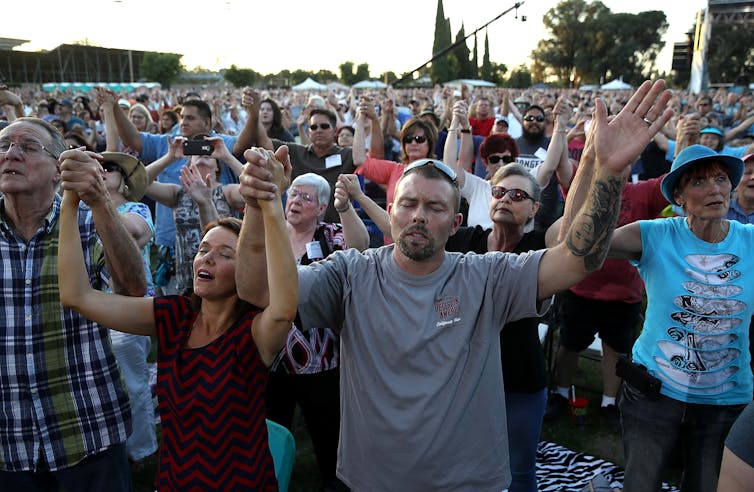
Attendees at evangelist Franklin Graham’s ‘Decision America’ tour in Turlock, Calif., in 2018. The tour was to encourage Christians to vote.
Justin Sullivan/Getty Images
By Tobin Miller Shearer of University of Montana
Religion is likely to play a big role in voters’ choices in the 2024 presidential election – much as it did in previous years. Despite an overall shift away from participation in organized religion in the U.S. populace, religious rhetoric in the political arena has intensified.
In the 2016 race, evangelical voters contributed, in part, to Republican nominee Donald Trump’s victory. Those Americans who identified as “weekly churchgoers” not only showed up at the polls in large numbers, but more than 55% of them supported Trump. His capture of 66% of the white evangelical vote also tipped the scales in his favor against his Democratic rival, Hillary Clinton.
Evangelical support for Trump continued to be strong in the 2020 presidential election. However, Joe Biden drew fellow Catholics to his camp and convinced some evangelicals, as well, to vote in his favor. Biden received public endorsement from 1,600 Catholic, mainline Protestant and evangelical faith leaders.
I’m a historian and a religious studies scholar who recently published a book exploring the role of religion in political movements such as anti-abortion campaigns. Historical evidence can help identify trends that will likely influence the mix of religion and politics in the year ahead.
From my perspective, three key trends are likely to show up in 2024. In particular, the run-up to the elections seems poised to feature intensified end-times rhetoric, more claims of divine support and relative silence from the evangelical community on the rise in Christian nationalism.
1. End-times rhetoric
End-times rhetoric has long played a prominent role in American politics. In 2016, as presidential candidate Clinton told The New York Times, “As I’ve told people, I’m the the last thing standing between you and the apocalypse.” Three years before, Texas Sen. Ted Cruz had warned, “We have a couple of years to turn the country around or we go off the cliff to oblivion.”
Indeed, American leaders have rallied adherents through apocalyptic rhetoric since the inception of the country. Ever since Puritan John Winthrop first called America a “city on the hill” – meaning a shining example for the world to follow – the threat of losing that divinely appointed status has consistently been employed by presidential candidates.
John F. Kennedy employed that exact image of the “city on the hill” in a 1961 speech on the cusp of his inauguration, claiming that – with “God’s help” – valor, integrity, dedication and wisdom would define his administration.
Part of Ronald Reagan’s rise to fame included “A Time for Choosing,” a speech in which he nominated Republican presidential candidate Barry Goldwater and warned, “We will preserve for our children this, the last best hope of man on earth, or we will sentence them to take the first step into a thousand years of darkness.” In his farewell address 25 years later, Reagan also revived the city on the hill image while lauding U.S. freedoms.
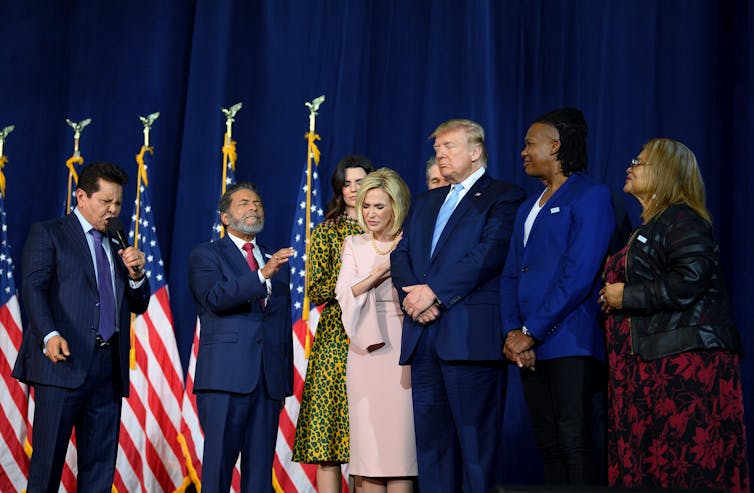
Faith leaders pray over U.S. President Donald Trump during a ‘Evangelicals for Trump’ campaign event held at the King Jesus International Ministry on Jan. 3, 2020, in Miami.
Jim Watson/AFP via Getty Images
In a late 2022 announcement of his presidential election bid, Trump asserted “the blood-soaked streets of our once great cities are cesspools of violent crimes,” drawing on apocalyptic imagery, in reference to drug-smuggling and illegal immigration. By March 2023, at the annual gathering of the Conservative Political Action Conference, he predicted that “if they [Democrats] win, we no longer have a country.”
Biden has likewise drawn on the image of final battles. In a speech at Philadelphia’s Independence Hall on Sept. 1, 2022, he said that he and his supporters are in “a battle for the soul of this nation.”
2. Divine mandate
Since the establishment of the republic, many U.S. political leaders have claimed a divine mandate. God, they asserted, guided the founding of the country’s democratic institutions, ranging from popular elections to the Constitution’s balance of powers.
George Washington, for example, claimed in a June 1788 letter to his secretary of war, Benjamin Lincoln, that “the finger of Providence has so manifestly pointed” to the founding of the United States. The previous year, Benjamin Franklin gave a speech to the Constitutional Convention in which he noted: “God governs in the affairs of men. And if a sparrow cannot fall to the ground without his notice, is it probable that an Empire can rise without his aid?”
By 1954, in the middle of the Cold War, President Dwight Eisenhower signed a bill adding “under God” to the Pledge of Allegiance, a reassertion of Washington’s earlier claim.
Scholars have long documented how those in power employ claims of divine authority to legitimize their role in a host of different countries. Recently, some U.S. politicians and public commentators have shifted to claiming divine authority for anti-democratic actions.
Doug Mastriano, a Pennsylvania state senator at the time, prayed right before the Jan. 6, 2021, insurrection that those seeking to “seize the power” would do so “providentially.”
The claim by conservative radio celebrity Eric Metaxas that the insurrection was “God’s battle even more than our battle” defined the event as divinely inspired. This kind of assertion by such influential voices intensifies the commitments of those seeking to undermine democratic electoral processes.
Regardless of the outcome of the 2024 election, the switch from historical claims of divine authority for democracy to divine authority to challenge democracy is already obvious and apparent.
3. White supremacy and Christian nationalism
In the U.S., religious and racial identities have been intertwined from the country’s inception. Although also expressed in more subtle and systemic forms, during the late 20th and early 21st centuries, white supremacists made the most explicit claims of divine favor on the part of white people in general and people of Nordic descent in particular.
They promoted Nazi ideology and developed new organizations that repackaged similar philosophies while drawing on religious claims.
The overtly white supremacist and virulently antisemitic Christian Identity movement, a North American new religious movement that gained popularity in the 1980s among organized white supremacist groups, claimed that people of color, who they deemed “mud races,” were created by God as inferior. They also asserted that the religious covenant – between God and people – spelled out in the Bible applied only to people of European descent.
Likewise, the unapologetically white supremacist “alt-right movement” that coalesced in 2010 around the philosophies of biological racism and the belief in the superiority of white peoples around the world have likewise mixed overt white supremacy with religious doctrines.
This close connection between religious claims and white supremacy among overtly racist organizations has shown up in mainline political arenas as well. In this case, the trend is one of omission. Evangelical leaders have consistently failed to condemn or disassociate themselves from leaders with overt white supremacy connections.
When given an opportunity to condemn white supremacists during the first 2020 presidential debate, Trump instead addressed the Proud Boys, a violent white supremacist group, by saying, “Stand back and stand ready.” His decision to hire staff like white nationalist Steve Bannon during his first presidential campaign and to dine with white supremacist Nick Fuentes in November 2022 continued that pattern.
Appeals to white supremacy have also surfaced in the current Congress. In spring of 2023, 26 members of the House Oversight and Accountability Committee refused to sign a letter denouncing white supremacy.
It remains to be seen whether these trends will continue in their current forms, transition to new ones or be displaced by rhetorical strategies as yet unimagined. What is most certain is that religion and politics will continue to interact.
This article is republished from The Conversation under a Creative Commons license. Read the original article.

About Tobin Miller Shearer
Tobin Miller Shearer is Professor and Chair of the History Department: Director of the African-American Studies Program at the University of Montana. You can read more about the author here.
Previous Post
January 3, 2024
100 years ago, the KKK planted bombs at a US university
Next Post
January 10, 2024 Pope Francis called surrogacy ‘deplorable’
Browse Our Archives
Select a Category Buddhism Christianity Hinduism Islam Judaism Religion and society Uncategorized
Select a Month July 2024 March 2024 February 2024 January 2024 December 2023 November 2023 October 2023 September 2023 August 2023 July 2023 January 2023 August 2022 July 2022 April 2022 February 2022 January 2022 October 2021 July 2021 June 2021 May 2021 April 2021 March 2021 February 2021 January 2021 December 2020 November 2020 October 2020 September 2020 August 2020 July 2020 June 2020 May 2020
Follow Us!
TAKE THE
Religious Wisdom Quiz
The beginning of knowledge starts with this.
Select your answer to see how you score.
Understanding Fear of the Lord Wisdom Instruction
Related posts from The Conversation


Electing A Virtuous President Would Make Immunity Irrelevant

Why The Olympic Games Are A ‘Civil Religious’...

The Catholic Church Is Using The Olympics To...
TRENDING AT PATHEOS Religion News

Catholic Integralists believe that religious values – specifically Christian ones – should...

Electing A Virtuous President Would Make Immunity Irrelevant
Presidential immunity can bring with it many risks. So how can we...

Why The Olympic Games Are A ‘Civil Religious’...
Sporting events form a vital space where Americans display their 'civil religious...

After more than a decade of news, research updates, and insights on...

Q: Why do Southern Baptists and like-minded Protestants...
THE RELIGION GUY’S ANSWER: Why? Simple. Because they believe that’s what the...

THE QUESTION: Is gambling evil? THE RELIGION GUY’S ANSWER: Analysts anticipate a...
view all Religion News blogs
Ad-Free & Subscriber Log-In Subscription Support
- About Us
- 2026 Calendar
- Videos
- Podcasts
- Library of World Religions
- Faith In Media Tracker
- Advertise With Us
- Write for Us
- Privacy Policy
- Terms of Service
- Do Not Sell My Data
- Contact Us
- Radiant Digital
- Manage Newsletter Subscriptions
- Unsubscribe From Notifications
- Sitemap
Copyright 2008-2026, Patheos. All rights reserved.
Subscription Support Ad-Free & Subscriber Log-In
Follow Patheos